
December 15, 2018
Half way through our travels on this trip, we visit Pemba, Mozambique and an island near there called Azura Quilalea. Pemba can be found in the upper right corner of the map of Mozambique.

Map of Southern Africa. Our destination is Pemba, Mozambique
December 17,2018
Am sitting on the porch of our villa at Azura on the island of Quilalea, in Northeastern Mozambique, looking at the pale blue sky above the lightly disturbed Indian Ocean, enjoying the cool morning breeze. We arrived here two days ago to sticky hotness that did not abate until last night when we had a big rain that continued much of the night and is still spritzing off and on.

Our Azura villa with its own mini pool.
As we relax for a few days on this Robinson Crusoe-like jungle island, complete with 58 large baobab trees, we reflected on our five safari adventures of the last few weeks. There have been so many experiences and sightings, we are struggling to remember what and where things happened. Here is our review.
First there was the Ngorongoro Crater. There we enjoyed a large diversity of animals, including our most unusual sighting of a serval cat, all in a bowl. Once inside the bowl, it becomes immense. We saw two rhino and a few elephants at a great distance. Our home there was a formal, overstuffed bungalow in a relaxed setting, on a cliff overlooking the crater. It was a tantalizing beginning to our adventure.
Next up was the Nimiri Plains. There we were in the only actual tent of the trip. The plains were full of tall lion-colored grass. We saw many animals, but remember the cheetah and lions most. At least 16 cheetah and 17 lions. Our favorite sightings were of a beautiful male lion named Bob Junior and a nameless mother cheetah we spent a whole day watching and came to refer to it as “a day in the life of a cheetah”. On our next morning drive to the airport, we spotted her and had just enough time to watch her kill a Thompson’s gazelle.
From Namiri Plains we went toMwibaLodge in the 148,000-acre private Mwiba Ranch. There we stayed in a solid house with canvas wall coverings. It was the most spacious and contemporary of our accommodations. Our animal sightings included a large male leopard in a tree and a pack of 13 wild dogs lounging in a meadow. For all that, I remember best our two cultural experiences: a Datoga clan and the Hadzada hunter-gatherers. Brad had told us this place would provide great memories and it certainly did. Our favorite driver/guide was here too—Godson. He was very knowledgeable, intelligent, responsive and fun to be around.
Our forth camp was the Sabora Lodge in the private 350,000-acre Grumeti Reserve. It was a successfully developed version of Mwiba, with 10 more years of experience and many more animals. Here in the open savannah is where we experienced the wildebeest migration in process. In addition to the wildebeest, we saw dozens of hyena and vultures feeding on lion kills after the lions had finished. We also saw a mostly eaten wildebeest killed by hyena on their own. There were numerous lions, too many to count. The wildebeest were a real draw. A leopard lay in a bushy tree waiting for darkness and we waited with her. She had hidden her kill in a bush the night before. We finally saw her go into the bush and heard her munching on meat and bones. Our camp was in a wooded plain and very colonial-big game hunter in style and décor. Our wooden, platformed tent looked out onto the plains and animals came right up to our deck when we were quiet.
That was it for Tanzania. Brad left us. We flew to Jo’burg and on to Tswalu Game Reserve, a 258,000-acre private conservation project owned and developed by the Oppenheimer Family in the arid savannah of southern Kalahari.

Tswalu Lodge and pool.
The lodge itself was pleasant with a well-located dining area and swimming pool overlooking the animal watering hole. Altogether a bit tired, the facility is scheduled for a major remodel in 2019. We remember two rhino seen deep in the brush and a pack of 20 wild dogs who hung around our camp’s water hole for two days before going off to hunt. We followed them until they were out of sight in the darkness. We remember a number of large antelope, not seen much in other places—roan, oryx, red hartebeest, and identified some different birds—Bokmakierie, Velvet-winged Waxbill, Eastern Yellow-billed Hornbill and Swallow-tailed Bee Eater. Other interesting experiences included walking among a mob of habituated Meerkats and seeing a Striped Polecat on a night drive. The best part of this Reserve, however, was the landscape itself. The scenery ran the gamut from rocky-mountains to rolling grass and brush hills, vegetated sand dunes and miles of flat lion-colored grassland. It felt infinite in its vastness.
Reflecting on the wonder of it all, I am thrilled by God’s planned diversity and creativity. Hopefully, with the continued help of wealthy conservationists, there will be wild places for the diverse animals to live and flourish in the future, even if access will most likely be restricted.
Thankfully, wildlife photographers preserve excellent stories of the animals and their habitats for future generations to see free of charge.
Meanwhile, back on December 15, the flight from Jo’burg to Pemba was an eye opener. We could watch the landscape 25,000 feet below us and saw mostly empty scrub land, devoid of roads, farms and people. Where do the 28,000,000 Mozambicans live? 36% live in a city. We did not see farm land and roads until we were nearing Pemba. As we flew over the city, the many small, closely packed houses had tin roofs. It was understandable that 47% of the population lives below the poverty line. We also learned that 45% of the same population is under the age of 16 and that 80% live by subsistence farming. No surprise that Mozambique is one of the poorest nations in the world. Aids has had a terrible effect on the population through excess mortality in all age groups. The current medial age is 17.2 years with a population growth rate of 2.46% and a birth rate of 38.1 births per 1,000 people. The 11thhighest in the world. Children average 10 years in school. There are many more facts if you are interested. Altogether it is a sad story.

Quilalea Island is the smaller one on the right. Azura lodge is on the left end.

Our helicopter arrival at Azura.
From Pemba airport we flew by helicopter to Azura on the island of Quilaleain the afternoon of December 15. The day was hot and sticky. The manager, Leon, greeted us at the helipad and led us on a gravel path through a jungle-like landscape for about a third of a mile to the camp. After his wife, Claudia, gave us the camp briefing, we finally got to our tropical, castaway style villa, dropped our clothes and jumped into our 6×6 soaking pool. It was warmer than we would have liked, but much better than no pool. We stayed in it when our butler, a friendly chap named Robson, showed up with the evening “drink of the day”, tequila sunrises.
Our Azura villa with its own mini pool.
Later, over dinner, served on linen covered tables on the beach, we learned that he is from a town in central Mozambique, has a wife and 4 children and really likes having this job, even though he works 90 days on and has 30 days off to go home and visit his family. He gets a helicopter lift to Pemba, then takes a 2-day bus ride to his home town. His wife worked here with him until she had their fourth child a year ago. Now she stays home. He sees her and the family only 3 months a year. The other children are 20, 16 and 14. Meanwhile, the work is not physically demanding and the pay is good. He gets no benefits from his employer, but he receives free health care at public hospitals and gets a pension, he says he can live on, when he turns 68. I suspect jobs in tourist resorts are very desirable when you can speak English.
December 16 was an island day. We went deep sea fishing at 6:30am for 3.5 hours and caught three fish along with several missed strikes. I, with much help, landed a 9-kilo King Mackeral. Mark caught a 4-kilo King Mackeral and a Giant Travally, which he had to throw back, because it is a protected specie. Our boat men spoke Portuguese, the local language in Mozambique, but virtually no English. We used sign language and got by.
On shore, we took photos of our fish and cleaned up for lunch. Then we went on a short kayak ride around part of the island. When the wind picked up, we turned back. Am hoping we do more kayaking before we leave. We wanted to see the baobab trees, so we went for a walk around the island and managed to see several of them and many more of a tree called a paper bark tree with turquoise skin under the bark. Very interesting tree. In less than 2 hours we pretty much covered the whole island.
We spent the rest of the day in our pool, reading and taking an ocean swim. Mark is spending a good bit of time photographing birds. There are many very pretty ones on this island. We are finally having an actual vacation. Cocktails, sunset and dinner back on the beach and then back to our room and bed. How dull is that?

Sunset from our island get away.
At 9:30 on December 17, I went for a shore scuba dive with the lodge manager, Leon, who has over 5000 dives under his belt. I was still rusty. Thankfully, he was very patient and helpful. The BC was too big on me and there was too much weight. We stayed under water only 35 minutes as the current was taking us into an area where there was nothing worth seeing and my equipment was becoming an issue. The underwater life was a mixed bag. The fish were small, plentiful and colorful. Several sea anemones harbored fish as did a few hard corals.

Leon and Julia head out to scuba dive from shore.
However, much of the coral was not in good shape and the visibility was about 30 feet and murky, probably from the previous night’s rain. Leon told me this dive was free. If I want to go again, he will charge me $30. Sounded good to me, so I am booked for 9am on the 18th. The day has heated up and we sit sweltering in the shade of our patio. More pool and ocean time.
Here are a few of Mark’s bird photos.

Swallowtail Bee-eater, adult and juvenile.

Yellow-billed Hornbill. Mark’s super shot.

Black-headed Weaver in front of its nest.

Madagascar Bee-eater in front of its nest.

Little Egret
Did another shore start dive at 9am. Sure is easier on my ears to start from the shore. Was outfitted with a smaller BC vest and a better fitting mask and only one weight. Much more comfortable. Even so, the weight was too much, so Leon took it out and carried it in case I needed it. We passed through many schools of fish that barely bothered to move aside for us. There seemed to be no fear of people. I extended my hand onto a shrimp cleaning station and soon I had several shrimp cleaning my fingernails. Their feet and bites tickled.
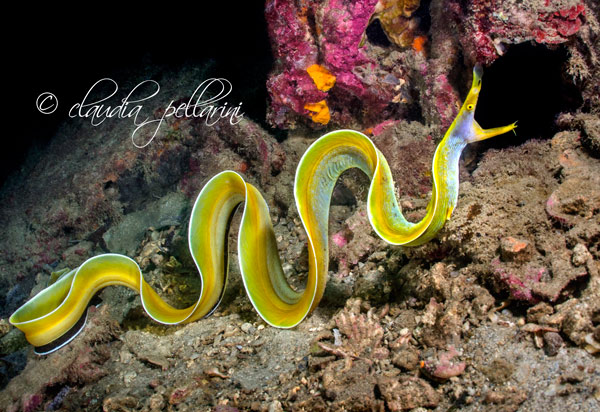
A blue and yellow, Ribbon eel, photographed by Claudia Pellarini, the co-manager of our Azura Lodge.
One of the more interesting and colorful creatures spotted was a small, blue and yellow, ribbon eel. When Leon poked a stick at it, it came part way out of its hole and tried to bite the stick. The fish were many and most colorful and the corals dead or muted. The island is in a Marine Reserve, which is why the fish are so plentiful and relaxed around us. Hopefully, the coral will recover also. We stayed down over 45 minutes. I still had a lot of air, but could not complain. The price was very minimal.
Lunch was King Mackerel sashimi from the fish we caught the day before. It was especially tender and delicious, not to mention fresh. With it we had rocket and roasted butternut squash salad. We are certainly eating well, considering the isolated location we have landed upon.
We still have 24 hours on the island before heading for Cape Town. Hope to send one more post before we depart the Cape for Camp Whichaway on Antarctica.
 Adventures with Julia
Comments
I’m glad to know you can take a day or two to relax!! what a big and varied trip this one is!!
In Peace,
*Suzie Daggett* *(530) 913-9592* *suziedaggett.com *
Author: The Pink Door Author: Pearls Author: From Ego to Soul
On Tue, Dec 18, 2018 at 4:27 AM Adventures with Julia wrote:
> adventureswithjulia posted: “December 15, 2018 Half way through our > travels on this trip, we visit Pemba, Mozambique and an island near there > called Azura Quilalea. Pemba can be found in the upper right corner of the > map of Mozambique. December 17,2018 Am sitting on the” >
Merry Christmas to you Madeline!
Enjoyed the beautiful sunsets and your experiences. Maria H.
Hi Maria,
Glad to hear your comments. Means you are still happily with us. If you feel up to it, give me a call. I’d love to chat with you.
Happy New Day, Each and Every One,
Julia