
August 28, 2019
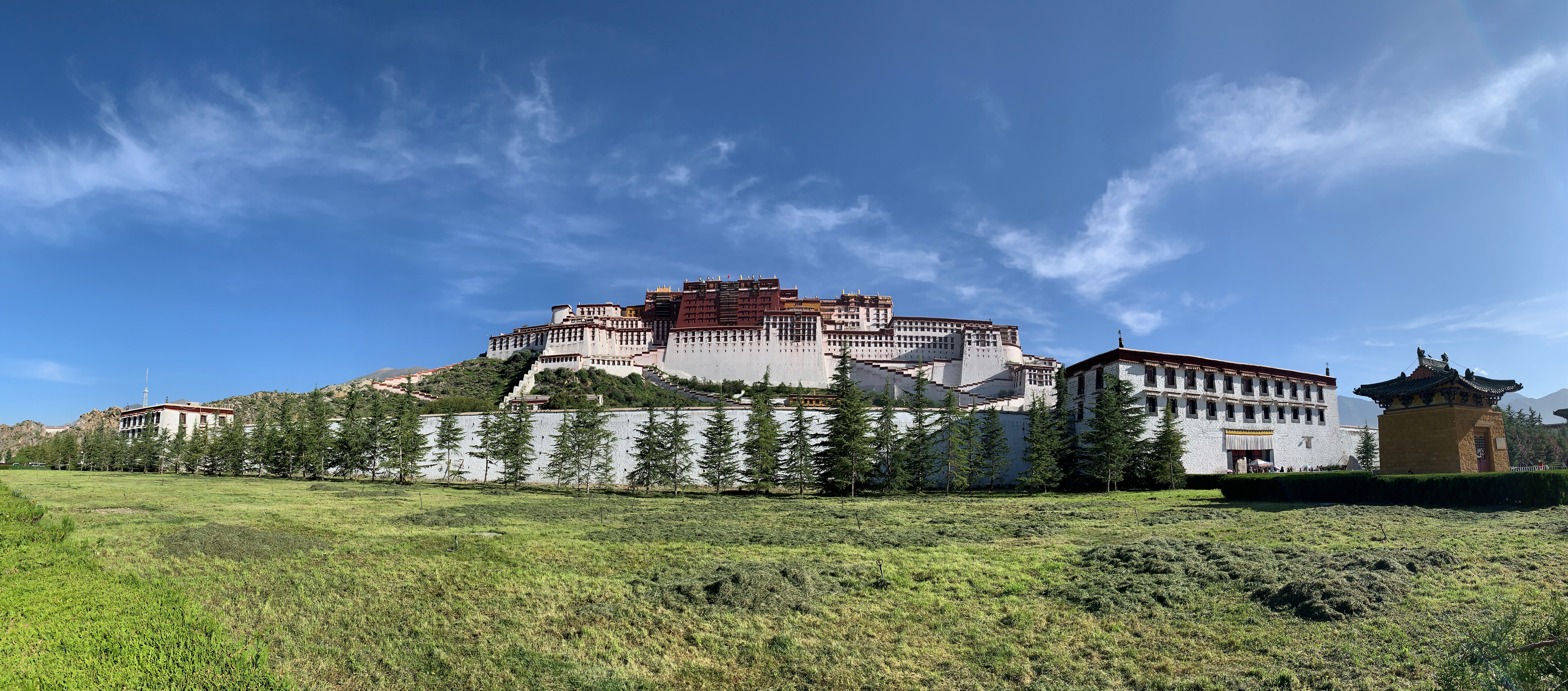
A panorama of the Potala Palace
Buddhas are the name of the game for another day. We start with the Potola Palace, which was the spiritual and governmental heart of Tibet until 1959 when the Chinese government sent in troops to capture the Dalai Lama, forcing him to escape in disguise at night. The troops proceeded to kill many people in the process. Today it is a living museum for the faithful and a treasure trove for historians and tourists. When we first arrived there were hundreds of people walking clockwise around the facility saying mantras, using prayer beads and spinning wheels. They all seemed very devout. We walked with them for awhile and then went back to to the ticket booth to pay and begin the walk up into the Palace.


We started at 11,992 feet, the same as our room as it happens. As we walked, we learned the Palace was founded in the 7th century by Songtsen Gampo with 2 chapels and slowly enlarged over time. In the 17th century the Fifth Dalai Lama made extensive modifications and moved his residence and administration into the Palace. Since then each Dalai Lama has made extensions and modifications. The white part of the Palace buildings are for administration and politics the red part is for religious purposes. It is clearly more administrative and political than it is spiritual or religious.
Without a guide, I would still be lost in the labyrinth of the 999 rooms. After walking up long steep ramps in the sun, we arrived at the bottom of the 13 floor complex and began to see inside a room here and there until we reached the top, where the huge Assembly Hall is located. I checked the altimeter again and it read 12,467 ft. I was amazed so many people made the climb without assistance. Just at the beginning, as a ploy to get us in the door earlier than our scheduled entry time ,our guide told the Chinese medical team that I might have difficulty walking and they all but carried me up to a shady place where they stuck a spray oxygen bottle in my face and wanted to check me out. I insisted that I was fit enough to make the walk and eventually started walking up the steps on my own. They stayed behind. I was a bit embarrassed but in the door 20 minutes early.
Again I was not supposed to take any photographs so I do not have many unfortunately. The attendants were vigilant. Some of the incredible artifacts we saw included huge, jeweled burial tombs of the 5th through 13th Dalai Lamas (Dalai Lamas are always mummified), except the 6th. Interesting story there. He liked beer and ladies and was not a good example of a traditional Dalai Lama, so he was ostracized at his death and buried somewhere else. However, he proved to be a very good writer and published books of poetry that, our guide said, could still be purchased today. He is remembered more than some other Dalai Lama’s. We also saw many chambers of statues of Buddhas and lamas, frescos and murals. One special statue was of a Buddha that was over 2000 years old and had survived the cultural revolution. One mural on a huge wall depicted the history of Buddhism.
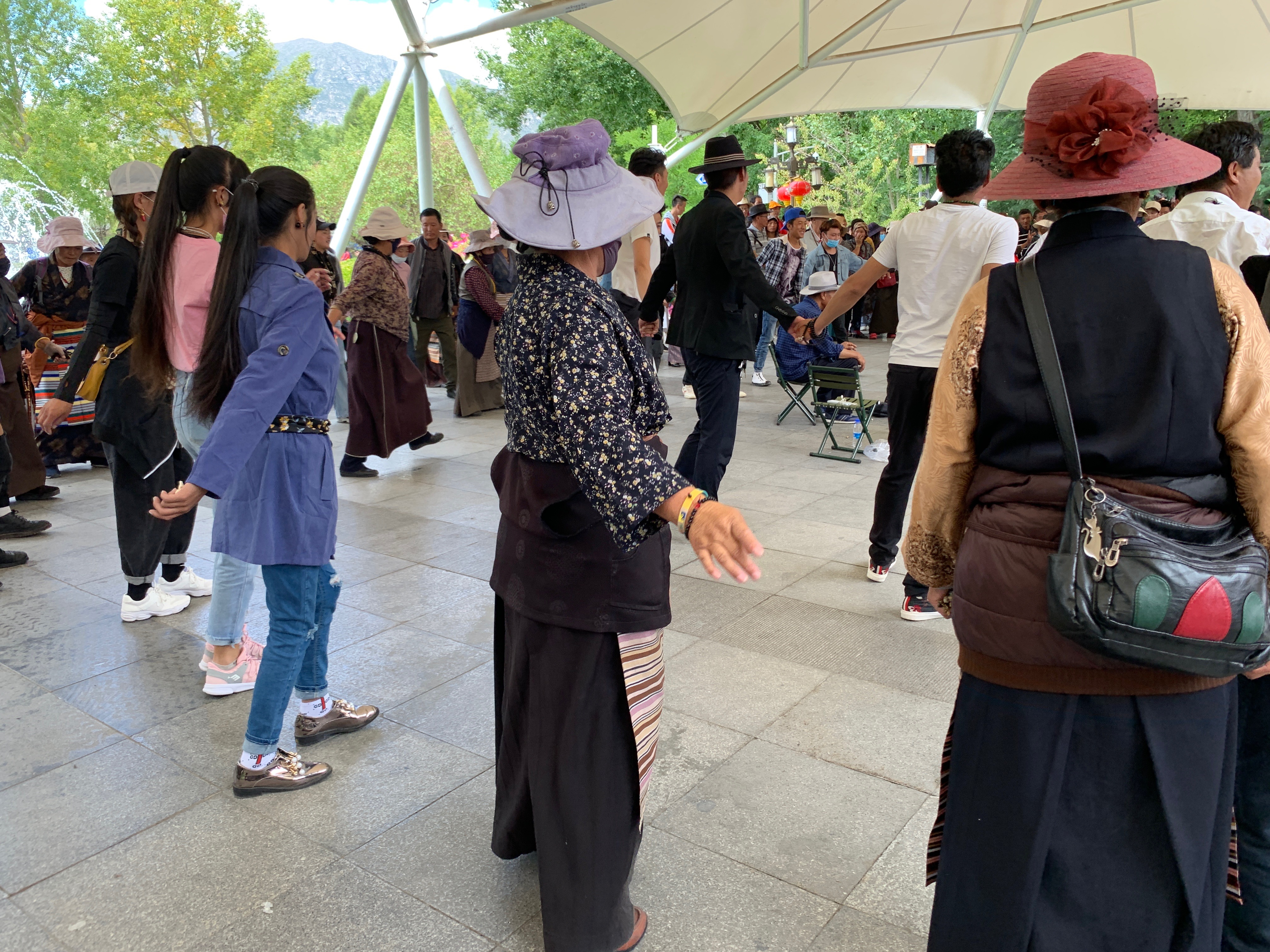
Line dancing in the park behind Potala Palace. The guy in white shirt is sporting big hair.
Back at the bottom of the Palace complex, we found ourselves in a park with a crowd of locals line dancing. It was fun to watch as all ages and styles of dress were happily dancing away. Several young men sported large pompadours and a few looked absolutely gay.
Our driver picked us up and off we went to a Tibetan restaurant for lunch. We are both noticing how filthy restaurants, restrooms and public places are, not to mention the monasteries and the Palace. Cleanliness is clearly not a priority. The streets, meanwhile, are being swept clean all day long by people in orange uniforms. We’ve also noticed that people are pushy, especially when lined up for something. And while we are complaining, Mark added that men and women spit a lot without apology .


Although we were sitting at a dirty, but pleasantly located roof top table, our lunch was just ok. Mark ordered a stir fried yak and vegetable dish. I ordered fried eggplant to go with it and a dish of pot stickers. The whole thing was pretty greasy. Time to get beyond yak, I think.
PinPin met us and off we walked through the Barkhor, Lhasa’s medieval Bazaar, to the nearby Jokhang Temple.
-
- Approaching The Joking Temple. All three buildings are included
-
- traditionally dressed worshiper outside the entrance.
-

- A wedding couple pray in front of the Summer Palace
-
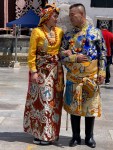
- Happy newlyweds in front of the temple.
-
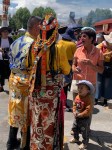
- Chatting with the wedding couple, who spoke a bit of English.
-
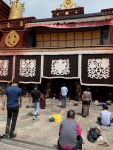
- Praying at the front of the entrance to the Jokhang Temple
-
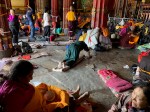
- At the door of the temple
-
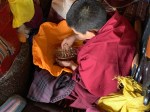
- sizzling beads over a mandala.
-

- Making a mandala
-
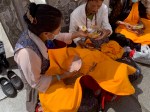
- Starting over
-
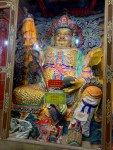
- Guardian King of the North. One of 4 kings just inside the entrance to the temple. Guardian King of the North.
-
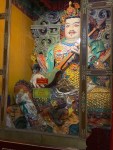
- Guardian King of the East.
-
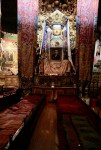
- Buddha of the Future. The photo is of the #10 Penchalama.
-
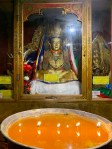
- Buddha of Longevity.
-
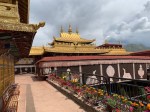
- The golden roof above the temple
The temple was built in 647AD by King Songtsen Gampo, who also founded the Potala Palace, and is the holiest temple in Tibet. It too was enlarged by the 5th Dalai Lama in the 17th century. The story is that the King had 3 wives–a Tibetan, a Nepalese and a Chinese. The Chinese bride brought a very old and important Buddha from China as her dowery. When she arrived and found no place to install it, she threw her ring. It landed in a small lake, so she had the temple built on the site of the lake to house the buddha. The charming story is told on a mural inside the temple. The king had only one son, who was from the Tibetan wife. He died at age of 32 and the Chinese sent an army to take back the statue of Shakyamuni, the 2,500 year old, original, Present Buddha, which had been made in India in the 8th century BC. The Tibetans hid the statue in a vault behind other statues in the temple and the Chinese did not find it. It is in the temple today.
The Nepalese bride also brought a buddha for her dowery, but it was destroyed during the cultural revolution.
When we arrived at the front of the temple, we passed people praying in several ways including prostrating themselves or building mandalas. The temple was, happily for me, on one level and there were not many rooms or statues. Again, I snuck a few photos in spite of the rules. There was a roof top level I did not climb. Mark said the roof top was gold colored and probably was the real thing. From the ground it certainly looked like a fancy gold roof.
We engaged with a few people in front of the temple and enjoyed the afternoon light. But there was no time to linger as we had one more stop—the Summer Palace.
About 3 miles away, the Summer Palace was built in what gradually became an 89 acre horticultural park in 1755 by the 7th Dalai Lama, Kalsung Ghatso. All the Dalai Lamas have used the Palace from then on including the current Dalai Lama. We saw groups of people picnicking on the grass here and there under lovely shade trees. Flowers were everywhere. There are several palace complexes. We entered the Truzing Palace of the 8th Dalai Lama and got to see an excellent Buddha of Compassion with 11 heads, 1000 arms and 1022 eyes. Also there, was a statue of a buddha we had not yet seen, the Medicine Buddha from the 11th century.
-
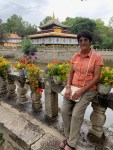
- Sitting in the Summer Palace Garden
-
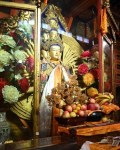
- Buddha of Compassion has 11 heads, 1000 arms and 1022 eyes. Is in the Truzing (8th Dalai Lama’s) Summer Palace
-
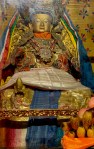
- 11th century Médecine Buddha holding herbs.
-
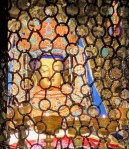
- The original 2500 year old Buddha of the Future. Sadly it was screened
-
- Buddha of Longevity.
-
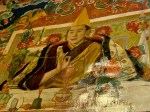
- The Dalai Lama at about 26 years of age
-
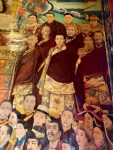
- Part of a mural of important people in the early life of the Dalai Lma. His mother is top left.
-
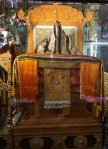
- The Dalai Lama’s throne.
-
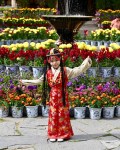
- A child poses in front of the Dalai Lama’s Summer residence.
Finally we entered the 14th Dalai Lama’s Palace. It was built in the mid 50’s and he occupied it for about 6 months before escaping to India to avoid the Chinese government. Unlike any other, it had twin staircases with modern handmade carpets and a clock that is stopped at 9pm, the time the Dalai Lama left for the last time. There was a wall with a huge mural depicting he at the age of about 27 surrounded by family, teachers, mentors, dignitaries and many others. Each face was very identifiable. We saw his throne and living spaces including his study room, sleeping room, meeting rooms, bathroom and living room. It was a very personal tour.
What I learned from PinPin about succession is: in the normal course of time, the two next highest people under the Dalai Lama, the Pachenlama and the Karmapa, choose the future Dalai Lama under a very strict set of procedures. In the current situation there are two Pachenlama. The real Tibetan one, the 12th Pachenlama, is in prison, and the second one, who has been appointed by the Chinese, but is not recognized by Tibetans. So the Dalai Lama and the Karmapa, who himself escaped to India in the early 2000’s, have been conferring on how best to decide on the next Dalai Lama. It seems like the Karmapa will have to do it alone following a set of procedures he and the Dalai Lama have laid out. The current Dalai Lama is 86 years old. I wish him a very long life and fear for Tibet once he has passed.
Dinner for the third night we again ate fruit in our room. We have lovely peaches, apples and bananas and lunches in restaurants have been less than satisfying. Oxygen again to sleep.
 Adventures with Julia
Comments
Why are the Chinese bent on destroying Tibet and its culture? It is certainly ot strategic militarily.
Hope you are having a great time and your comments and photos are very much appreciated.
Ann
Dear Ann,
We believe the Chinese want one homogenous Han Chinese country. The same applies to Uyghurs, Hong Kong and Taiwan. They want one China and will not stop until they get it. It is very sad for the minority groups being targeted, but the handwriting is on the wall. Each time we visit, the place is more prosperous and more unified and more Chinese. Break the rules at your peril. People are very fearful to discuss politics, so this is our opinion, not fact. Be happy to talk about this more when next we meet.
Thank you for your continued interest, Julia
Another Great Read
So happy you are having a great trip. So beautiful. In your neck of the wood, in South Lake Tahoe for a wedding tomorrow 😊❤️❤️
Julia – Really great that you are providing these. I understand what you mean about the current Dalai Lama and what might happen once he passes. Thanks again for documenting, Aseem