
August 31, 2019 continued
I ran out of time to tell you about the Indo-European mummies. They were all Uyghurs buried in the cemetery with logs sticking up. The reason they were so well preserved is that the cemetery was in the Taklamakan Desert in western China. The bodies received no special treatment. Just placed in a box and laid in the ground. I think it is special to see regular people, not pharaohs, from 4,000 years ago. It also proves that Uyghur people, who are Indo-European, were living in the area long before the Chinese give them credit.
September 1, 2019
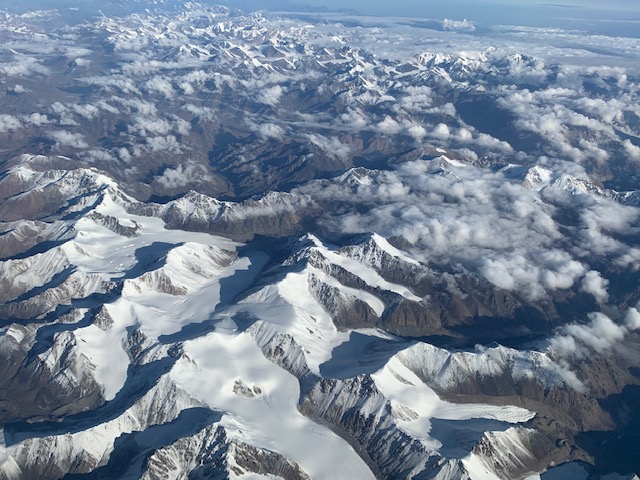
Tian Shan Mountains in western China

The following morning, we said good bye to Hassan at the airport and caught an early, 1.5 hour flight from Urumqi to Kashgar. It was a crystal clear day and I stared at the snow covered peaks of the Tian Shan Mountains and then the dry, hot, flat looking Taklamakan Desert below, I also read an article in a magazine that struck a cord, and thought I would share it with you, as it really speaks to our adventures on this trip as well as other past adventures.
“Doing something that you are not passionate about is much harder than traveling through treacherous environments.” Ye Ziyi, a celestial star photographer.
I hope that helps explain why we travel to the places we do. We are indeed passionate about our adventures.
Before arriving in western China I had done some reading about the history of the region. Uyghurs, I learned, started building Kashgar in 200BC. The first Kashgar king, Sultan Sutukbugra Khan, converted to Sunni Islam in 951AD. Meanwhile, Sufiism, which also dates back to 200BC in Persia, was brought to Kashgar by King Appakhoja in 1621. The combination of Sunni Muslims and Sufiism influenced Muslim people to be tolerant of each other, even to this day. The current problems are about the Chinese government wanting to control the activities of the minority groups in China, of which Uyghur is the largest. We learned a lot about the situation while we were in the Xinjiang province, but feel it is unwise to put people at risk, so we have avoided sharing information with you on the internet. There are, in fact, eyes everywhere in China, looking and watching.
-
- A large yak
-
- Sheep were everywhere
-
- The largest bull I have ever seen.
-
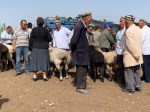
- Discussing the price of sheep
-
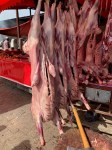
- Sheep carcases complete with testicles
-
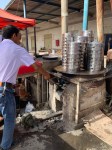
- Stoking the fire to keep the steamers hot in the animal market food court.
-
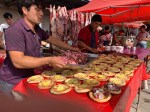
- Creating mini pizzas with naan, raw mutton and vegetables. It will then get steamed.
-
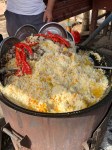
- The dish we described as Polo, also know as rice pilaf
-

- Making mutton dumplings.
As this is Sunday, it is livestock market day. We went directly from the airport and we wandered around the sheep, goats, cattle and yak, but no camels. Turns out it is off season for them. We did see a few yak, but could not get a good photo. People watching proved more interesting, especially around the food court.
Then we went to the Appakhoja (pronounced: a pak ho ya) Mausoleum where the king is buried and the Fragrant Concubine was supposedly buried. There was a lot of controversy about whether she actually went to Beijing to become the Emperor’s concubine or committed suicide rather than go.


When her grave was dug up, the tomb was empty. Her remains were found in an eastern town called Hebei. That solved that mystery. Next to the Mausoleum we saw the largest Uyghur cemetery in the world.
Our room was still not ready, so we went to lunch at a Uyghur restaurant called Dawayi Gheza (Da wa ye ge za). There was a female musician who made us laugh, she was so bad. “ A scalded cat” was how Mark described her. Abdulla said she sounded like a lost calf looking for its mother. Both comments were very descriptive. Lunch, meanwhile, was good. We both had Chao Mian.
-
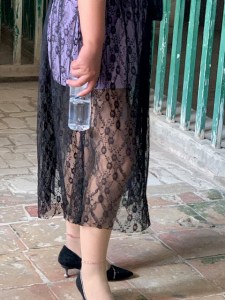
- See through skirt seen on the street
-
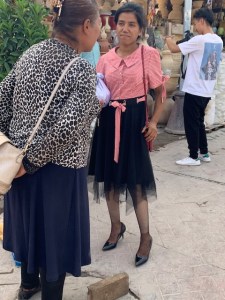
- Another see through net skirt
-
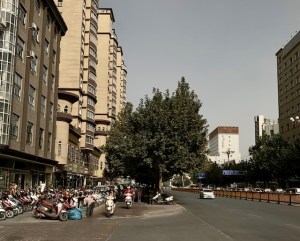
- A city street in Kashgar.
-

- I found a purple bike in a huge bike lit near Old Town. None are allowed into the town between 10am and 10pm so they park outside toe town.
After lunch we checked into the room, dropped our bags and headed out to see old Kashgar. The Chinese demolished most of the old town between 2003-2011. What is left of it has been remodeled and the home owners are required to pay the remodel costs to continue living in their own houses. Most people lost their homes and are expected to move into the new, unappealing, high-rise apartments.


We walked all around the Old Town, which is still pretty large, capturing images and finally reached Id Gkah Mosque, the oldest (1442) and largest (20,000) mosque in China. It has been closed since 2016. There are no more working mosques in the province and no more calls to prayer allowed. Although I prefer not hearing the call to prayer when it is loud and early morning, I must say that it was sadly missing from the local environment. There was plenty of sound on the craft street, where people are paid to be busy making crafts to sell to the tourists the government wants to attract.
It is hard to stick to history when the present demands so much attention. I have heard that a book, “Oracle Bones” by Peter Hassler 2007 discusses Uyghur history for the last 50 years. I encourage you to look it up to learn more about this persecuted minority in Xinjiang Province. We plan to read it ourselves.
By 6:30 Beijing time Mark and I were ready to call it a day. We ate peaches Mark pealed with his new knife and ordered a couple of appetizers from room service. Tomorrow we head for Pakistan on the Karakoram Highway.
 Adventures with Julia
Comments
Sorry to see the range and depth of Chinese persecution. Eliminating history and imposing cultural change.
Love the Ye Ziyi quote! Aseem