
September 2, 2019
We left Kashgar (4180 ft) and began the slow assent up the Karakoram (kara=black, koram=soot) Hwy at 9:50am. Our guide, whose name we are withholding out of concern for him, told us today was Flag Day. It is a ceremony that happens every Monday and attendance is required for all minority groups and lasts 3 hours and includes Chinese songs, the national anthem and pro Chinese speeches made by preselected minority persons. No Han Chinese are required to attend and none do. As a result we could not buy naan as the bakery workers were at the meeting. One more example of discrimination against minorities in China.
One good thing the Chinese did do, was build the Krakoram Hwy from Kashgar to Thakot, a town 200 miles north of Islamabad, between 1966 and 1976.
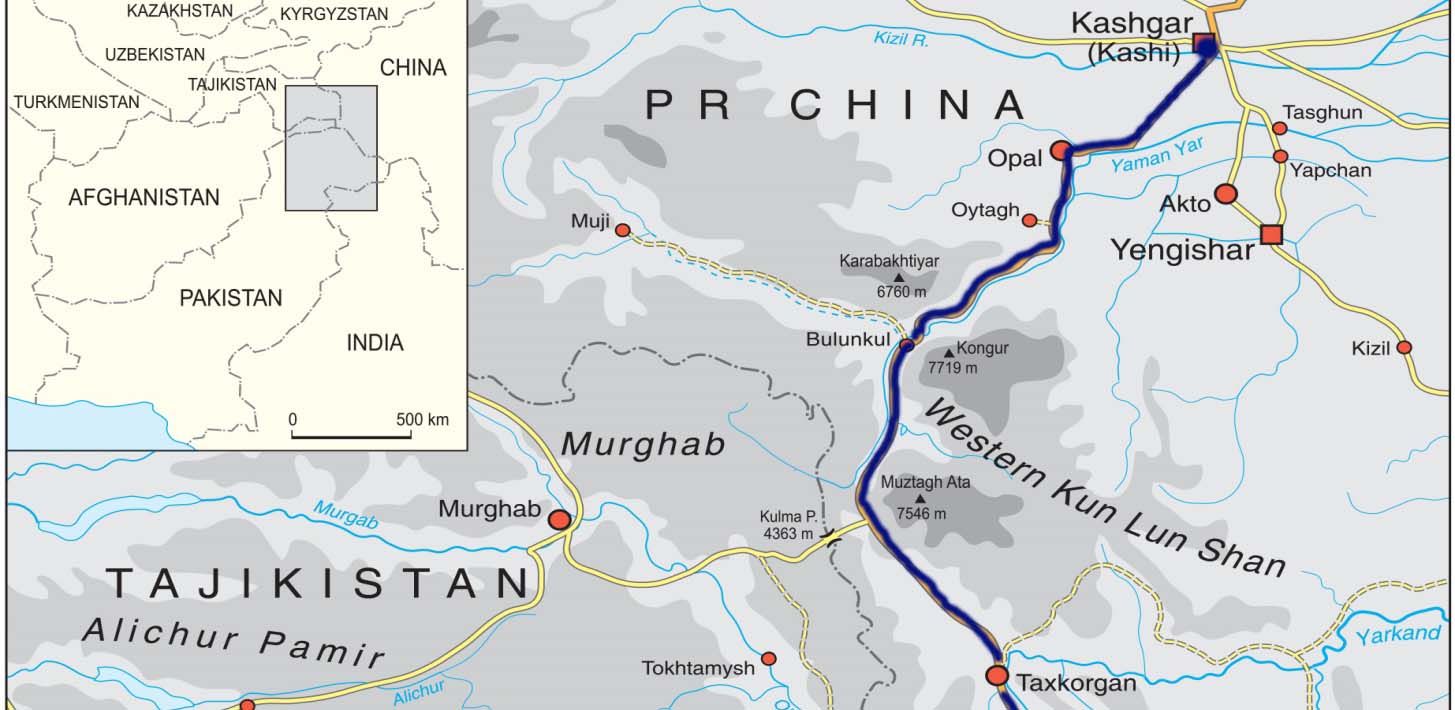
Close up map of the Karakoram Highway from Kashgar to Tashkorgan, the last city in China before the border with Pakistan.
On the Chinese side, the terrain is gradual, like the west side of Donner Pass in California. At first poplar trees line both sides of the road. We drive through Oytag Glacier Park, where the hills are of deep red rock. Bactrian camels are frequent sightings.


Then the road enters a large glacial drainage with no trees and a gray raging river called Gas (which means salty). Road signs are in large Chinese characters and small Uyghur ones. We pass by the third highest mountain in China, Konggor Shan, at 25,324 ft. The snow lever in early September is at 16,404 ft.
I can’t remember how many times we had to show our passports, but we encountered at least 4 passport control stations and had to get out and walk from the first station to the 2nd. Our guide said there are about 4 million government people who work in this province and they all need something to do.

Muztag Atta. A beautiful mountain. Great for skiing and training mountain climbing.
Along the way, we pass through a modern 2 kilometer tunnel, alongside a reservoir called Blungkol and near a very large, round, white mountain called Muztag Ata. We also pass and open iron pit, which is not working because the price of iron is low.
-
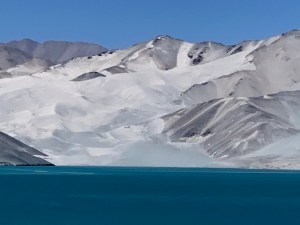
- Lake Blunkul with mountains of sand down to the waterline. Shortly before reaching the yurt.
-
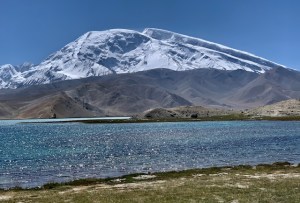
- Lake Karakol in front of Muztagh Atta mountain.
-
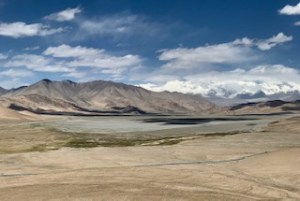
- An alpine meadow in front of Muztag Atta.
-
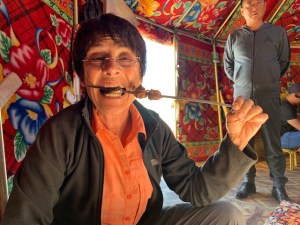
- Lunch along the road side. Mutton Kabob in the yurt
-

- Parked in front of the yurt was this decorated bike.
-
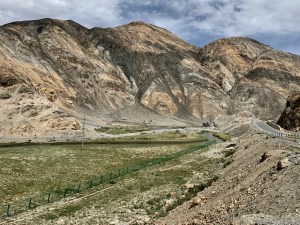
- Colorful hills just passed the lunch stop
-
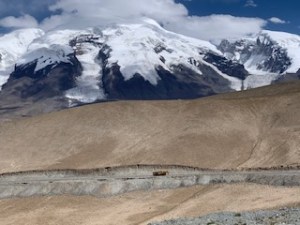
- After lunch we go over Blunkul pass and see Muztagh Atta mountain with a truck taking Chinese goods into Pakistan gives some perspective.
Our lunch stop is a yurt along the roadside by Lake Karakol. Along with our guide and driver, we enjoyed hot sheep broth, mutton kabobs, rice pilaf, spicy carrot salad, a pear and a nectarine. Very tasty and filling. From there the landscape was wide open with high snow capped peaks in the near distance. One more check point and we finally reached the town of Tashkorgan, where the customs office is located. This was our last overnight stop before crossing the border. The elevation was 10,242 ft. Our accommodations are a place called Crown Hotel, modest but clean and acceptable. Our guide brought us some food to eat in the room and the three of us had a very intense conversation about what has happened to him and his wife just because they are Uyghur. I hope to find a way to share the story with you as it is important to know what is happening to minority people in China, but the time is not yet. I can tell you that minority people are not allowed to have passports or freedom of movement, while Han Chinese are free to come and go at will.
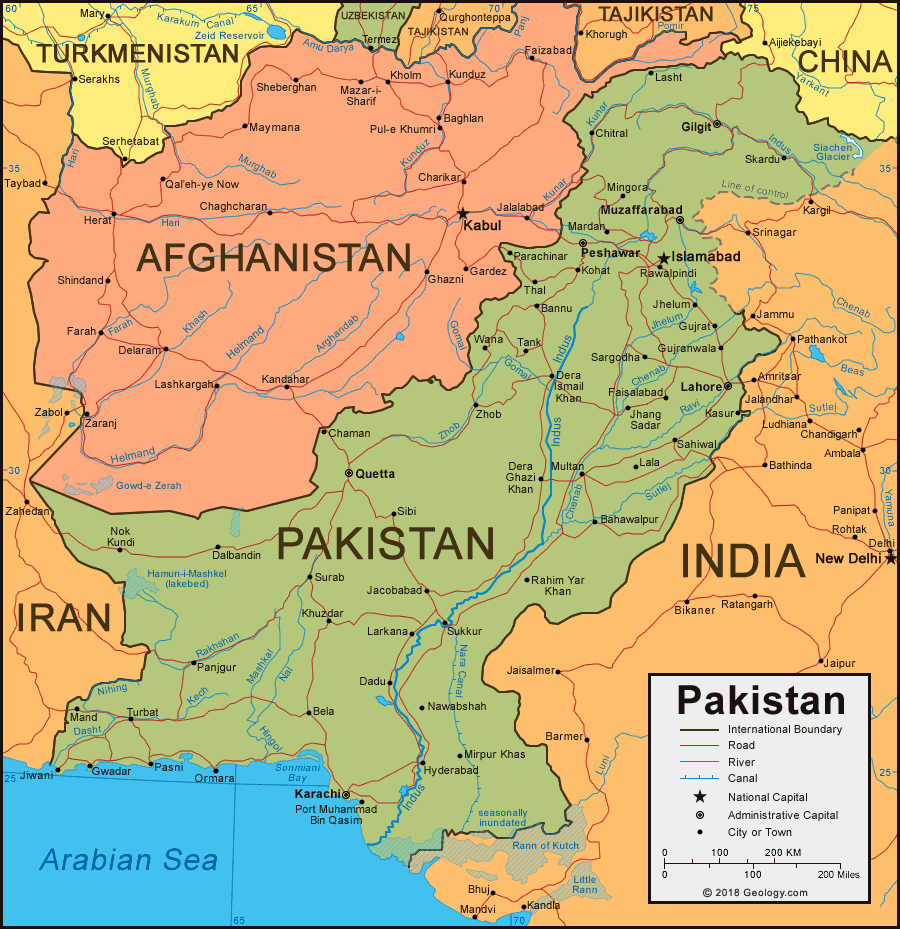
Pakistan sandwiched between Afghanistan and India. Our entry into the country is on the pink line at the top of the map between China and Pakistan.
September 3, 2019
Our Pakistani guide, Mohammed Shifa, showed up early and for a short time we had two guides helping us negotiate the passage from China into Pakistan. We go to the traffic office at 10:30 to buy tickets for the public bus to Sost, the nearest town in Pakistan, because we are not allowed to have a car on the Chinese side of the customs house. We can walk but must have a bus ticket to get through. What sort of rule is that? Eventually, with connections, the two guides get us and our bags through customs about 1pm. We say good bye to our Uyghur guide and head for the Pakistan border with Shifa in a small van.


Pakistan, Shifa tells us, is a poor country, but a free one and we will like it. The current Prime Minister is Imran Khan (63). He has been in office a year and is well respected. He has put corrupt officials in prison, speeded up the judicial process and streamlined the police department, increased the budget for education, provided health benefits for the poor and initiated a project to house homeless. He has also speeded up the visa process. Pakistanis are allowed to own property. The majority of Pakistanis are Sunni Muslims. Life is not perfect, but most people are doing better than they were a few years ago. The military has a powerful voice, but they are not ruling the country.


We arrive at the Khunjerab Pass and go through the final Chinese checkpoint. We could hardly wait to be out of China. The van moved slowly through the gate and we were unexpectedly greeted by local Pakistani’s hanging out at the 15,510 ft sunny, but chilly Khunjerab Pass waiting to greet foreigners into their country. They clapped and shouted “Welcome” as we entered. Our driver stopped the van and we got out to shake hands with the smiling well wishers. We were as happy as they were to be free. Apparently it is a popular activity to drive up to the pass to see the scenery and cool off. Foreigners are a bonus. Many of them spoke good English. We even received an invitation to dinner in Lahore by two financial analysts. After spending half an hour chatting with happy people and feeling deliciously free, we began our drive down the mountains to Sost.


Like the east side of Donner, the view was dramatic and spectacular, but the road was much longer and steeper with 2 narrow lanes. My heart was in my throat much of the way down, but the scenery was so spectacular I could not take my eyes away. The mountains we passed through were all part of the Karakoram Range.


At one point we stopped to look at a herd of Ibex on the opposite mountain side. We soon learned that Shifa is also a hunting guide and takes big game hunters into the local mountains in winter to hunt Ibex, Blue and Marco Polo Sheep. He said he spotted 18 animals including babies. I was able to find 6 with his help. The tan animals are mostly lost amid the rocky slopes.


Further down the mountain side we came upon a large flock of sheep being herded across a very narrow, home made bridge to get to the other side of the river. We arrived in time to see the first animal being helped across and then the next several. Soon, the sheep stood in line dutifully to cross the tiny bridge. It was fun to watch. Back on the road, we reached a Guest House and stopped for tea and cookies. When we pulled into the hotel at Sost it was 3:40. The time suddenly changed to 3 hours earlier, upon entering Pakistan, due to the National Beijing time throughout China. Much more reasonable for the actual daylight. The elevation was 9450 ft, a huge drop from the Pass. The hotel was several levels below our preferred digs, but they were the best available. The floor was lumpy and there was only a trickle of tepid water. The bed was ok.
 Adventures with Julia
Comments
Wow! Very interesting and also the way you write is also very entertaining.
Please keep it going. LRC
What an extraordinary adventure you 2 are having, seeing parts of the world many of us have never imagined. Thank you for sharing and stay safe, please.
Joel and Cindy
Fascinating. How are you handling the dramatic changes is elevation.Hugs jan
We must hear more about the Uyghur Chinese when you come home