
September 4, 2019
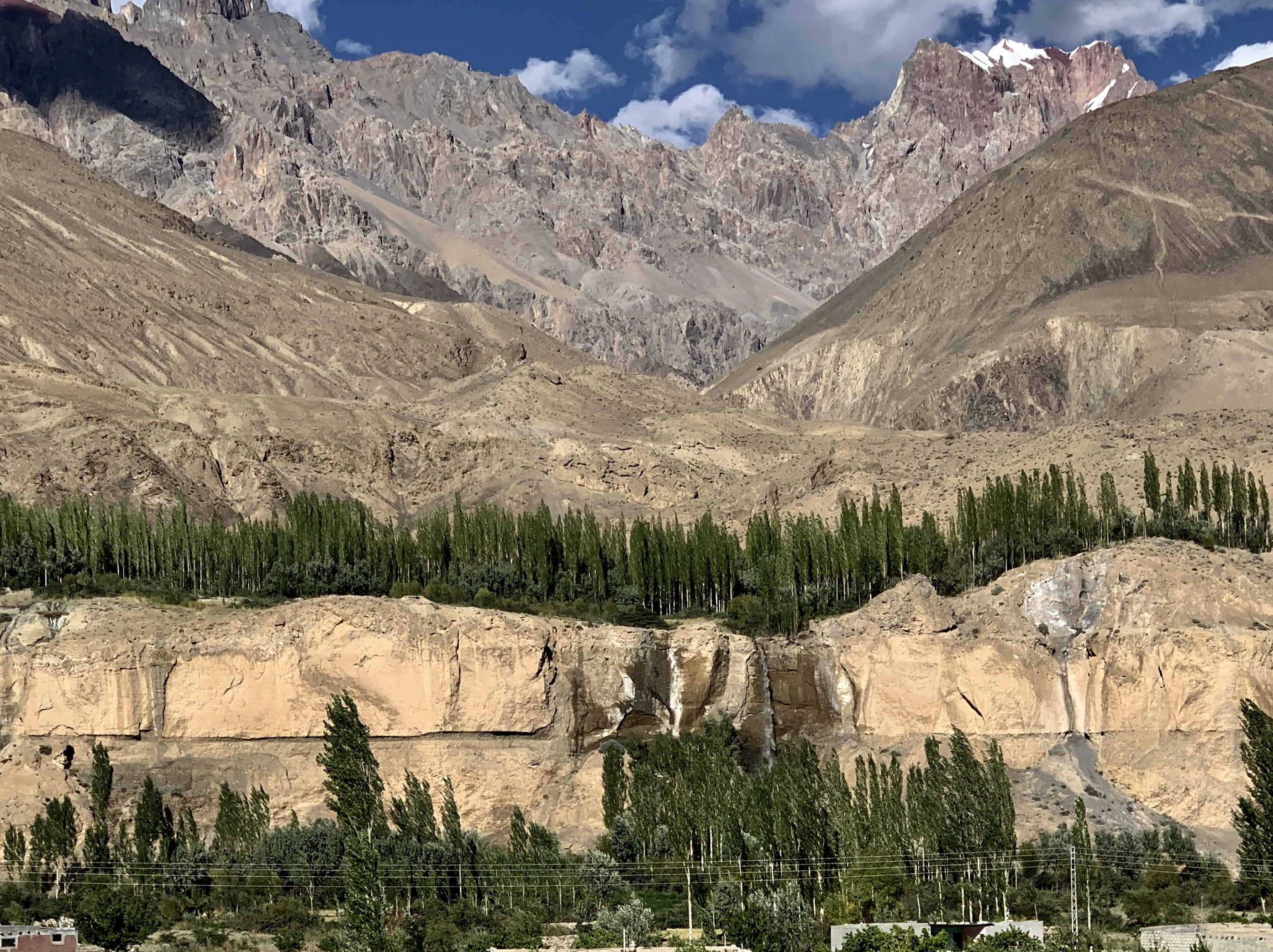
Waterfall behind our hotel. It comes from the ditch created by 60 Sost men
With a drink of good scotch that Mark purchased at the Duty Free Shop in the Customs House in Tashkorgan, we sat on the roof of the Embassy Motel in Sost looking at the mountains and sipping our drinks. On the far side of the nearby mountain was a waterfall that came from a man made ditch and a hillside sign, “Diamond Jubilee 2018”. Shifa told us it was in honor of the visit and 60th anniversary of His Highness, the 4th and current Aga Khan. He is the spiritual leader of the Ismaili sect of Shia, to which Shifa and most everyone in Sost and nearby villages belong. There are approximately 15M Ismaili throughout the world, with about 2% living in Hunza Valley. According to Ishmaili.com the Shia Ismaili Muslims are a community of ethnically and culturally diverse peoples living in over 25 countries around the world, united in their allegiance to His Highness Prince Karim Aga Khan as the 49th hereditary Imam (spiritual leader) and direct descendant of the Prophet Muhammad. He went on to say that Ismailies are a peaceful and happy people. Men and women pray together and enjoy most activities together.
Then dinner was served. I had local farm trout and Mark had curry. The food was good and we happily went to bed shortly after dinner.


It turned out Shifa is from Sost and really knew his way around the area. First he drove us up a short hill to the Dry Port where trucks coming from China transfer their goods to Pakistani trucks, which then deliver the goods all over the country. The Chinese trucks return to China empty. This “Port” is part of the Silk Road and owned by local people who are all members of AGM, the community trust. The trust leases the property to NCL, the National Logistics Cell, which is a military agency. The trust receives an annual distribution that is divided among the members. Shifa is a member and says the business is quite lucrative.
Having switched from the mini bus we had used from Tashkargen to Sost, our driver, Khajullah Beg, now drove a very nice Toyota Land Cruiser. He took us up a steep and very rutted mountainside track to overlook the river below that flowed around Sost and emerged down stream from the town. Not a tourist site. Shifa explained that In 1974 the Hunza Principality, which had ruled the area with an iron hand since the 10th century, was abolished by the government and life in the valley began to improve. The Principality, he told us, disallowed locals from leaving the valley. There had been limited education and health facilities and no freedom. Suddenly roads, schools, hospitals and irrigation began to be built or improved.


Local men, including Shifa’s father, decided to dig a tunnel through the mountain we were standing on to divert water from the river to the town of Sost. 60 men hand dug a ditch 7 feet tall, 3 feet wide and 1374 feet long. After years of planning and resistance from government officials, who thought it was a foolish idea, it took them just 2 years, with no loss of life, to complete the project in 1985, all on a volunteer basis. Suddenly the Sost community had a permanent supply of irrigation water. Here is a photo of Shifa in front of the opening, pointing to his father’s name on the list. The current Aga Khan, the Duke of Edinburgh, two presidents of Pakistan, and almost all ambassadors of foreign countries came to visit the site in 1987. Everyone was proud of the men. So much so that each, of the 60, was granted a parcel of land in the vicinity of the new irrigation ditch.
We walked into the tunnel a few feet and when we turned around to come out, Mark stumbled on the ditch slats and to save himself from falling onto the slats, he overextended one leg and pulled a hamstring in his right leg. He was in some serious pain for a few days and the hematoma on his leg turned dark purple. I had some ancient Tiger Balm I rubbed on the spot and we applied hot compresses. The pain has lessened somewhat and he is walking ok, not great. The hematoma will take time to resolve. Our activities did not change.


From the ditch we headed for the Diamond Jubilee School for our first scheduled meeting with school children. The principal, Mehr Kamil, met us at the gate and showed us into the first building, which happened to have been built by CAI, the Central Asian Institute which Greg Mortensen had founded, but was no longer maintained by them. The school was in excellent condition with a fresh coat of paint, nice desks and colorful slogans and signs on the walls. As we visited each classroom, we learned that there are 190 students in the school (about 2/3rds boys and 1/3rd girls), 17 teachers and 5 staff. Students pay 2000 ($12.82) rupees per month in grades 9 and 10, 1500 ($9.62) per month in grades 6-8 and 1300 ($8.33) in grades Pre-primary – 5. Scholarships are available for those who cannot afford the fees. Everyone was in uniform. The local Mullah provides uniforms for students who cannot afford them. School is closed in the heat of summer from late June to July 20 and again for winter from December 20 to February 20. Exams are held in September and March and combined for final results. The National language is Urdu, so that is also the primary language in the school. However, several classes are taught only in English—science, math, physics and English, which is the second language of Pakistan. Other courses include biology, chemistry and Islamic studies. Most schools operate on this schedule. At this school most kids are getting reasonable to good grades. This year 100% of the 10th grade students graduated and were eligible to go to high school in Gilgit. Some may need scholarships.


The principal told us a few of the teachers quietly support some of their students. How nice is that? I was asked to speak to the students and while they played during recess, I thought about what to say. I don’t remember exactly what I said, but I did tell them to study hard to be able to get ahead in the world, to be grateful for life and make each day count. I tried to inspire them to value their eduction and continue, if at all possible, through University. I sure hope some of them took my message to heart. The principal and a few teachers seemed grateful for my comments. Not every student understood me, so one of the teachers did an ad lib translation of my talk. I left feeling full of hope for the school.


About noon we stopped for lunch at a restaurant Shifa knew well. Hanging on a wall was a photo of the largest recorded Ibex ever taken. He had been the guide on the shoot and was very proud of the kill. Then we headed for a small extension of Hunza Valley called Chepursan Valley, on a side road out of Sost. The distance was only 45 kilometers from Sost, but the drive took 3 hours on a grueling one lane, bumpy road with terrifying cliff edges. I could not look down, it was so steep in many places.


At one point the road was under construction for a pipeline and we had to wait, luckily, only half an hour. Eventually we reached the Sky Bridge Guest House (elevation 10,677 ft), our home for 2 nights, in the village of Zoodkhun Shetmerg in the late afternoon. It was another best available situation.


We were the only guests and allowed to use whatever facilities we needed. As there was no hot water and the toilets only flushed when you turned on the water at the wall, we decided to use one bathroom for the splash bath with ladles. The owners provided us with a bucket of very hot water and we mixed it with cold and used ladles to pour it over ourselves. We slept in another bedroom with a king bed and used its dry bathroom during the night. We had the run of the living room, dining room and kitchen. The guy who owned the Guest House, Fahim Baig, was very helpful, in spite of the water problems. He and his staff cooked up really good meals for us, including breakfast. I finally got a bowl of barley meal, which was just as good as oat meal. Mark’s eggs were perfectly cooked to his liking.
September 5, 2019
Fahim told us there were about 6,000 people living in the valley in 11 different villages. Shifa added that 100% of those people are Ismaili (pronounced: ish my lee). The sect got its start with Mohammed’s cousin Ali, just like the Shia did. There are 72 sects in Islam, of which Ismaili is one (6 Shia sects and the rest Sunni). The current Imam is the 4th Aga Khan. The title was conferred by the Shah of Iran in the 18th century. The current Aga Khan divides his time between France and Portugal.
There are significant differences between Ismailis and Shia Muslims. To be an Ismaili one must: 1) Believe in one god, whose name is Allah. 2) Accept Mohammed as the last prophet. 3) Believe in Imamat: The chain in leadership from Ali, Mohammed’s cousin, to the present, which is the 49th Imam. 4) Be charitable. 5) Pray 3 times a day in the local Jamat Khana (prayer hall), unless unable.
The current Aga Khan is the 4th. His grandfather, the 3rd Aga Khan, was a very rich man and increased his wealth when at his 60 anniversary, he was given his weight in diamonds and, at his 70th anniversary ,he received his weight in platinum. With so much wealth he established a chain of schools called Diamond Jubilee Schools, of which the one we visited in Sost was one. While in Chipursan Valley we visited another Diamond Jubilee School that was even larger than the one in Sost.


This one was in the village of Zoodkhun Shetmerg. The enrollment was 224 students from pre-primary through 10th grade. I was pleased to learn that 50% of the students were girls. In addition to visiting a few classrooms, we saw the computer lab that could accommodate 11 students at a time, and a sparsely outfitted library. Again’, I was asked to speak to the students and gave a similar speech as at the first school.
CAI had constructed a building at this school also and it was in good condition like the other school buildings built by other agencies. Everyone we met spoke highly of CAI and hoped they would be working in Pakistan again soon. In this valley alone there are 34 CAI projects, including a small museum, which we visited, a vocational facility, and a health workers program, where women learn about hygiene, cooking, health education, family planning, caring for children and more.


We also visited an unfinished college CAI was building until the government stopped their permit and brought construction to a halt in February. CAI is doing everything they can to get their permit back so they can continue with their projects. The supervisor of the college construction was a man named Hikayat Shah. He is also the LSO, or Local Support Organization Chairman. He met us at the entrance and showed us around the entire unfinished facility. It was sad to see the construction at a stand still, with no idea for when, if ever, it will be finished.


After visiting several facilities in the valley and chatting with everyone we met, we drove the final 10 kilometers ( about 1.25 hours), to the end of the road where there was an Ismaili Shrine Shifa wanted us to see. However, about 100 yards before the Shrine, a military blockade stopped us from proceeding and told us to go back. Shifa was upset, but we had no option but to retrace our steps. In fact, we were only 20+ kilometers from the Afghan border. What we missed was the tomb of an Ismaili holy man in the middle of an otherwise empty building.
On the way back we did get to see a few Hoopoe birds and several Chucker Partridges, but got no good photos. This image gives an idea of the bird.
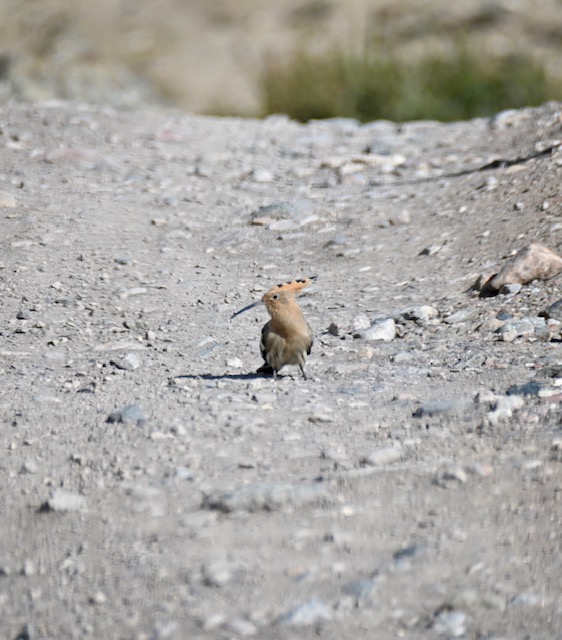
A Hoopoe bird
I asked Shifa how he knew so much about the Ismaili religion and how come so many people knew and greeted him, wherever we went. So he told us he was very involved in the administration of the Ismaili community in upper Hunza Valley and had been President of the Ismaili Council for 7 years. He is a lot more than your average guide and we are blessed to have him show and tell us about his world.
Back at the Sky Bridge Motel, we had dinner, watched some English speaking news on TV—all unpleasant—and went to bed.
 Adventures with Julia
Comments
This IS a major inspiring journey. I vision another OLLI PRESENTAION. Take care of yourselves ! ❤️❤️❤️❤️😍👨🎓👨🎓👨🎓
Very nice to read these adventures. Thank you for sharing.
Julia and Mark – it is wonderful that you have devoted so much time to visiting these schools; you are delivering a powerful and important message for the youth there that Americans are compassionate. Kudos. Imran Khan is a famous cricketer; it would be like Babe Ruth or Mickey Mantle being President of the US.