September 6, 2019
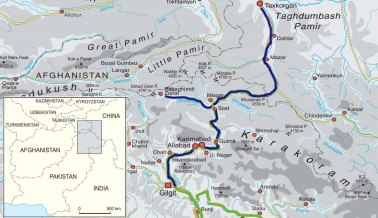
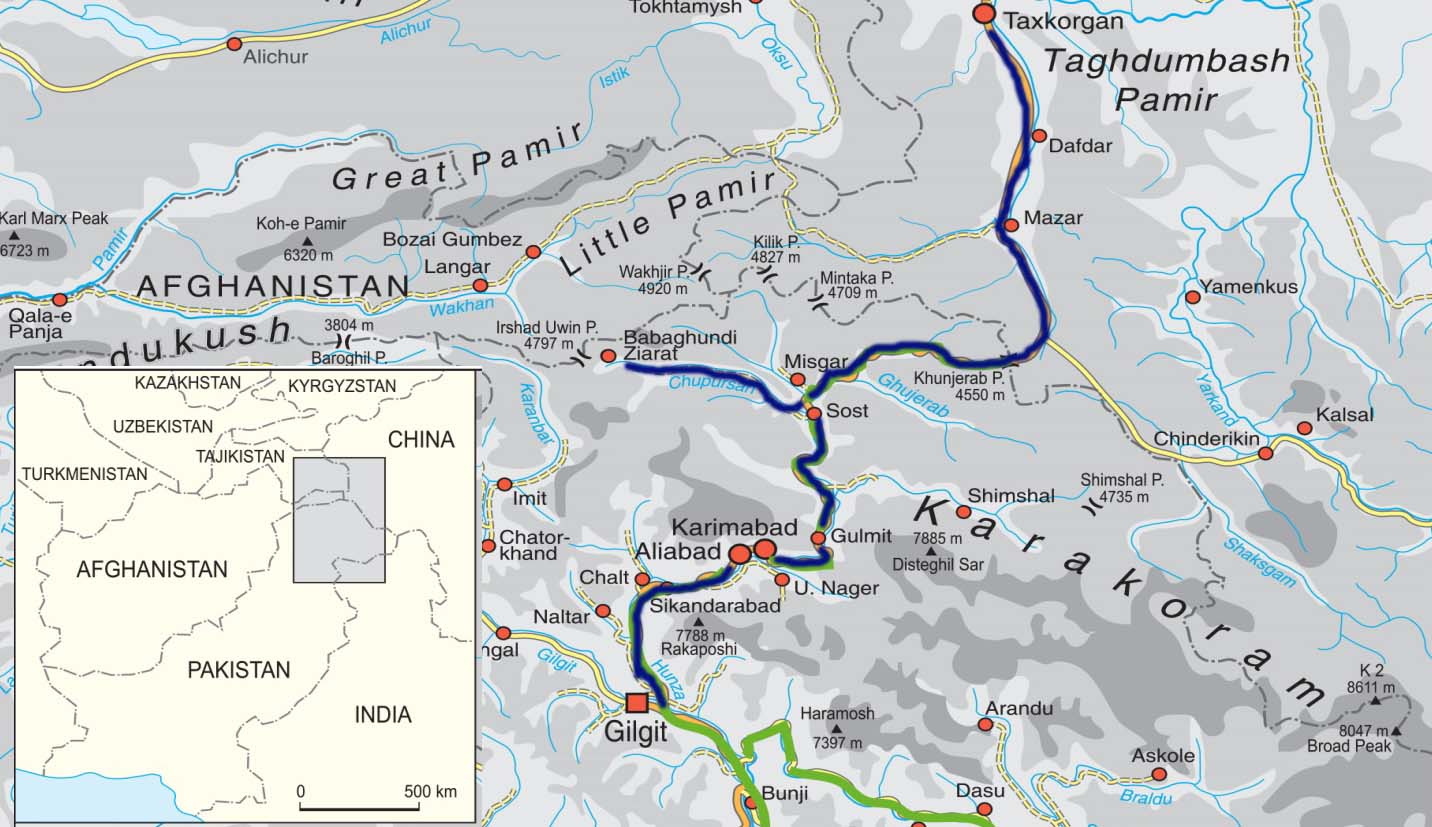
Detail map of far northern Pakistan. We went as far west as Ziarat in the Chipursan Valley, which starts at Sost (follow the blue line left from Sost). By the end of this day, the 6th, we will be at Gulmit. Eventually we will get to Gilgit and Skardu before flying south to Islamabad.
Before leaving the Guest House, Fahim gave Mark a local, white wool hat. It was a very thoughtful gift. Then we said good bye to the staff and drove back through the valley. The morning light was really nice and we took several photos of people working in their fields. Wheat is the primary crop in northern Pakistan.
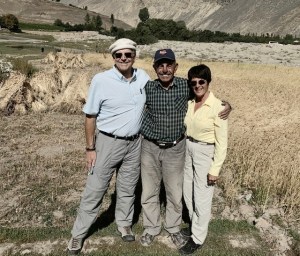
Mark in his new Chipursan Valey wool hat joins me in greeting Hikayat Shah in his fields.
We saw Hikayat Shah working in his fields as we were passing by and he ran across them to greet us. Such an infectiously nice man. We chatted with him for several minutes and were sorry to have to say no to his offer to share tea and bid him farewell. Shifa later told us Hikayat was the Local Support Organization Chairman (LSO), which means it is his job to keep harmony in the community. He is certainly perfect for that position. We decided to walk awhile to get some exercise and enjoy the day, Khajulah followed us in the car. While walking, Shifa recognized a woman walking on the road too and they chatted as we walked together. He told us he had arranged a scholarship for her to attend 11th and 12th grades through a hunting client. She had completed high school, but not gone on the university because her parents wanted her to get married. So she got married and now has 2 children, 7 and 3. Shifa believes her parents wanted to get her married so she would not be their responsibility any more.

A small hut with a million dollar view.

Shifa and a woman we met along the road. He had known her since her childhood and arranged a scholarship for her to finish high school. Now she is a mother of 2 and works in the local health clinic.

The Janat Kyana, or Ismaili Prayer Hall, located in the village where our Guest House was.
As we walked, we passed a prayer hall, giving Shifa another chance to talk about Ismailis. There are 2 leaders in each local community; a first and second, who minister to their congregation in addition to managing the prayers at the daily meetings. Their wives minister to the women in the community. Their terms last only 3 years or possibly 6. Then they must leave the job or transfer to another community, if one is available.
By that time we were ready to ride in the car, and sat quietly enjoying the scenery on the way back to Sost, except for one very scary spot.

Coming down the steep grade to the river we reencounter the road crew working in the same spot we had seen them two days before.

Shifa carefully directs Khajulah over the now very narrow passage with the cliff on one side and the 4 foot ditch on the other.

Khajulah was back to see how he had managed.

THe car behind us struggled with the same passage.
The place where the men working the day before had caused us to wait until they could clear the road, were still working in the same place. Only now there was no shoulder on the cliff side of the road and an open ditch for a new 12 inch pipe on the other side. We got out of the car and watched Khajullah straddle both edges of the 12 feet of open road with Shifa directing every inch of movement until the car reached solid ground again. We all breathed a sigh of relief. Now I know better what scary really means.
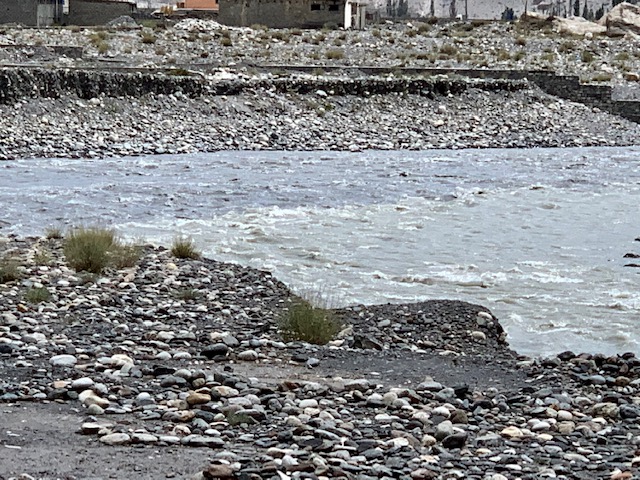
Just as we were about to reach the paved KKH, we saw the confluence of the grey silty Chipersan and the clear Khunjerab Rivers, join to become the Hunza River.
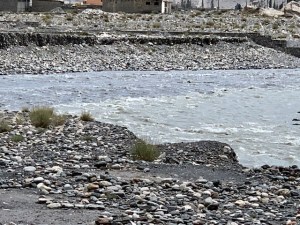
Merging of the Chipersan and Khunjerab Rivers into the Hunza River.
We pass through Sost stopping only to photograph the colorful Pakistani trucks lined up and waiting for their turn to get a load of goods. Each driver decorates his own truck and takes great pride in its appearance. Some of these I caught in motion and others were parked and waiting for a load.
Down the road we stop for lunch at a hilltop restaurant aptly named Glacier Breeze. All of northern Pakistan is in the middle of apricot season and this place has everything on the menu made with apricots. I had apricot soup, which was ok but not great. Then I had chicken curry with apricots. The best part of the meal was the apricot cake. Not unlike pineapple upside-down cake, it was easy to see why people flocked here just for the cake. Outside, the view is spectacular in every direction. Hard to know where to cast your eyes.

Aptly named Glacier Breeze Restaurant afforded fantastic views everywhere. Here we see a receding glacier close up.

The view nearest the front door.

Front view from the restaurant sitting on top of a small hill.

View from the side

Apricot soup was the starter to an apricot meal, ending with the popular Apricot Cake.

An apricot tree loaded with ripe fruit.
Another 20 minutes and we reach Gulmit, our last one night stand for awhile. This place is slightly better that the previous places as it has running water. However, we were the only guests at the hotel and our room was a long way from the hot water tank. It took ages to get warm water. Neither one of us had a hot shower, but it was better than only cold. The food was just so so, and the bed and linens were very tired, but the view from our room was grand and the hollyhocks by the front door wherever pretty. Mom would have liked them. Another Best Available.

The Best Available in Gulmit

These pretty hollyhocks reminded me of Mom. She loved these flowers that reminded her of Minnesota.

The grand view from our room.
September 7, 2019
The drive from Gulmit to Karimabad is only an hour, but we took a round about route to get there.

Scene along road to Borit Lake
Off we went on another rough and narrow gravel road to a lake called Borit. It is an alpine lake surrounded by granite boulders eroded over millennia into many interesting shapes.

A small lake called Borit

Rocks that formed strange shapes. This one looks like a leopard to me.
From the lake edge we climbed up a glacial moraine to a view point overlooking the edge of receding Bassu Glacier. We have seem other receding glaciers in Pakistan, but none so close up. Mostly the ice was covered with dirt and was not pretty. Back at the lake we enjoyed tea at an Inn overlooking the lake. In a room under the terrace, 2 young men played local songs on drums and a keyboard. It was quite pleasant music.

In front of the dammed up Lake Attabad. THe water is a pretty turquoise.

Our boat driver leaves us to climb up the hill to our car.
From Bassu Lake we drove another 20 minutes to Attabad Lake, which was formed by a landslide on December 9, 2010. By 2pm the next day the valley was filling behind the earth dam and a whole village was wiped out. By July of 2011, the lake was full and a spillway had been created to keep the water from getting higher. Several kilometers of the KKH were also underwater and through transportation impossible. The Chinese came to the rescue and, between 2012 and 2015, they built a new road including 8 kilometers of tunnels to pass through the devastated area. Today dead trees are still protruding above the lake in some places. Several commercial enterprises have sprung up, so we were able to rent a short boat ride on the lake. We tested the water with our hands. At an elevation of 7,791 feet, the lake is colder than Tahoe.
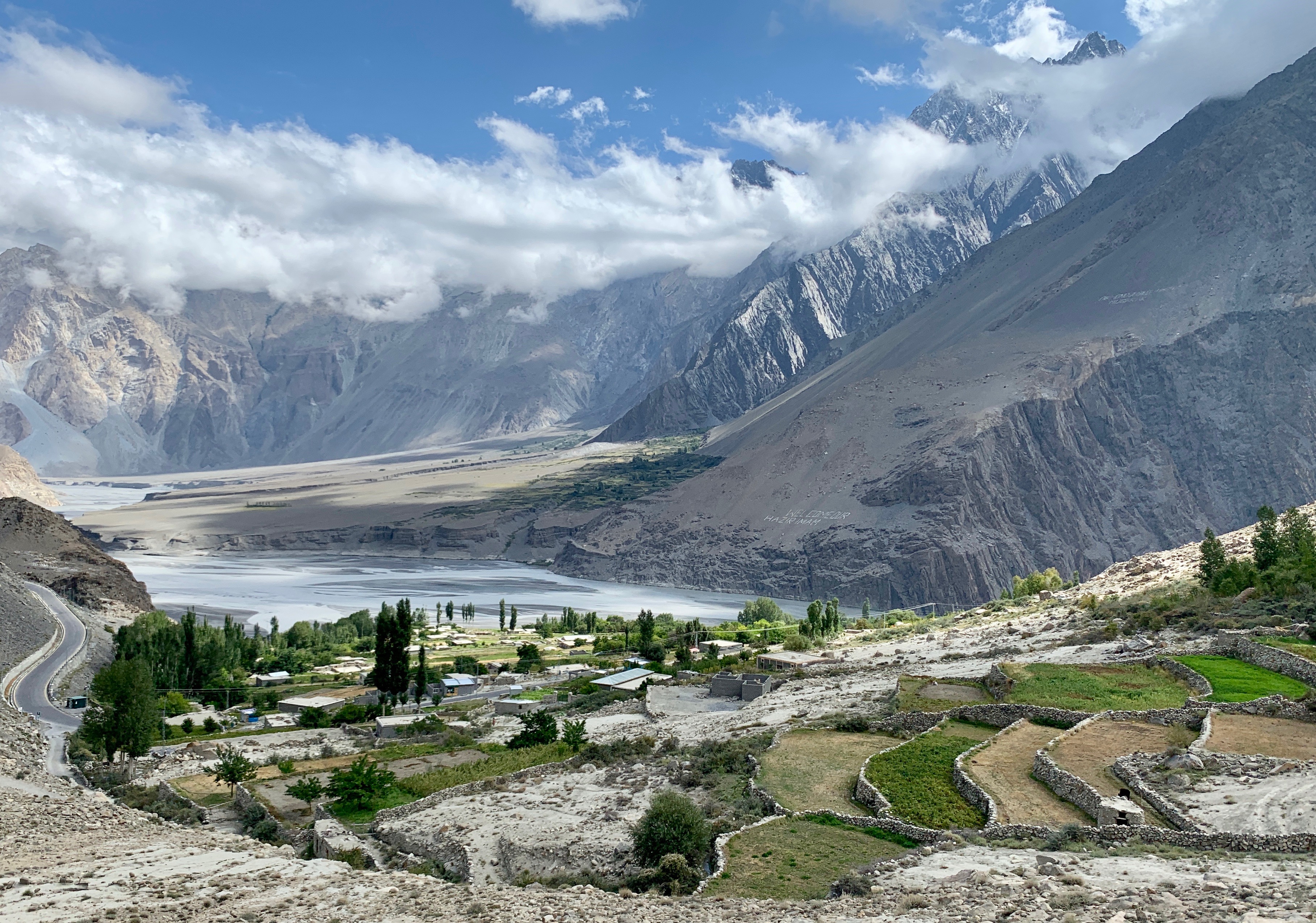
Back on the highway, we pass through the tunnels and see a bit of the landslide area between tunnels and arrive in Karimabad at 2:10pm. The town straddles both sides of the Hunza River and is very green and lush with many planted trees and giant snow covered peaks all around. It is a very lovely setting and no wonder so many Pakistani tourists from the flat, hot and humid, southern part of the country visit the area on holiday during the summer. The temperature is very pleasant at 70-75 degrees with cooling breezes that moderate the heat of the direct sun, which can be intense at the 7,722 ft elevation of our hotel patio.
We had barely arrived when Shifa talked us into an hour long walk along the sandy Karimabad city ditch.
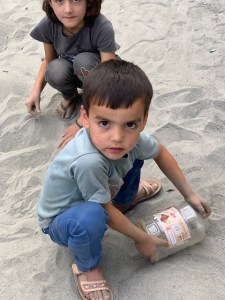
Kids playing in the sand along the path next to the ditch.
Very much like our irrigation ditches at home, this one followed the horseshoe shape of the town from our hotel, the Hunza Serena Inn, at one end and a road at the other end. Houses lined the ditch on both sides with one side being up hill and the other downhill. Every house had a lovely setting amid trees, flowers and peaks in the distance. Mark thought there was a slight resemblance to Sausalito. Khajulah picked us up at the far end of the horseshoe and drove us through the bazaar along the road back to the hotel. We spotted a couple of shops we made a note to visit later. Finally, we were in a room that allowed us to feel comfortable. The plumbing worked correctly, the shower was enclosed, the bed was good and we had a lovely veranda with a view of the town and the peaks above. My only difficulty was the slowness of the internet.
We had an early dinner at the hotel with Shifa. We ordered a variety of different dishes and tasted them all. I ate way too much and felt very stuffed. The best dish of the evening, from my point of view, was the local version of fish and chips. As alcohol is illegal for Pakistani Muslims, and we do not want to offend anyone, we put our beer in a tea pot and drank it out of tea cups. This seems to be a common solution for anyone who wants to drink alcohol in public.
I struggled with the weak WiFi connection or a couple of hours and finally gave up and went to bed.






 Adventures with Julia