
September 13, 2019
The morning was free and we enjoyed staying in the hotel and reading and writing. Shifa was supposed to pick us up at 1pm, but he did not show until 2:10, very unlike him. Our plan was to go to the old bazaar and look for fake ruby stones to make earrings for me. After checking several stores we finally found two we think will work. The stones are not exactly the same size, but maybe no one will notice when I have them on.

Old Bazaar in Gilgit. We bought fake rubies here.
From the old bazaar we went to a department store looking for a Pakistani men’s shirt and bottoms. Nothing fit. Shifa thinks we will do better in Islamabad. I would like to find an outfit for myself as well. We shall see.
Then we went to a girls hostel in town for a prearranged visit. It is called the KVO Hostel. KVO stands for Khunjerab Villagers Organization, which consist of seven Ismaili villages near Khunjerab Park, which are the owners of the land acquired by the government for Khunjerab National Park. The agreement is that KVO receives 80% of daily park entrance fees received from foreigners visiting the park. They also own and operates the hostel in downtown Gilgit for about 50 Ismaili girls aged 18 to 25, from remote areas in the Gilgit Baltistan province. Ismaili girls in grades 11 through 14 are welcomed on a first come first served basis. The goal is to provide housing at low cost so the girls can afford their school fees. The students pay 5,000 rupees/month or $32.19. Other living arrangements are considerably more expensive. In addition to the Girls Hoste,l KVO supports other Ismaili community development projects.
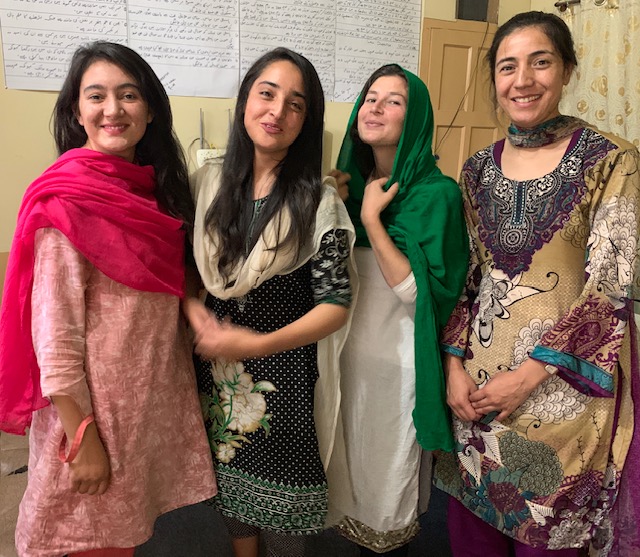
Some students in Girls Hostel in Gilgit.
After learning about the KVO and the hostel from the administrator, Sultanuddin, and the finance manager, Qudrat, who are on the hostel board, I met four of the students and had a lot of fun chatting with them. Most of them spoke reasonable English and they helped the girls who did not understand. I also started to speak slower and that helped. They all want to finish university and have parental approval to do so. They all expect to have an arranged marriage after finishing school. They trust their parents will choose well, even though they agree that not all arranged marriages work out well. Some of their married friends are quite unhappy. Nevertheless, they totally agreed that was what they wanted to do. Sex before marriage is completely out of the question.
They toured me around the hostel and showed me their rooms, the study hall, kitchen, dining room and bathrooms. Other girls joined the parade. The accommodations did not meat our standards by any stretch, but the girls were happy with their circumstances and appreciated the opportunity to get a good education, which their parents could not have afforded any other way. I noted that there was no shower, only one exposed bulb in the study hall, and the grounds looked shabby. I didn’t say much to the girls, but did notice that some of them smelled rather ripe even though they looked ok.
Back in the administrators office, I was asked what I thought could be improved. I was pleased that he asked and immediately brought up the shower situation and the dim light making it impossible to study in the hall. Shifa and the administrator and finance Manager took my comments to heart and marched right over to the bathroom to see what options were available. While they were gone, Mark and I conferred about the situation and decided to give the school $500 to remedy the shower problem. Both Shifa and the Administrator were pleased with our offer and said they could install at least 2 showers, improve the lighting in the hall and have a little left over. It is so nice to have so little go so far in places like Uganda and Pakistan. As we left the facility everyone was smiling. I thank God for the gift of being able to improve the lives of even a few people.
That evening we had dinner at our hotel with Shifa and his family. His wife, Gohar Nigah, spoke no English, but his daughters, Shagufta (18) and Shaista (16) spoke reasonably well. The ladies all arrived dressed up and I was glad I had something appropriate to wear too. We worked very hard to keep the conversation going and learned that both girls plan to finish university and have their parents select a suitable husband for them. The younger girl wants to work in computer science and the older one wants to be a teacher. They were both curious about our work and our interest in Pakistan and traveling in general. The mother did not talk at all and that put a cramp on things. After an hour, dinner was over and it was time to say good bye. I forgot all about taking a group photo. Am sorry now, but we were happy to get back to our nice cozy room and terrace.
September 14, 2019
Leaving Gilgit at 9am, we stopped very soon at the confluence of the Gilgit River, which had only a few kilometers before overtaken the Hunza River, and the Indus River, the largest river in Pakistan.
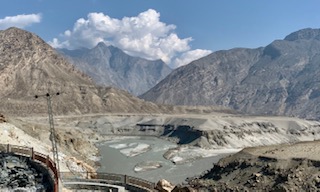
Confluence of two rivers-Gilgit and Indus and three mountain ranges-Hindu Kush, Karakoram and Himalaya. Pretty heady sight to ponder.
At that same point we were looking at the confluence of three mountain ranges: Hindu Kush on the left; Karakoram in the middle; and Himalaya on the right. The highest peak of the Hindu Kush is Tirch Mir at 7,800 meters; of the Karakoram is K2 at 8,611 meters (the 2nd highest in the world); and of the Himalaya is Everest at 8,848 meters. All were out of sight at this juncture, but a mile down the road we got our first glimpse of an 8000 meter peak, Nanga Parbat at 8,125 meters. Shifa told us the wind is so strong that snow does not stick to the mountain. Nanga means “naked” and Parbat means “snow”. It was first climbed in 1953 by a German, Hermann Bul, the same year Edmond Hillory climbed Everest.

Nanga Parbat, a peak measuring 8,125 meters. Notice the very windy top. No wonder no snow sticks to it. This was the clearest image I could get.
From now on our route will take us through the Himalaya mountains. Down the road we stoped on a hillside in a village called Jaglot for a better view and found ourselves at the front door of a religious secondary school for boys. They were just taking a break and came over to check us out. They stared at me and Shifa thought I might be the first girl in western dress that they had ever seen. Secular classes had been added only 3 years earlier and their education was very poor. Even the English teacher had a hard time communicating with us. I felt strange and was glad to get away from the situation.


This encounter got us into a discussion about Mujahadeen and Taliban. My simple understanding of the trouble is that Pakistan was doing well until the 80’s when they agreed to train men and boys to become Mujahadeen (Volunteer fighters for a holy cause) and fight the Russians in support of the US. The short of it is that they became trained killers. Pakistan continued to conscript and train boys until 1995. When that war ended, the fighters needed a reason to keep fighting, joined the Taliban (Student Seekers) and established a government in Afghanistan. After 9/11 they fought against the US to get us out of Afghanistan. As time passes, so will the Mujahadeen as Pakistan is not training more of them.
Some observations we made along the drives south is the changing of crops. In the far north, there was only wheat. Around Gilgit we began to see corn and before we get to Astore, the dominant crop was potatoes. Continuing down the road we stop at a waterfall and a sawmill. We have seen very few waterfalls, but many sawmills, which always reminded me of my father, who was in that business for many years.


At 2pm we reach our overnight stop, the Wazir Mahal Hotel at 7,900 feet, just passed the town of Astore. The place was rather dirty and weird with a menagerie of animals in cages and several different colored lights strung over fences and around trees and poles. However, the WiFi was really good and I was able to get a post sent. Another GeoEx group with 6 vehicles and 18 people arrived and we shared cocktails and dinner with them.


They were all interesting people to be sure, but I was a glad there was just the 4 of us traveling together. The food was getting very boring and, in this case, was not well prepared either. I ate pasta and bread and felt bloated. The full moon came up around 8pm this Friday, the 13th and I remembered that Hospice of the Foothills was putting on their fundraiser called Moonlight Magic and hoped they would do well.
September 15, 2019
During the night I suffered an attack of the trots. Ugh! More or less had it under control by 6am and managed to get down some oatmeal and hot water. This was our longest driving day and, given my tummy cramps, it was grueling to say the least. We drove away from Astore at 6:30am and did not reach our destination at Shigar until 4pm. I managed to stay plugged all day. But, enough about that.
The drive was only 145 kilometers to Shigar crossing through the Deosai National Park and the Deosai Plateau, but it was all bumps with no peace. The morning was the most pleasant as we got out of the car and walked through a few villages, chatting with and taking photos of people and scenery as we went. We learned about the mix of Yak and Cow to create a Zo, similar to a mule. Zos are more able to tolerate warmer conditions than Yaks and they are stronger than cows. They are used for their milk which is rich in fat like yak milk, while their meat is more beef like.


We walked through a conservative suni village where there were dozens of men congregating around cauldrons of food–one with rice, one with yak stock to mix with the rice and one with mutton stew. I walked amongst the men shaking hands, looking into the pots and asking for photos. Shifa told me later that I totally flummoxed the men who are not use to women meddling in their affairs. What I did not know was that there were men in the crowd who were hosting the meal and expecting the crowd to hang around for a speech about politics and religious fervor afterwards. After about 10 minutes, Shifa indicated we should leave and so we walked away. Another interesting encounter.


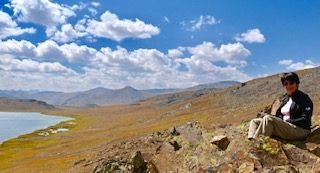
Overlooking the lake from a rocky outcrop at 13,500+ feet.
Once we had passed the last village we entered a heavily forested area at about 10,000 feet and began to see birch trees in autumn color as well as large stands of conifer trees. This was the largest forest of timber we have seen in Pakistan, and not a stray piece of dead wood anywhere. Every bit of scrap all the way to the top of the mountains was picked up for firewood. The forests were pristine, unlike our old ranch. It was about 9am when we left trees behind and entered Deosai Park and paid our $10 fee. We bumped along the road looking at brown rocky hills for over an hour and eventually reached Chikar Pass at 13,822 feet. Right after the pass we stopped to climb a rocky promontory to view heart shaped Sheosar Lake that Shifa insisted we see from above. I was not wearing proper shoes but managed to crawl up the hill to a very nice view spot on a rock. Fortunately, the path down was much easier and I managed it without incident. Mark meanwhile, wandered around like a mountain goat. After passing the lake, there was nothing but bumpy plateau for hours. The most exciting part about the plateau was the hundreds of fat marmots living there. We all took many photos, but Mark got the best of our shots.
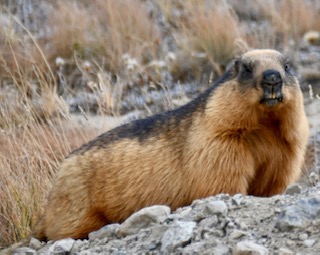
A fat marmot in the Deosai Plateau.
At one point we stopped at a camp providing food and tea for travelers. Shifa and Khajullah needed a break. We did too, but I could not face the food or the tea. The camp looked as desolate as I felt.
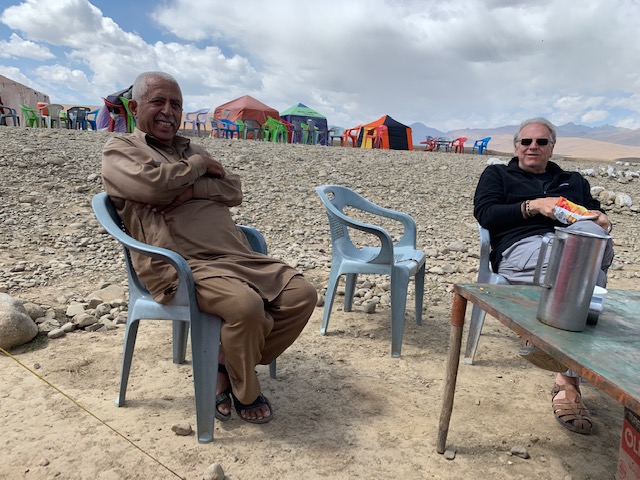
Khajullah and Mark sip on tea in the windy, desolate camp ground.
I ate a couple of crackers and drank a sip of water. Back in the car, I could think only of getting to our destination as soon as possible. Nevertheless, once we left the plateau at 13,440 feet, and began the long, steep, narrow, hair pin turn descent to Skardu at 7,750 feet, I forgot my stomach and spent the time being afraid we would go over the edge. Then, once in Skardu, Khajullah drove like a crazy man through city streets trying to get to our destination as fast as possible. My insides were frozen solid. It was not until we reached our room in the Serena at Shigar Fort at 4pm, that my body relaxed. I had survived the day with no embarrassing moments. I ate a toasted cheese sandwich and went to bed at 8pm. Mark sat up enjoying our private terrace with lovely mountain views all around and listening to the sound of the river passing next to the walls of the fort. We had been assigned the Raja and Rani’s rooms on the top floor of an ancient, meandering, irregular fourth floor walk up.


September 16, 2019
Woke up feeling almost whole. Was ready for breakfast at a relaxed 8am with the river flowing just below the dining area. Our conversation with Shifa was very interesting about the KVO, his involvement, what it is doing and what it plans to do.


Then we wandered around the lovely gardens and had a tour of the fort. The architecture is much like the Baltit and Altit forts only not as old. This place was build in the 1634 by the King of Shigar and was called the Palace on the Rock as it is built into the side of a mammoth boulder. Occupied by Rajas until the end of the 38th dynasty in 1990, it was abandoned until 1999, when rehabilitation began. It was finished being restored in 2004 by the Aga Khan Cultural Service and turned over to Serena Hotels for operation. The property is operated for the benefit of the Shigar community. The hotel is in the region of Baltistan, the home of the Balti people, and Raja was the name for king in Balti.
We walked into the local village and found a taylor and a fabric store and ordered an outfit called a Shalwar Kamiz for him. It is supposed to be finished by 9am on the 17th. We shall see.


Then we walked fast to get to the public girls school before they finished for lunch. We reached the very small school of 59 students and 3 teachers and enjoyed our time with them, even though none of the students spoke English and the teachers spoke very little. Shifa did most of the talking with everyone. He thoroughly enjoyed himself and the students seemed to enjoy him too. Clearly, this school was in a very poor neighborhood.


From there we walked by two old mosques. The first one we saw, built in the 1600’s, is called Khankah-e-mualla Mosque, and also serves as a meeting hall similar to the Ismaili meeting hall, Jamat Khane.


The second mosque was called Amburiq Mosque. It was very charming and is considered the first Islamic religious monument mosque in the Shigar Valley as it was built in the 14th century. It too was built with stone and wood to be earthquake proof. It too was restored by the Aga Khan Cultural Service in 1998 and now has a UNESCO heritage conservation award.


Slowly we walked along the village irrigation ditch back to the hotel and spent a relaxing afternoon on our terrace. Stayed away from the car all day. Felt great.
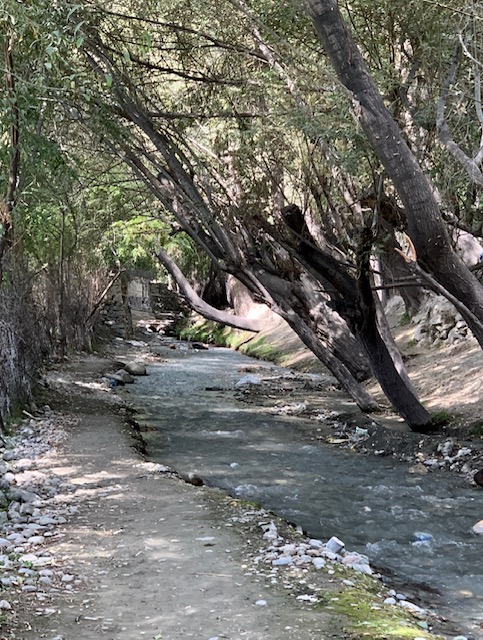
The village irrigation ditch offers a break from vehicle traffic and provides a pleasant experience.
 Adventures with Julia
Comments
Wonderful travel log Julia. As usual you have a gift of describing with such wonderfully vivid detail that I felt all the angst of some of the adventures. I am curious about the “fake” rubys — what type of stone are they really? Looking forward to hearing more about this trip when you return. It would be another fun Olli Class!! Miss you — Love, Valarie
What a spectacular journey. Love hearing all the stories. Hopefully you are feeling better Julia.
The Friendship 100 raised over $90k yesterday. Amazing as the weather turned rainy and cold. The sun came out at dinner time
I froze and finally warmed up after a brisk walk this AM.
safe journey. ❤️❤️❤️❤️😎😍BT
The Draft Horse Classic is this coming this weekend.
Hi Dear Julia and Mark. Your continued adventures in the “unseen” world around us is so totally amazing! Not to mention your inquisitive yearning to see what the “real” world is like. Could I keep up with you, or could I do this? NO WAY. Julia, I would have those “trots” all day –even at 13,000+ feet in the Andes I got a slight altitude sickness. But truly I love and admire your humane and positive adventures to understand all of us on this planet, and I love the fact that you visit places, peoples, and children who dwell here and are trying to understand what is happening today, here, and now. You guys are great. And the many people everywhere you travel are enlightened by your visits to share the diversity of the world we live in. And I appreciate greatly your fortitude and love for the whole of mankind –I would say today people-kind. Love and see you after you are rested from the amazing journeys you guys take.
LOVE to YOU,
JEFF
Excellent travelogue
Very interesting information, another great read. Julia
It’s so amazing that you were at the confluence of the Hindu Kush, Karakoram and Himalayas. You were very close to the Khyber Pass, which was the route Alexander the Great took to enter India. Is that on your itinerary? Rudyard Kipling called the pass “a sword cut through the mountains.”