
September 17, 2019
Here is the map I have intended to send for days. Finally, Shifa was able to get it downloaded. It goes with the last couple of posts, so you will have to refer back to previous days to match the places with the adventures. I hope you find this helpful.
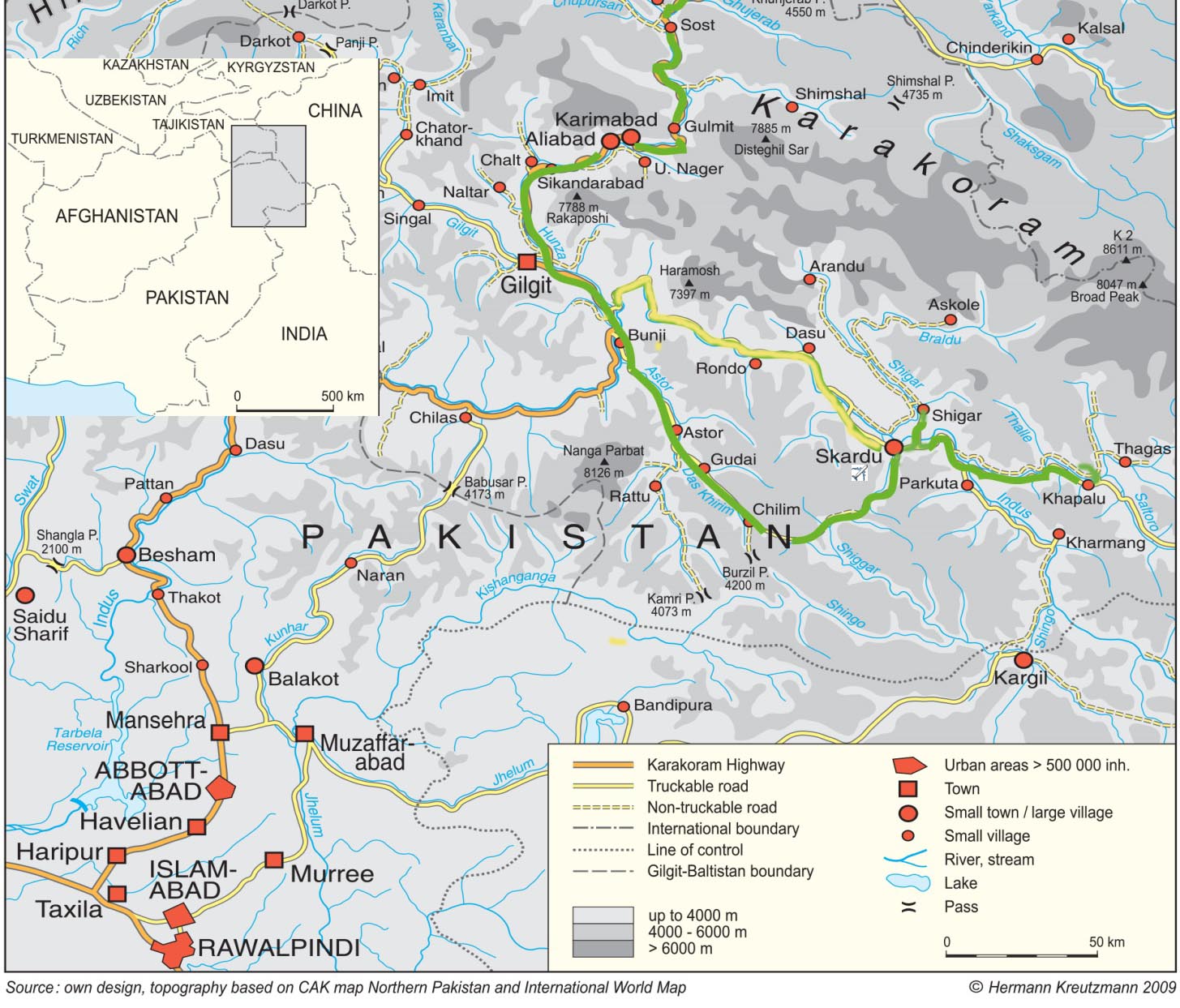
Map of Pakistan from Gilgit to Islamabad. The green line is our path. On the 19th we drive from Khapulu back to Skardu and fly to Islamabad in the lower left corner of the map.
On the morning of the 17th, we had another leisurely breakfast in the dining room at the Shigar Fort. I was recovered from the tourista and Mark’s leg is returning to normal. For the first time since this trip began, we had some rain and wind and felt cold enough to eat indoors. At 9am, Shifa and Mark went to the tailor’s to see if Mark’s Shalwar Kamiz was ready. It was, it fit well and it cost a total of 600 rupees or $4 plus 1800 rupees or $12 for the fabric.
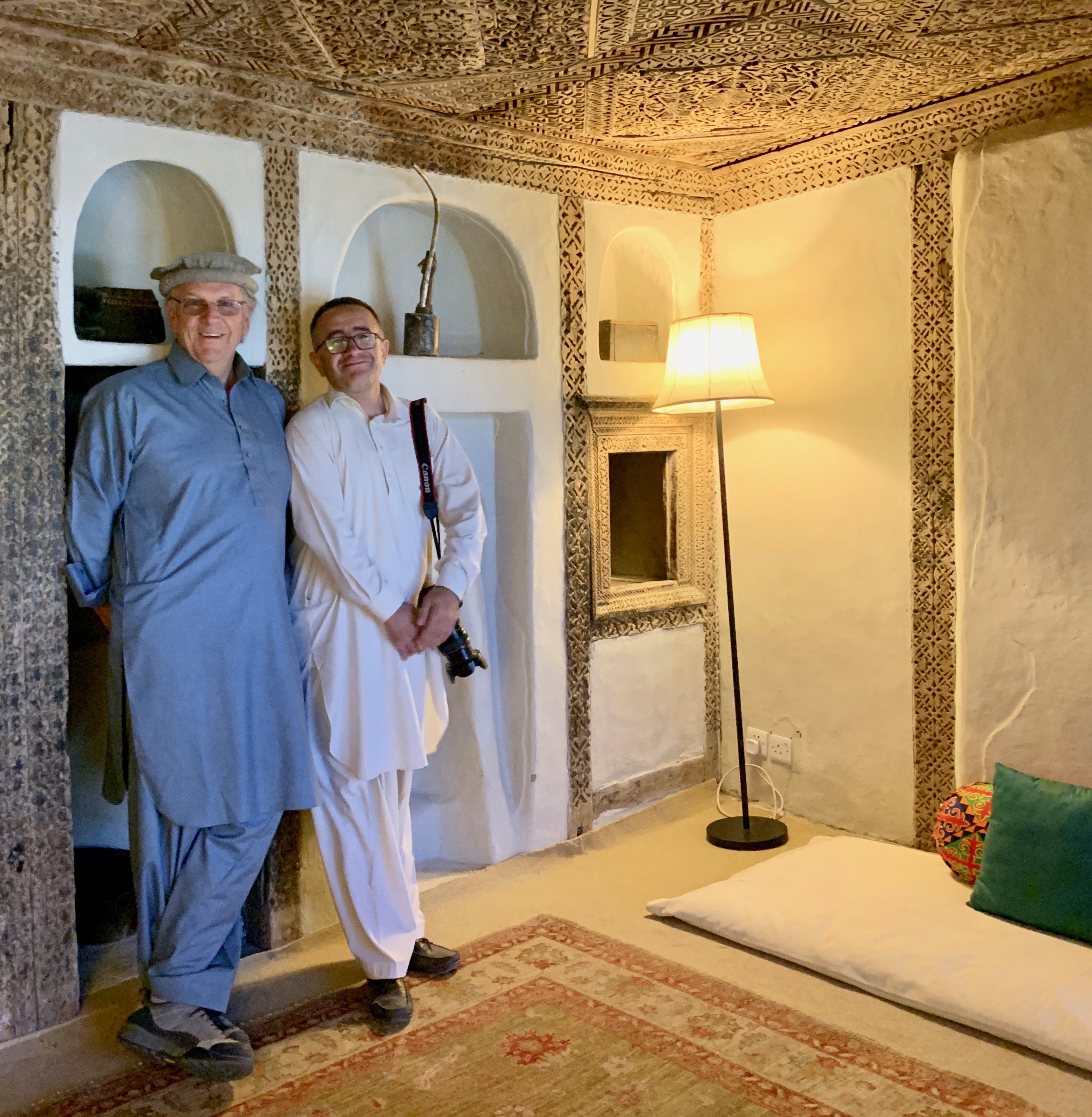
Mark and Shifa in their Shalwar Kimiz’s in the queens sitting room at the Khapalu Palace.
What a deal. He now has an impressive outfit to wear to dinner parties for less than $20. He couldn’t leave the tailor’s place without giving the tailor a tip for his time and quality. There is a photo of the tailor in the last post. We learned that he had polio, but we never saw him walk. We only know he had a pleasant personality and was happy for the work.
Back at the fort, we checked out and began our next long drive to Khapalu. It was ever so much easier than the drive through Deosai National Park. The roads were paved almost all the way and the trip took only 4 hours. We started by following the Indus River for a good distance until it was intercepted by the Shyok River. After crossing the Indus, which had grown huge by then, we followed the Shyok River, which was no small rover itself.


Shifa had promised to keep the trip as short a possible, so we made very few stops. One of them was in a village he told us was Suni and that many of the people were of the very strict Wahabi sect. They may not want women or girls to be seen in public or educated, or photographed. They believe in Shuria law. Suni men can generally be identified by their beards. Long scraggly beards and no mustache often means the man is Wahabi. We saw a few as we passed through the village, but we had to stop when we saw a public primary school full of girls let out for the day. I made the mistake of trying to take photos. All the girls scattered and I got nothing. This was one of those cases when it would have been better to have a live experience rather than a photo memory. The good news is that now Wahabi Suni’s in this region are also willing to allow girls to be educated.


Driving down the road we encountered a forest of poplar trees that had been planted in perfect rows along the road and were very attractive. Khajullah stopped to let me capture the scene.
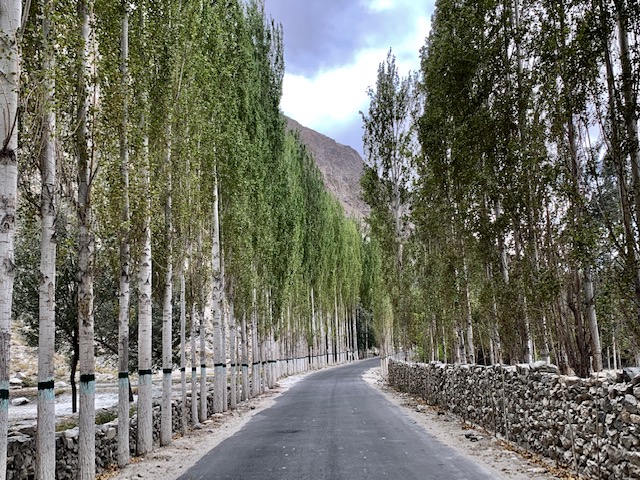
Poplars along the road.
We made one more brief stop at a craft center. The place was supposedly under construction but could have been in a state of collapse as well. We saw 2 women weaving fabric in very unpleasant conditions. The manager told us they do it to make money for their families. One woman’s husband is disabled and she has two children and him and herself to feed. The display space was dark and dirty and the products nearly impossible to examine. Nothing to do, sadly, except leave.


We reached the Serena Khapalu Palace around 2:30. Shifa stuck to his 4 hour time line for which I was grateful. At the palace we were given a choice of rooms and after seeing the royal digs, we were most happy to take a less-than-royal room. The royal rooms were old, dark and considerably less comfortable.


The palace was built in 1840 as a residence and was not used for defense. Only three Raja’s lived there before the Khapalu kingdom was abolished in 1973 and the province go Gilgit Baltistan was nationalized. The last kingdom to fail occurred one year later when Hunza collapsed and the kingdom system was abolished. The Palace was restored between 2005 and 2010 with the Aga Khan Cultural Service providing expertise and the Government of Norway providing the necessary funds.
The scenery is more mountainous at Khapalu than at Shigar, and very lovely, bot it does not the lush green vegetation, and roaring river that I loved at the Shigar Fort. The rain stopped about an hour after we left Shigar, and the mountains everywhere had a dusting of snow on them. Rain at 9,000 means snow at 15,000 and above.
After settling into our room, we had a delicious bowl of local soup with home made noodles and spices served on our terrace and enjoyed the afternoon sunshine. Fortunately, we had a new menu to consider for dinner ands had one of our better Pakistani meals that night.
 Adventures with Julia