
September 20, 2019
The population of Pakistan is 208 million and the country is almost twice the size of California, which has 40 million people. Given that the snow-capped peaks are uninhabitable, the useable land is much closer in size to California, so you can begin to imagine how close together the Pakistanis live, especially in the flat, arable southern half of the country. Pakistan is able to provide all its own food needs as well as iron, copper and salt. The country exports mango’s, dried fruits, rice, cotton, medical equipment, rugs and textiles. Necessary imports include: gasoline, vehicles, airplanes, industrial products, plastics and technology. Islamabad, compared to the lightly populated north, seemed very dense, even at only 1 million people.
At 9:30am, Shifa introduced us to our personal guide for the day, another Ishmaili schoolmate of his named Mueez, who is a PhD professor of archeology and history at the University of Islamabad. We drove to the historic site of Taxila where several Buddhist monasteries once existed between 600BC and 600AD. It was on a crossroads of trade. Even Alexander the Great came here in 327BC and stayed for 6 months. His effect on the local was long lasting as he brought Hellenism and Greek influences to art. The first century sculptures of Buddha give him the facility of Apolo and include Greek draped fabric. Art developed into a mix of Greek, Central Asian and Indian Cithian.
Remember that you can enlarge any image by couple clicking on it.


After Alexander came King Ashoka Mouria, who killed many people to expand his empire. However, he felt remorse at having killed so many and decided to become a monk. In 270BC, he became the first king to embrace Buddhism. He wrote 14 edicts in 3 scripts plus many languages. As a result many people learned about Buddhism and converted. The most important edicts were: 1) Stop the killing of animals; 2) Provide hospitals for animals as well as people; 3) Establish monasteries for teaching and preaching. His edicts reached Rome and he was pleased he had made a major conquest without fighting. He established stupas for the placement of relics of Buddha’s body. Originally there were 8 body parts and 8 stupas. From those he went on to establish 75,000 stupas during his lifetime. Now there are only 3 intact, of which one is at Taxila.
Today there are no monasteries or monks and only 100 Buddhist families live in Pakistan. Between 500-600AD the Huns invaded Pakistan and demolished the monasteries. Hinduism took hold in the 7th-9th centuries. In 1001AD a Muslim leader, Mahmud, invaded Peshawar and defeated the Hindu leader, Jaipal. This was the beginning of Islam in this area. By the 7th century, Islam had reached Iran and by the 8th century, Afghanistan was Islamic too.
After looking through the museum, which Mueez has made much more interesting for us, we drove to two different sites in Taxila. It was too hot to spend any more time outdoors. The first stop was Dharmarajika Monastery, where we saw the remains of the stupa King Ashoka built circa 270BC. It consisted of a large mound made of stone and dirt, surrounded by monk cells and smaller square stupas, which were to honor deceased monks.
The second stop was the Jandial Temple, built on the site where Alexander supposedly sacrificed a horse. The temple was built in 200BC. It is Greek in style including columns.
After departing Taxila, we drove into Rawalpindi, the twin city to Islamabad, only much older. On the way to a restaurant at the Pearl Intercontinental Hotel, we drove by a Catholic church, St Paul’s. That was a nice surprise. Apparently, according to the stats, 3.6% of the population is Christian and Hindu.
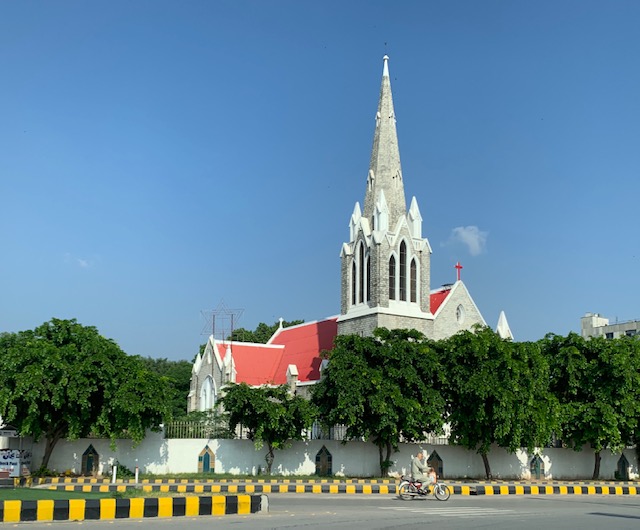
St Paul’s Catholic Church, Rawalpindi. Sure caught my eye. Would like to have visited it.
Rawalpindi, at 2.11 million people, is more than twice the population of Islamabad and more than twice as busy. After lunch we spent the afternoon walking through the old town bazaar, chatting with people and taking photos. The afternoon was a lot of fun. We bought more fake ruby stones, ie glass, and mixed it up with people. Observed the old architecture and crazy wiring, the Hindu temple at a distance, shopped for lingerie, and other adventures. At the end of the afternoon we took a wild rickshaw ride through and out of the bazaar. Whew!


Took a quick break in our room to clean up before going to visit the Faisal Mosque, the 14th largest in the world, holding 74 thousand people. It was built between 1976 and 1986 by King Faisal, who spent 120 million on the facility and was assassinated by his brother before it’s completion. It was interesting to see the mosque at night all lit up. There were many people walking around and children running and screaming everywhere in the courtyard.


We were not allowed into the mosque so we hung out for awhile, then went to dinner back at the hotel.
 Adventures with Julia