
September 24, 2019
I mentioned our last Pakistani stop at the Shalomar Gardens, but did not provide any photos. So here they are including our last photo with Shifa.


Picking up where I left off on the 24th with our new guide, Ashim, we arrived at our hotel in Amritsar having received an ear full about Sikhism. Apparently there is a large percentage of Sikhs in Punjab State where Amritsar is located. Lahore is also in Punjab. Pakistanis call it a province rather than a state. Before independence in 1947, Punjab was a united region in India. Even now many things are the same. The people look, dress and eat the same. The cities look the same and traffic is just as crazy and congested. The politics, however, are different and the two countries are at odds with each other and get very possessive about their cricket teams. Good idea to stay away from the India-Pakistan cricket matches.
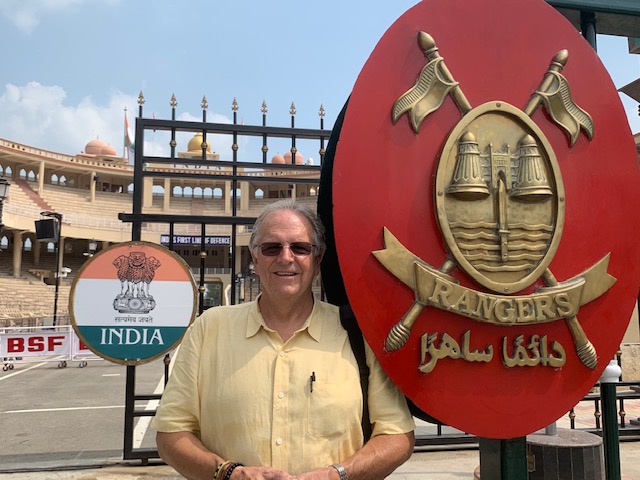
Fortunately for us, passing out of Pakistan and into India was very smooth. We departed Pakistan at noon and were in India by 1pm. Several check points, but no big deal and many smiles along the way. Nothing like getting out of China.
We were in the hotel from lunch time until Ashim picked us up to go to the Golden Temple at 5:30 to see the sunset. In the meantime, a 6.2 earthquake struck a small town between Islamabad and Lahore, where we had just been. I was on the 6th floor and the building shook pretty vigorously. By the time I was contemplating walking down the stairs, the quaking stopped. Then sirens started up and a voice telling us to leave the building. The sirens were more disturbing than the earthquake. Just then Mark called me from outside after he was evacuated from the 3rd floor where he was getting a pedicure, dark blue toe nails this time. We discussed the situation and agreed I would stay put. Thankfully, the sirens stopped about then. There were no aftershocks in Amritsar. Later we learned that 19 people died, many were injured and there was a lot of damage to roads and buildings.
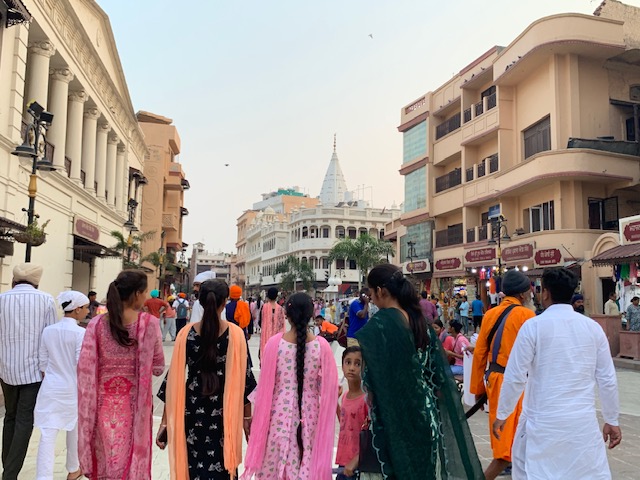
Masses of people walking toward the temple. Notice how modern the buildings are and how nicely dressed the ladies.
At 5:30 we headed for the Sikh Golden Temple. It turns out the Sikhs are hard working, smart and have done very well for themselves economically. Many of them are quite wealthy. It should be no surprise that the temple is covered in 22 carat gold that is 3-4 mil thick everywhere, including the inside of the temple. Many Sikhs live in Punjab to be near the temple and spend a great deal of time there.
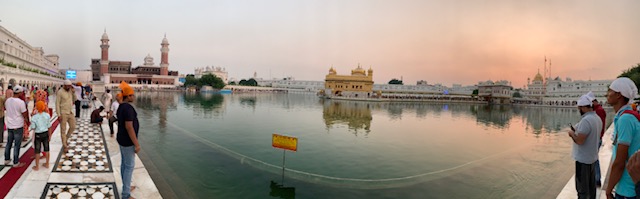
Pano of Sunset on the Gold Temple. It was more of a fade than a set.
Ashim gave us a good bit of information about Sikhs that I will try to condense here. There are three offshoots of Hinduism: Jainism, which got started in 1500BC; Buddhism, which began about 500BC; and Sikhism, which came into being around the 15th century. The founder of Sikhism was Guru Namak Dev. He opposed idol worship and the inequality of the caste system. He wanted to reform Hinduism, but his followers eventually started a new religion. They developed 5 main symbols: 1. Do not cut any hair on the body. God gave it so one should keep it. 2. Keep a small wooden comb in or near the hair so one can keep it groomed. 3. Were a metallic bracelet on the right wrist. 4. Carry a dagger or sword close in case a weapon is needed. 5. Keep string handy so one can tie up their loose underwear. Very few of these symbols are practiced today, except the bracelet, which is easy to wear. Today only 2% of the Indian sub-continent is made up of Sikhs. 75% of the population is Hindu and 14-15% is Muslim. Small pockets of Sikhs exist around the world including our own Sikh community in the Yuba City/Marysville area.

Slowly the lights come up on the temple as the sunlight fades. The gold domed building at the right is where the Sikh holy book is kept at night. It is treated like a living person, with a bed, blankets and lots of attention. In the temple during the daytime, it is read from out loud all day.
Back to the temple. It was built in 1589 by the 5th Sikh Guru. We went to see it by sunset, but the sunset was a slow fade and barely noticeable. The place was crowded with people walking around the temple and just hanging out. Head covering was required of everyone and we complied. As the sun faded, electric lighting slowly came up and eventually the temple glistened in the light. It also made lovely reflections in the man made pond.


Ashim explained that one of the ways the Sikhs try to eliminate the caste system is to feed people from a place of equality rather than out of hunger. So hundreds of volunteers prepare, make, serve and clean up for thousands of others all economic levels to eat, no questions asked. Sometimes 30,000 people will be fed in a day, every day. The day we were there it looked more like 10,000 were being fed. That was still a lot of service. We watched the whole process with friendly people acknowledging us wherever we looked. It was an amazing experience.
-
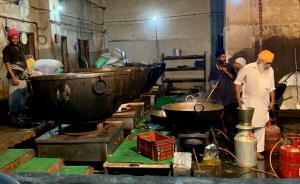
- The food is cooked in huge vats.
-
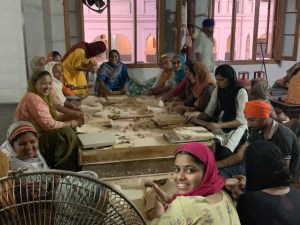
- Volunteers make chapati bread.
-
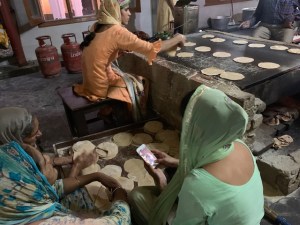
- Other volunteers butter the chapati and pile it for the cook. Cooking the chapati
-
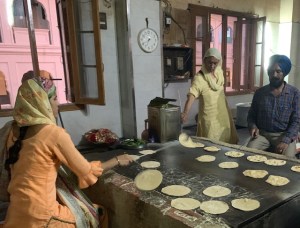
- Cooking the chapati and flipping it till done.
-
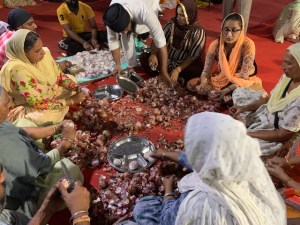
- A team of workers chop garlic.
-
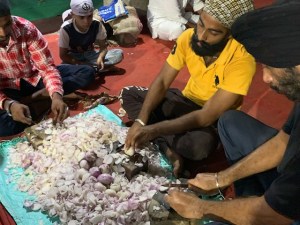
- Other volunteers chop onions. The guy in yellow was super fast. We both thought he must be a chef in his regular job.
-

- After eating and bussing one’s own plate, bowl and spoon, the dirty dishes were banged against the side of a large vat to get the scraps removed and tossed into bins for washing.
-
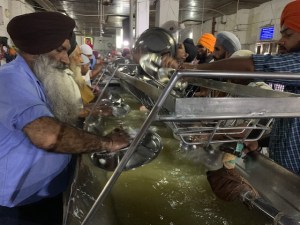
- A line of volunteers cleans, washes and rinses the dishes. The line must have been 50-60 feet long.
-
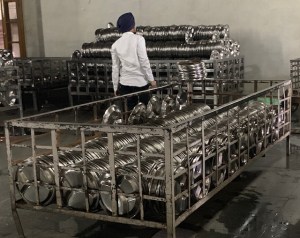
- A couple of carts full of cleaned plates. The one in the back must contain several thousand plates.


By 8pm we had had enough and went back to our hotel for food we hoped we could eat without getting sick. Comfort food was in order. We each had pasta with aglio olio sauce.
 Adventures with Julia
Comments
Good info on the Sikhs