October 1, 2019
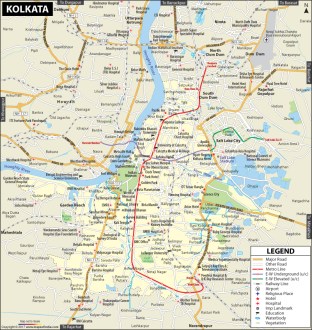
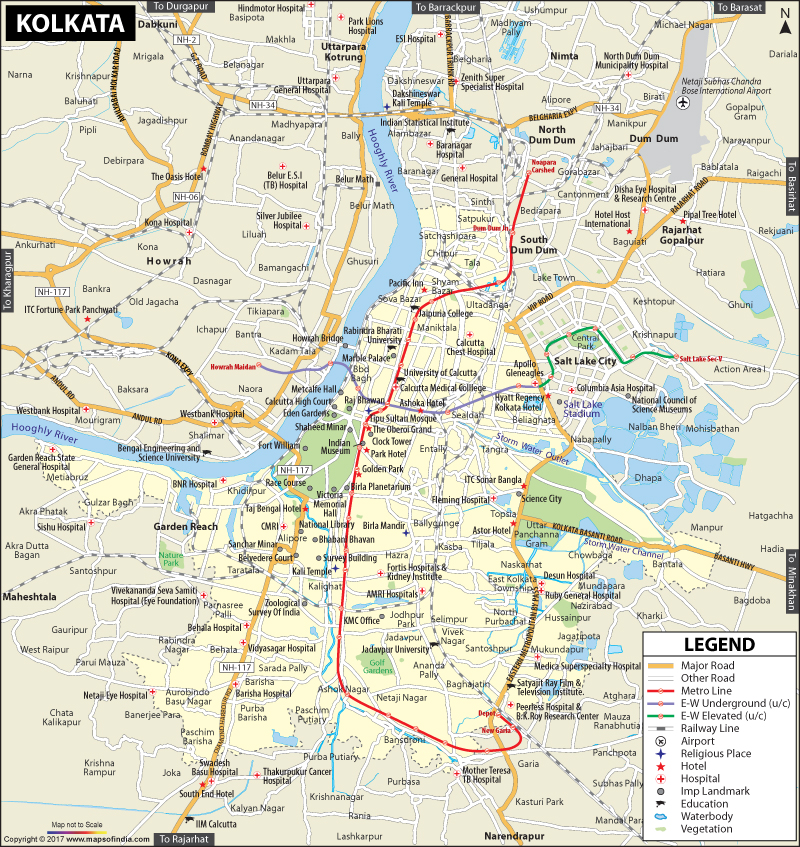
Attached is a map of Kolkata. It is hard to find places on it, especially if they are not marked, but I will try to locate the things I can. Our hotel is the Oberoi Grand and it is on the map near the north east corner of the green park land. In the south end of the park is the Queen Victoria Museum and on the right side of the Howrah Bridge is the Flower Market. The boat ride started and ended at the Chandpal Ghat just south of Metcalfe Hall, which is listed over the water slightly north of the park. The place I most wanted you to know about is not marked in any way, the Missionaries of Charity, Motherhouse and museum. The main building is located just to the right of the “”l” in Park Hotel, which is labeled just below the Oberoi Hotel. The orphanage is located just to the right of that where the A in Entally is named. I hope this has not confused you too much. Now on to the story.
Teaming masses is the description that continually came up for me as we walked and drove around the city for two days. The heat and humidity were very oppressive and the impact was even greater when combined with the mass of people everywhere. Sometimes it felt as though there would not be enough air for everyone as bodies continually rubbed past each other in unwanted but necessary contact. The mind bends to allow the body to accommodate the circumstances. Here are a collection of people we encountered during our time in the city.

A fruit vendor getting ready for the day.

Free city water is available for everyone.

This dish was popular with everyone.

THis man feels the heat.

A street shave in progress.

Trying to stay cool

Looking for work.

A local sculpture. Nice work.

Another man trying to get cool.

Feeding the boy.

A holy umbrella does not help much. Mark gave him a good one and the guy was non-plussed.

Another shave in the works.

This man looks cool.

Hauling some of that free water.

These men are praying.

She wanted money for her photo.

Bathing on the street and drying clothes too.

Cooking local food.

A well =to-d lady getting directions.

A family doing laundry.

Washing in the river.

A whole group of people clearing trash from the beach.

People on the move.
The population in Kolkata is roughly 18 million, not counting the thousands of mangy dogs who roam freely everywhere, packed into a derelict looking, mostly 4-story city with roads built for man-pulled rickshaws and motorcycles that now accommodate thousands of honking vehicles, which pay no attention to lanes and come so close to each other it was amazing the traffic flowed at all. Often we sat for several minutes before being able to move forward a few feet. The good news about such moments was that we looked out the windows and watched people going about their own activities without being noticed. It seemed that life happened on the streets—-people hawking their wares, relieving them selves as needed, cooking, eating, laughing, arguing, lecturing children, fighting, bathing and washing laundry in the street side city taps, drying laundry on public handrails, sleeping, spitting, smoking and chewing tobacco, kissing behind umbrellas, praying at the many different temples, buying flowers for the gods and goddesses and strewing trash, especially plastic, everywhere. You name it, we probably saw it.
Delhi, on the other hand is considerably larger at 21 million, but the streets are wider, the buildings taller and cleaner and the size of the city significantly larger and more spread out. Delhi is more like other major metropolitan cities in the world. Kolkata is in a category by itself.
We had two days only in the city, but felt like we gained a lifetime of understanding. Our first stop was at the Missionaries of Charity, founded by Mother Teresa (1910-1997) in 1951. Now I understand why God sent her to Kolkata. I do not know another place in the world with so much poverty, deprivation, disease, depression and loneliness packed in so tight a space.

The purpose of the Society of the Missionaries of Charity.

The entrance to the Missionaries of Charity Motherhouse.

Mother Teresa founded the Missionaries of Charity in 1950.

One of the sisters greets people as they arrive.

Inside the Motherhouse

The steps leading to Mother Teresa’s cell

Mother Teresa’s cell where she lived and died.

Mother Teresa’s Tomb in the Motherhouse.

The caption on her tomb.

Statue of Mother Teresa with her hand held down in blessing for those who sit under it.

A close up of Mother Teresa’s face.
When we entered the Missionaries of Charity Mother House, we were ushered by a statue of her and into a room where her tomb is located. There were benches for people to sit and pray. Words engraved her tombstone read; “Love one another as I have loved you”. We also saw where the sisters live, as well as her private room. We were allowed to look at the room she lived and died in at the top of a flight of stairs. It was all very simple, as I expected. We also saw sisters going about their daily business in their lovely, but course, white cotton habits with blue trim, that Mother Teresa had designed.
One room contained a museum of her life and that was interesting to read through and see the images from different periods of her life. Nearby we visited one of her orphanages, called Nirmala for “soft heart”. It is also a home for disabled children. The orphanage was being remodeled and those children were not there, so we visited with with nurses and disabled children. Two of them caught my attention and I spent some time talking to them and touching their faces arms and legs. The nurses welcomed whatever attention I could give. One of them had Cerebral Palsey, I think, and the other one had hydrocephalous. It tears your heart out to see children with such diseases. I prayed that God will take them home soon.
One of Mother Teresa’s comments that moved me in this city of multiple religions was, “Some call Him Ishwar, some call Him Allah, some simply God, but we all have to acknowledge that it is He who made us for greater things, to love and be loved. What matters is that we love. We cannot love without prayer, and so whatever religion we are, we must pray…”
With a full heart, we moved on to less emotional activities.
Our next stop, which made me feel very disjointed, was the main Jain Temple in Kolkata. Leena, our Kolkata guide, who was as thoroughly Hindu as I am Catholic, and had not had anything to say when we were with the Missionaries of Charity, suddenly had lots to say about Jainism and Hinduism and no sensitivity or awareness about my feelings. I decided to keep quiet and get with her program. Jainism, which Mark and I had learned about on previous trips to India, preexisted Buddhism by about 1000 years and is one of the most affluent groups of people in India, representing about 2% of the population. They are similar to Jews in that they tend to be the bankers in a community, own businesses and are very entrepreneurial. This particular temple was built by one family using Greek, Hindu and Islamic styles of architecture to honor the 10th Guru, Sheetlanath. There are 24 Gurus, or prophets, in the Jain religion and the 10th was one of the most important. What makes the Temple unusual and stunning is that it is full of glass mosaics, Italian Moreno chandeliers, and gold leaf and is kept in pristine condition with funds from the original owner of the property.

A Kain TEmple honoring the 10th Guru, Sheetlanath

Some of the glad and mirror work on the ceiling of the Jain Temple.

Glass mosaics in the temple.

Another glass mosaic flower in the temple.

Gold work and Greek columns inside the temple.

A portion of the central ceiling in the temple.

Spectacular mirror work inside the Jain temple.
These devotees of Jainism keep the statue of their Guru, Sheetlaneth, spotless and constantly blow incense and sandalwood paste at it. The followers of Jainism preach vegetarianism, meditation, non-attachment (but what about attachment to this very rich temple); non-violence, truthfulness and moral inspiration of life values. Jains, it seems, are generally healthy and well-to-do.

A book seller on the Used Book Street.

Booksellers and Publishers.

THe street entrance to the Indian Coffee House.

Passing power boxes on the way upstairs.

The dining Hall in the Coffee House.

Waiters lined up to get their orders.

We visited a long time in this clean comfortable environment.
From there we headed to lunch at the India Coffee House. We would never have considered the place on our own, but with Leena’s suggestion we agreed to try it. Located on the narrow Used Book Street ,second largest in Asia, it was upstairs, passed a bank of electric power meters, where we entered a large room filled with people sitting around 4 tops, drinking coffee and eating lunch. Turned out to be a fun place for middle class locals to hang out, and the food was good. No one paid any attention to us, except a man sitting at the next table, who asked us lots of questions and wanted a photo of himself with us. He was a local history teacher. While we ate, Leena told us Indians have a passion for sugar cane and that they love sweet things in general, especially in their coffee and after a very spicy, hot meal. As a result of their love of sweets, Indians are dying mostly from heart disease, then diabetes, mouth cancer (from chewing tobacco), diarrhea and cervical cancer. Many men have switched from smoking tobacco to chewing it.
Then we got into a conversation about why India’s time is off 30 minutes from every other country. Ashim explained that Pakistan declared independence on August 14, 1947 at 23:55 and India declared Independence on August 15, 1947 at 00:05. As Pakistan declared independence first, they were given the opportunity to choose the time zone they wanted. So East Pakistan (now Bangladesh) chose 6 hours GMT and West Pakistan chose 5 hours GMT. Even though there was barely 5 minutes difference, India received second choice. As they did not want to have the same time zones as Pakistan, they chose 5.5 hour GMT, or 30 minutes off Pakistan and thus every other country as well. One more example of how divisive the two countries are toward each other.

Queen Victoria Memorial Museum

A young Queen Victoria

This surveying tool, a 24-inch Theodolite, was constructed in 1846 by a mathematical Instrument Maker, Saided Mir Mohsin Hoosain. A fascinating piece of equipment.

A painting of Durga as presented in the Durga Festival, which we saw.

Feast of the Churruck Puja. Mark was fascinated by the gay appearance of the men in this drawing.

A Bunderwallah, an 1832 pen and ink. How can a goat stand on a tiny post? This fascinated Mark too.
Finally, we left the Coffee House and drove to the park to see the Queen Victoria, aka Empress of India (1877-1901) Memorial Hall Museum. It was designed by the British, built between 1906-1921 by the Indians and credited to the British. We were there about an hour and a half and learned, from our Indian guide, Leena, about the rise of the British in India, especially the East India Trading Company and finally the independence of the country and the departure of the British by 1955. It was a very interesting tale as she told it. Being Indian, her story certainly favored the Indians. There were many paintings by British artists, drawings of how Kolkata looked during the years of British rule and far more stories than we could absorb or care about. One interesting bit of trivia I picked up was that the name “Indi” was used by ancient Greeks as their word for part of the sub-continent and Alexander the Great launched a campaign in what today is Pakistan, to conquer the sub-continent, and the world, in 326. He did not succeed in his multiple campaigns and died in 323 BC. Mark remembers it was hot inside the building and there were way too many people. He did like a few odd items, which I have entered here. Onward.
We switched to a pleasant experience. A boat ride on the Hoogly River that passes through the center of the city. We motored up river into a delicious cooling breeze for over an hour looking at various buildings on the shoreline.

Boarding a boat for a cruise on the Hoogly River

A large crematorium in operation as we sailed upriver.

A local ferry boat full of passengers.

One of many ghats along the river

People bathing on the steps of another ghat.

And yet another ghat with people bathing.

A small fishing boat.

Enjoying the ride and the breeze as we motor upriver.

Rama Khishna Mission.
Just at the turn around point we came upon a Rama Khrishna Mission. It was a collection of 4 buildings spread over a large parklike area. A man named Vivekanand (1863-1902) founded the mission, with the purpose of serving the poor. It is amazing how many different religions we have encountered in this country. As we floated back downriver, the sky grew dark and the city lights came up. Kolkata looks much better lit up at night than in the daylight.
October 2, 2019
Our goal for the morning was to visit the Flower market. It was quite a drive north through the heart of the city, so Leena gave us a running commentary as we passed by many buildings. We passed the Assembly Building with a white dome, the Kolkata High Court built in 1872 in Gothic style, the Town Hall built between 1807 and 1814 with Doric columns, the Governor’s House built on 34 acres of parkland.
We saw many other colonial buildings built by the East India Trading Company between 1613 and 1730, including many warehouses. At some point the East India Trading Co (EITC) began collecting taxes with the permission of the reigning moghul emperor. Gradually the emperors became puppets of the EITC. In 1857 the emperor rebelled to get control of India. Crushed by the EITC with the help of the British army, the British called the rebellion mutiny, while the Indians called it their War of Independence. The emperor died in exile in 1862, his sons having been killed in the war. Thus the moghul empire came to an end.
By 1880, all EITC’s had been taken over by the British with a few exceptions, such as Goa being operated by the Portuguese Trading Company until the 1960’s and Pondicherry, which was operated by the French Trading Company until 1954. By 1955, the EITC had left India.

Crowds at the Flower market.

Millions of marigolds for sale for the gods.

A pretty collection os flowers.

This lady is folding leaves for an arrangement.

Not sure what is on her mind.

Hibiscus buds

Cockscomb

Lots of Lotus

These men make smalll arrangements.

A colorful skirt in the market.

The shade helped keep people from overheating.

The flower business is brisk.

Roses and lotus

Special flower wreaths.

Packaging hibiscus.
Finally, we reached the Flower Market and spent an hour or more wandering through the market while coping with claustrophobia and the sweltering heat. Got lots of photos of people and flowers. One special flower Leena identified for me was the cockscomb, a pinkish flower I had seen during our last hour in Pakistan at the Shalimar Gardens.
The rest of the day was spent learning about the Dirga festival and watching the figures for it being created. Everyone is involved in the process. The 10 day Pandal Festival was in its second day. The festival is meant to include 9 days of days of fasting and prayer with the 10th day consisting of a procession of taking the dirge figures to the river and letting the straw and mud dissolve in the water. Durga is the dominant goddess of Hinduism. She is strong and an equal with Shiva. When a good mother is needed, she is that, when a war needs to be fought, she is the fighter. She is most popular in eastern India, especially Bengal. In Kolkata alone there will be over 8,000 shrines to Durga built and displayed during the festival. Shrines can be simple or complicated, small or large, inexpensive or lavish. What is required is the presence of the Durga’s statue, people praying to her 24 hours a day, lights and loud music the entire time. She is made from bamboo, grasses, mud, paint, fabric and jewelry. She must have multiple arms that represent strength and power. More arms, more power. There must be a lion, which she rides, and a demon, which she kills. There is always a snake that bites the demon and a water buffalo, who dies with the demon. When a team of people can afford a more lavish structure, she will be surrounded by her 2 daughters and her 2 sons. Each of them is also represented by an animal. One of her sons is Ganash, the elephant god we have seen in other parts of India.

The statues start out as stray figures.

Then they become mud statues .

Some of the statues are very intricately carved.

Then they are painted.

Here is a room full of partially finished statues.

Another naked Durga.

The sculpture is finished and waiting to be transported.

A sculpture is being moved to a vehicle.

Ganesh is ready to go.

Kali is another version of Durga . This was the only statue I saw of her.

Carrying a figure to be transported.

It took several men to drag this scene to a waiting vehicle.

Out to the street they go.

Loading the figures onto a truck.

Getting the figures into position

A small version of the Durga story.

A complete scene with all the characters.
I describe all this, because the city was completely into this festival and we could not get away from the intense energy and building crowds. In the afternoon we visited streets where the Durga statues were being fabricated. Many were in various stages of completion. Several were finished and waiting to be transported to their designated location. Out in the streets, we encountered many being transported, precariously, by a team of people keeping them from falling over. Later in the afternoon, we walked by a few that were finished, but not yet open. Here are the settings we saw in the afternoon when things were quiet.

Another Pandal installed in front of other buildings.

The Durga scene inside the temporary pandal.

A pandal ready to open.

Durga inside the ship construction.

Another Pandal

A lavender Durga Scene

Lotus flower pandal opening to the Durga. I liked this simple one better than most.

Durga set inside the Lotus.

My favorite Durga pandal. The place was not yet open, but we managed to get by the guard anyway.

After passing around the gate, we walked a long gold sculpted and painted hallway. Very impressive.

A scene along the hallway.
In the evening, Mark having bailed out, Ashim and I went together to see some of the bigger displays in operation. The crowds were unbelievable and Ashim and I had to link arms to not loose each other. We were able to see 3-4 different Durga displays before we quit. We could not get even close to the largest one that I wanted to see. The intensity, proximity, noise and difficulty to even move became too much for me and we finally fought our way to the edge of the crowd, where we met up with our car and returned to the hotel.

The walk to our last Durga was like being in Disneyland

Another animal lit up
I asked to walk the last block to the hotel see what was going on there. In the morning it is very quiet and all the vendors’ goods are packaged up. At night the vendors and shoppers are crazy with frenzied purchases.
The hotel was, thankfully, peaceful and quiet. I could not imagine the festival getting any bigger than we experienced it, but Ashim assured me it would get even more intense as the days passed.
October 3, 2019
Another travel day. At 2:30 we were up. Ashim met us at 3am and we headed for the airport. The Durga Festival was only slightly less crazy than the evening before. Having planned extra time because of it, we were in good shape. The three of us departed Kolkata for Delhi at 5:45am. During the flight I asked Ashim a parting question. What would he say about India and its people in general. His comments came easily and quickly. India, he said, is a country of contradictions. Indians are patient and tolerant of the lack of infrastructure, of poverty, of traffic, of masses of people. On the other hand, they honk constantly at other vehicles, motorcycles and pedestrians and have no patience for queues, cutting in front of the line without apology. He went on to add that he is grateful that education became a requirement in 2012 and that Modi is finally talking about population control in parliament. The middle class is now about 25% of the population and growing. As more people become educated, and if the population begins to shrink, the country will be better off. His last comment was “If Indians take a good direction, there will be much improvement in the next 10 years.”
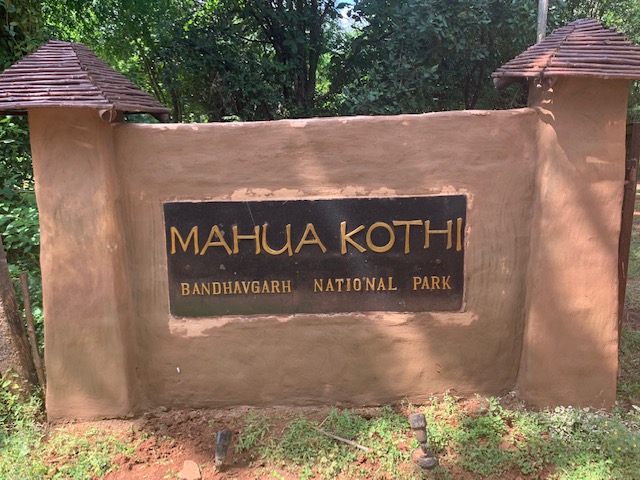
We parted company in Delhi and Mark and I caught a flight to Jabalpur, where we were picked and driven 3.5 hours to Mahua Kothi Resort near the Bandhavgarh National Park. The whole transfer had taken 12 hours. Our accommodations were …well, different. We had our own house complete with a large outdoor patio, full bath, king bed and sitting area. The whole building was made of bamboo, mud plaster and woven mats laid over over a wood beam ceiling. The floor was covered with tile and woven mats. A dirt pathway lead between the houses and public areas. It was quite charming and comfortable, even if a little rustic. We were served a lovely dinner on the open air roof of the restaurant building and went directly to bed.


 Adventures with Julia