
October 4, 2019
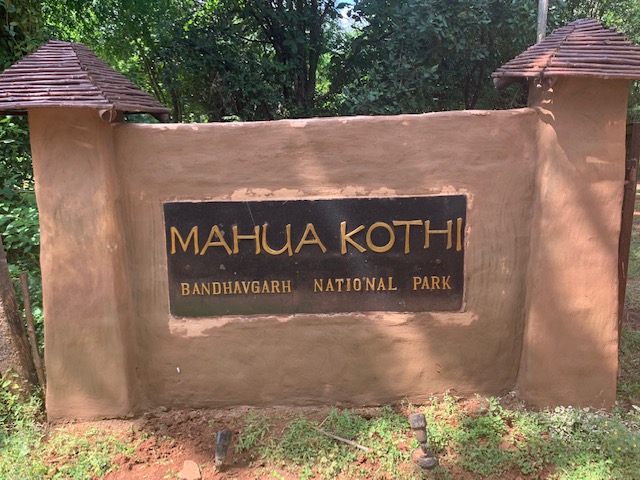
The entrance gate to our Bandhavgarh Resort
Mark’s opened our comments for this part of our adventure: “Our wake up was at 4:30 in order to drive away from camp by 5:15. We have a park permit that allowed us entry at 5:45, 15 minutes before the other cars are allowed in at 6am. We arrive around 5:35 and drive to the front of the line of cars, just in time for our driver/guide to fill out the required paperwork. Our park spotter has joined us and we are off on our epic tiger hunting adventure.”
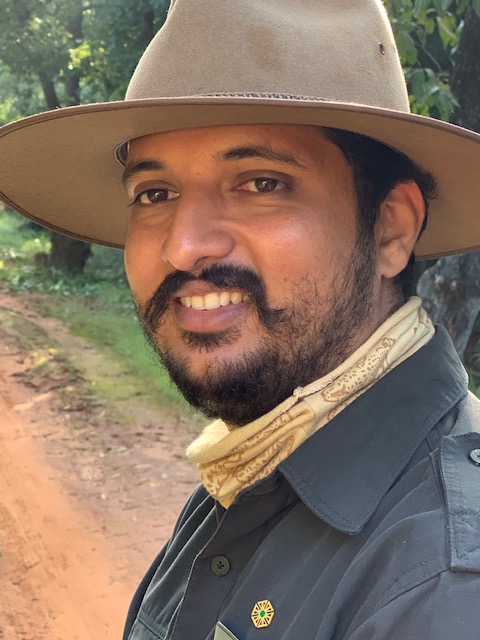
Harsh, our driver/guide in Bandhavgarh National park
Our driver/guide was a tall, good looking man named Harsh, which means Happy in Hindi. The previous evening, he gave us an orientation about the park and what to expect. The core of the park is 700 square km and the buffer zone that surrounds the park is 820 square km. However, only 175 square km are open to the public. We are confined to 25% of the park. There are 60 adult tigers living in the park along with about 40 cubs.
Because of our special permit, the park is open to us from 5:45 and we can go on any roads in the 25%. All other vehicles must wait until 6am to get into the park and are assigned specific roads they can travel. We had paid dearly for this permit and were glad to have a chance to see tigers before a crowd appeared. Today, only 20 vehicles are allowed into the park each day. The last time we were here, 2011, there was no limit on the number of vehicles and we remembered never seeing a tiger because we could not get through the crowd.
I hated the early rise, but was glad when we actually spotted our first tiger on the first morning. We were alone with the adult male when he stepped out of the undergrowth and onto the road. He was glorious to us, having traveled so far to see him. And on our first game drive at that. Harsh, our driver/guide had heard the warning calls of the monkeys and stopped our vehicle where he thought the tiger might be. He was right on. Casually, the tiger walked out of the undergrowth and by a tree, stopped and slowly marked it. Then he proceeded across the road and pooped in the grass. Having finished his business, he walked into the brush and out of sight. Other vehicles joined us, but we had the best view point.
Harsh thought the tiger would walk through the forest to the road on the other side of the woods, so we headed there, followed by a number of other vehicles. Sure enough, we heard the warning calls again and the same tiger emerged where Harsh expected. He did not hang around this time, but walked directly across the road again and out of sight. My fear of not seeing a tiger on this trip evaporated. We were both happy campers. With several more game drives ahead, we relaxed and enjoyed the rest of what the park had to offer.
We saw many Rhesus/Macaque and Gray Langur monkeys. Rhesus are tan with fat faces and short tails; used in lab experiments and not very good looking. Langur monkeys are whitish with black faces and very long tails and much more appealing to watch.
There were also many herds of spotted deer, who were very skittish and shy and hard to photograph. Otherwise there was the occasional wild boar, water buffalo, Golden Jaeckel, Ruddy mongooses, an Indian Muntjac barking deer, and an Indian elephant with its mahout. Lots and lots of peacocks. They have all lost their tail feathers due to the monsoon rains, which just ended. Gradually new feathers will grow back. Some of the birds we got a good look at included: Serpent Eagles, Indian Rollers, White-throated Kingfishers and a Crested Hawk Eagle.
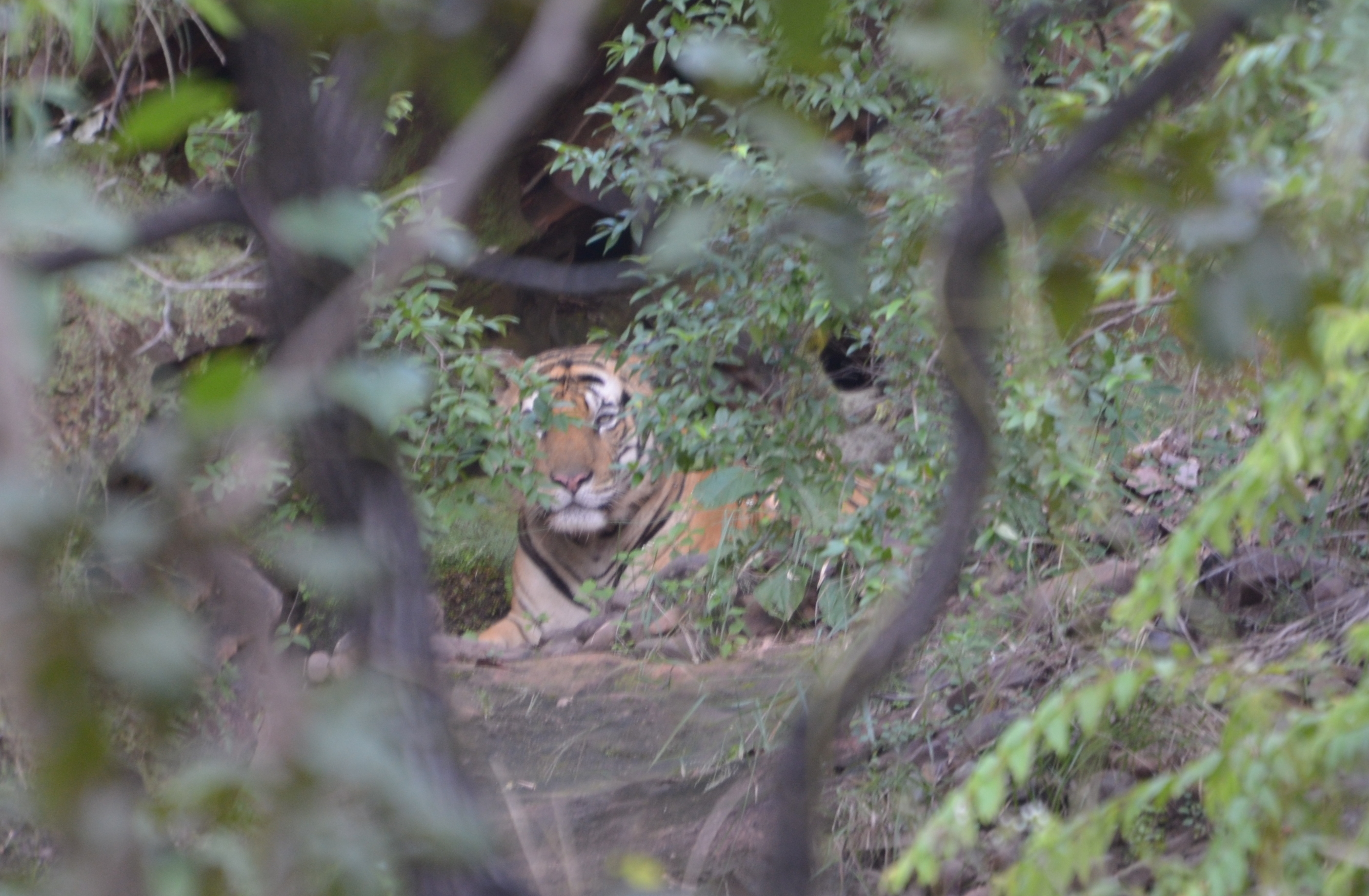
This image does not do the view I had justice. But it was the only shot we got.
On our afternoon game drive, which started at 2pm and went until 6, we were lucky enough to spot another tiger. This time we were all alone with him for over half an hour, as the other vehicle are not allowed into the park until 3pm. He was laying down in the shade in a small water course. Our spotter, Manjeet, saw him first. We would not have seen him at all, due to the dense foliage. As it was we had a full view of his face for some of the time and he starred directly at us for quite awhile. I was thrilled. Eventually other cars arrived and gradually the tiger pulled back and out of view. We finally drove way and left the other vehicles to try to find him, but he had melted into the forest.
That evening we were served dinner under a huge, old Mauha Kothi tree, for which the resort named. It was a pleasant setting. So far, the weather has been pleasant in the morning and evening and hot and sticky in the sun in the middle of the day. The game drives were ok as long as we parked in the shade or were moving. Our house/bungalow was causing us some problems as we could not get the hot water to work and the AC was intermittent. The camp was nearly full, so we decided to manage. The staff was very attentive in helping us solve our problem. We moved accommodations after two days. The second bungalow was identical, but further away from the main lodge building.
October 5, 2019
Getting to and from our lodging and the park was like running a gauntlet. In the morning cows and dogs lounged all over the road as the surface was warm.
In the afternoon, children play in the road and adults carry bundles on their heads as walking is easier on the paved surface. There are no sidewalks anywhere in India that we have seen, except in the big cities. All vehicle drivers, including ours, honk their horns incessantly to make an opening for themselves. After awhile, one becomes immune to the honking and it is not as effective as it would be if drivers were more judicious about it. Harsh told us the driving age is 18, but there is no test and people ignore the law. Kids drive as soon as they can. Some looked to be in their young teens. Cows are no longer allowed in the large cities, thankfully, but there are no animal laws for the countryside or villages.
Back in the park at 5:45am, Harsh and Manjeet told us more, as we drove along, about the tigers we had seen the day before. The first tiger we saw twice in the morning was named Bamera’s Son. He was born in 2011 and is in his prime. The tiger we saw in the afternoon was named Mahaman and was born in 2012. All the tigers have been named and dated as to their birth and death, when known.
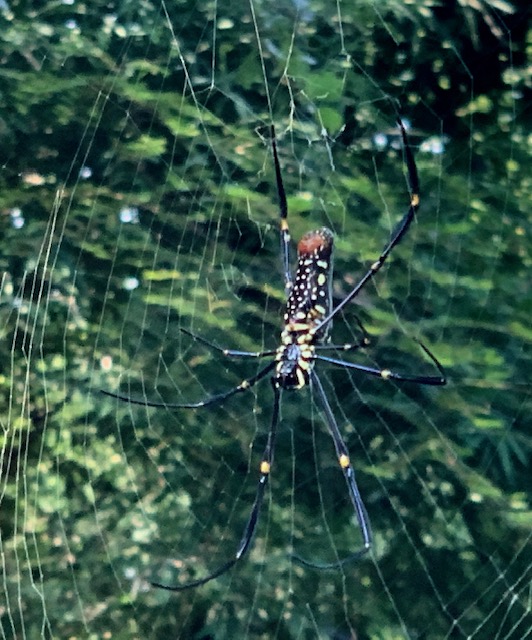
A large spider in its web. I could get close enough with the iPhone. Something to do while waiting for tigers to appear.
I began to notice the forest more, now that we have seen a couple of tigers, and learned that many small trees are satinwood, which have acacia-like leaves and grow to about 30 feet. There are millions of bamboo trees that block out much of our view of animals, and Sal trees, which are tall and dominate the park. There are also ebony and crocodile bark trees, which are less frequent. As this is the end of the monsoon season, the forest is still very green and dense. In the summer months, the bamboo and grasses brown out and viewing is much improved. However, the temperature becomes exceedingly hot, humid and unbearable. As you look at the various photos, notice the vegetation. There are open meadows as well as forested areas.
-

- The tiger walks through the water course.
-
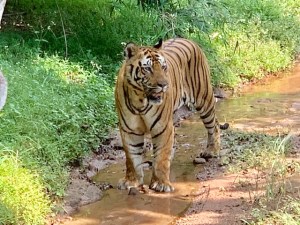
- Step 2
-
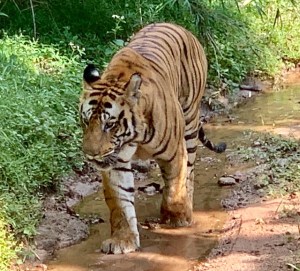
- Step 3
-
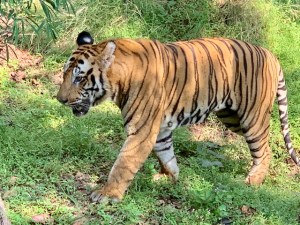
- Step 4
-
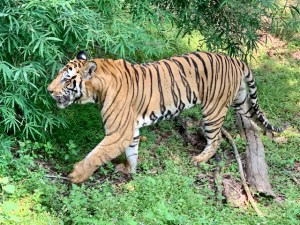
- Step 5
Shortly after our breakfast break, which we took at a required group location with other vehicles, we departed ahead of the other vehicles planning to quit and go home. However, almost immediately, we came upon a tiger just getting up from a water hole. We had a wonderful view of him, with no other vehicles, for several minutes as he ambled around near our vehicle and finally walked up the road and into the bush. This was our best sighting yet and our third in three game drives. Here is a selection of shots in order. It is the best I could do with my i-phone and no video. Such good luck for us. We headed back to camp to enjoy the resort before going out again in the late afternoon. On the way, we saw more of the same animals and birds as the day before.
After lunch we went swimming in the resort’s pleasant pool and chatted with other Indian guests. Aside from a German couple and several Indian families, we were the only foreigners.
That afternoon’s game drive was our only bust. Harsh shared with us that the park came into existence in 1968 when the government took the property from the Maharaja, whose family had used it at their private game reserve for centuries. In 1994, the park became a tiger reserve. No animals have been imported except bison, which are in a part of the park off limits to tourists.
We tried very hard to get good photos of spotted deer, but were not very successful. Mark’s long camera lens had broken after our first game drive and my i-phone was virtually useless for anything more than a few feet away. The spotted deer are know as Chital in India. It is a Sanskrit word from which the name Cheetah is also derived.
Harsh gave us his opinion about Modi. He thinks he is too pro Hindi in his approach to governance. He prefers that the country remain secular and accommodate all religions. He is also not happy to have his tax money paying for the Indian army to be fighting an unnecessary war in Kashmir. He thinks Kashmir-Jammu should new divided between Pakistan and India, fighting should stop and peace should reign. Here Here!!!!
Dinner that night was under another tree deep into the woods. Every meal has been good. The chef is very attentive in finding out our preferences in food and serving what we request. And why he prepares is quite good.
October 6, 2019
At 8am we were at a tiger cub sighting. Three 1 1/5 year old cubs had been seen in this spot the day before so we arrived ahead of the pack and waited. We finally saw two of them asleep under dense bamboo. They were very hard to see, unfortunately. We sat with them a couple of hours waiting for them to move.
Gave up and went to a nearby designated breakfast location. Ate quickly and returned to the cub sighting. While gone, the cubs had move a few hundred feet and parked under more bamboo. All the other vehicles had moved off for their breakfast and we were able to get into a reasonable position about 45 feet from one of the cubs, who was sound asleep. We watched him for about three hours, how patient is that?
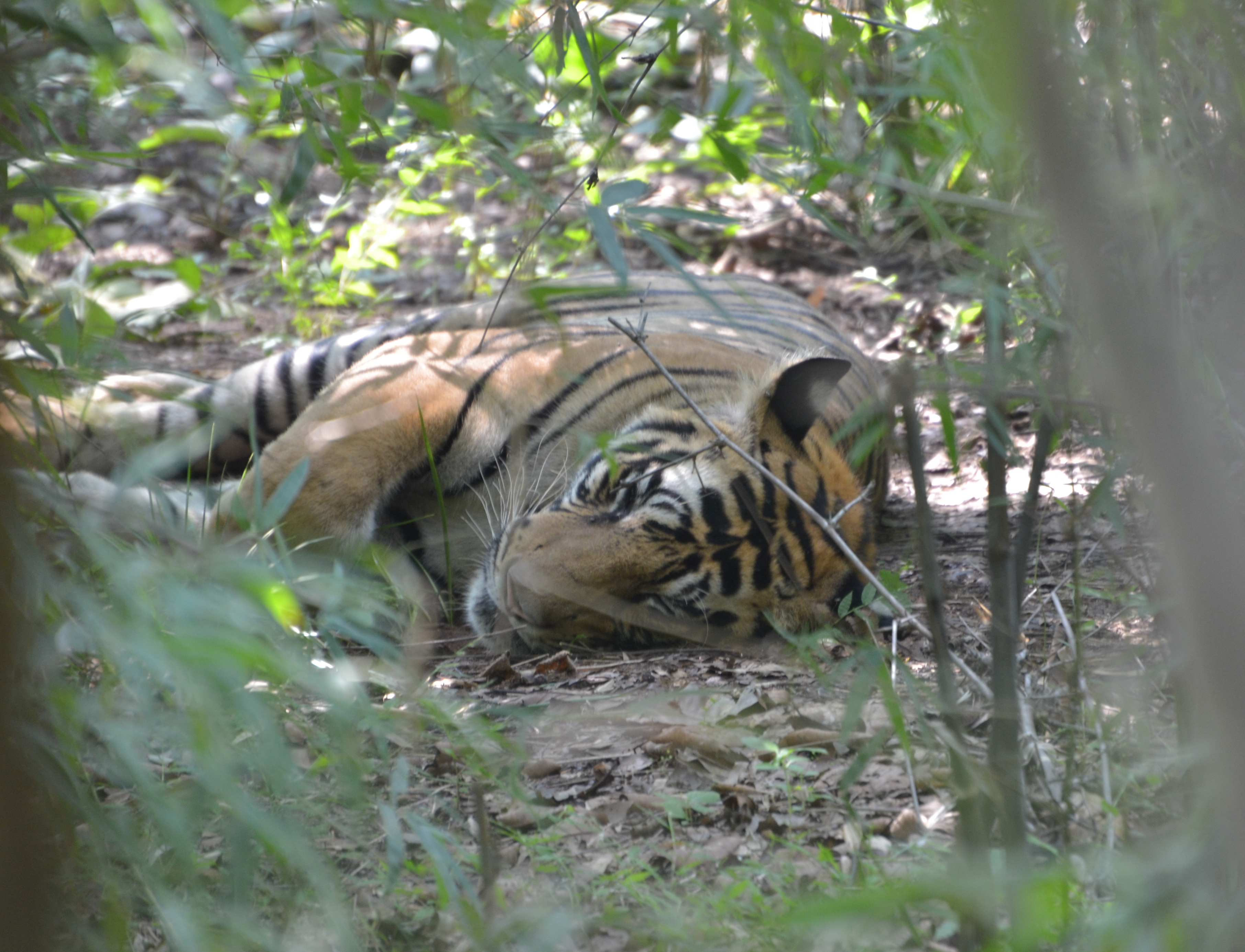
This is what Harsh was able to get with his camera. It is about what I saw with my binoculars.
With the binoculars, I saw him twitch his tail, wriggle his ears, lift his head and swat bugs, but never get up. Finally, we gave up at 1:30 and drove back to camp. Along the way we spotted a Grey Hornbill in a tree and a Sambar deer, partially hidden behind a tree.
We did not go back in the afternoon. Dinner was at the swimming pool that evening. Fun to change locations each evening.
October 7, 2019
Departure day. We do not have the special permit, but Mark decided to go out anyway, while I decided to work on the blog. Mark made the correct choice. He had the best sighting of the week.
And got some really nice images as the tiger was close to the vehicle. So, like you, I could only look at the photos. Shortly after the sighting Mark returned about 10:30, we had lunch, packed up and departed at 1:30 for the Jabalpur airport. Using Mark’s count, he had seen a tiger 5 out of 6 game drives. That was an excellent ratio, considering we had experienced 0 for 4 in 2011 and other complained about not seeing any either.
A surprising image Mark took that I had not even known existed was of this 35 foot sandstone carving of Lord Vishnu reclining on the seven-hooded serpent Sheshnaag. It was made from a single piece of stone in the 10th century AD and is a classic example of the unique monuments of Bandhavgarh, a for that existed many centuries before there was a park.
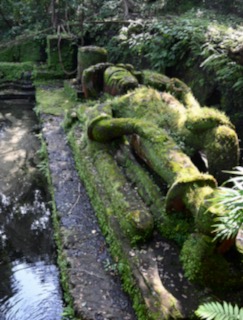
A sandstone carving of Lord Vishnu resting on a serpent. Part of the ancient fort that belonged to a maharaja of long ago.
The 3 hour drive to the airport was uneventful, if you don’t count the cows, kids and people we encountered on the road and the two villages markets we drove through. Only stopped to catch one last Durga Puja in a small village. Otherwise, I would have loved to walk through the two markets we passed, if there had been time. They were both feasts for the eyes.
At the airport, a mother sat next to us to feed her 3 month old baby. She asked me to help her open the formula, so I asked her about bottle vs breast feeding. She said most Indian mothers breast feet for the first year. She had to stop after 45 days because she has a full time job in Dubai. She and her husband were flying back to work there, after having spent some time with their families in Jabalpur.
The flight to Kolkata was only a couple of hours and after a short drive we were at our airport accommodations, Swissotel, and in bed by 10:30.
October 8, 2019
We have the whole day at the Swissotel. We work on our last post—my writing and Mark’s photos and go for a walk in the neighborhood shopping mall. It is the final day of the Durga Puja—the day the statues are carried to the river and ceremoniously drowned in the water, hopefully to melt there and float away. Unfortunately, there is too much paint, fabric and jewelry for everything to melt. The river must be a mess.
Went for a walk around the block and, of course, ran into a cow, almost literally. Nice way to end our trip. We are homeward bound. Tonight we fly from Kolkata to Singapore and then on to SFO. Closing thoughts will come when I can put them together. It has been an incredible experience. One we will not soon forget.
Many blessings to all of our followers,
Julia and Mark
 Adventures with Julia