Twenty years ago Julia and I set out on an adventure to explore and meet the tribes of southern Ethiopia. We had been in northern Ethiopia in 2004 to visit the stone hewn churches of the orthodox Christian’s.
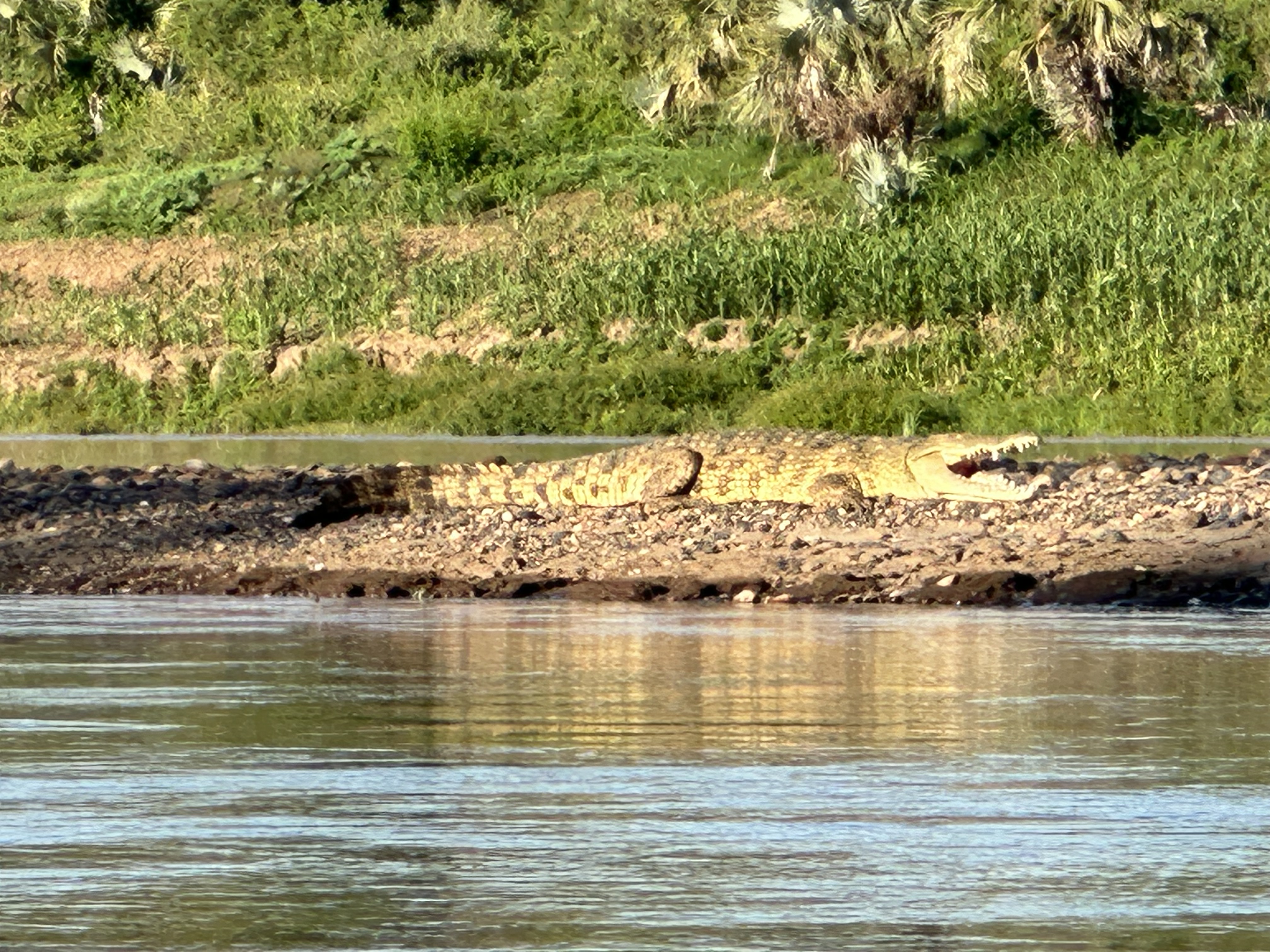
We set out from Addis Ababa with a driver-guide, Atnafu, and cook, Mustafa, in a Toyota SUV packed with camping gear on our journey to Lake Turkana on the border with Kenya. There are not many “camp grounds” in Ethiopia but Atnafu had a plan. We would drive until we found a suitable site and set up camp. We were quite a site and you can imagine we always grew a crowd of onlookers. To say it was hot and dirty would be an understatement but we always found a way to get a shower at the end of the day. We saw a few animals along the way: giraffes, Cape buffalo and the largest crocodiles we have ever seen to this day. We met people from tribes we were searching for including: Hamer and Mursi tribe members.
All in all that part of trip was quite an adventure and the plan was for us to rendezvous with our Kenyan guide at lake Turkana and continue our journey up the Omo river to the stronghold of where these tribes live.
Eventually our Kenyan guide, Halowyn, arrived in two boats for our journey up the river, one boat full of gear, a second for us explorers. After an unimaginable lunch of fresh greens in a salad and wonderful charcuterie, we headed for the mouth of the river. As we reached the area of a sandbar we had to cross to enter the river, it was sadly evident there was not enough water to float our boats. We were in the water up to our knees but were unsuccessful in getting the boats to move over the sand. With crocs in the water our pushing efforts did not last long. Our plans to explore the Omo River delta were dashed. We did go on to have an enjoyable time with Halowyn, exploring other places and tribes around the lake.
So now we sit on the shore of the Omo just above the delta where we were stuck 20 years ago.
This year we started about midway down the river and spend time in a camp near the Mursi tribe. On we traveled down the hersey brown river in the very same boat as 20 years ago to a second camp to visit the Hamer and Kara tribes and we finish our travels with the Dasenach tribe in the river delta just above where we had been stuck.
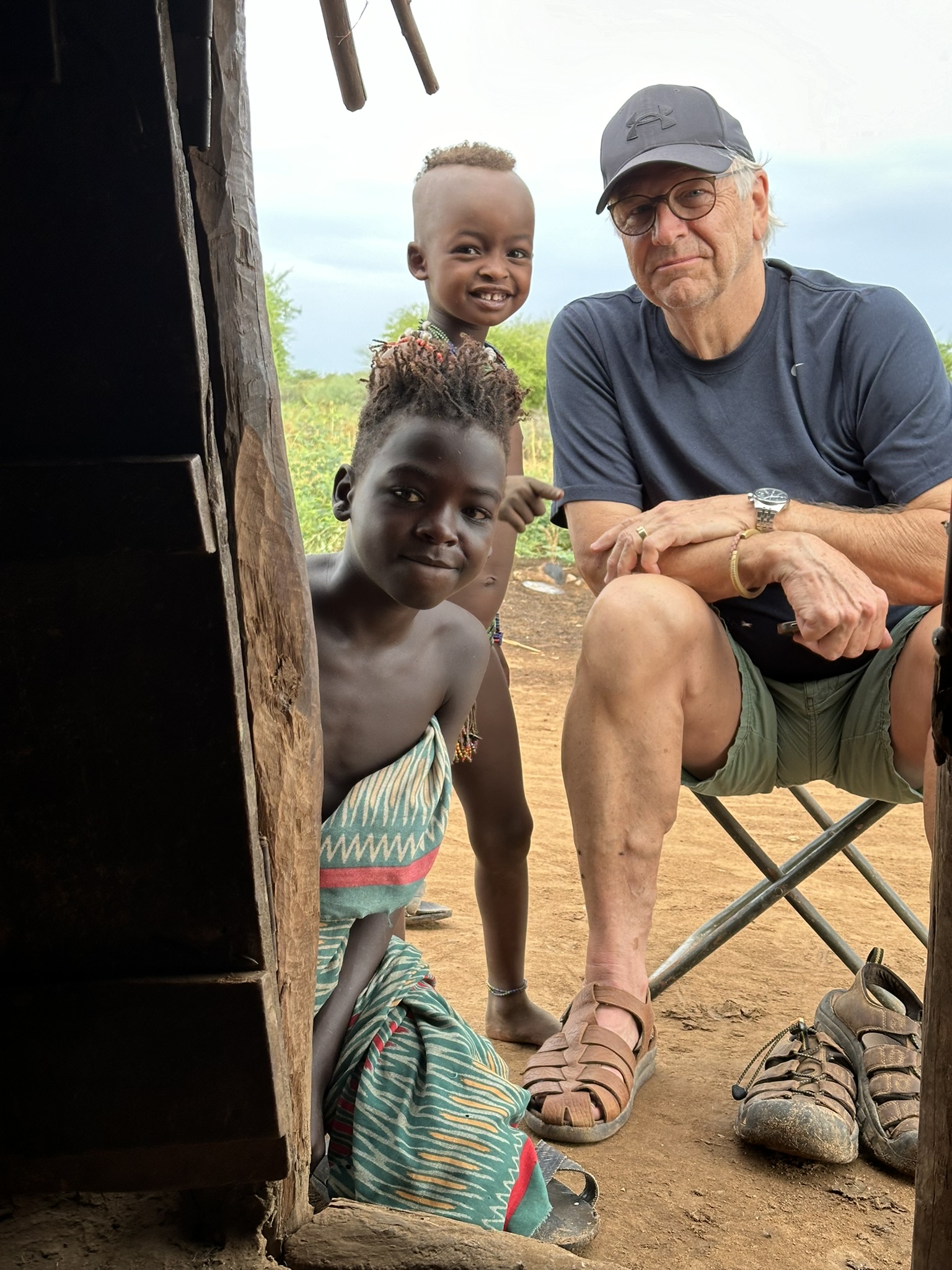
After 20 years there seems to be little progress in the lives of these tribes. There is a random cell phone in a few guys hands and a solar panel near the odd hut. They are guardedly friendly and curious towards us as we stroll through the village. Last night we were in a remote village that may see no more than a handful of outsiders a year. The reception was slightly guarded at first but gradually the people warmed to us.
So after 20 years we close the chapter on our Omo adventure having come full circle. I don’t imagine we will ever be back in this area but we leave having met wonderful people just trying to survive with their families. Lovely people although our worlds could not be further apart.
We started this trip at the Bwindi Community Hospital for the ground breaking of a new clinic, an effort to improve the sight and dental condition of those in Bwindi, Uganda. Next we went to Queen Elizabeth park to see some animals and left with the hope of putting a tracking collar on a lion to better understand the lions habits and travels. Next stop was the DRC and saw the conservation efforts of African Parks as they fight to defend the animals and nature from marauding poachers. We have been exceeding priviledged with opportunities in travel.
I guess Julia and I are lucky to have found each other with both of us enjoying to travel to what seems to be the end of the world. The heat and dirt and bugs don’t seem to be a deterrent, although challenging at times. We don’t know what’s next but remember this thought I have picked up somewhere.
“Travel is the only purchase you make that makes you richer”
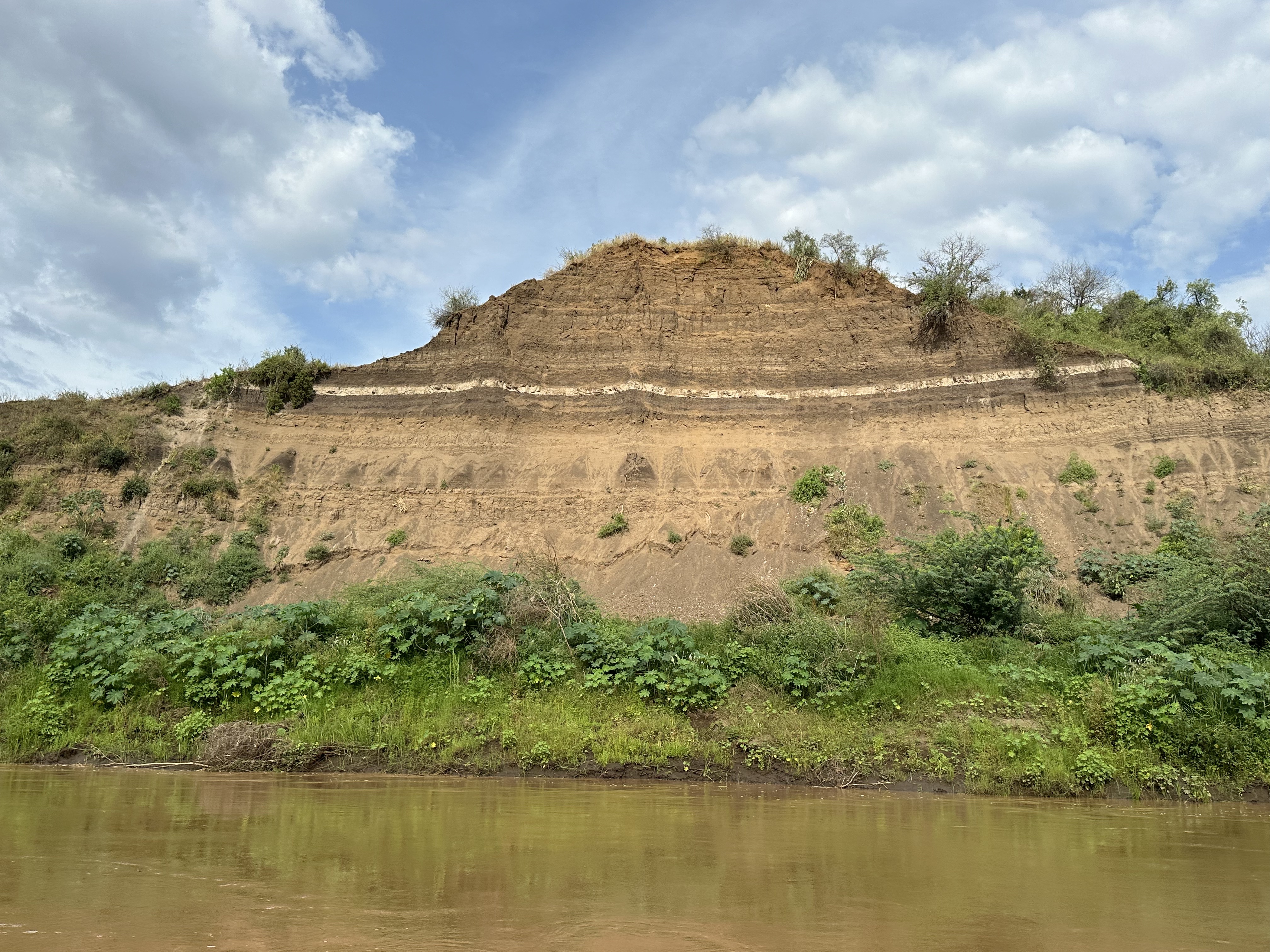
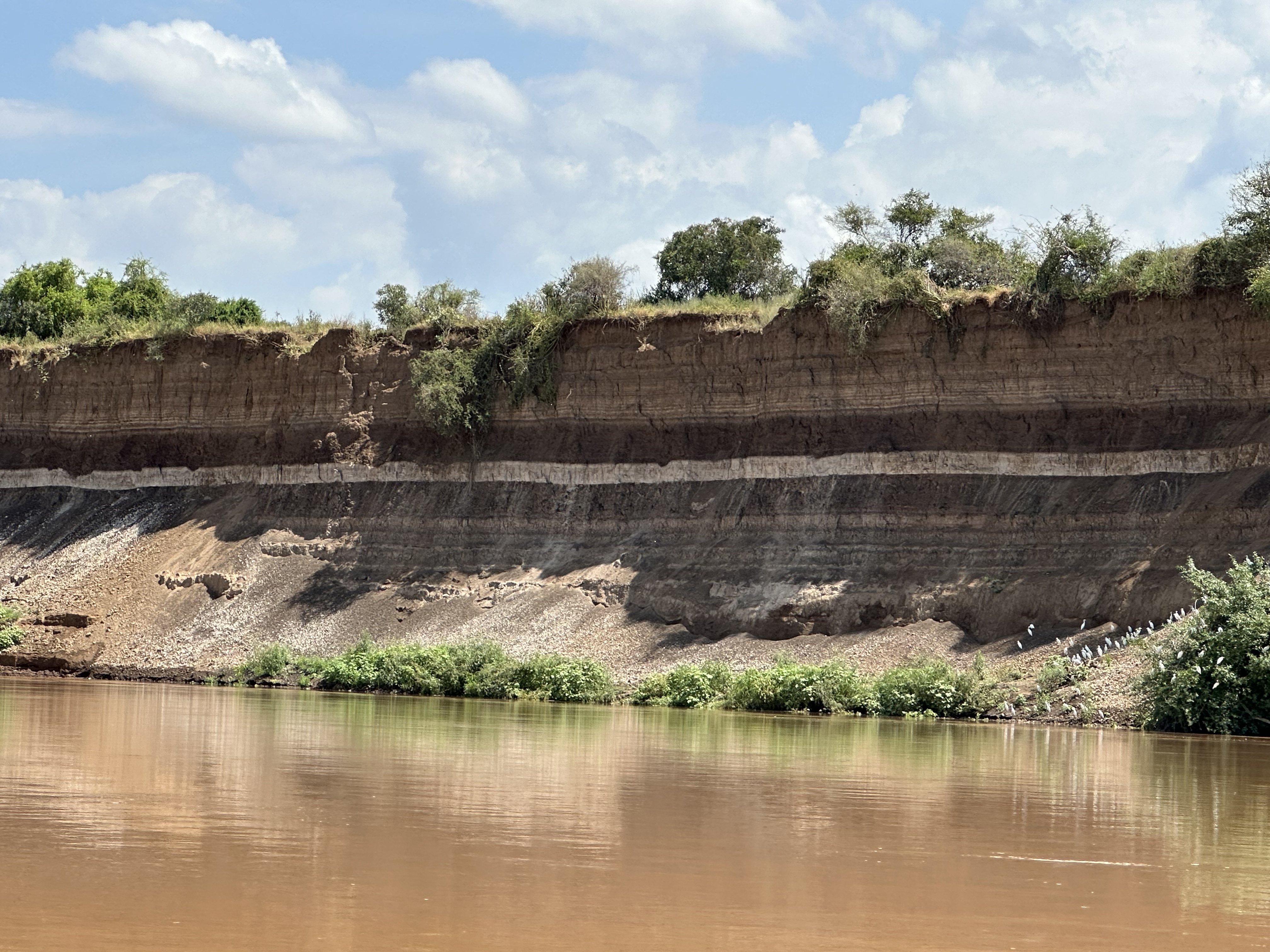
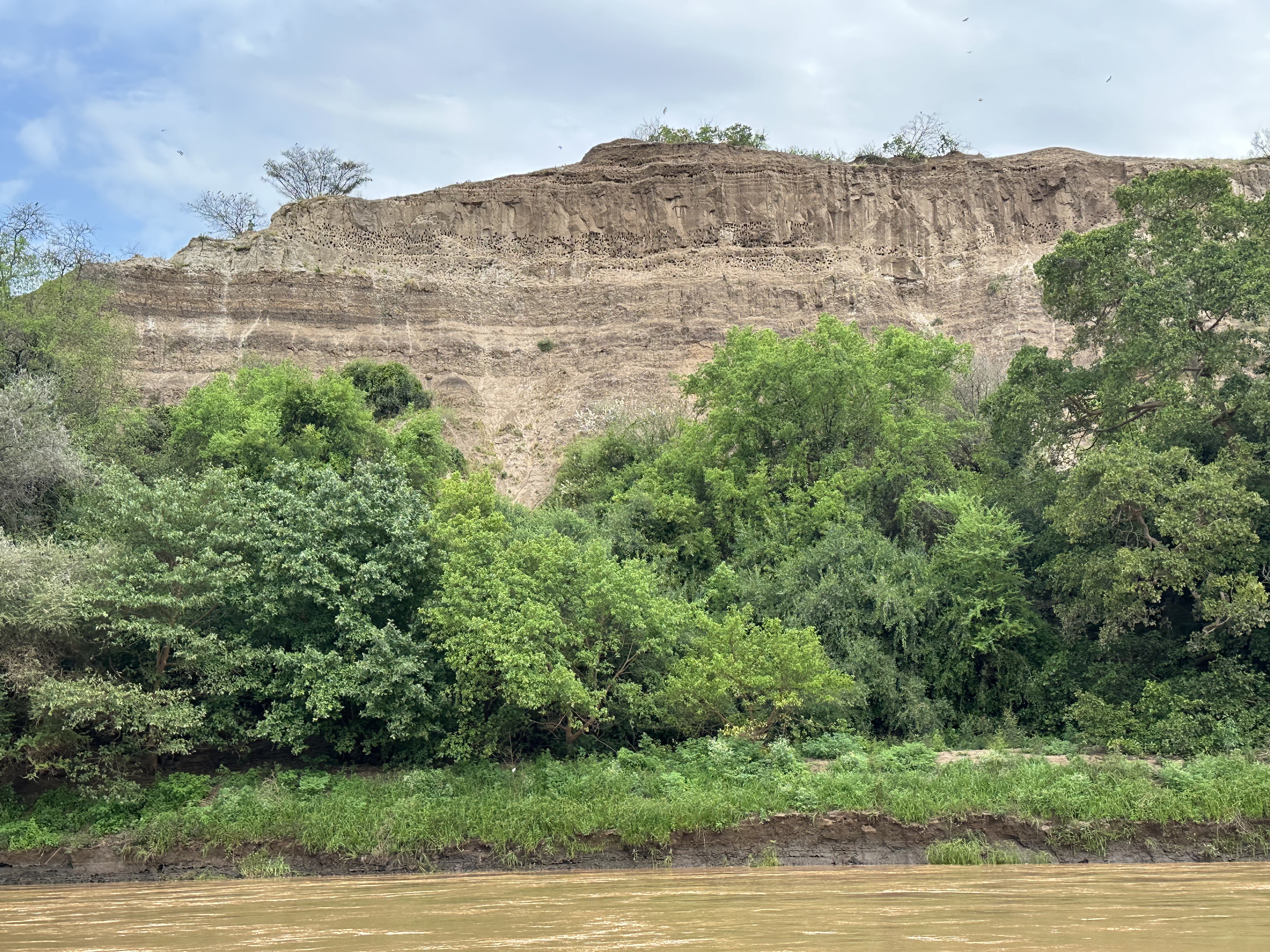
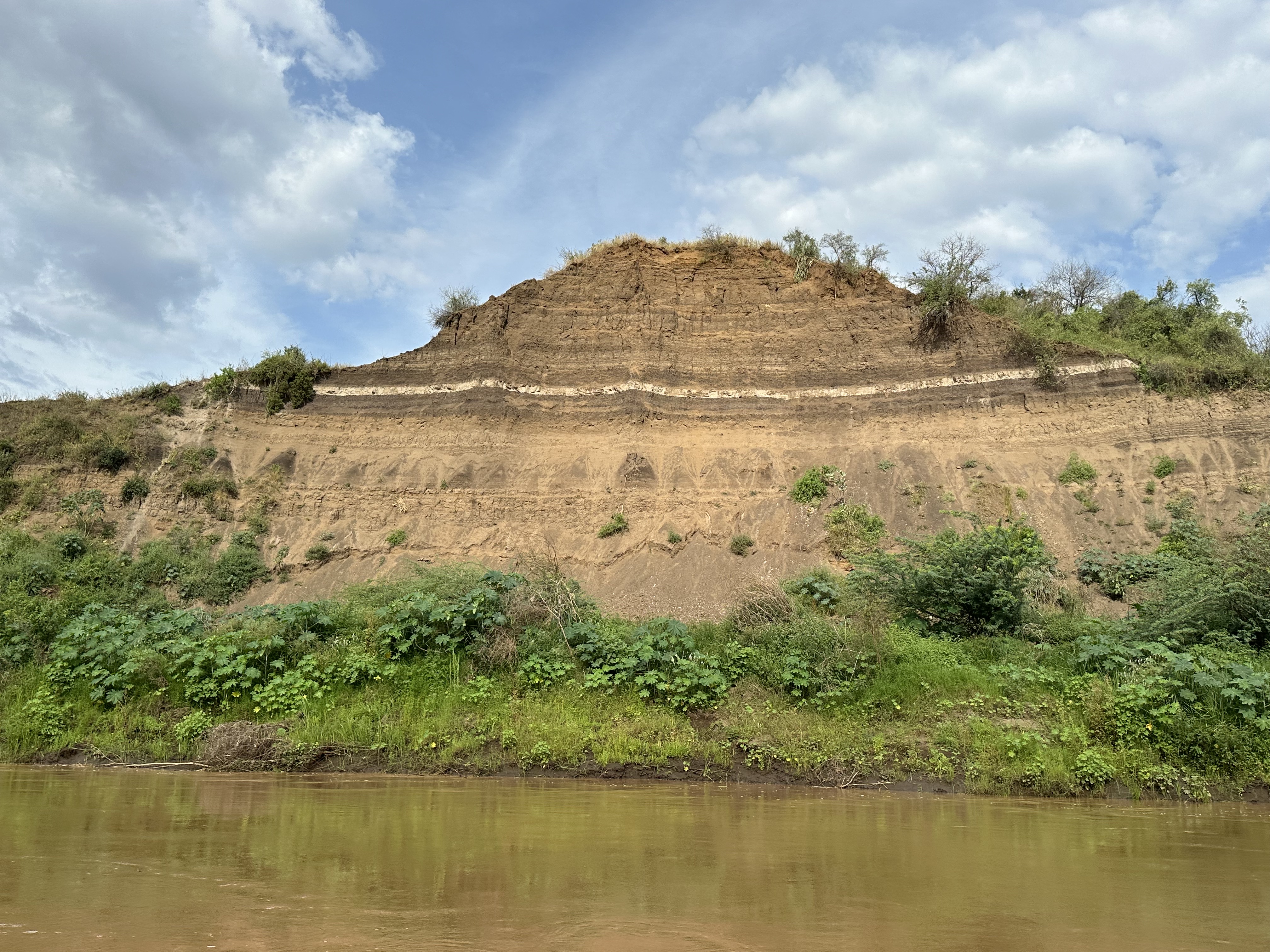
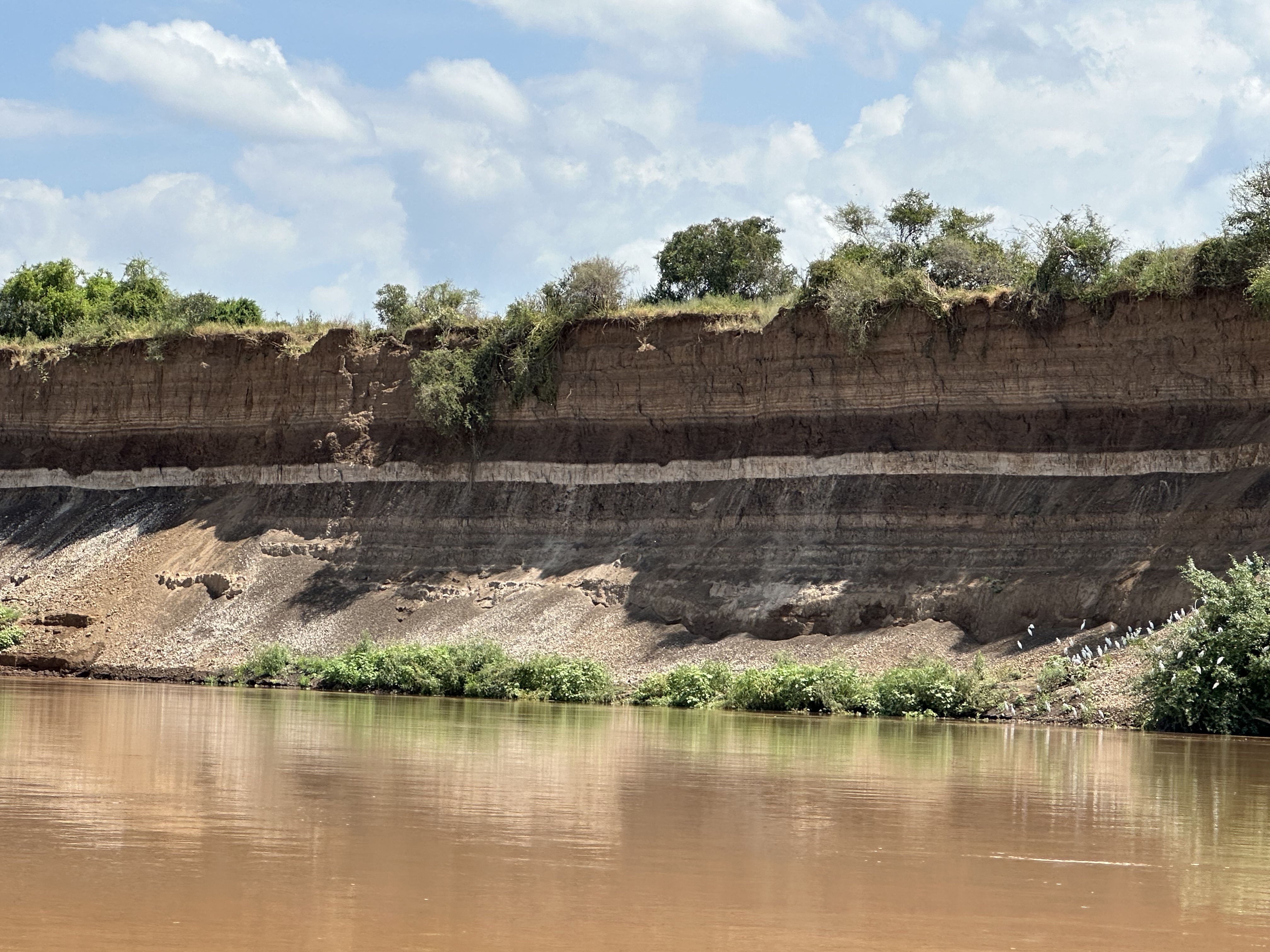
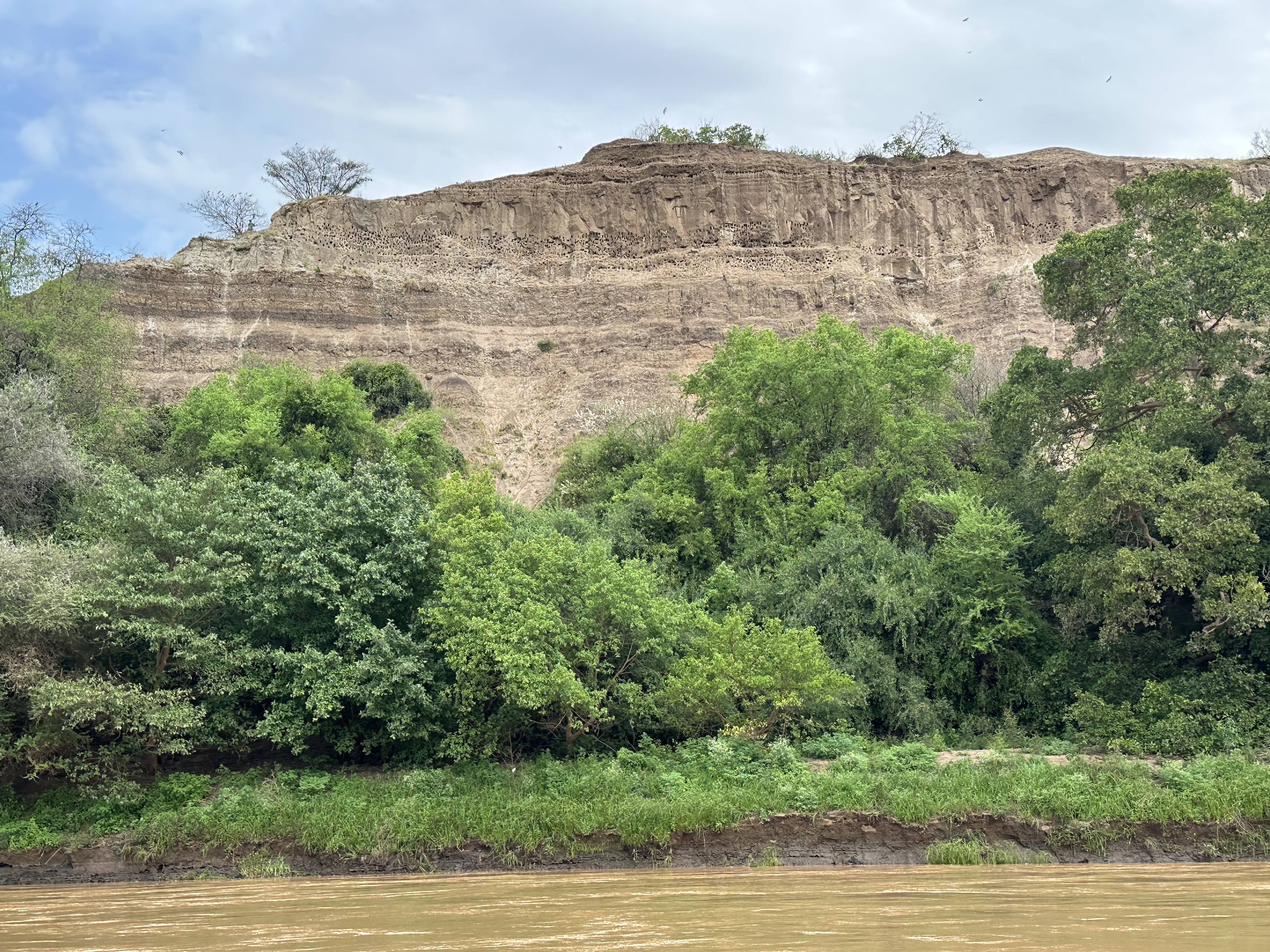
Breakfast and goodbyes to the Chen Camp staff at 8:30. Gave a special hug to Bardoley. Then we motored down river for an hour to the takeout where our cars were parked. So, we were off the boat and into cars for the next leg. Another bumpy dirt road followed by the paved highway for 1.5 hours to another 40-minute river trip, all to avoid an 8-hour serpentine river ride. Our boat was larger, and the next leg was pleasant. We saw a Sykes’ monkey in a tree and many bee eaters starting to build nests in the hillsides above the river. I was fascinated by the different striation in the cliffsides and wondered how old the hills were. Will thought they were at least 300 thousand years old.
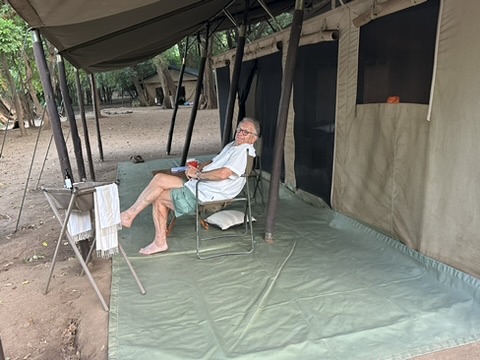
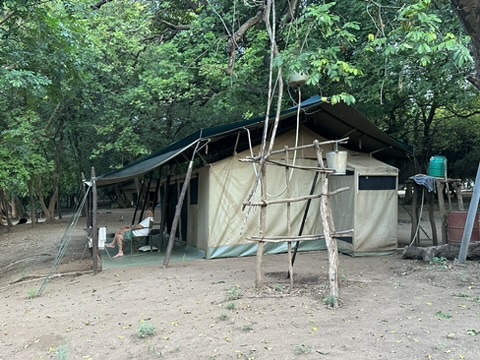
ash layer was quite deep and must have represented a long volcanic period. At last, we arrived at our second camp, Lale, where the Kara people live. The camp is on a bluff above the river and offers some shade and cooling. As expected, we are the only guests in camp. Our tent is on the edge of the bluff. We were greeted by vervet monkeys and found the tent slightly larger and nicer than the Chen Camp. We settled in quickly. Behind the camp is Korcho, the local Kara village where most of the camp employees live.
About 5:15 we began what was supposed to be a 1 hour walk that lasted 2 hours and found us trekking across logs and stumps in near darkness to get back to camp. I clung to Mark’s hand to keep from falling. The first half of the walk was fine. We saw a few special birds including a cardinal woodpecker. a red-billed hornbill, and a Pell’s Fish Owl, which was sitting grandly on a large limb in a nearby tree. It is so large that it is unlikely to be confused with any other bird. Still, I needed help spotting it, but managed to get a reasonable shot with my iPhone. Eventually we stumbled back into camp with the staff wondering what had happened to us. We were very hot and sweaty and wanting a full shower bucket of water each. The water was cool and refreshing, even though we were still a bit sweaty afterward. We had a pleasant dinner and by 9:30 were laying on our beds with no covers. The air was still quite warm.
February 1, 2024
Wow. It’s February already. Our one whole day in Lale’s Camp. We left camp at 6:15 to visit the Hamer people in their village called Dus, about 20 minutes away. They were delightful people; friendly and welcoming.
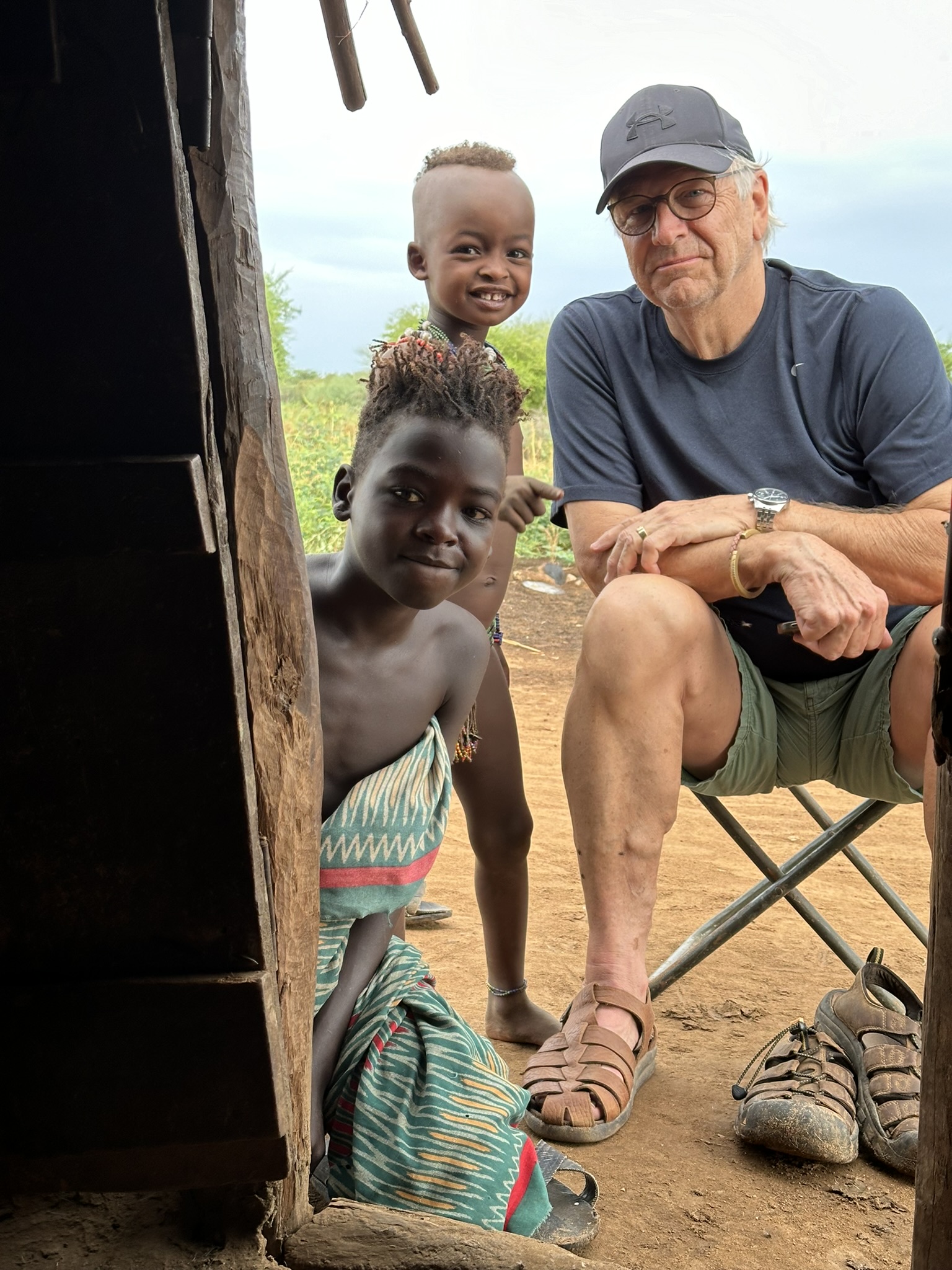
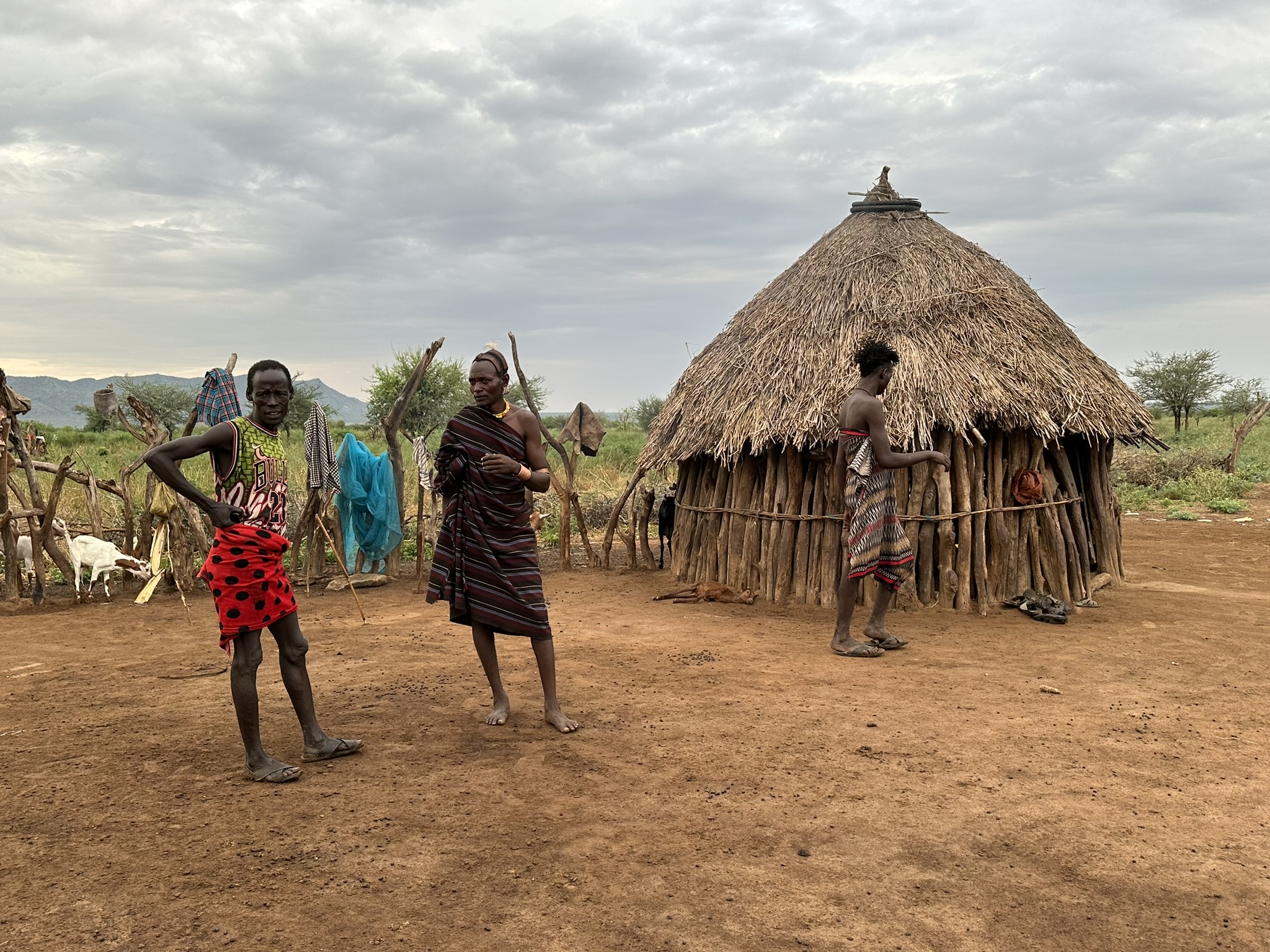
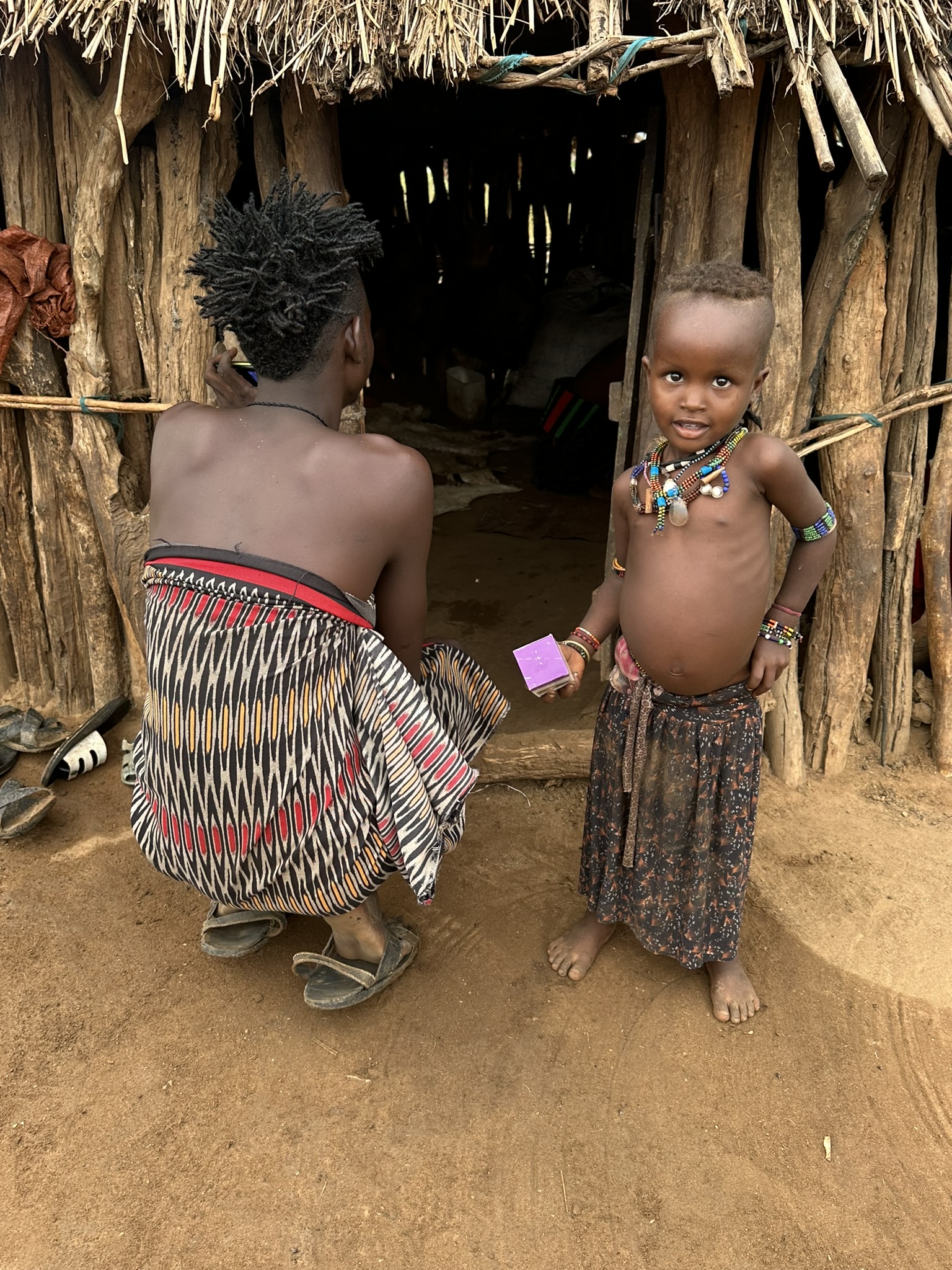
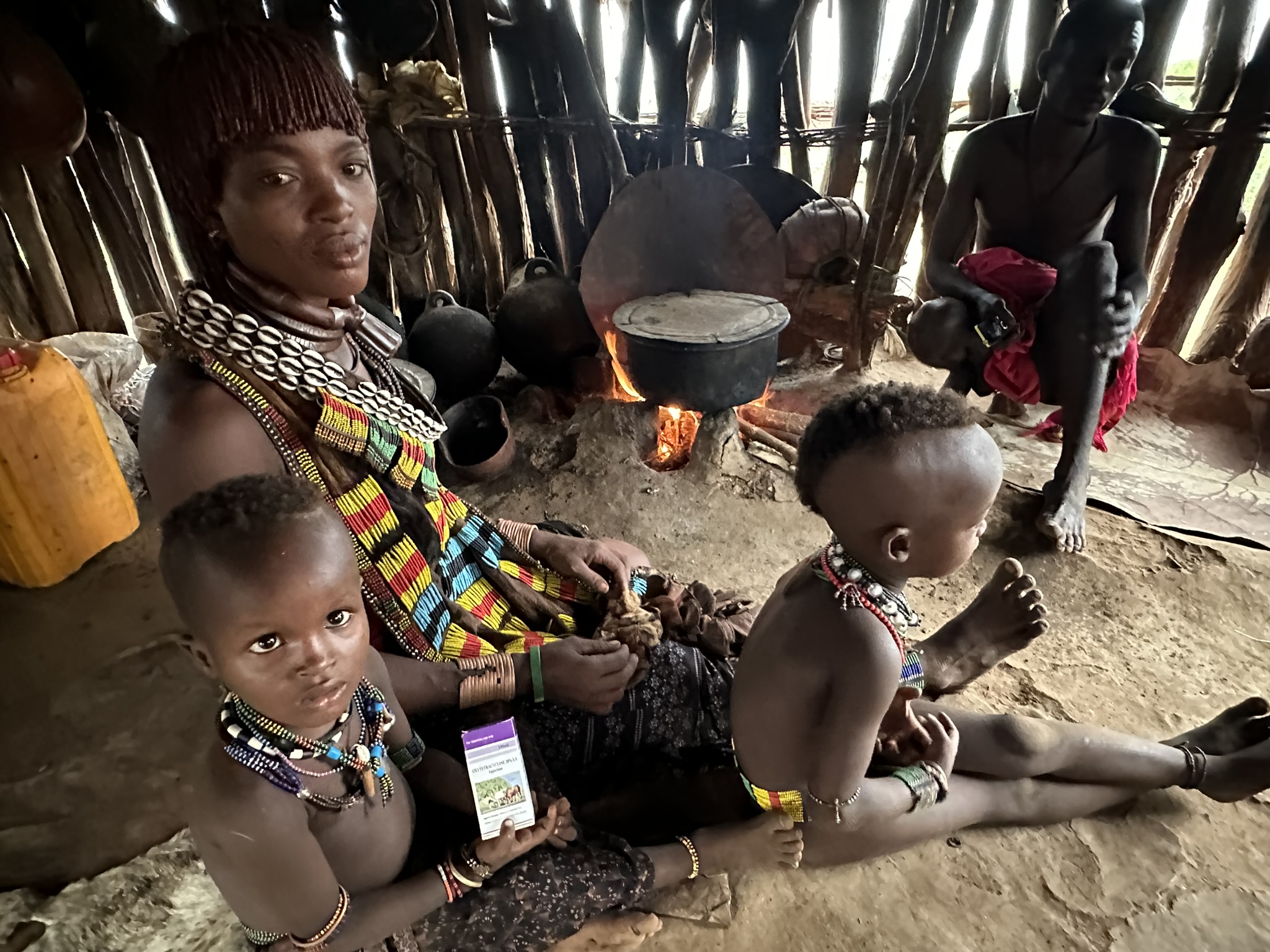
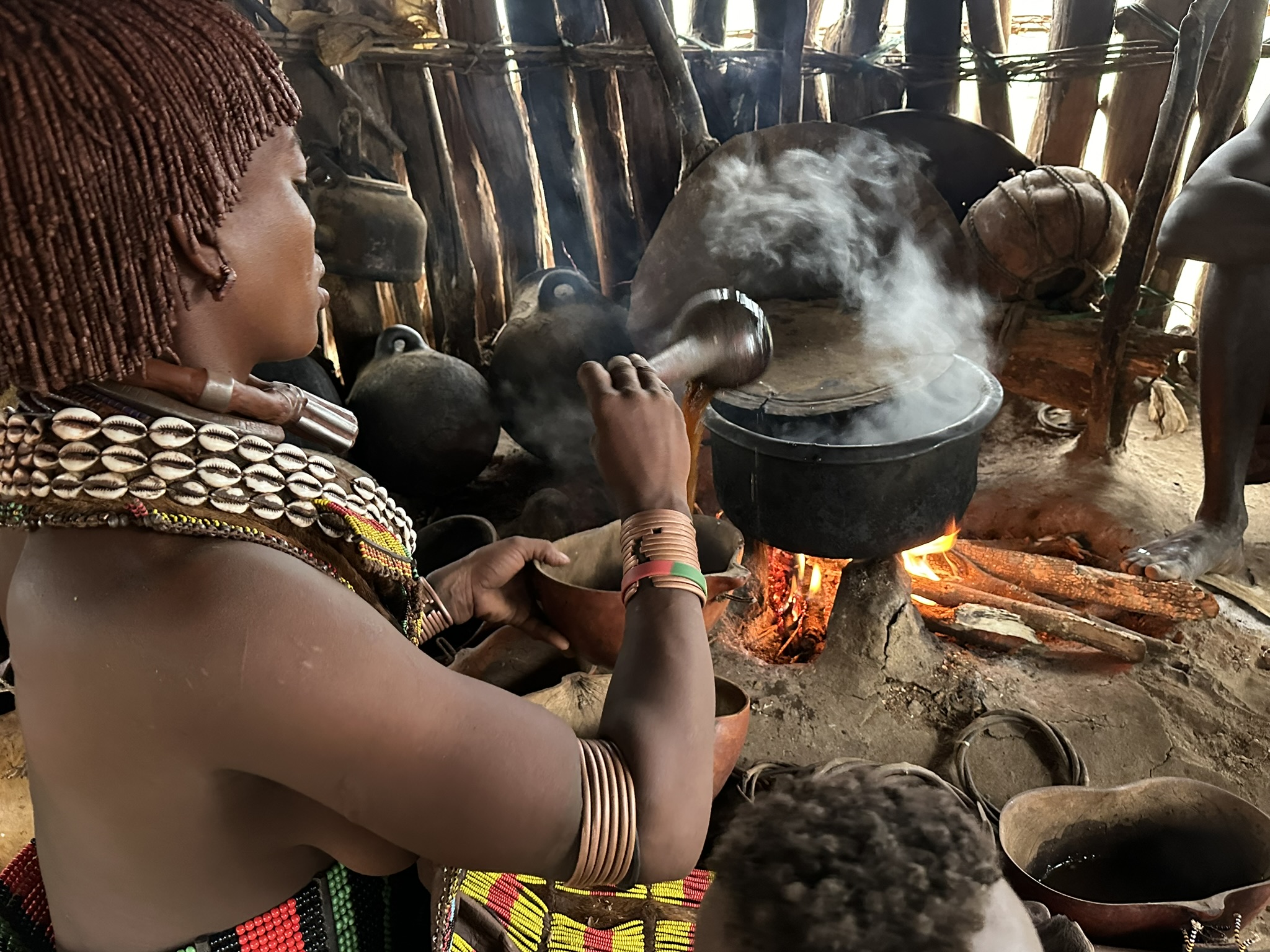
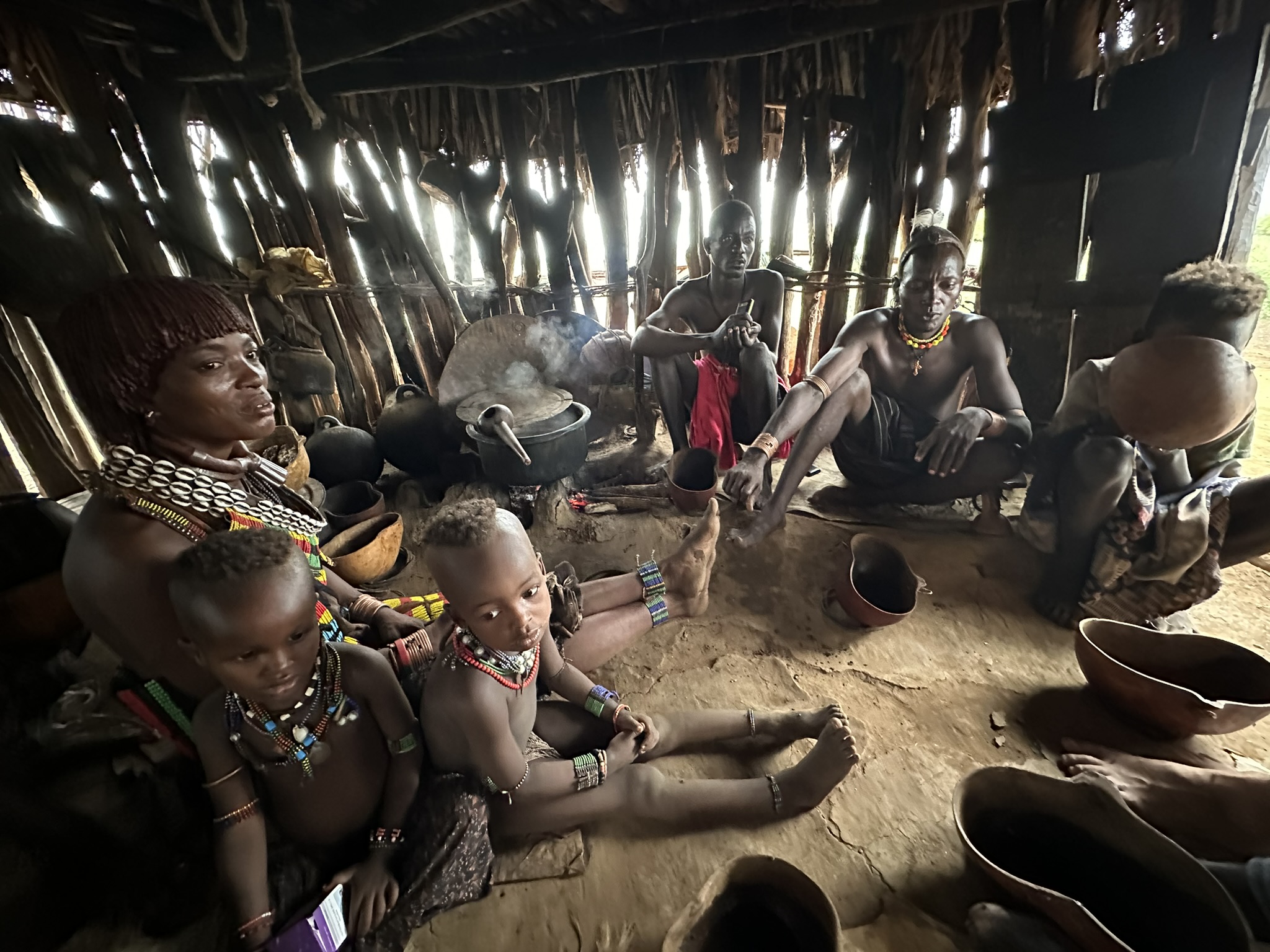
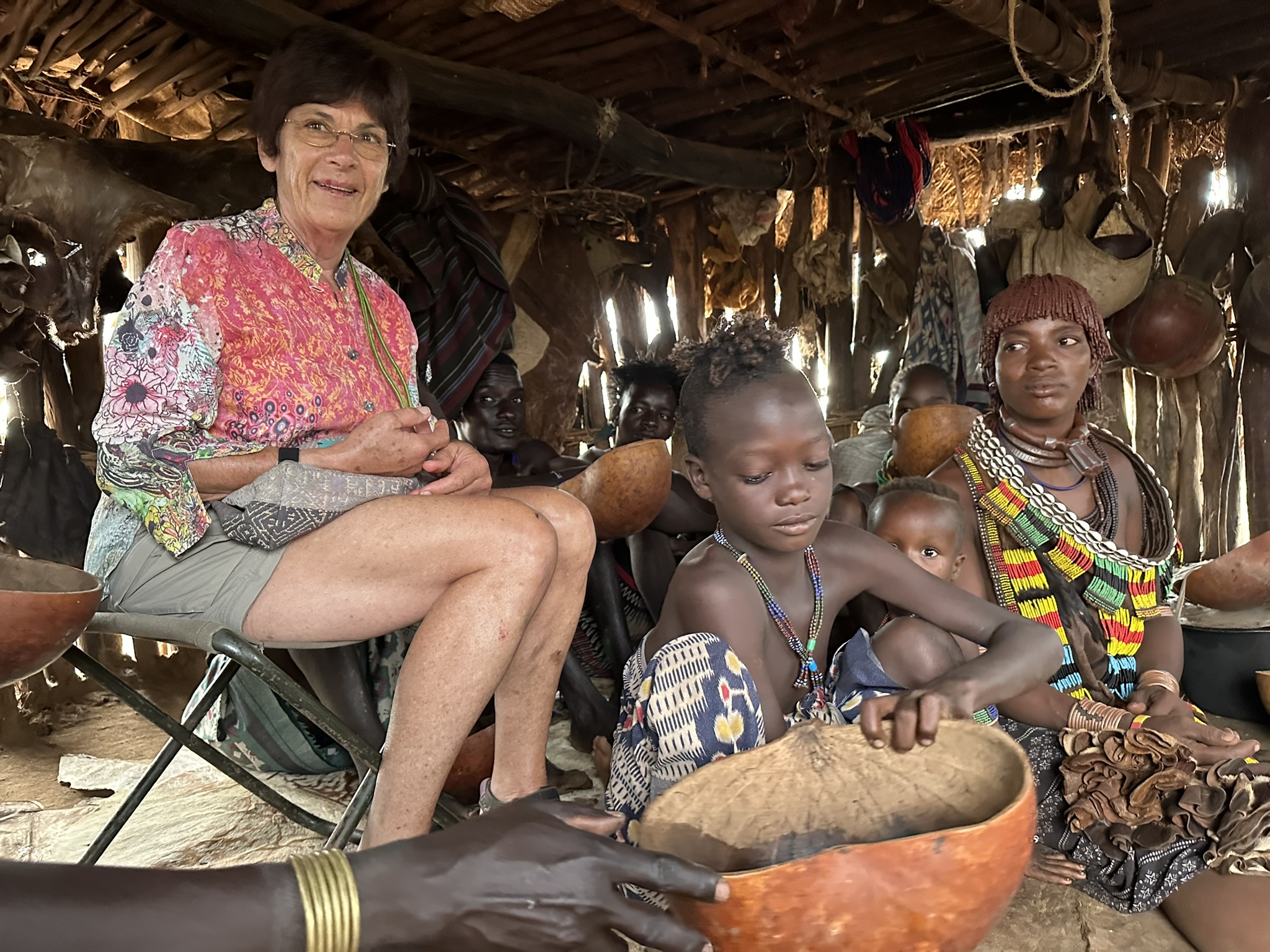
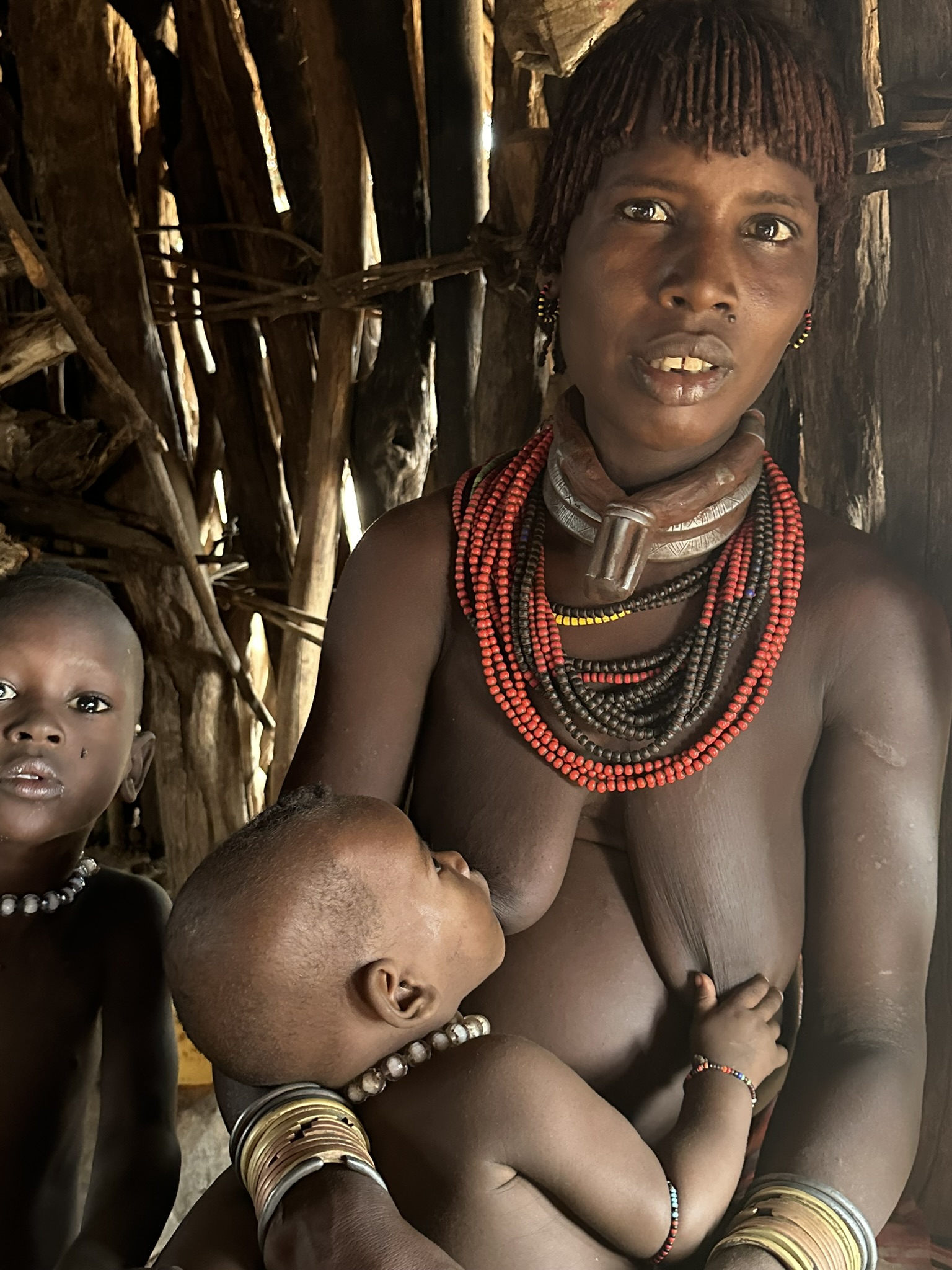
At the first compound we visited we were invited into their round wood-pole house with a thatched roof. There was the husband, Banko, his number 1 wife, Lapa, several children, and other family members who continued to crowd into the space to catch the action. We were just in time for their morning coffee service and were served coffee made using boiled coffee bean husks and served in a calabash shell. Lapa had many calabash shells to go around, and everyone was served except the small children. Banko then gave a blessing by taking a sip of coffee and blowing it out in a fine spray. Mark and I took a couple of sips of the brew just to be polite. I noticed the coffee boiling and figured it was probably safe although the calabash shells were dusty and Lapa used her hands to wipe the dust off. There were a lot of back-and-forth questions about them and us. We talked about cows, sheep, and goats and how his family would take care of the animals when he is gone. Banko wanted to know about our “resources” and who would take care of them because we had no children. He asked if he could tend our resources himself. We told him we had made other provisions and that our resources would go to help other people. He accepted our answer and stepped outside to tend to his hoofed resources. We were pleased with the interaction and happily chatted with other Hamer people in the village.
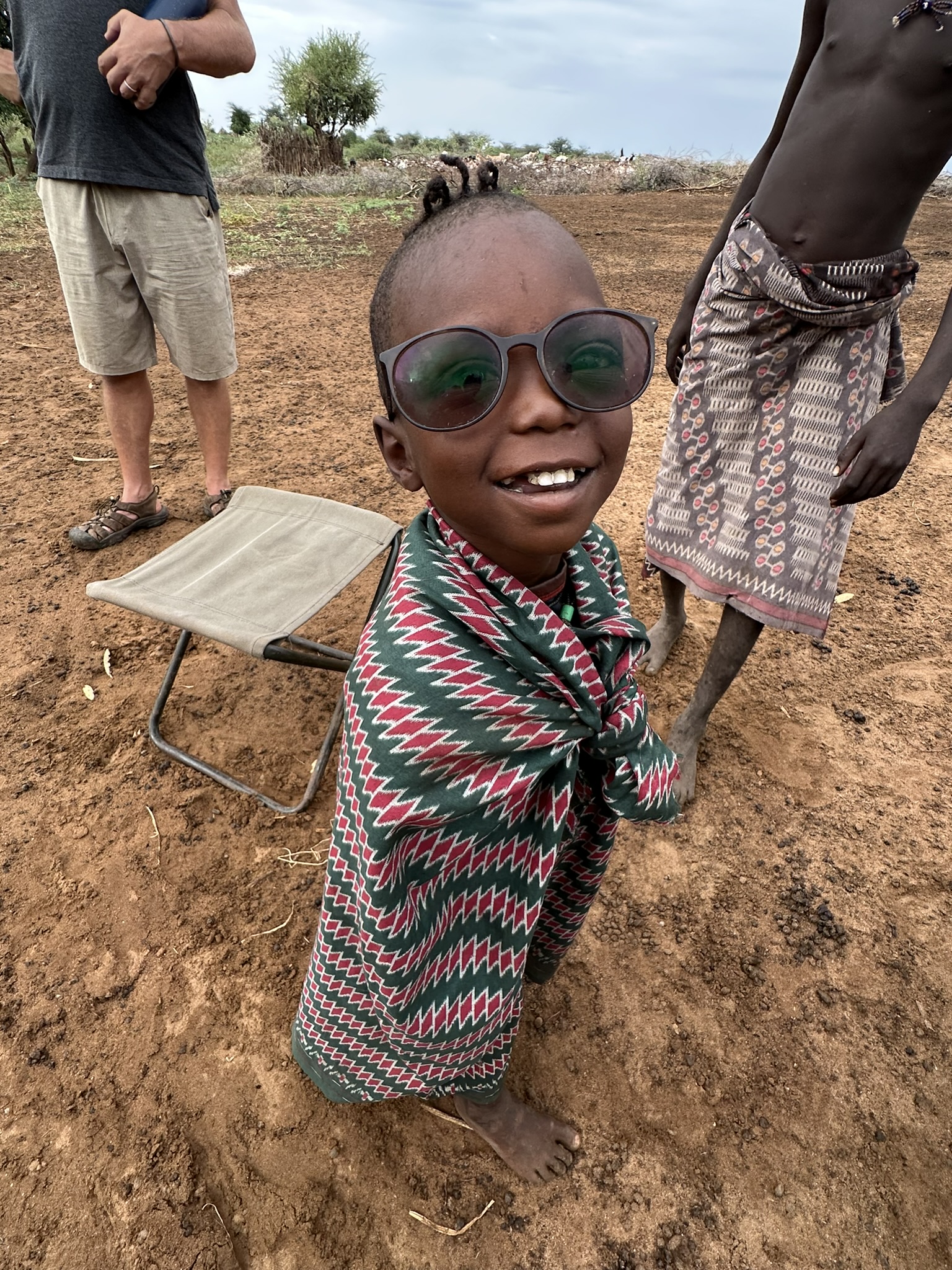
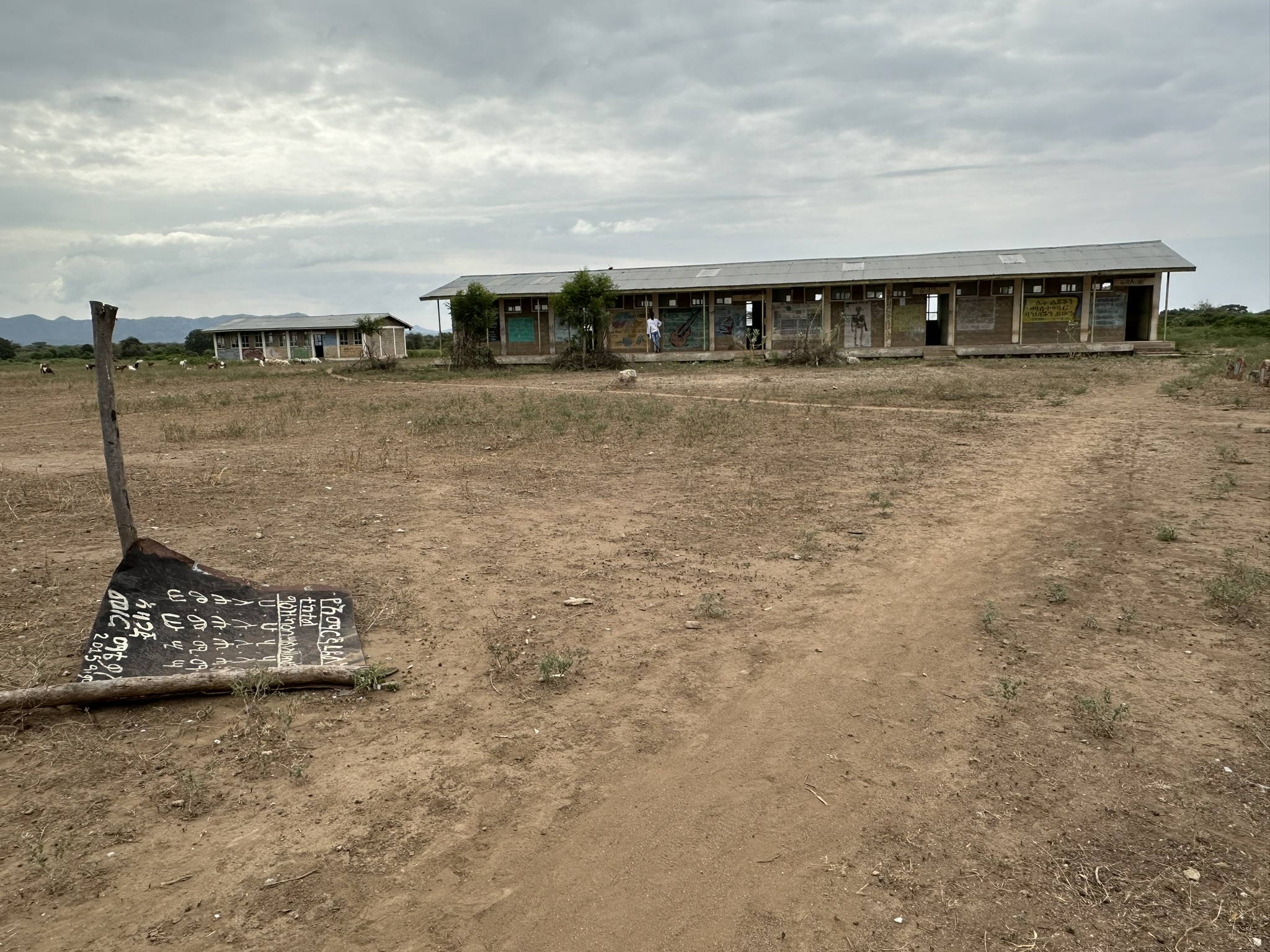
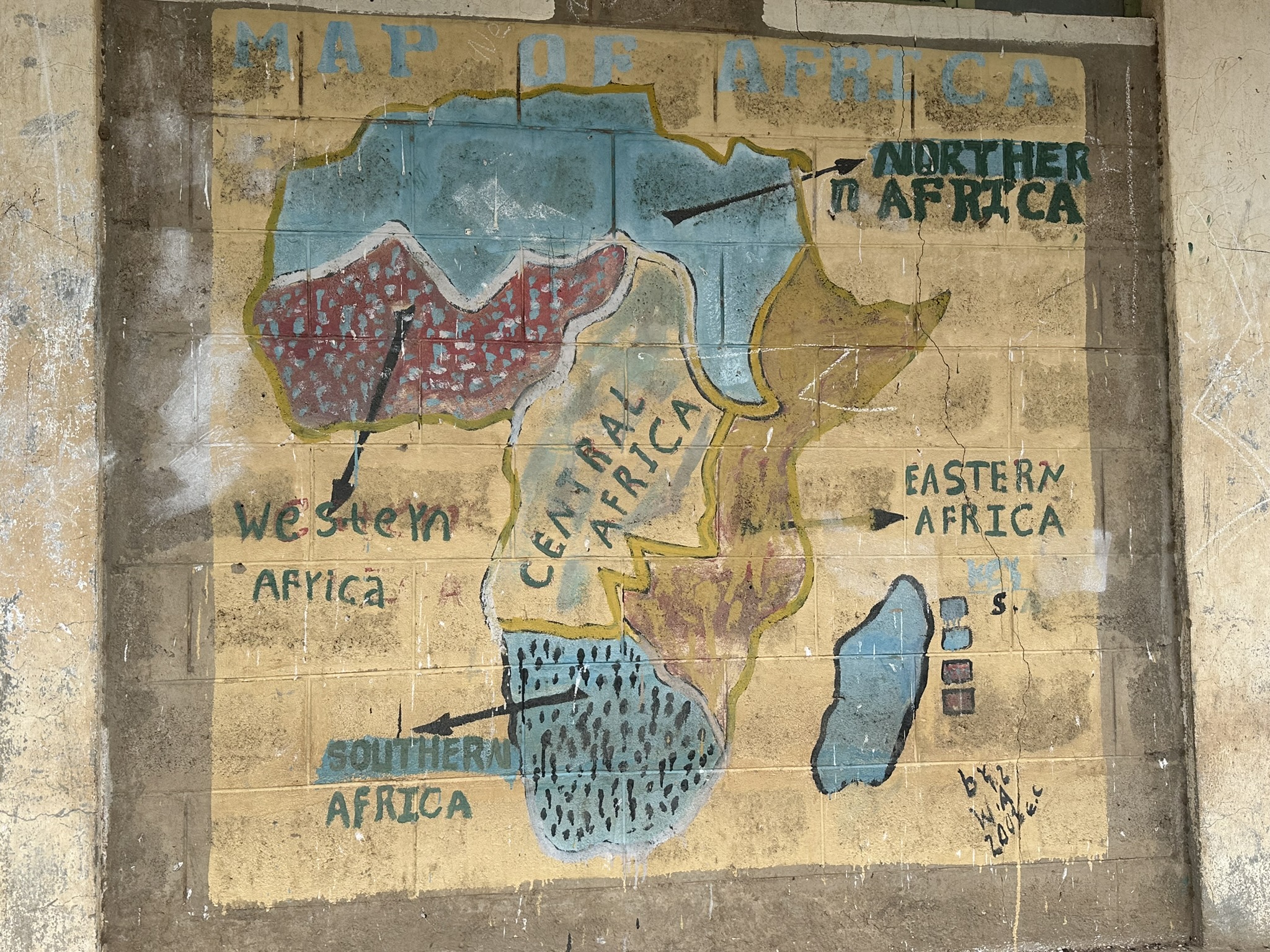
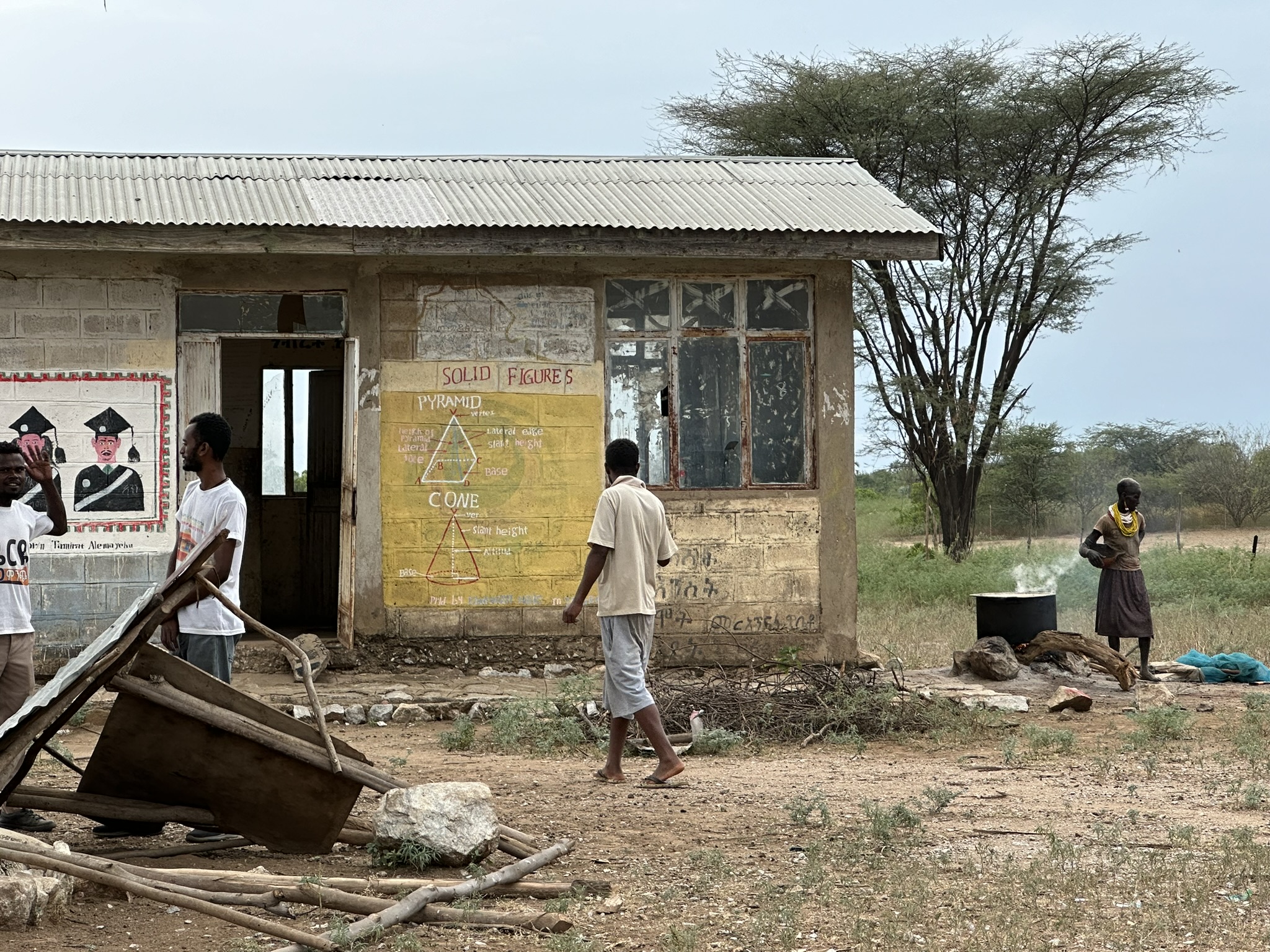
Near the village was a grammar school so we stopped to visit it. There were very few students, especially in the upper grades, and the school was very dilapidated, but functional. We wanted to help them with supplies so planned to buy things in Turmi the next day.
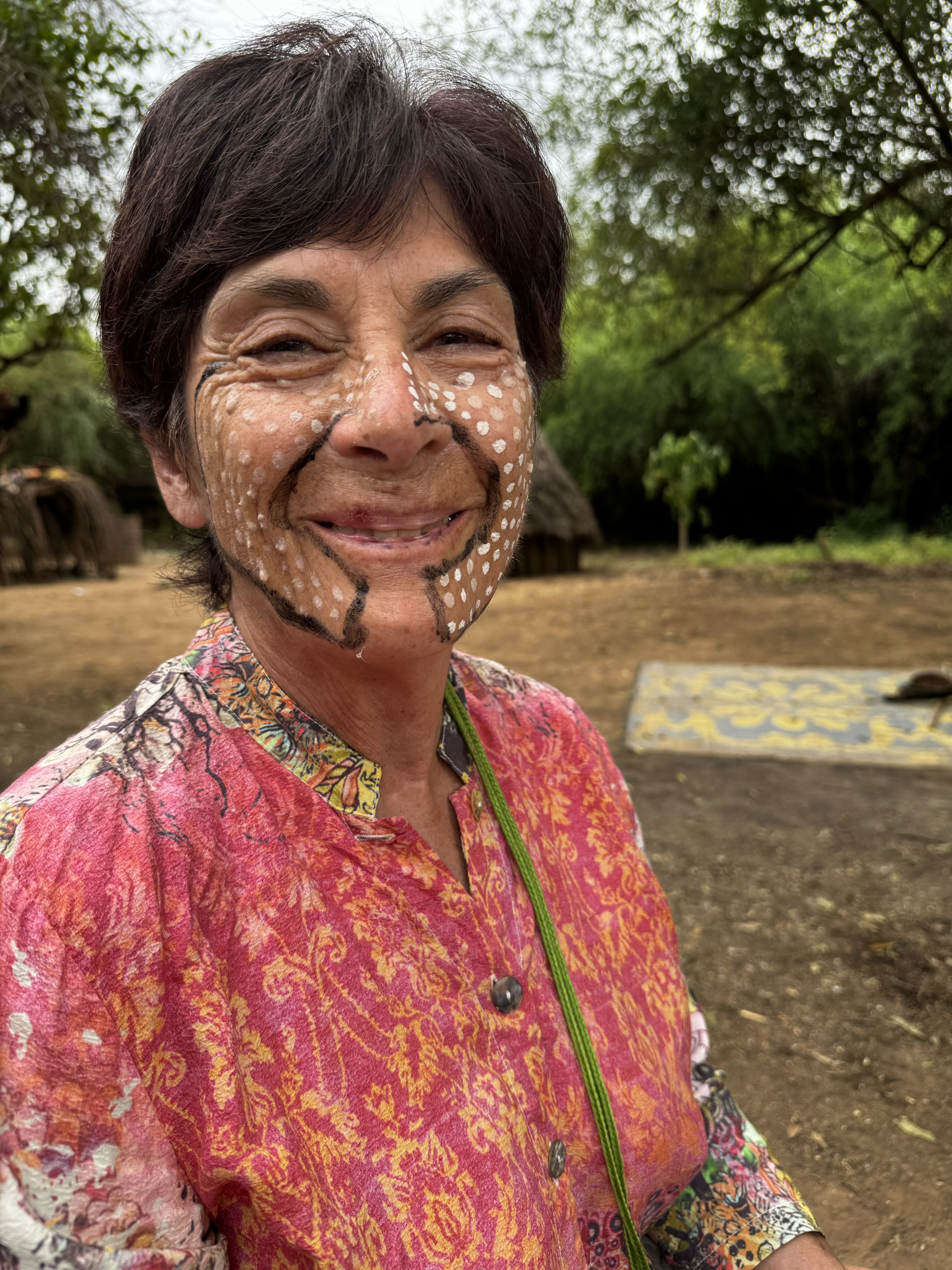
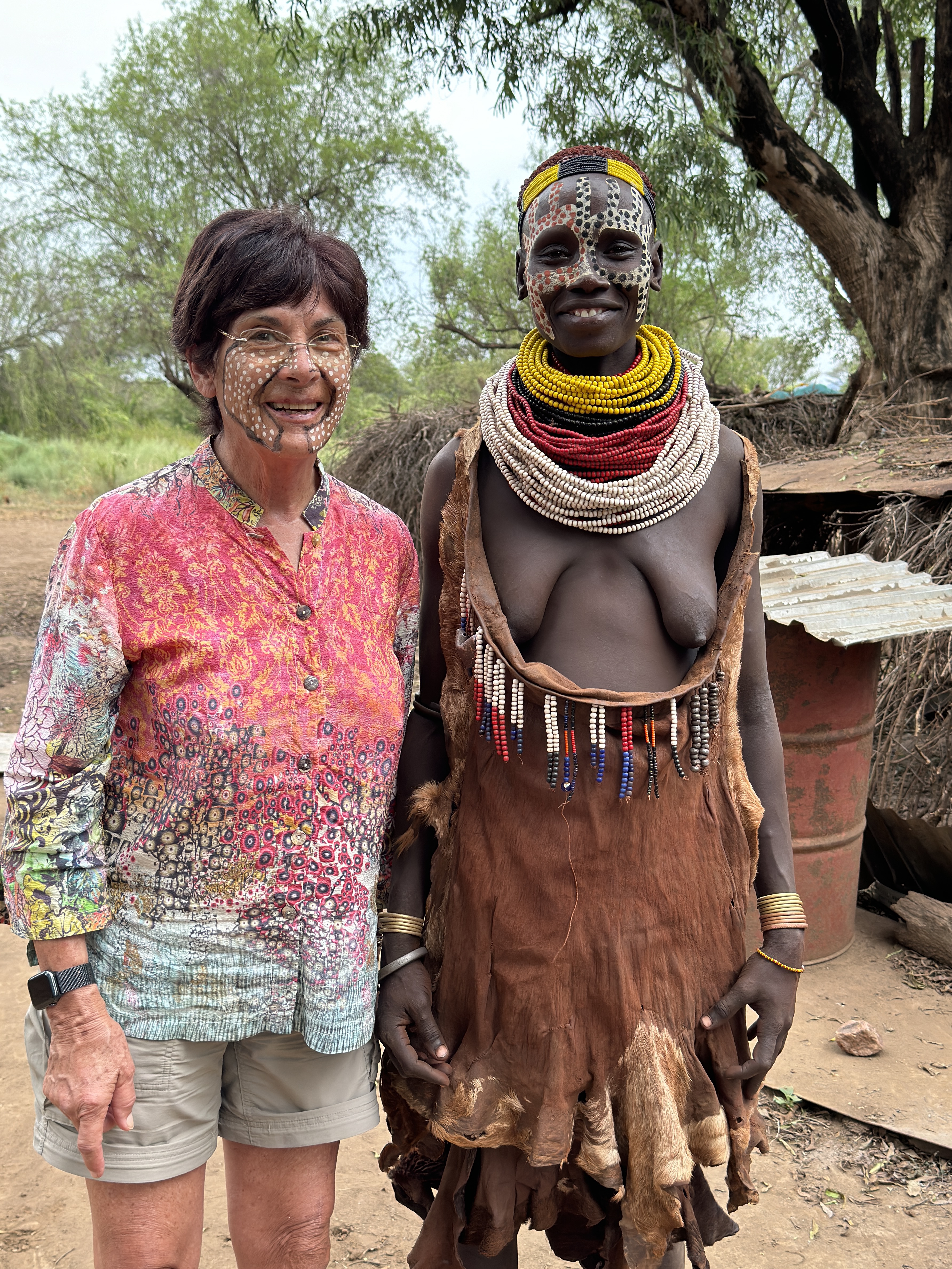
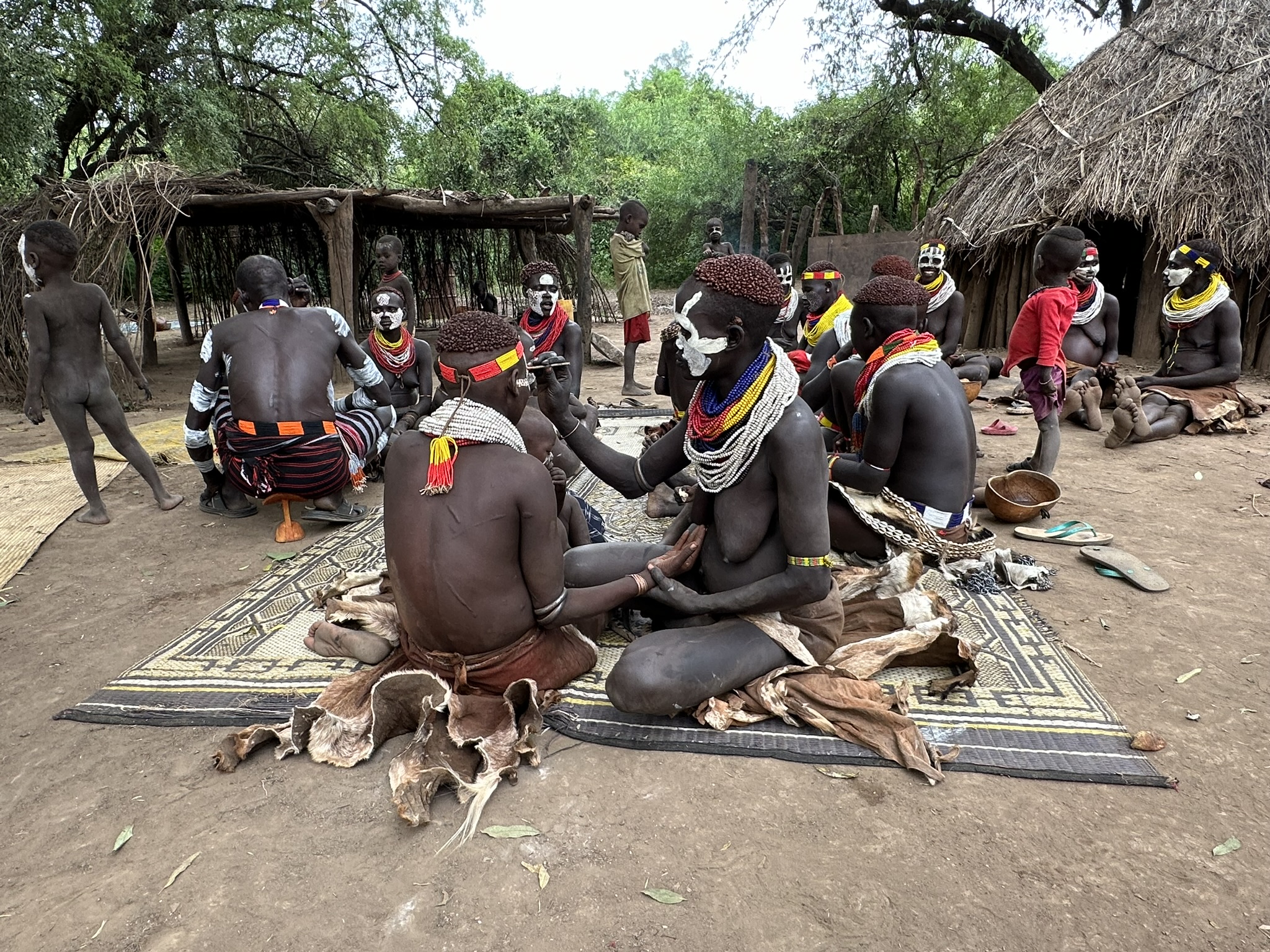
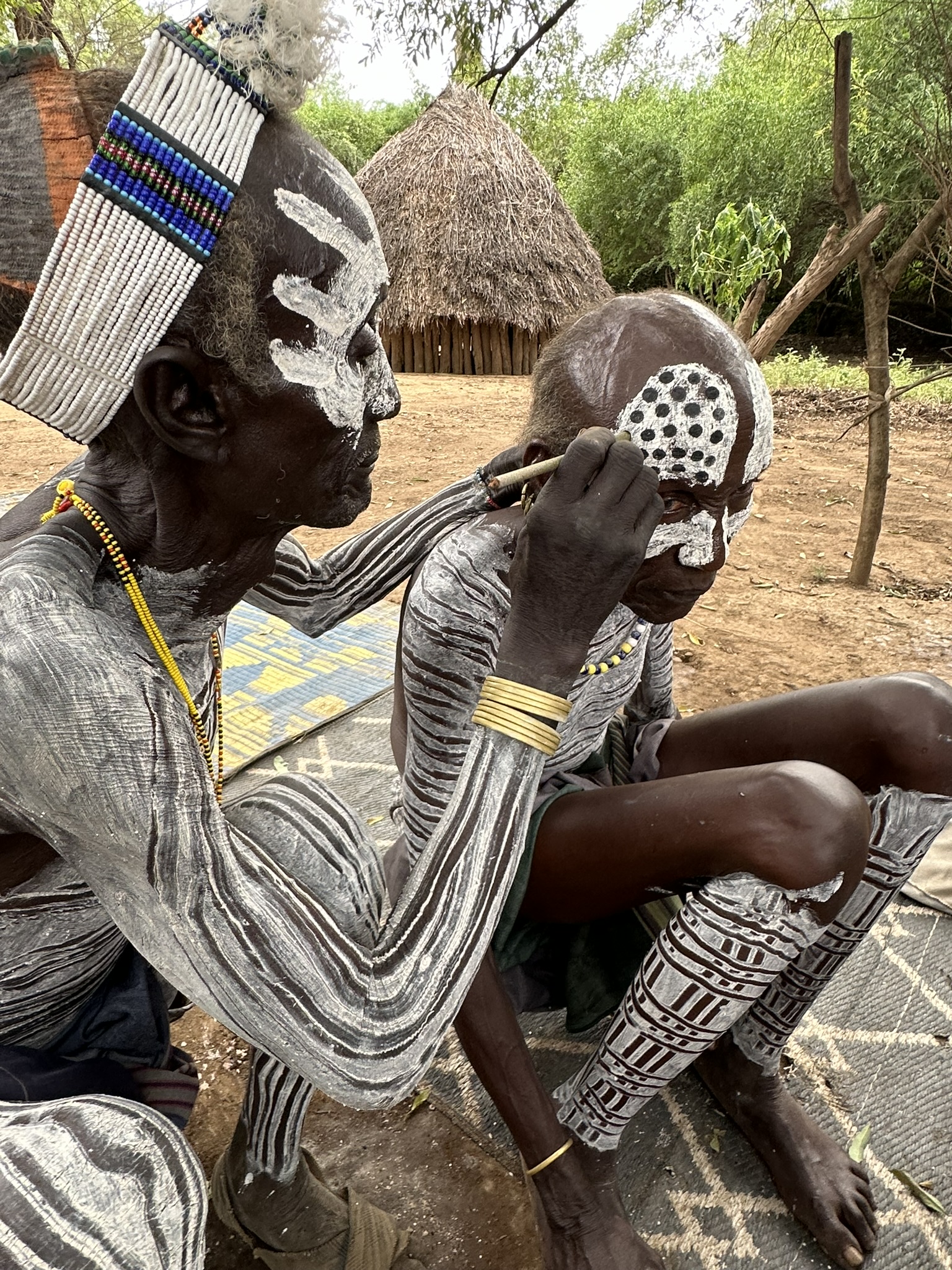
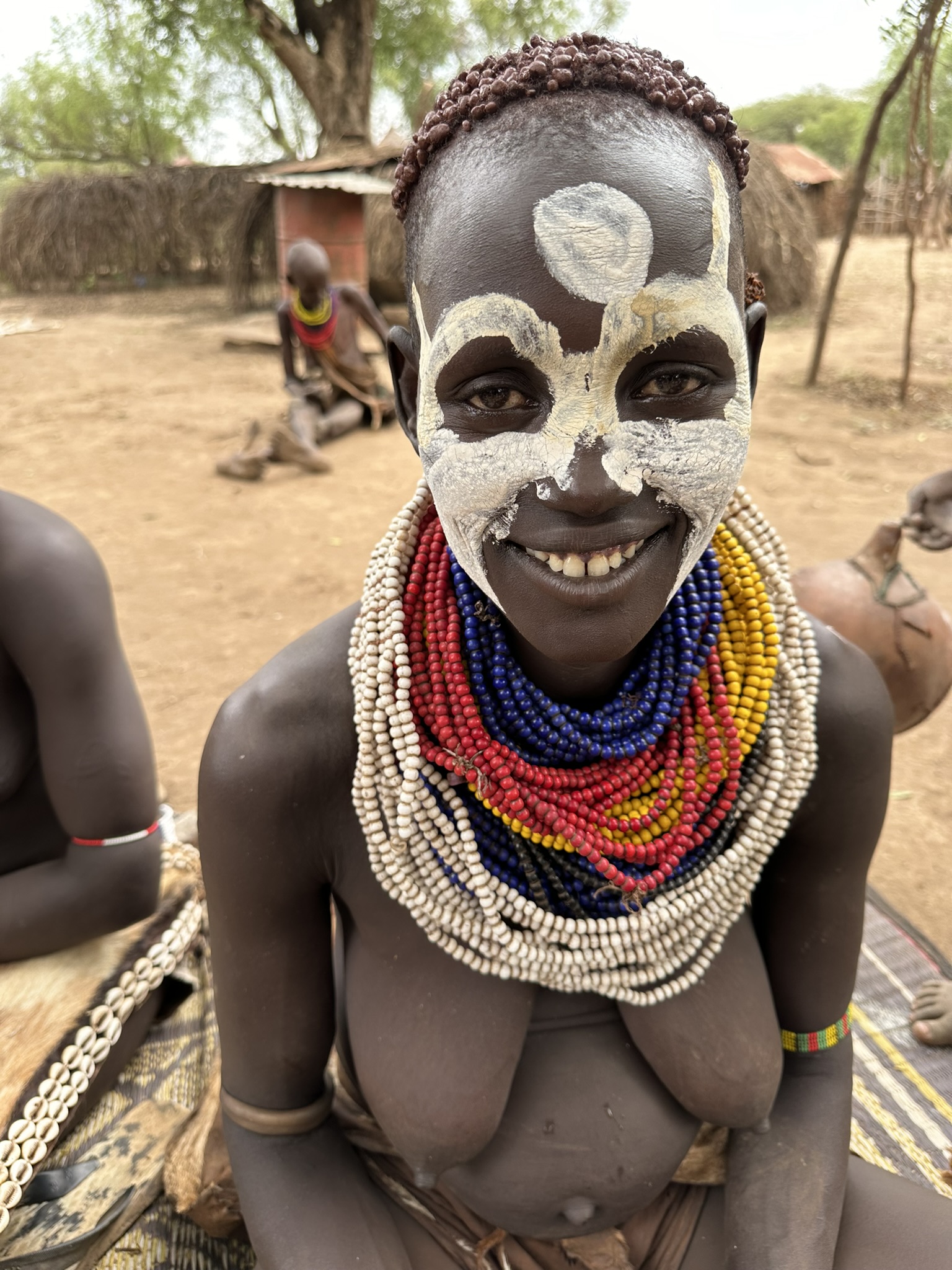
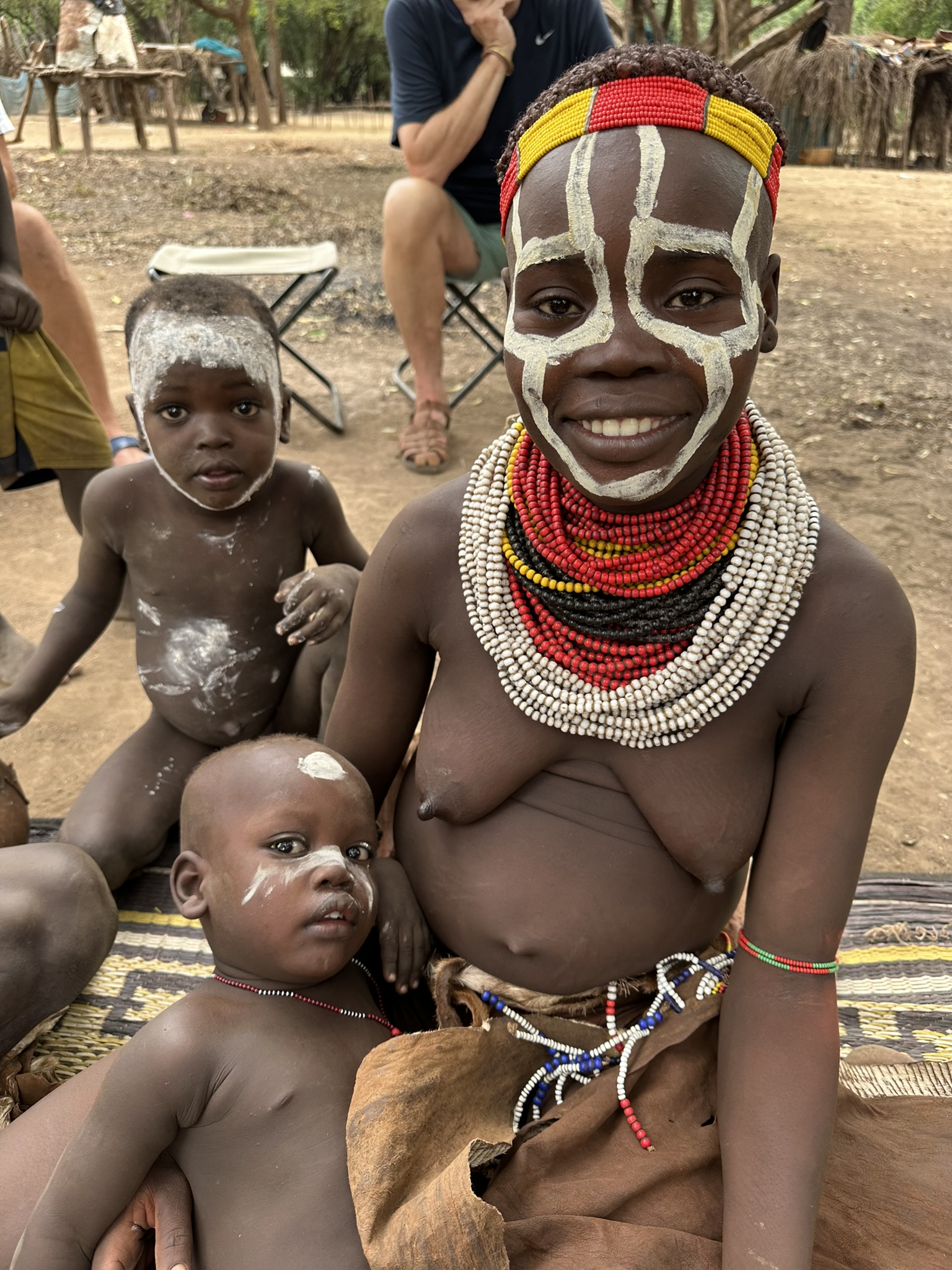
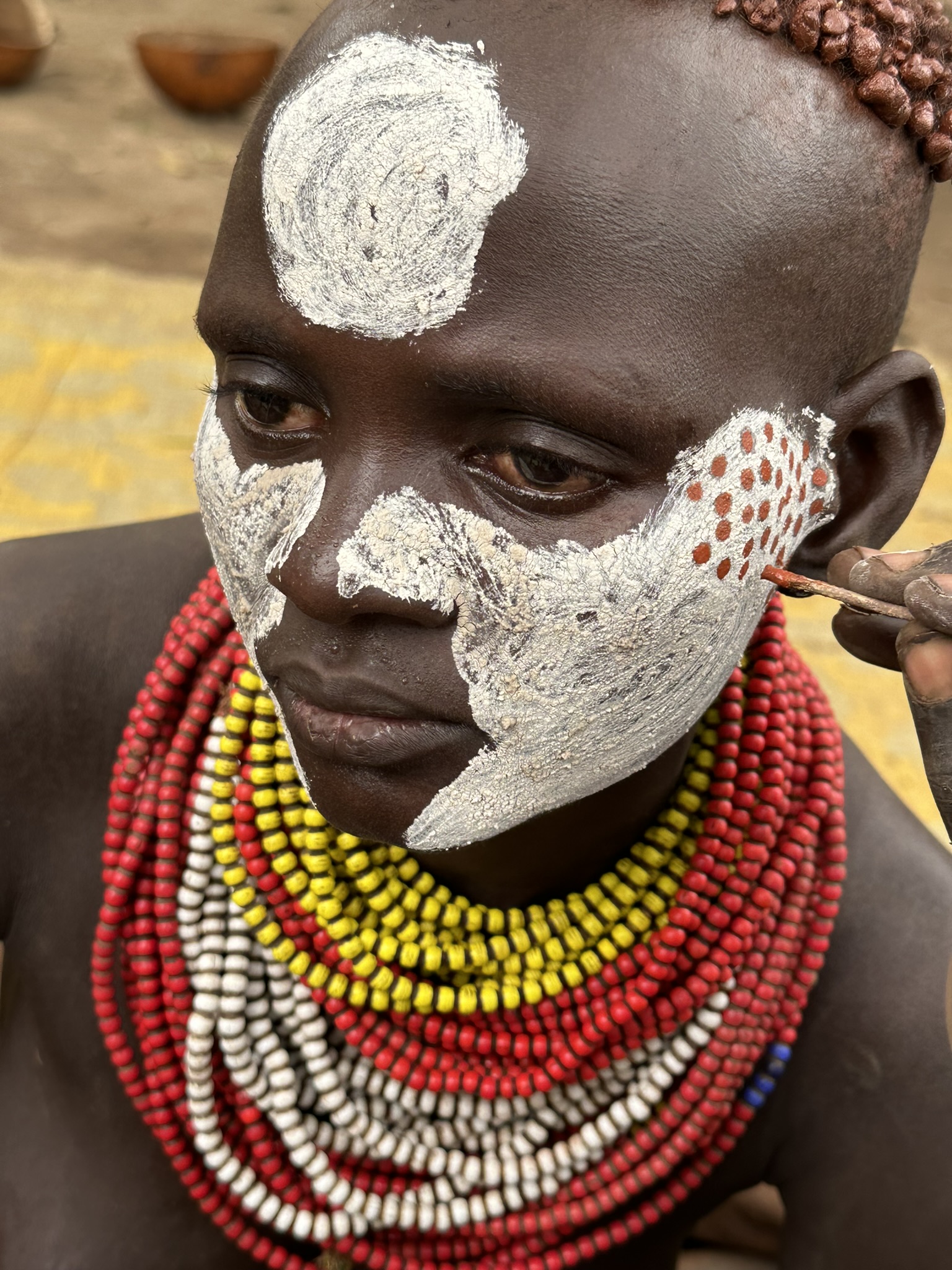
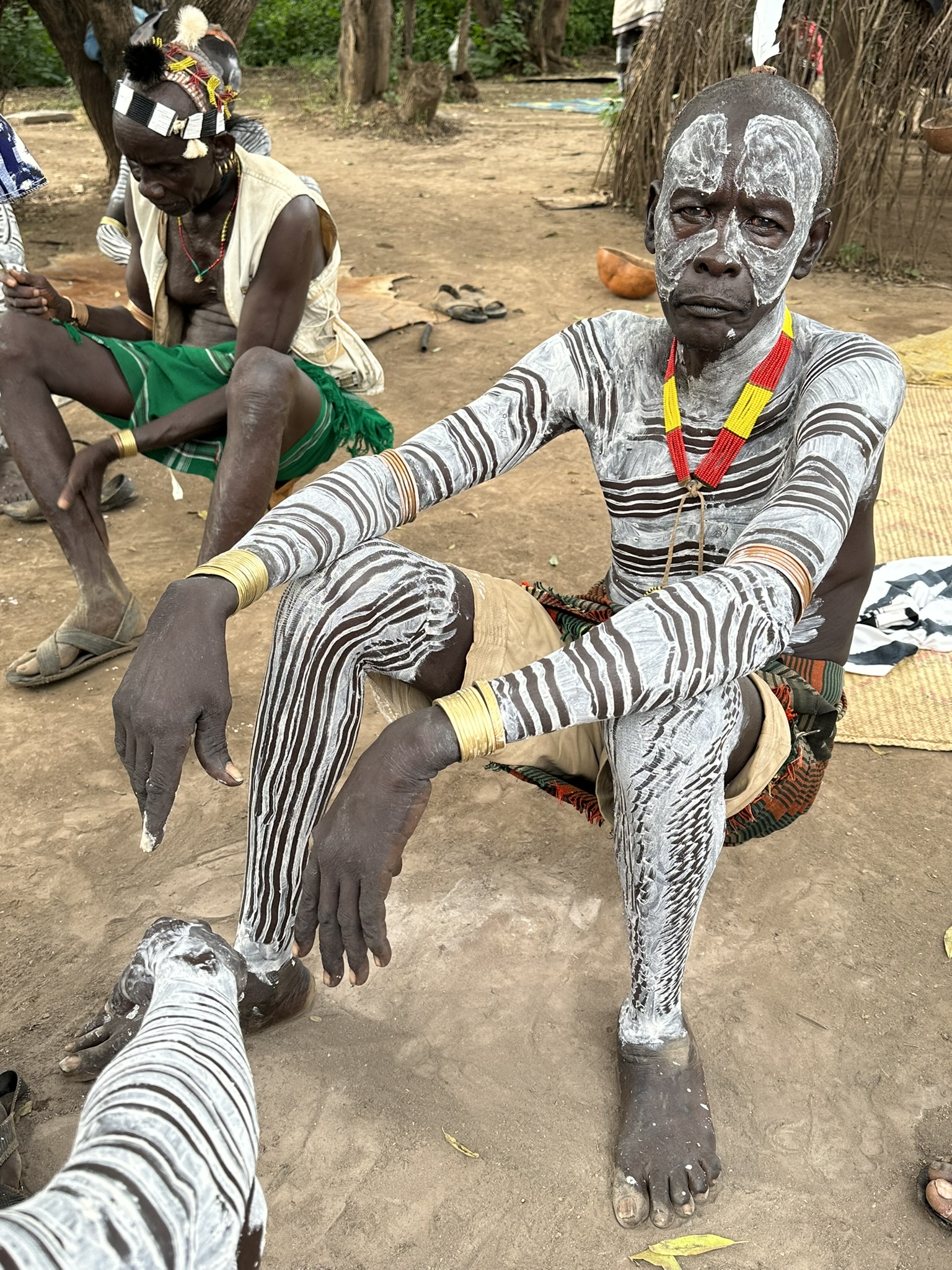
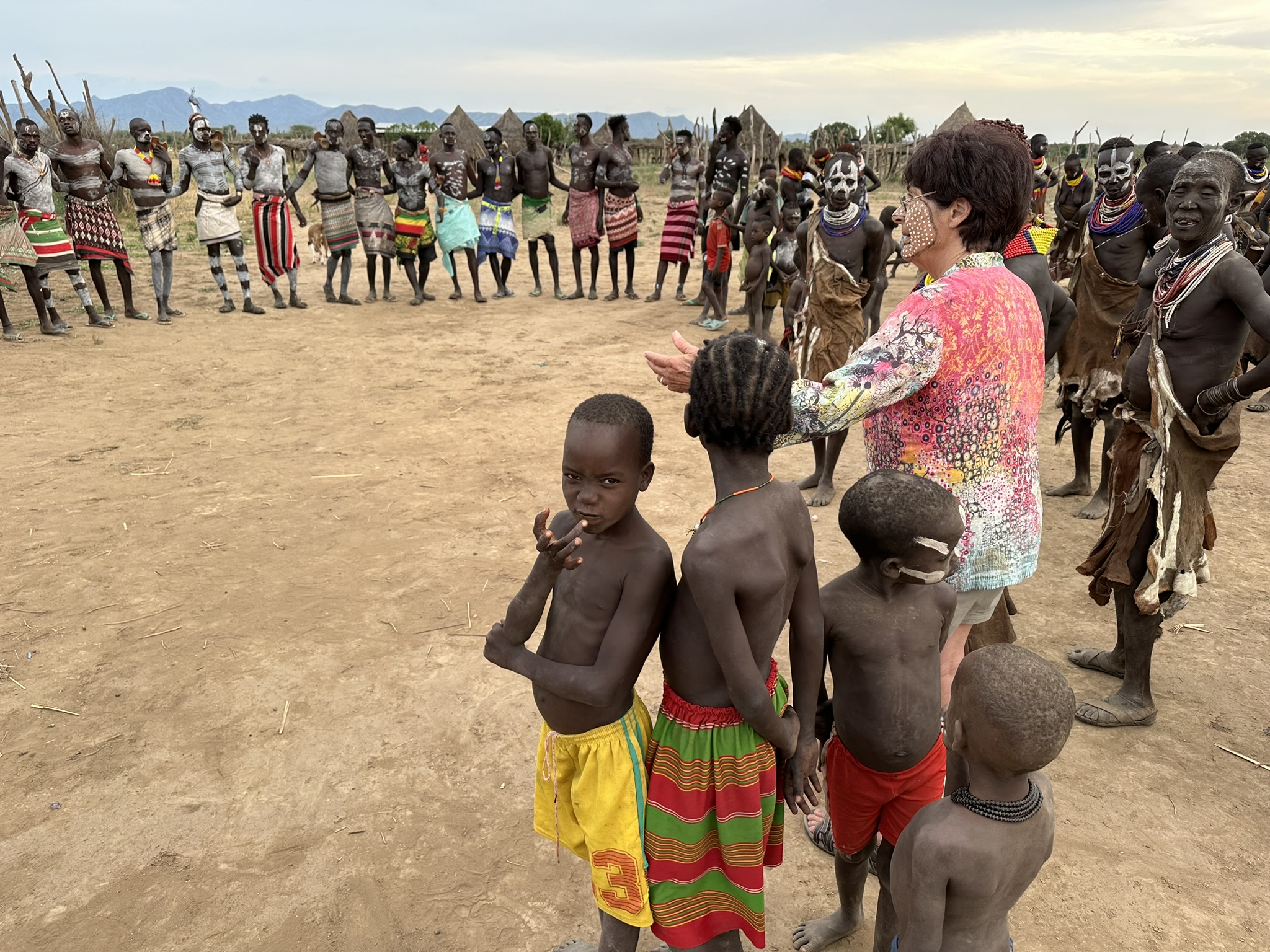
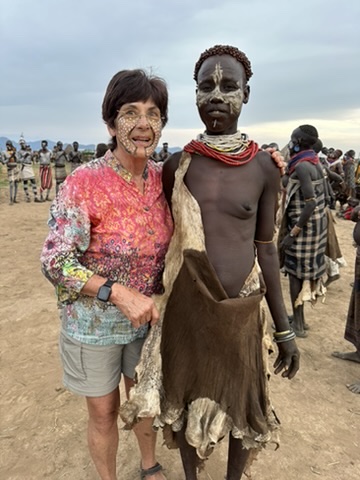
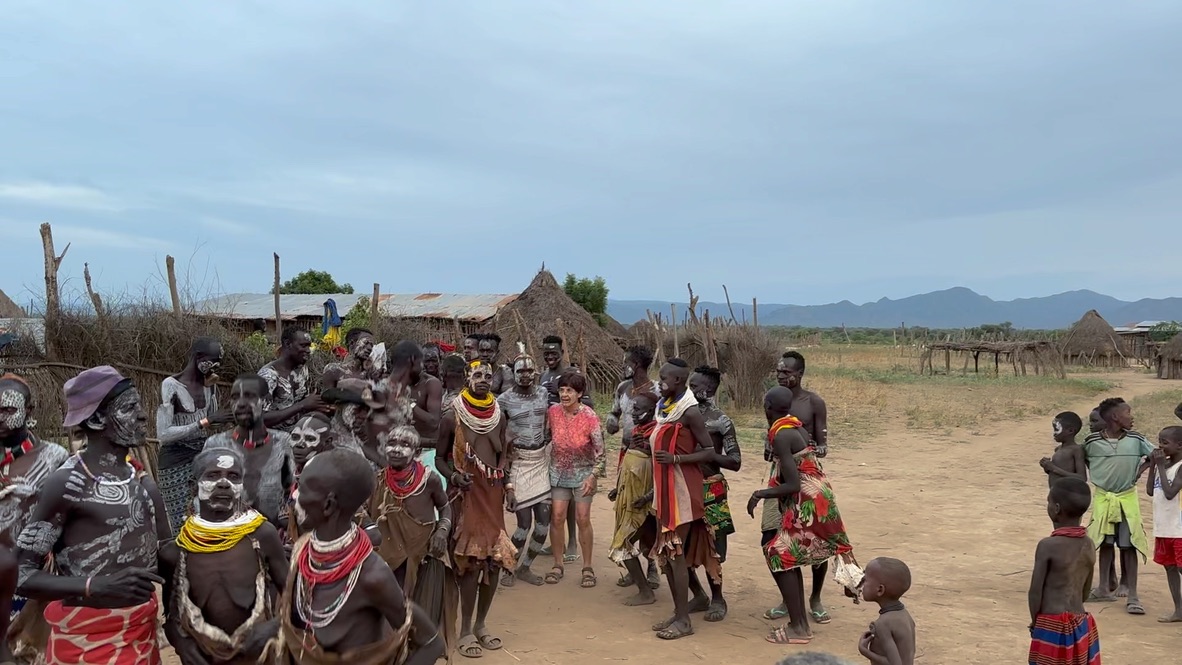
We relaxed by the river in the heat of the day and then walked over to the kitchen area where the staff and other Hamer people were putting on clay and mud makeup. They were almost ready when I decided to join them and one of the ladies painted my face.
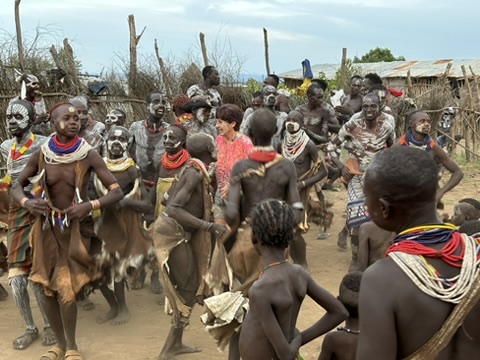
I looked a bit silly with my western hair style and glasses, but who cares. Everyone laughed. And off we all went to the Dus village where the ceremonial dance was to take place. The ladies dragged me into the dance where I was matched up with a different young man for each dance. I am not good at jumping up and down, but I did my best and did several dances before one young man got a little frisky with me. Fortunately, that was the beginning of rest time. We left the scene to go home for showers and dinner. It had been a delightful experience.
February 2, 2024
Departed Lale’s Camp by car at 9am to head for our next camp. Meanwhile the boat had left very early and took 8 hours to get to the camp ahead of us. The drive was much shorter at 2.5 hours. While on the road, I had a long chat with Adja, the manager of both Lale and the delta camps. I asked him about the culture of different tribes regarding death and religion.
The Mursi people do not believe in God and bury their dead at night of the same day as death occurs. They mourn the death of a man for 4 days and the death of a woman for 3 days. After the deceased is buried, the villagers move to a new location.
For the Hamer people, when a Hamer man dies, all the relatives are notified, and the body is carried to the foot of the local mountain where it is buried, and the grave piled with rocks. Mourning lasts for 1-3 months depending on the age and importance of the deceased and the length of time to get to the grave site. Half of the deceased’s animals go to the men who carry his body to the grave site. They eat what they need along the way and keep the rest. The Hamer do believe in Gods and a life after death.
The Kara people bury their dead the night of the death and mourn for 4 days for men and 3 days for women. Adja is Kara and Christian and believes in God and life after death. His left ear is clipped to indicate he is married, a Kara tradition.
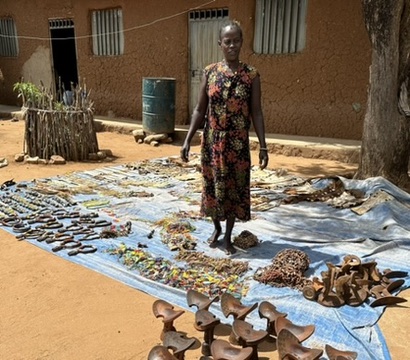
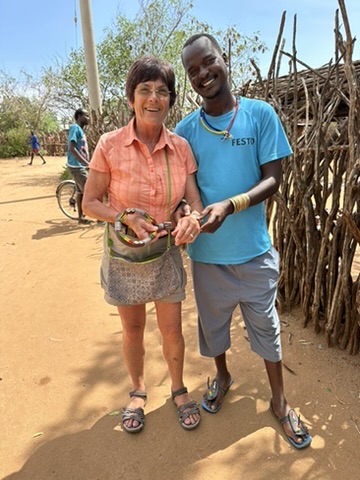
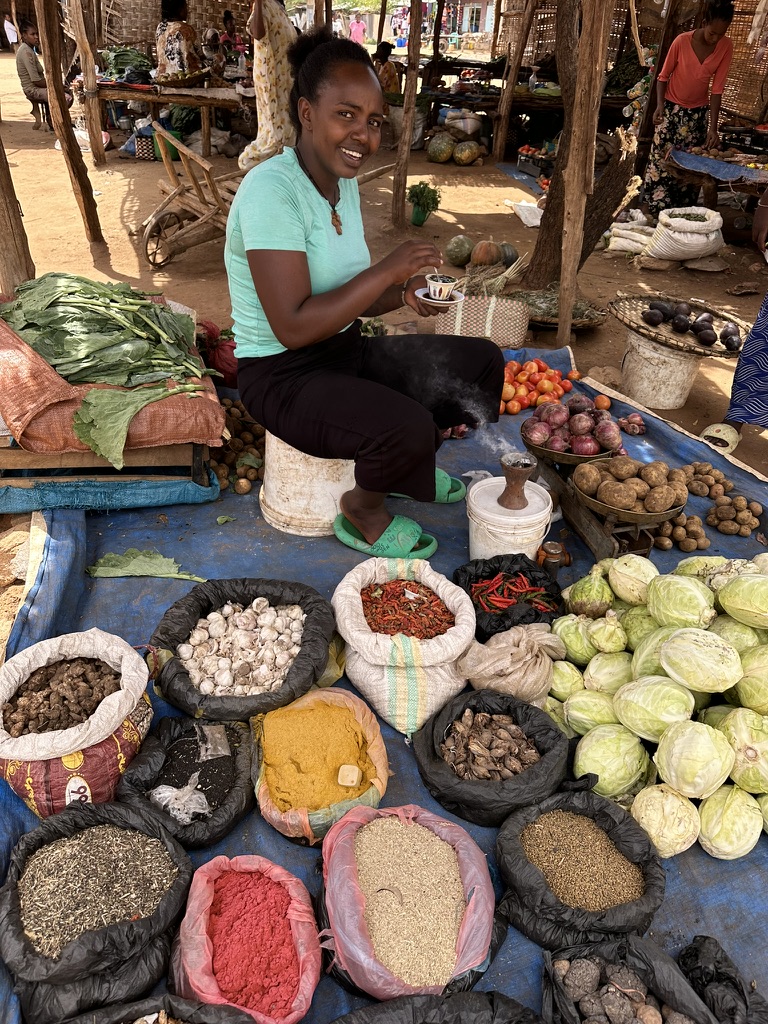
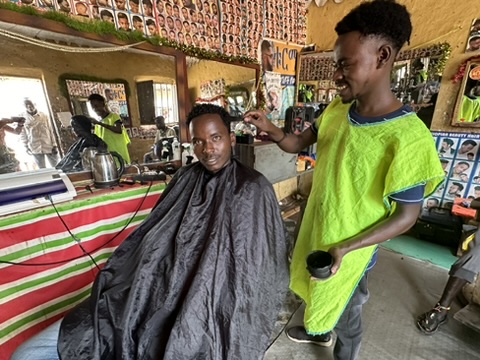
We stopped in the small town of Turmi to buy school supplies. Bought reams of notepads and plenty of pens for the whole school. Wish our purchase could make a difference. Then we walked around and found a street vendor selling the Hamer first wife style necklace and bought one for our collection. A guy selling bracelets approached us and we bought one each to wear. We also saw a vegetable vendor and a bag of coffee husks the locals use to brew a cheap coffee and a barber giving a man a black dye application. Will posed with a well made wood fence. The many we have seen are both attractive and functional. Then we drove on to the town of Omorate for lunch.
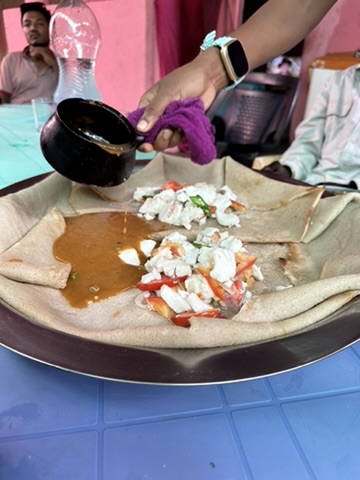
The driver knew a restaurant that served engera, so we stopped and had engera for the first time since our last visit to Ethiopia 20 years ago. The place was less than appealing, but the food was fine. It was made with Nile Perch and tasted good. However, a few efforts using my hand was enough and I asked for a spoon. Mark managed the whole meal with his right hand. 20 years ago, I managed with my hand too. This time I did not care. It went down with a cold beer. After lunch we drove 20 minutes to our Omo delta camp near the village of Calama, which is occupied by the Dasanach people.
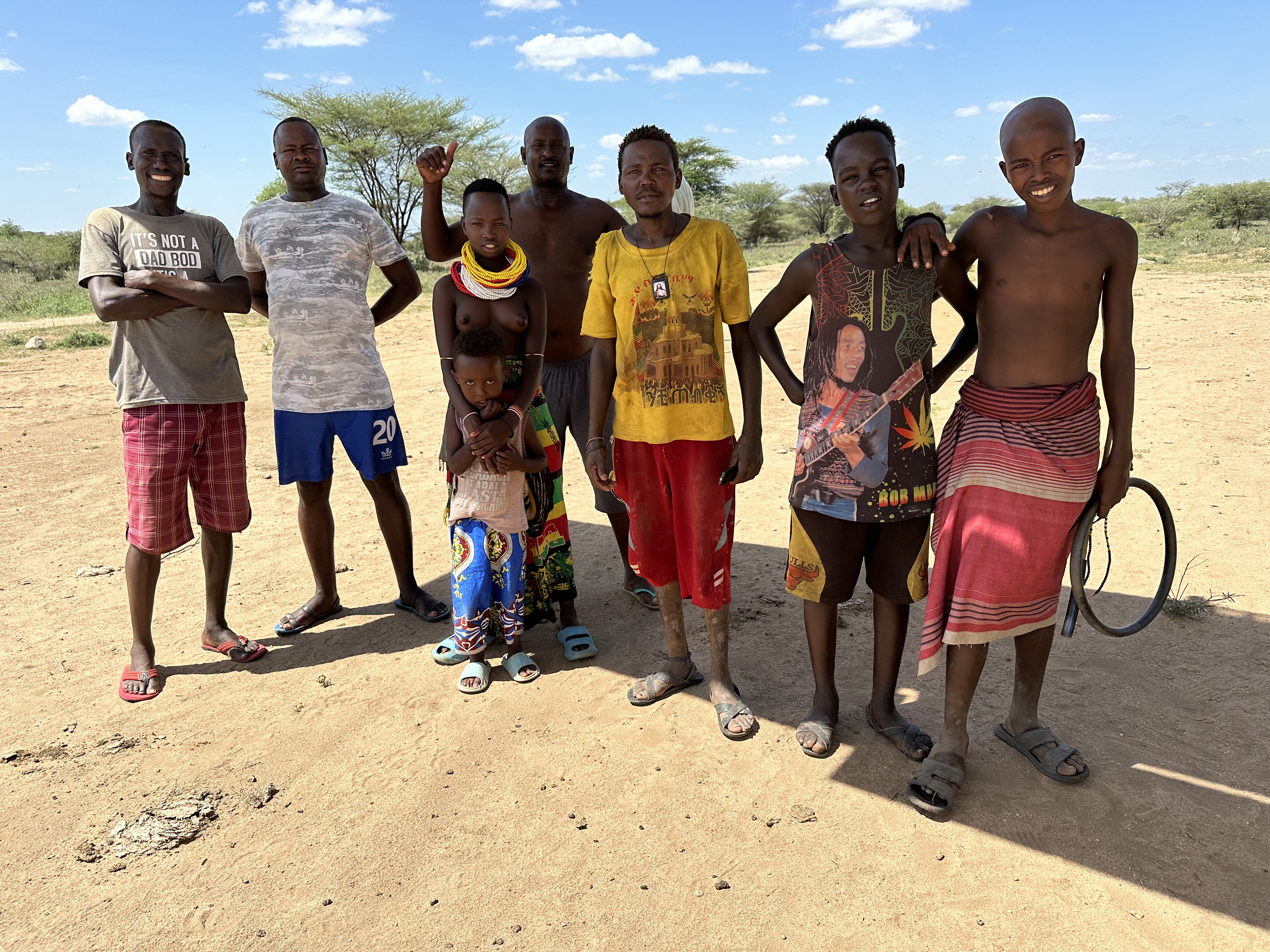
The Dasanach live in oval huts covered with corrugated tin roofing material. It keeps out the rain, but not the hea,t and it is very hot. There are about 25,000 of them and they live in the delta area of Ethiopia and in northern Kenya. They are Agra-pastoralists. According to Adja, they do not get along with their close neighbor, the Turkana.
They do practice dimi, the circumcision ceremony for females. Every day the fathers and mothers of the girls about to be circumcised, do a daily ceremonial dance through their village for several months, up to 3 years before the actual event. The actual circumcision is done by the mother and another elder woman.
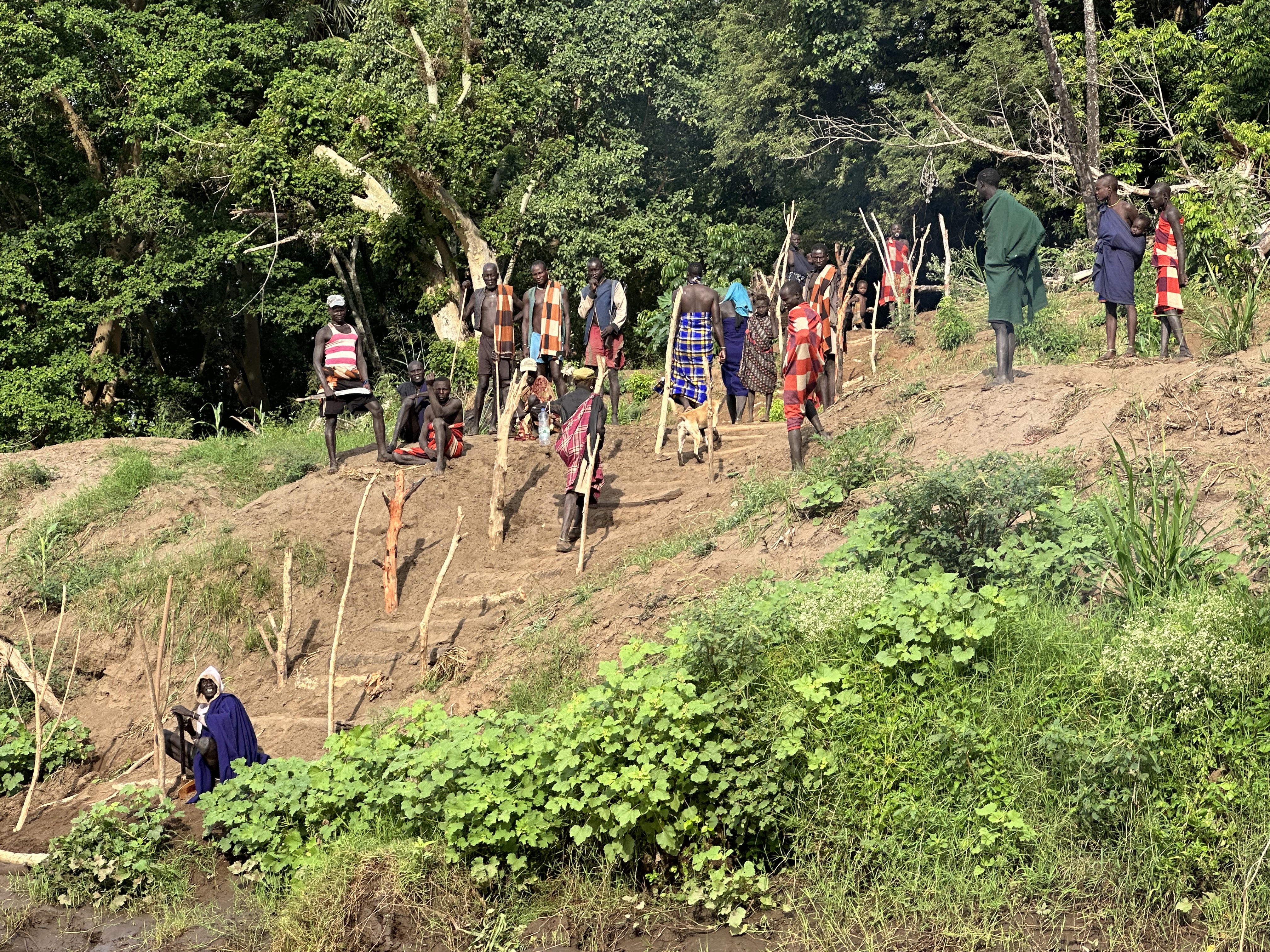
About 5pm we boated across the river to an area where there are no roads and walked into a Dasanach village where we managed to get several photos in spite of the sensation they had seen whitenot people before. It was as if we their first visitors. It was the first time Will’s Delta camp had been set in this location and there is no easy river crossing. The village had been destroyed by flooding and moved to this barren, dirt moonscape of a location. Then back across the river for dinner and bed.
February 3, 2024
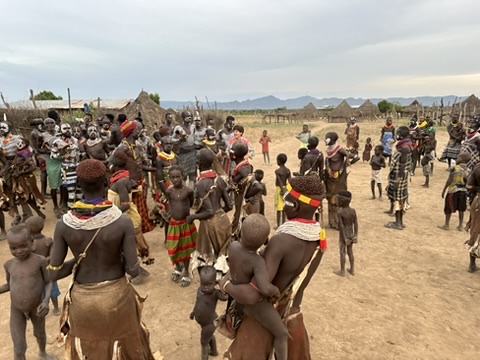
Early this morning we drove to a Dimi ceremony at a village called Kalem. It was a large place with many huts in a broad loose circle for about 2000 people. There were about 15-20 fathers and an equal number of mothers dressed up for the dance. Men were wearing leopard skins and ostrich feathers in their hair and women wore colobus monkey skins. The men also carried 12-foot-long sticks vertically for the dance. There were totem poles at several of the huts and they were each covered with leopard and colobus monkey skins and topped with ostrich feathers. The dancers moved around the camp dancing in front of the various marked huts. The dancing continued until about 9am and the dancers dispersed. We went back to our camp for breakfast. We chilled during the heat of the day and got onto the boat at 3pm to make a long ride down river to almost the mouth of Lake Turkana. We saw several birds including fish eagles, pied kingfishers, a goliath heron, a grey -headed kingfisher, a black-winged kite and a rare, black-crested eagle. There was much green delta marshland with few trees. Then we slowly motored back upriver to camp, arriving just at sunset for a lovely photo to finish our adventures. We enjoyed a leisurely dinner and talked about the highlights of the whole adventure.
Will believes the birth of mankind took place near our location, as the first homosapien was found near Kibish, a village near our camp. There is a vast genetic variance in people, with 52 unique linguistic groups in the area. We have come close to the ends of the earth or maybe the beginnings of it. Will thinks we are the first visitors in the area in years and there are few others who will venture this far.
Will wondered if we were anxious to go home. I would happily carry on if I could have a good shower. I am not ready to go home. Our cold showers felt good even if we hardly cooled off. It rained during the night and the air cooled down some.
February 4, 2024
Our last hours in the delta. After breakfast, we packed up and drove to Omorate to clear customs and visit the Christian Orthodox church as it was Sunday and we had heard people singing across the river since early morning. It reminded us of the orthodox churches we had visited in northern Ethiopia years before. The church was octagon shaped with a cross on a high central point as typical of an orthodox church. However, the decorations were fewer and simpler and there was almost no interior. Will bought a scarf for me to wear. Everyone sat outdoors on rocks or the ground. By the time we arrived the singing was over, and a preacher was carrying on in a fire and brimstone fashion. Not long after arrival we were introduced to the head of the church and asked for support for their church. We told them we supported our own church and that was enough. That was our call to leave. Mark still slipped him some bills and off we went to the airstrip. I happily kept the scarf.
We drove the short distance to the Omorate airstrip and waited about 15 minutes for the plane to arrive. Our 2.5-hour flight to Addis was overcast, and bumpy, but, once on the ground we enjoyed the lower temperature that the elevation gain provided. Back at the Hyatt Regency we took long hot showers and felt clean for the first time since leaving the Hyatt a week earlier. I had a salad for lunch and worked on the post until our final dinner with Will. He checked my post for correctness and then we enjoyed our last time together.
February 5, 2024
We spent our last morning in Addis working on the blog. I keep having trouble getting the details worked out and Mark help ed me. Sometimes with success and other times not. This last post may not go out before we get home as I must add all the photos to accompany the text.
I did learn a few things about the city. The population of Addis is 5 million and the country is 120 million. It is the second most populated country in Africa behind Nigeria and ahead of Egypt. When we were here in 2004, the only road that was paved was the main road through the city, which was much smaller. Today all the downtown streets are paved, and traffic is very congested. Then we stayed at the Sheraton and the street in front of it was dirt. From our room we could see the shanty town across the street. What a difference 20 years has made.
Here are Mark’s comments.
Twenty years ago Julia and I set out on an adventure to explore and meet the tribes of southern Ethiopia. We had been in northern Ethiopia in 2004 to visit the stone hewn churches of the orthodox Christian’s.
We set out from Addis Ababa with a driver-guide, Atnafu, and cook, Mustafa, in a Toyota SUV packed with camping gear on our journey to Lake Turkana on the border with Kenya. There are not many “camp grounds” in Ethiopia but Atnafu had a plan. We would drive until we found a suitable site and set up camp. We were quite a site and you can imagine we always grew a crowd of onlookers. To say it was hot and dirty would be an understatement, but we always found a way to get a shower at the end of the day. We saw a few animals along the way: giraffes, Cape buffalo and the largest crocodiles we have ever seen to this day. We met people from tribes we were searching for including: Hamer and Mursi tribe members.
All in all that part of trip was quite an adventure and the plan was for us to rendezvous with our Kenyan guide at lake Turkana and continue our journey up the Omo River to the stronghold of where these tribes live.
Eventually our Kenyan guide, Halowyn, arrived in two boats for our journey up the river, one boat full of gear, a second for us explorers. After an unimaginable lunch of fresh greens in a salad and wonderful charcuterie, we headed for the mouth of the river. As we reached the area of a sandbar we had to cross to enter the river, it was sadly evident there was not enough water to float our boats. We were in the water up to our knees but were unsuccessful in getting the boats to move over the sand. With crocs in the water our pushing efforts did not last long. Our plans to explore the Omo River delta were dashed. We did go on to have an enjoyable time with Halowyn, exploring other places and tribes around the lake.
So now we sit on the shore of the Omo just above the delta where we were stuck 20 years ago.
This year we started about midway down the river and spend time in a camp near the Mursi tribe. On we traveled down the hersey brown river in the very same boat as 20 years ago to a second camp to visit the Hamer and Kara tribes and we finish our travels with the Dasenach tribe in the river delta just above where we had been stuck.
After 20 years there seems to be little progress in the lives of these tribes. There is a random cell phone in a few guys hands and a solar panel near the odd hut. They are guardedly friendly and curious towards us as we stroll through the village. Last night we were in a remote village that may see no more than a handful of outsiders a year. The reception was slightly guarded at first but gradually the people warmed to us.
So after 20 years we close the chapter on our Omo adventure having come full circle. I don’t imagine we will ever be back in this area but we leave having met wonderful people just trying to survive with their families. Lovely people although our worlds could not be further apart.
We started this trip at the Bwindi Community Hospital for the ground breaking of a new clinic, an effort to improve the sight and dental condition of those in Bwindi, Uganda. Next we went to Queen Elizabeth park to see some animals and left with the hope of putting a tracking collar on a lion to better understand the lions habits and travels. Next stop was the DRC and saw the conservation efforts of African Parks as they fight to defend the animals and nature from marauding poachers. We have been exceeding priviledged with opportunities in travel.
I guess Julia and I are lucky to have found each other with both of us enjoying to travel to what seems to be the end of the world. The heat and dirt and bugs don’t seem to be a deterrent, although challenging at times. We don’t know what’s next but remember this thought I have picked up somewhere.
“Travel is the only purchase you make that makes you richer”
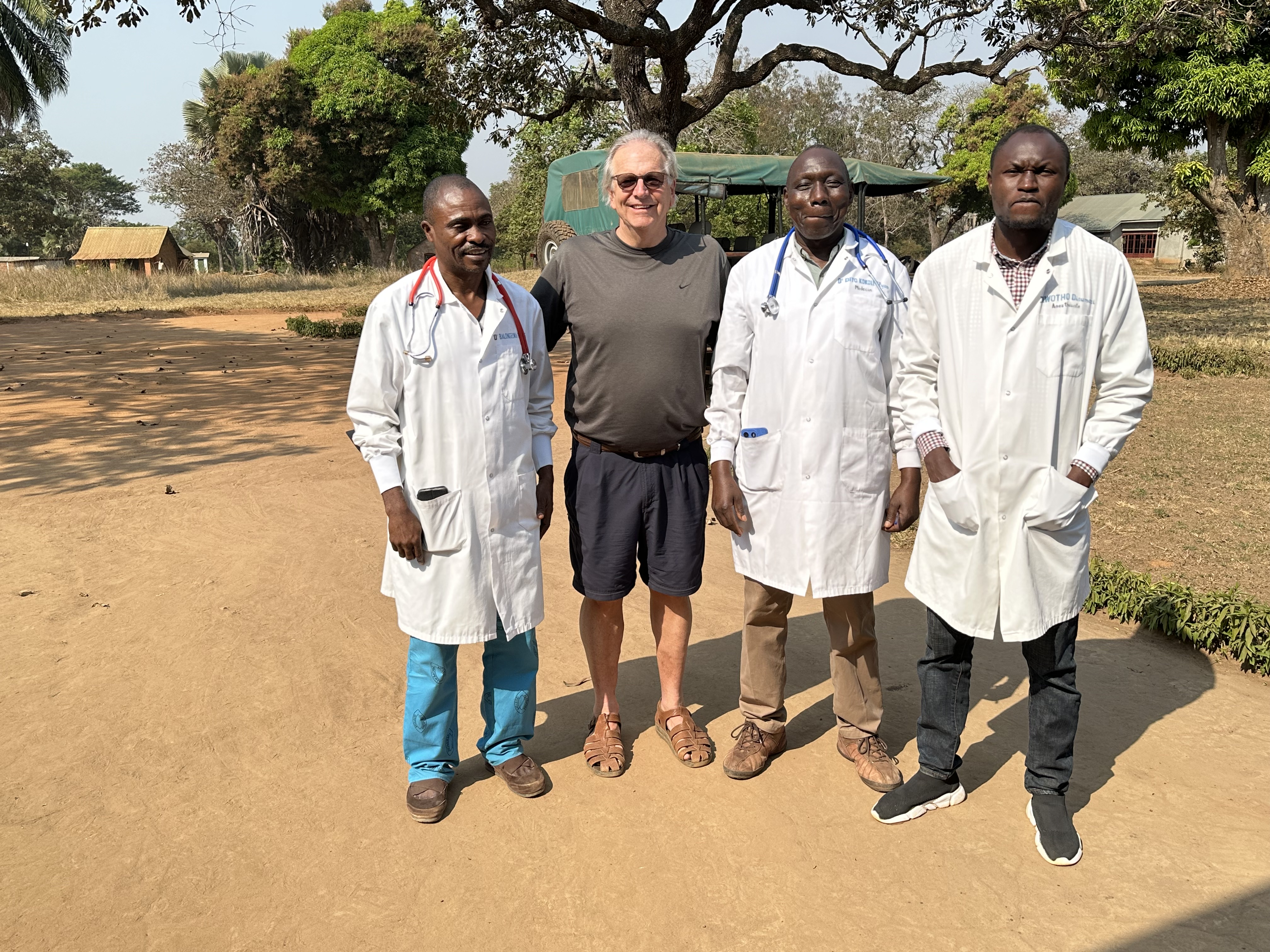
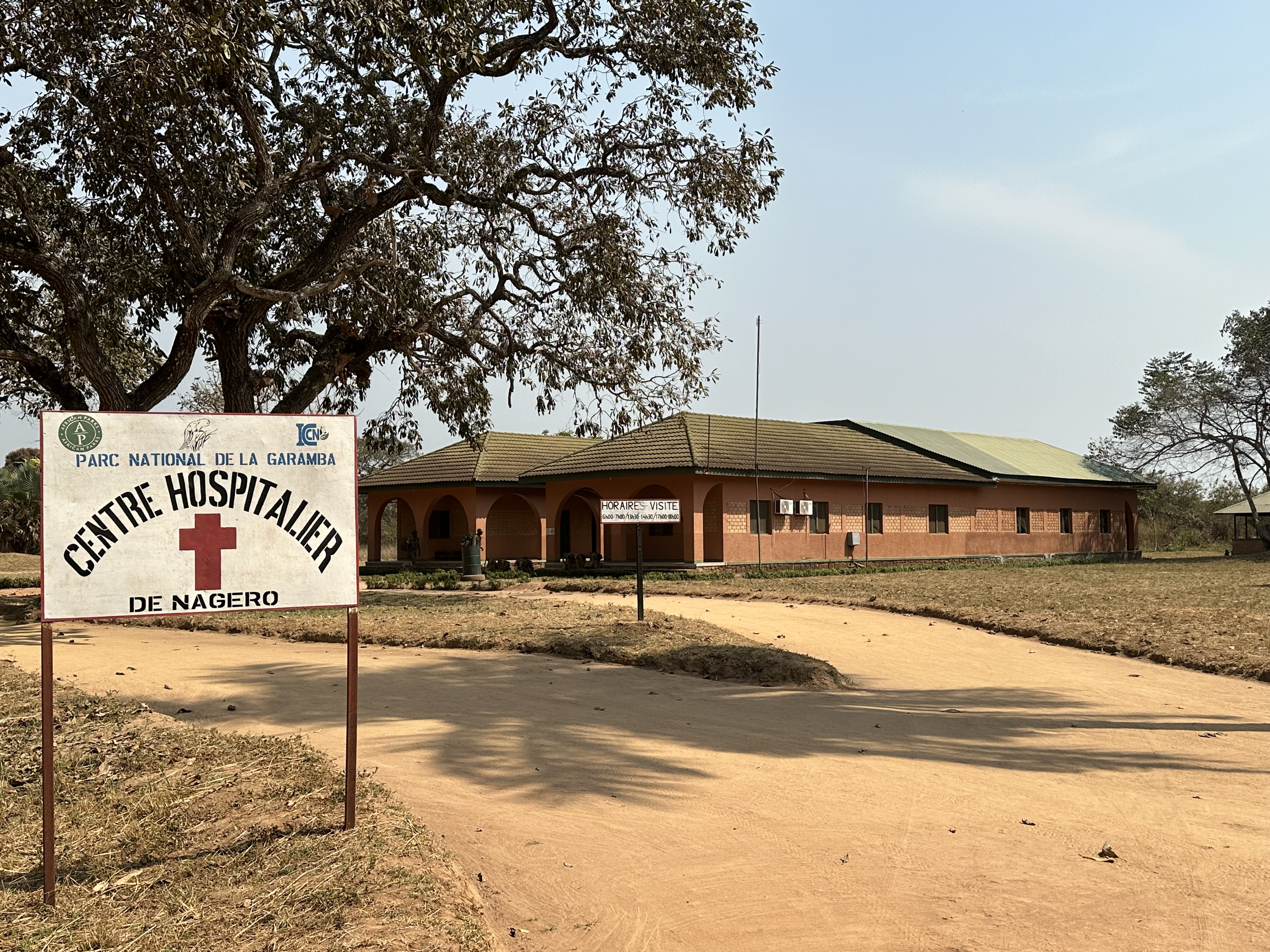
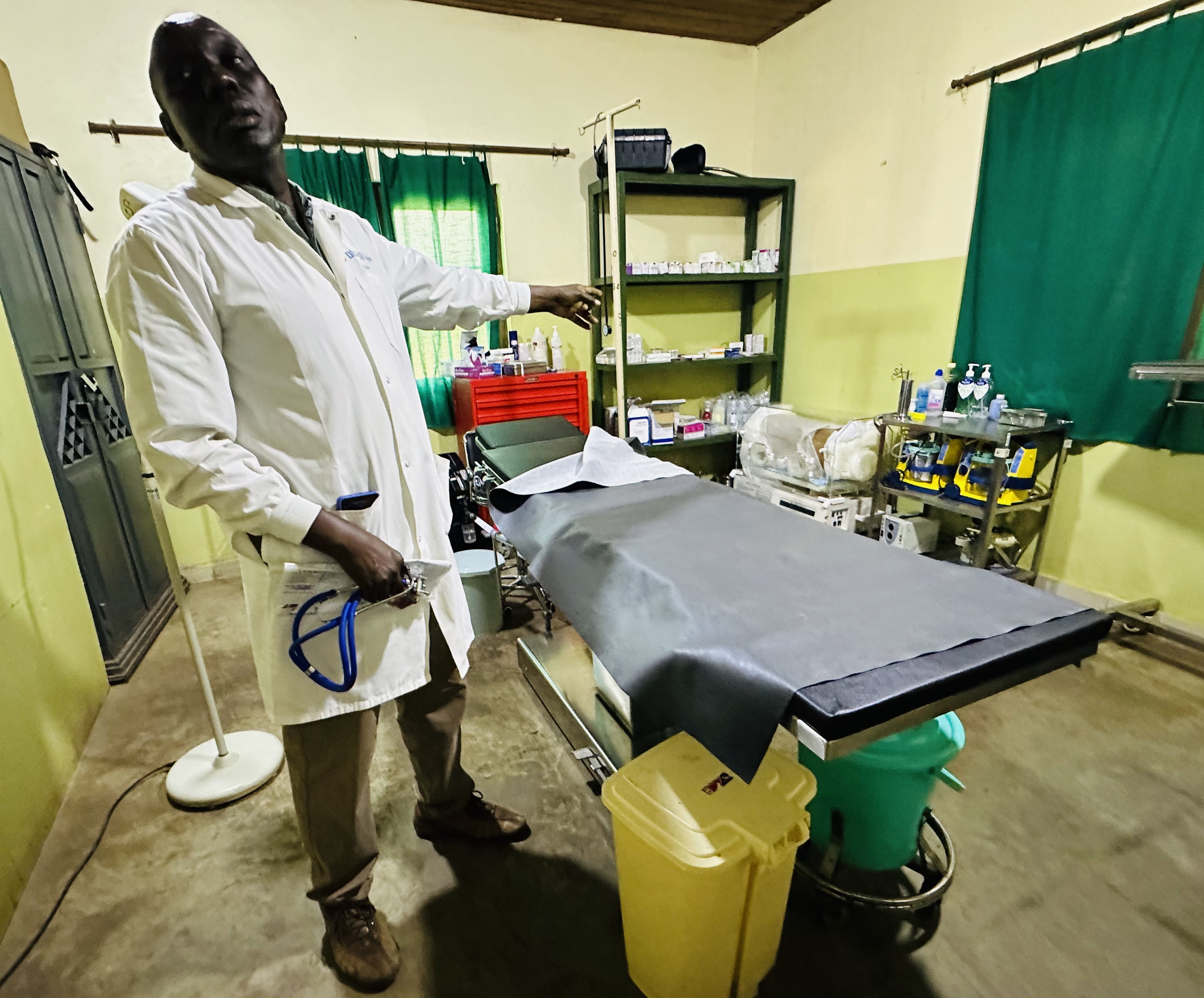
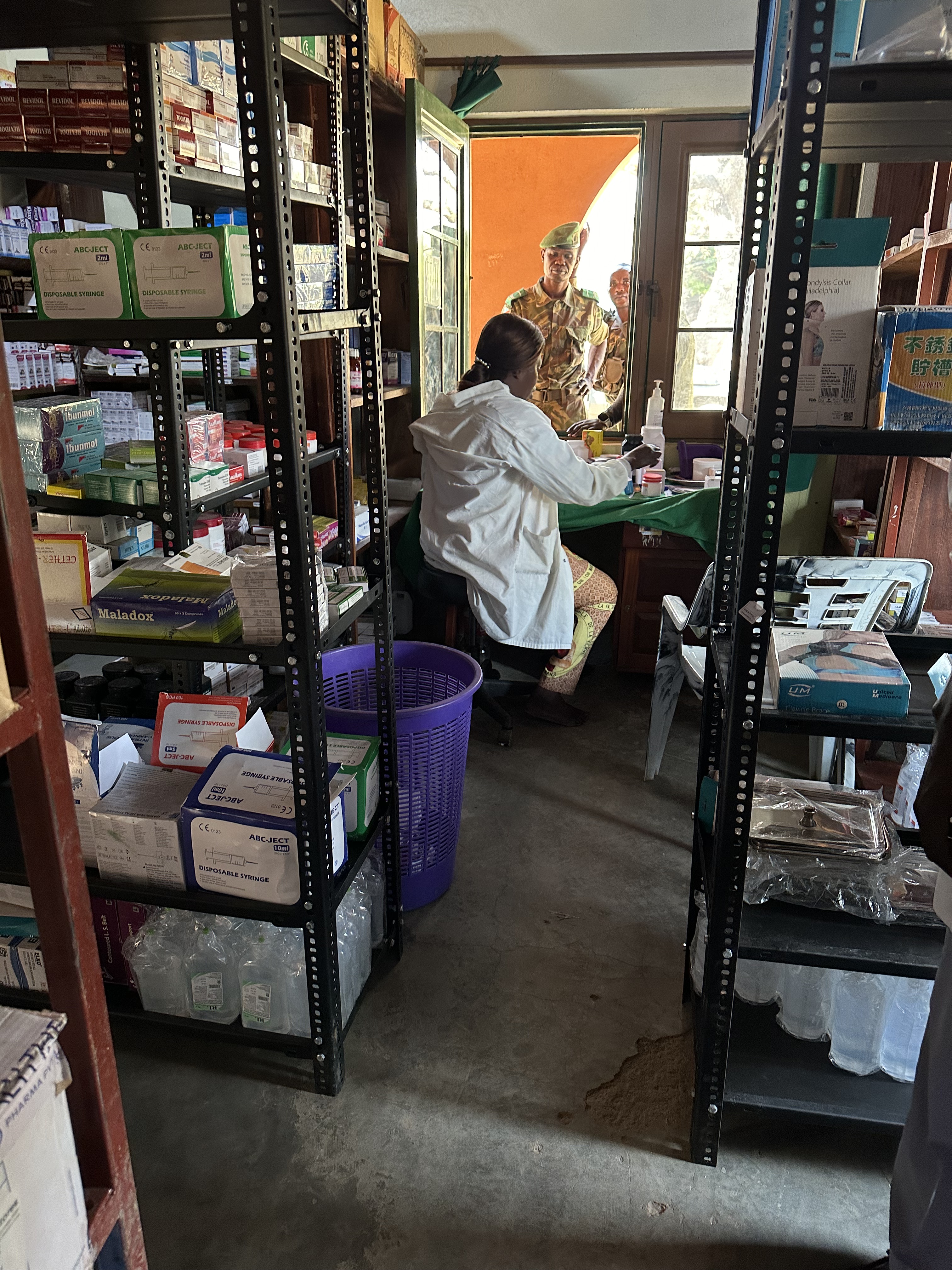
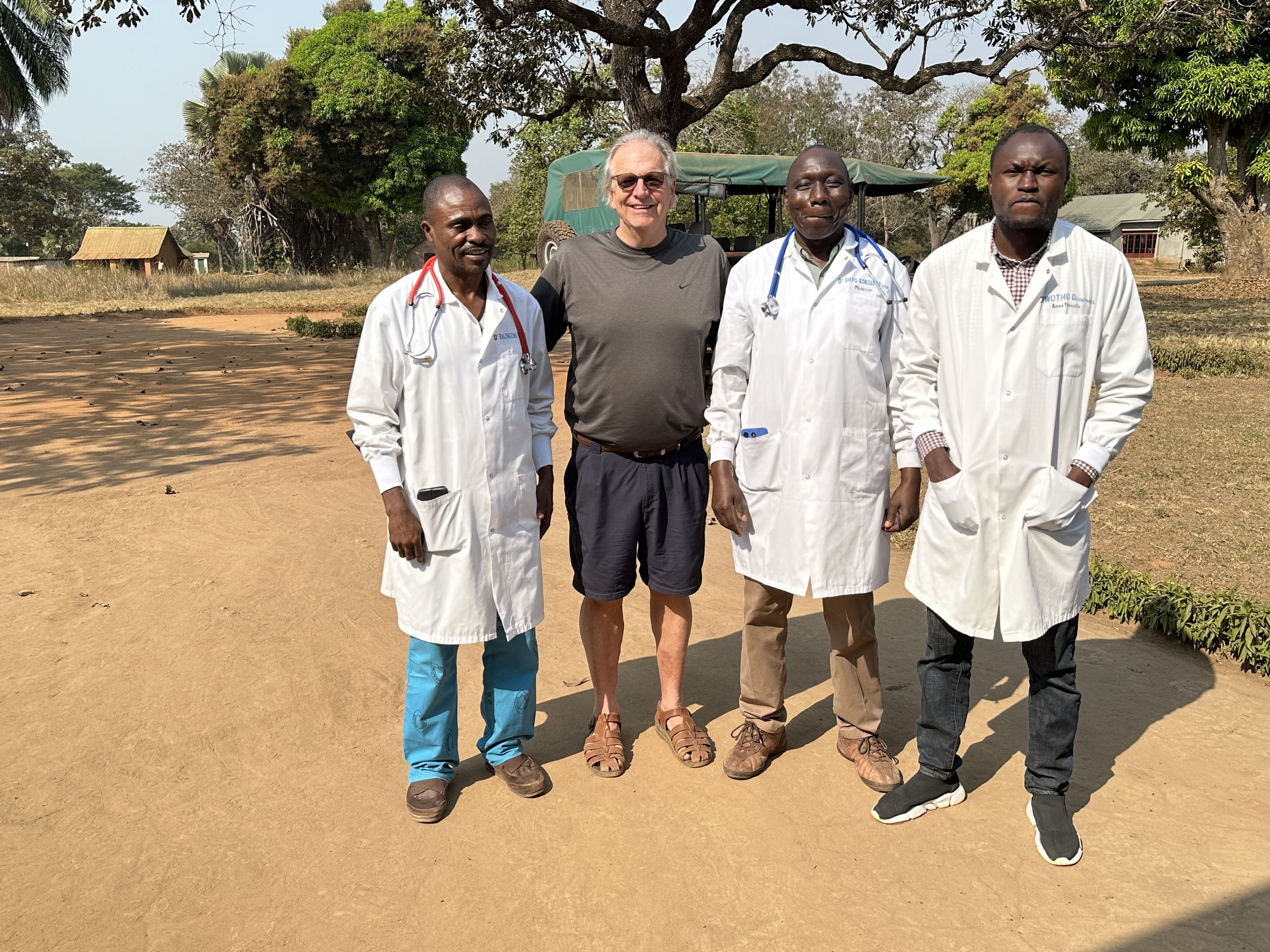
We departed Garamba National Park on the morning of the 27th after stopping at the hospital to ask the doctor about the sores on my tongue. He thought I had Candida and prescribed a mouth wash that worked almost instantly. He had also given Mark antihistamine for his heat rash and that was helping too. We got a tour of the small, 14 bed facility with one OR a small maternity ward and a pharmacy. There were 2 MDs, and a few nurses. The doctor told us there are 20 births a month in the hospital. Malaria is a big problem as he cannot get the people to use the bed nets he distributes. He gives them out and people sell them rather than use them.
We left a small donation for the hospital and drove to the airstrip. where we waited for the caravan to take us to Entebbe. It arrived at 10am. There was plenty of room for more people, so Martin joined us to Entebbe. We arrived there at 12:30 and were met by Jonathan’s driver, David, who dropped us off at Hotel No. 5 in Entebbe. It was nicer than the Protea, where we usually stay, but it did not have a view of anything, and we missed seeing Lake Victoria from our room. We both took long showers. Then Mark chilled for the rest of the day as I worked feverishly to get the Garamba post finished. The wi fi had been problematic the entire time we were in the National Park and I had not been able to do much until we were back in Entebbe. I finally made good progress and we went to dinner. Pizza and pasta were the foods we craved. Then bed.
January 28,2024
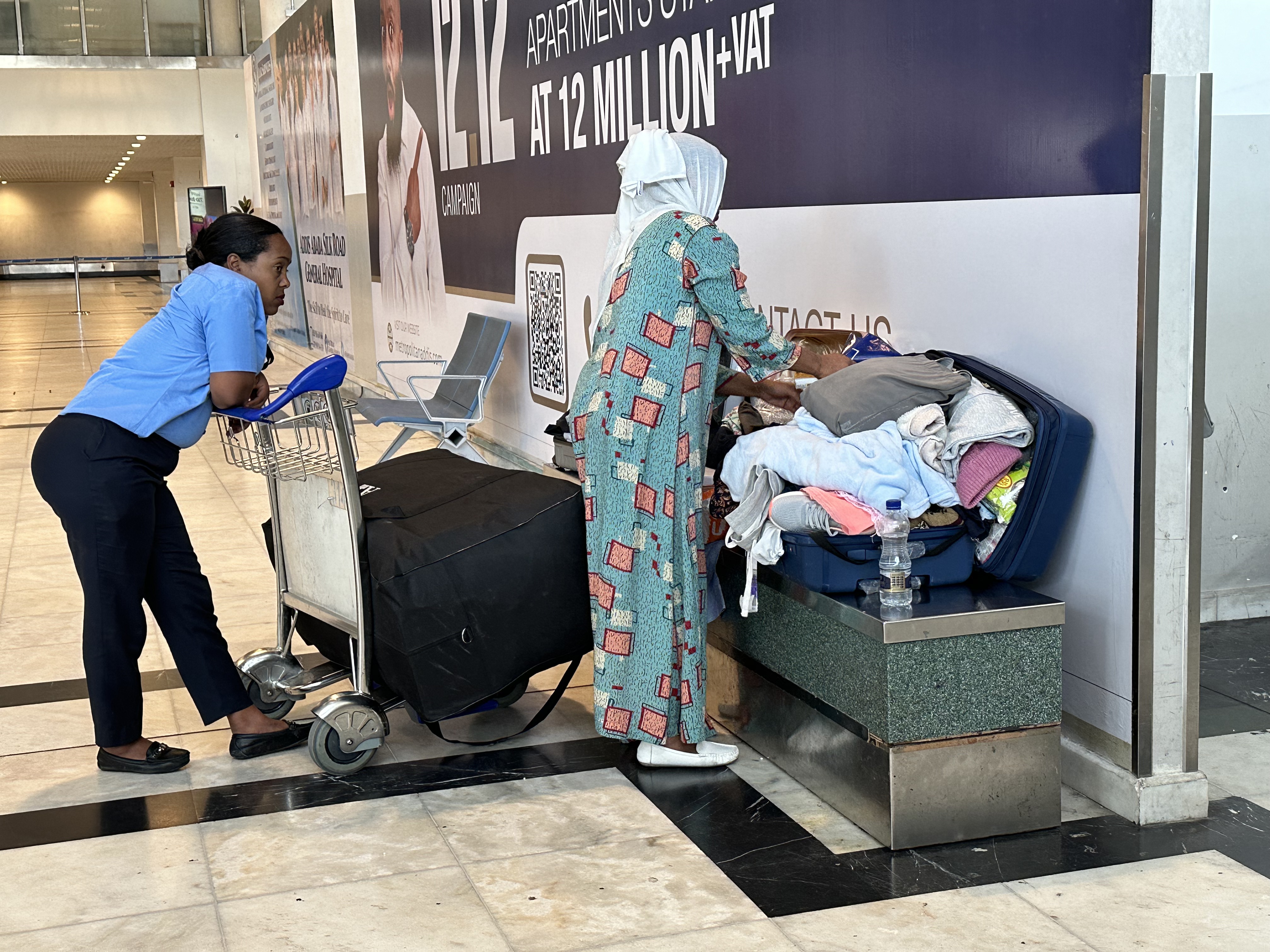
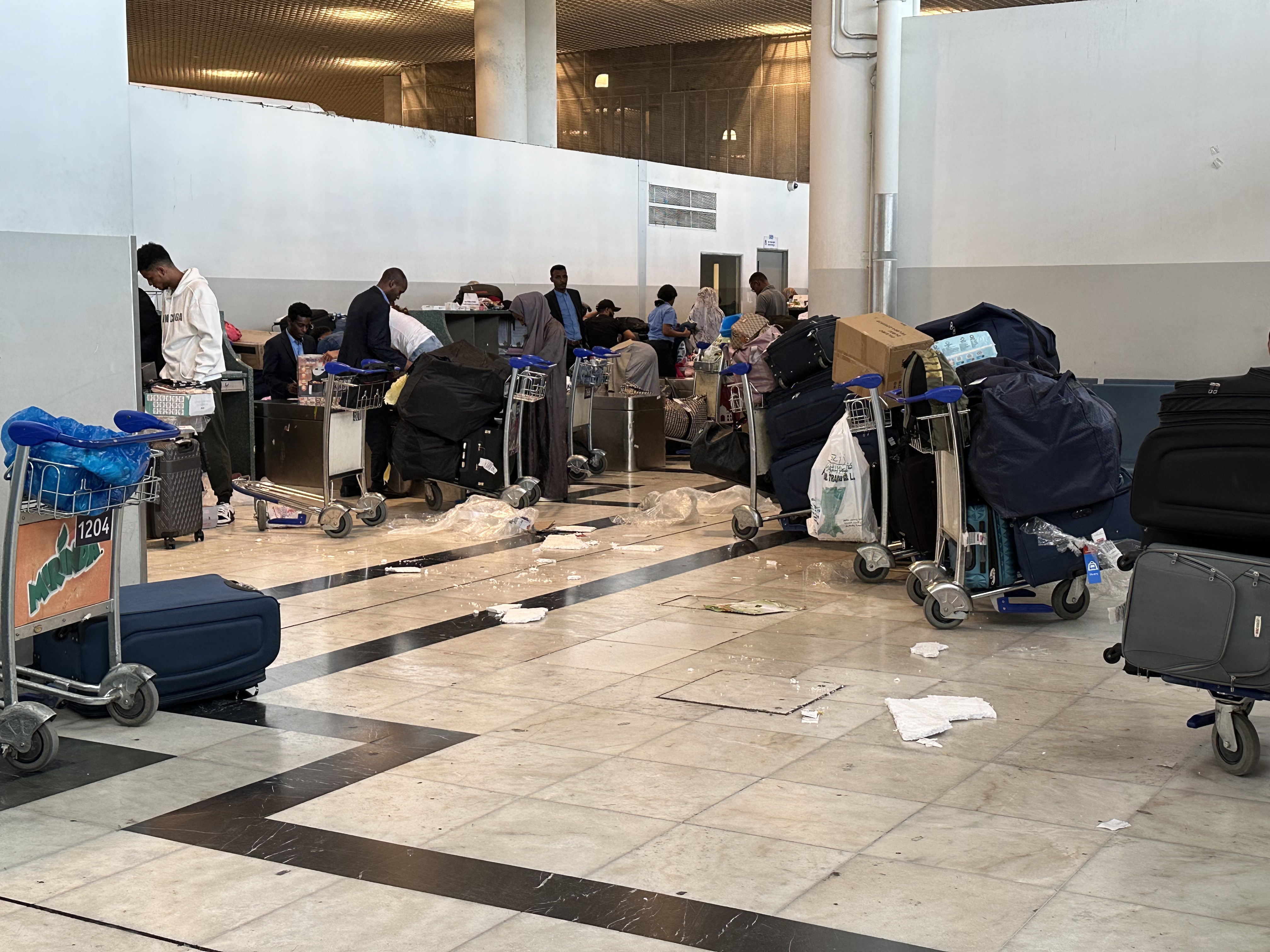
David picked us up at 8:30 and took us back to the Entebbe airport for our 11am Ethiopian Air flight to Addis Ababa, which, at 7520, is the second highest elevation airport in the world. There we were met by a facilitator, Mr. Lewl. Good thing, as I did not have a visa, despite Marks efforts before we left home. We went through some hoops at the airport and finally, at much expense, I had a visa. The next problem was our binoculars. Although we had prepaid the fee to bring both pair, the officials would not allow Mark’s binoculars into the country, as they were too powerful and the requirements had changed to dis-allow them. So, after 2 hours of hassle, we left his at the customs office and took mine. While we waited, I watched lines of people get all of their bags ransacked. What an ordeal.
Once outside the airport we met Will, our guide and owner of Journeys by Design, his assistant Ben, and a driver. They had waited patiently and drove us to the Hyatt Regency for one more first-class hotel night before heading into the bush. While hanging out in our room, I finished the Garamba post, Mark edited it and then we published it. With that project done, we joined Will in an Asian Restaurant and started learning more about the Omo River and our journey.
The lower Omo Valley of southern Ethiopia is home to some of the world’s least changed cultural groups. The area is a melting pot of cultures and communities and represents some of the greatest genetic variance on the continent. It is sometimes described as the birthplace of mankind, and it is not hard to see why.
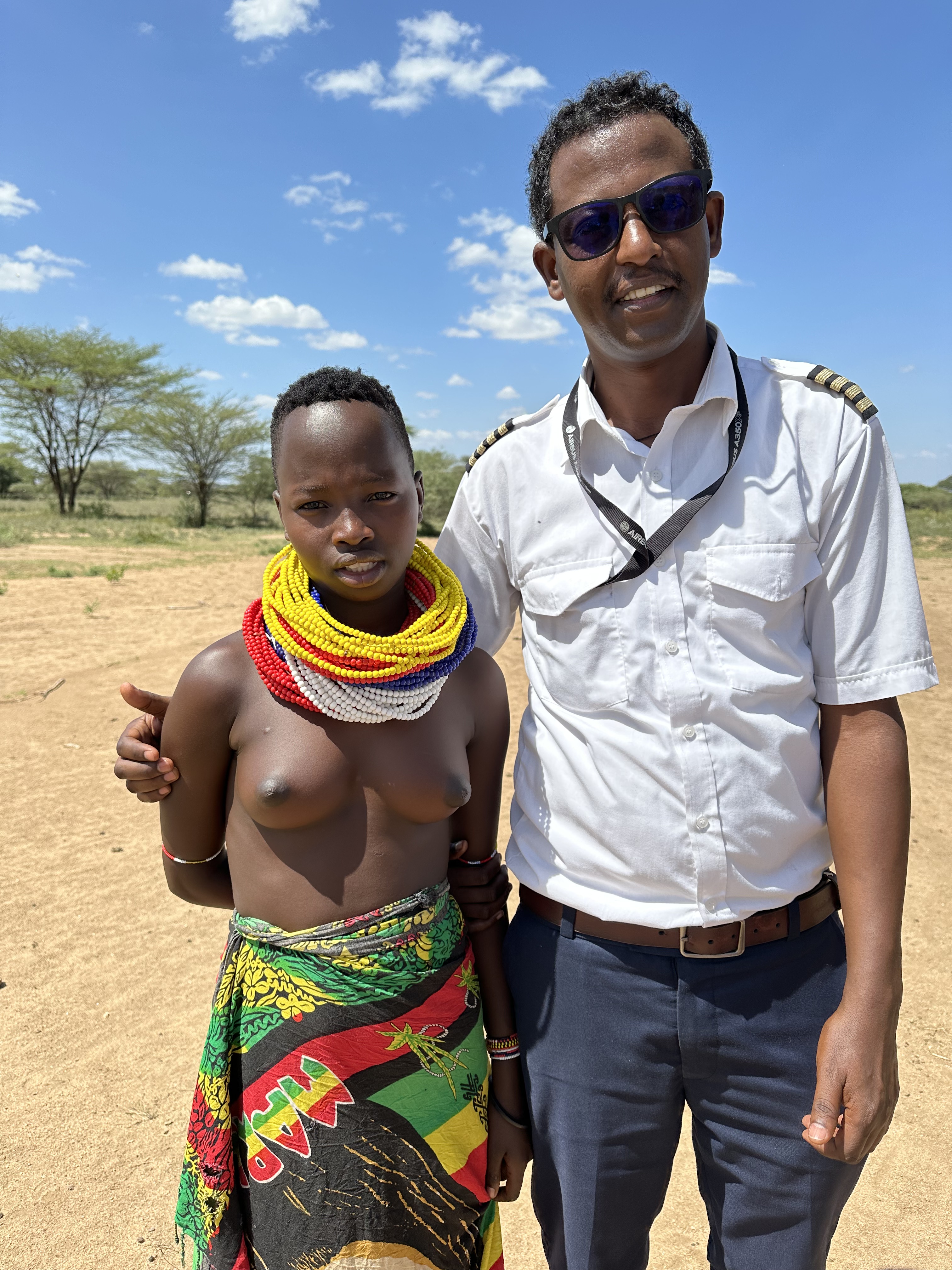
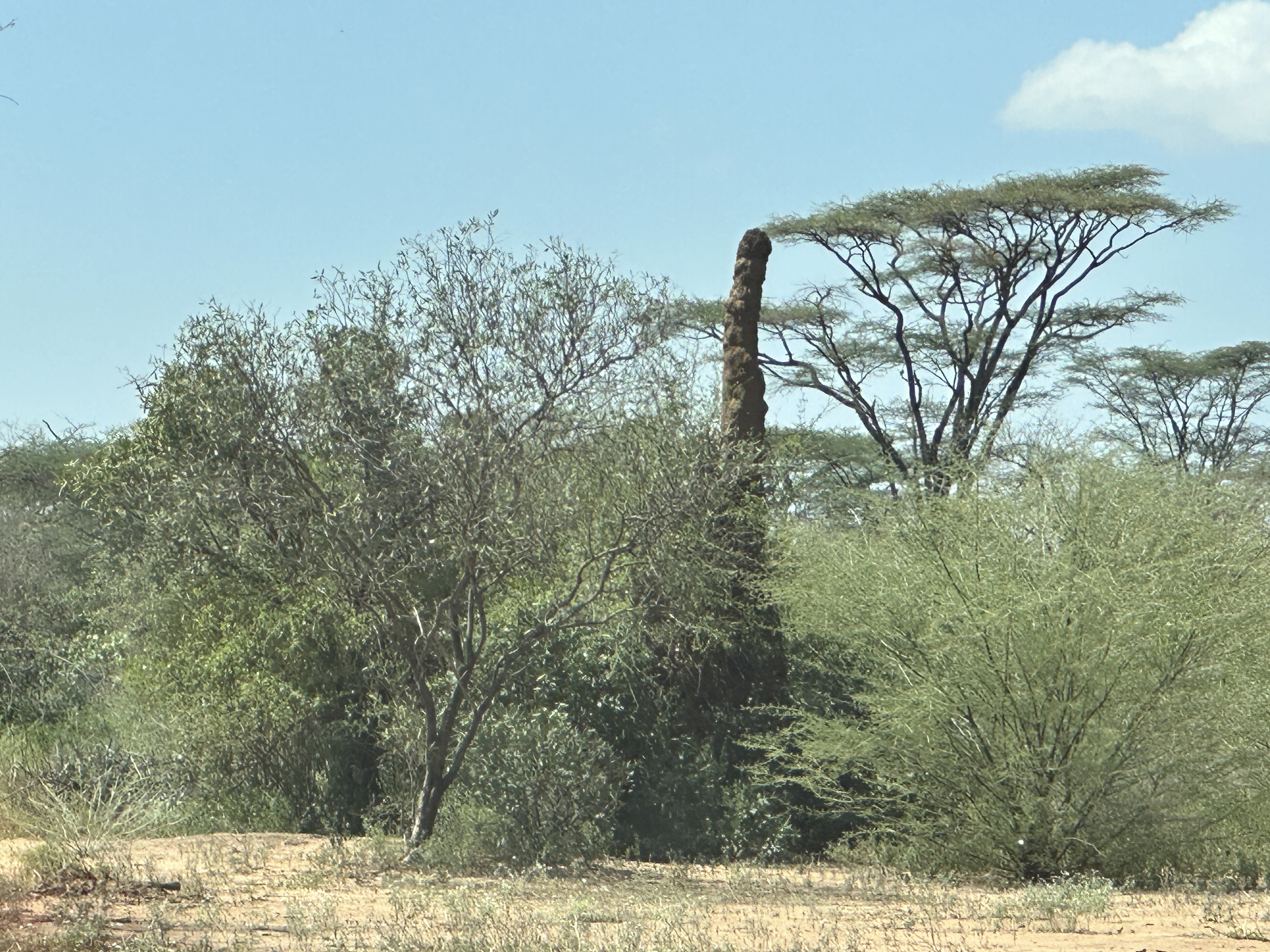
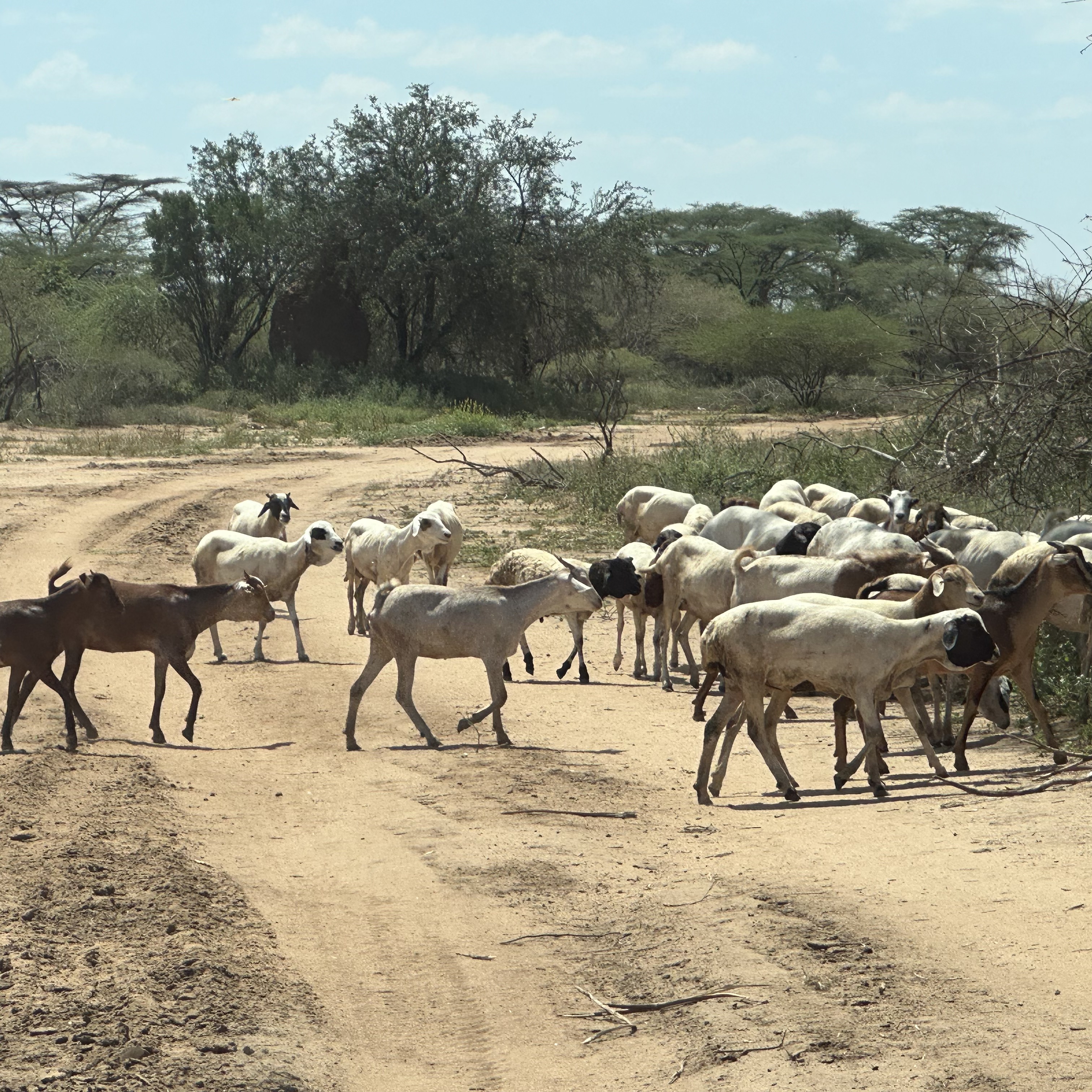
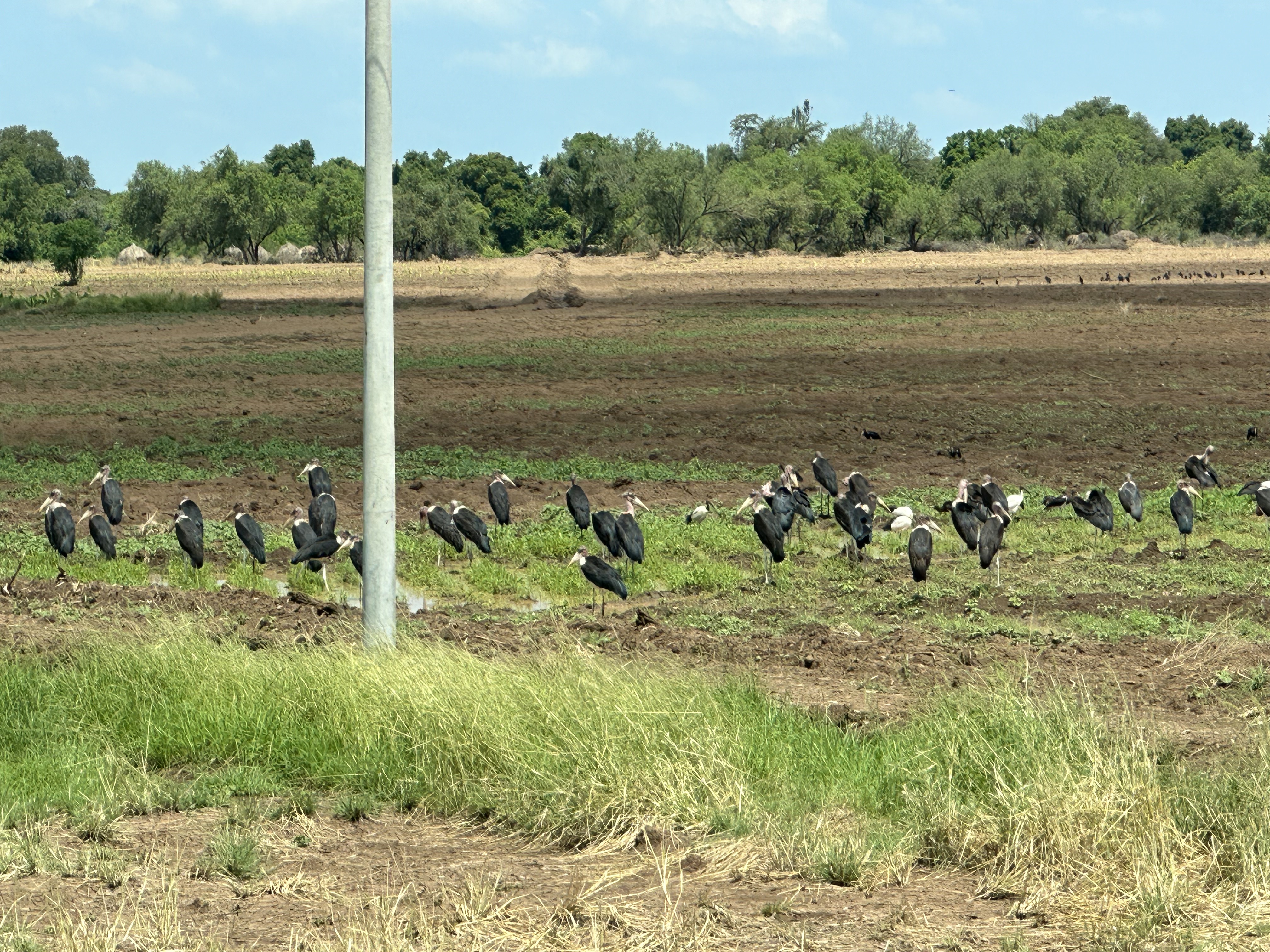
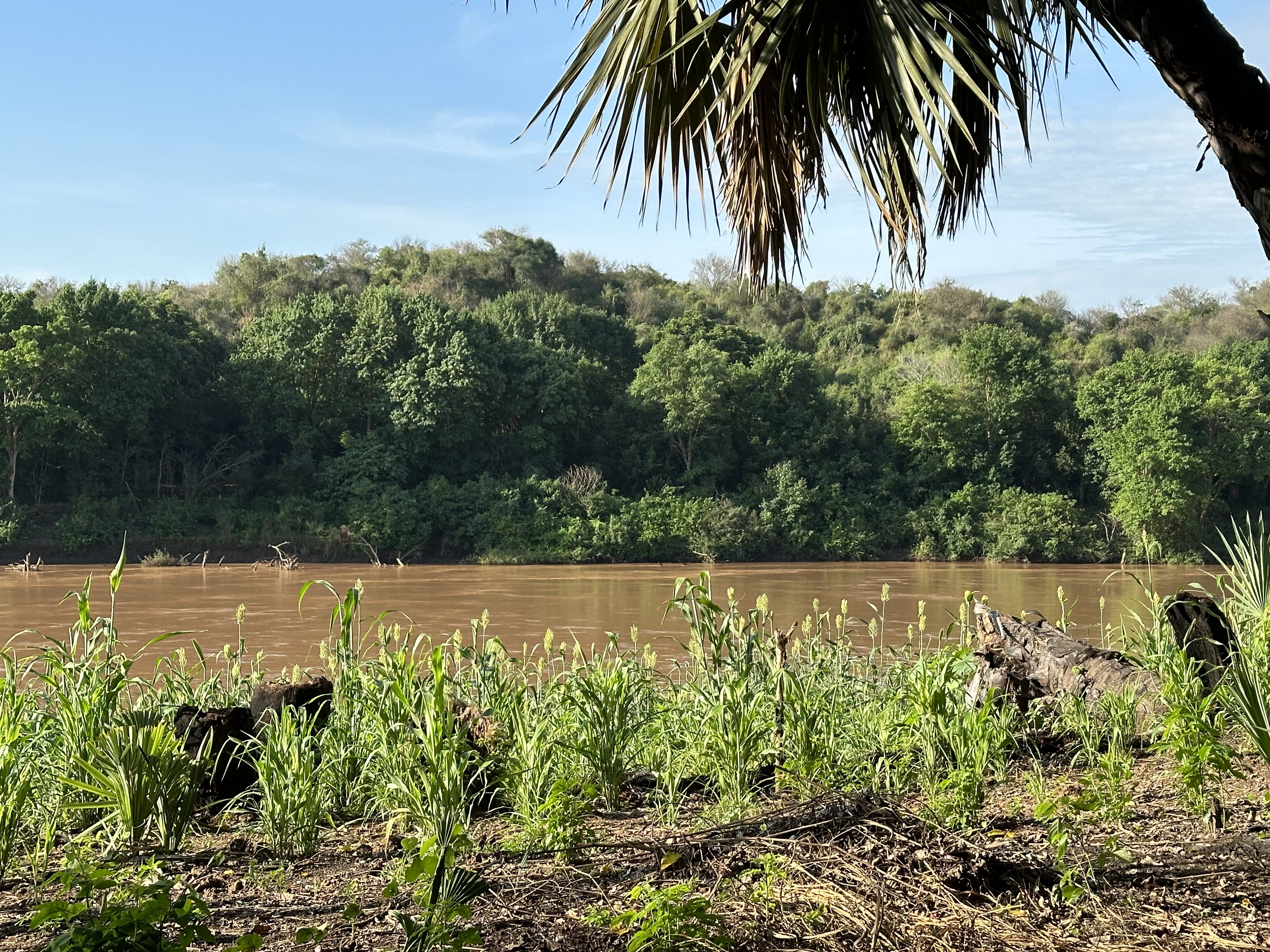
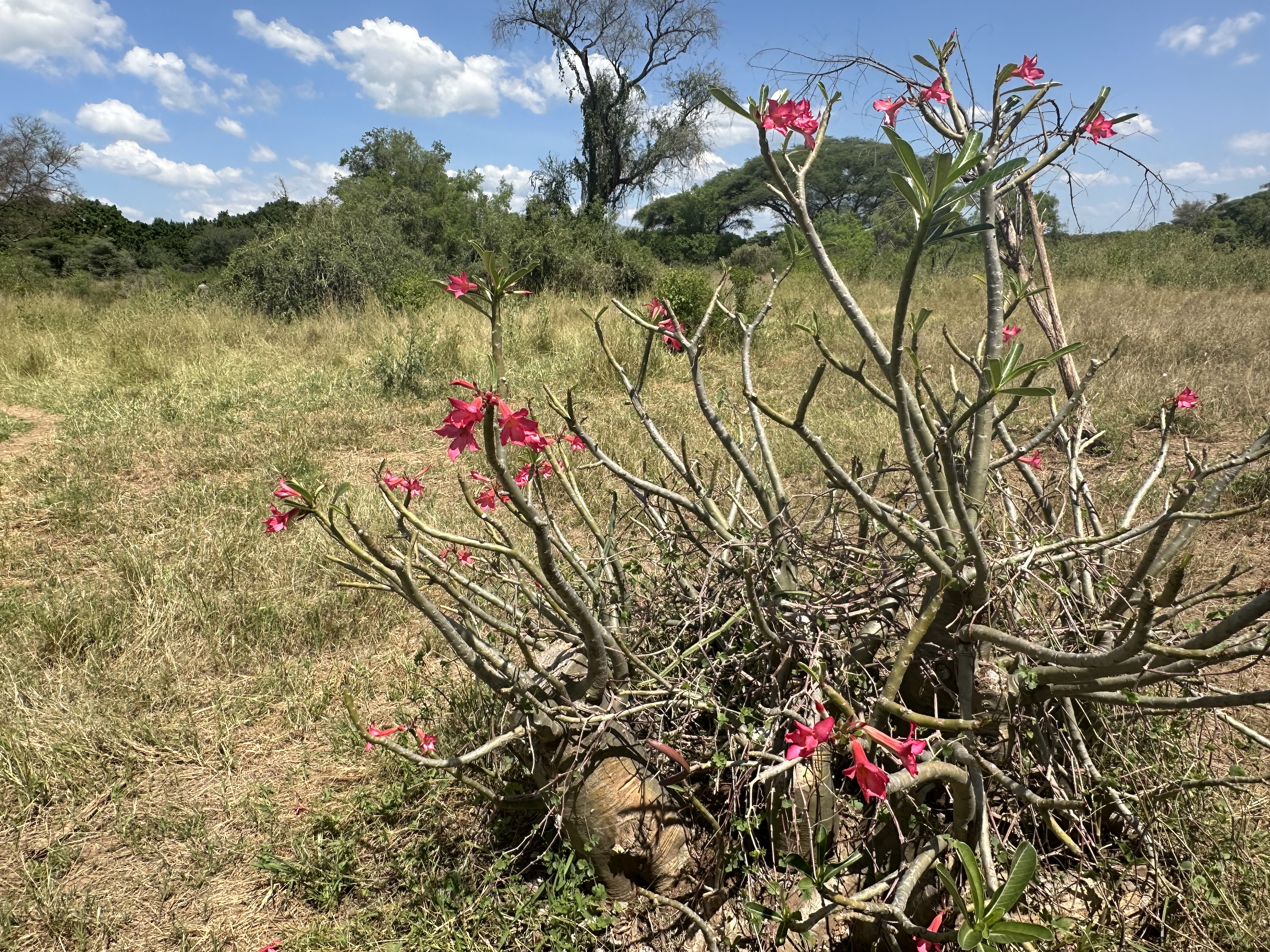
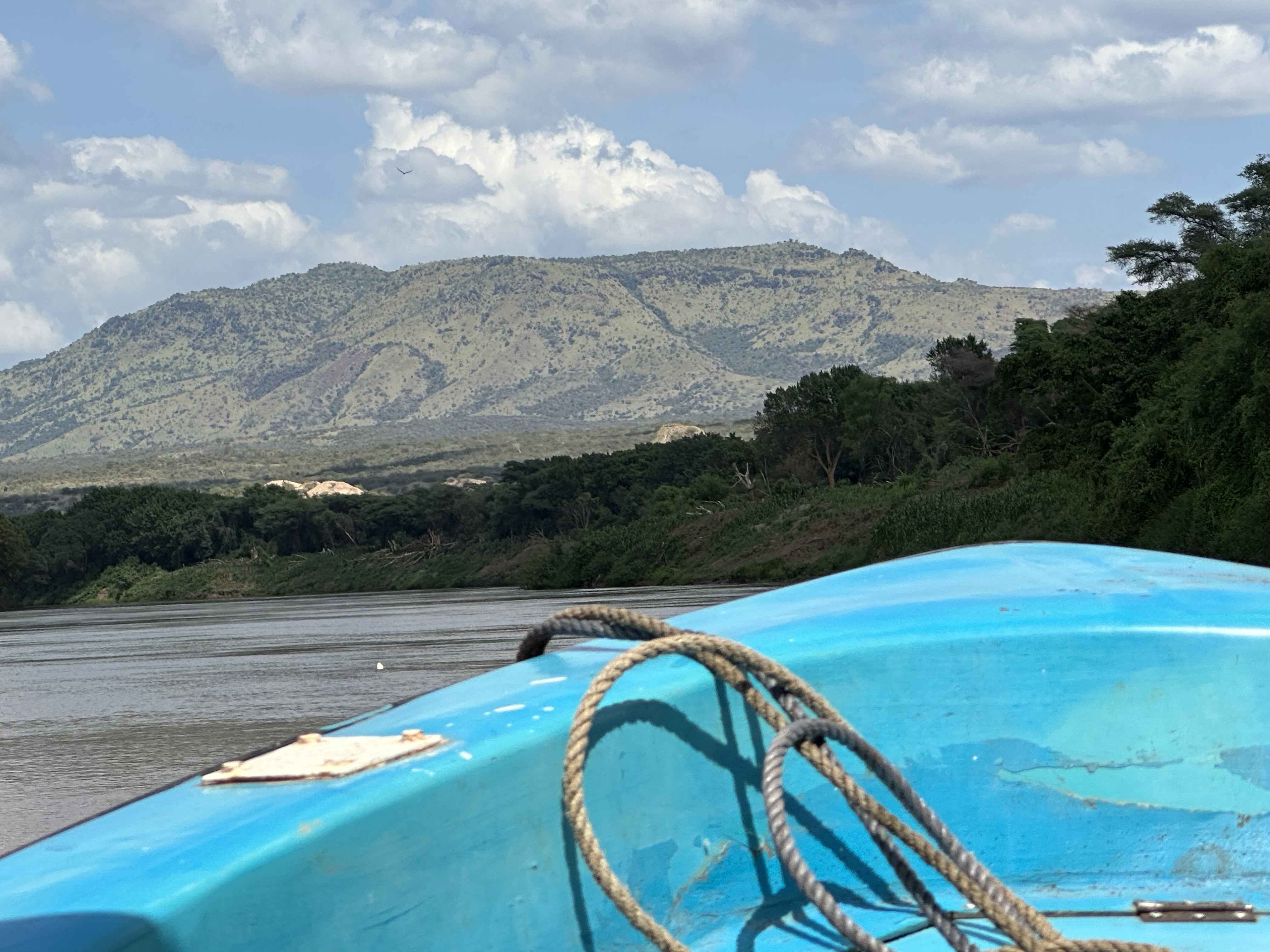
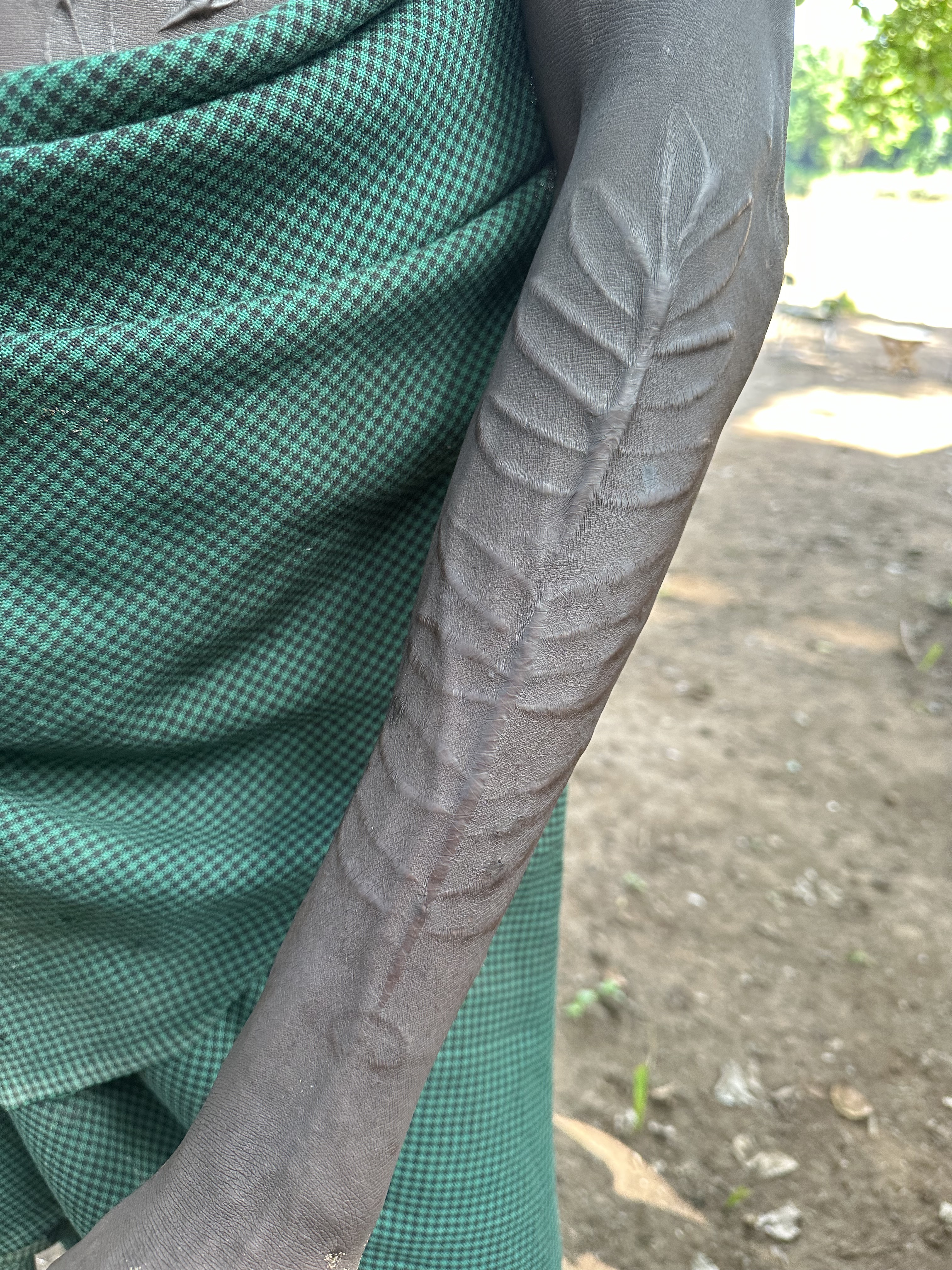
Known for their painted, pierced and scared bodies, the people of the Omo River Valley, tucked deep in the country’s southwestern corner, are some of the most unique on the African continent. Over 40 tribal groups live remotely here. Following in the footsteps of their ancestors, they are known for their cultural traditions and interaction with the physical environment—a lifestyle in harsh and unforgiving landscapes. Today for example, the temperature is above 100 degrees F. as it was yesterday and will probably be tomorrow and weeks to come. The Omo River is a lifeline for these tribes. Here are some images of our first day in the Omo Valley–a typical termite mound, goats on a typical road, white-backed vultures in a freshly planted field, sorghum growing along the banks of the Omo, a desert rose bush, our boat on the river.
The tribes rely on the river’s natural flood cycles for farming, fishing and grazing. The lower Omo Valley is very beautiful with diverse ecosystems including grasslands, volcanic outcrops and one of the few remaining pristine riverine forests in semi-arid Africa which supports a wide variety of wildlife.
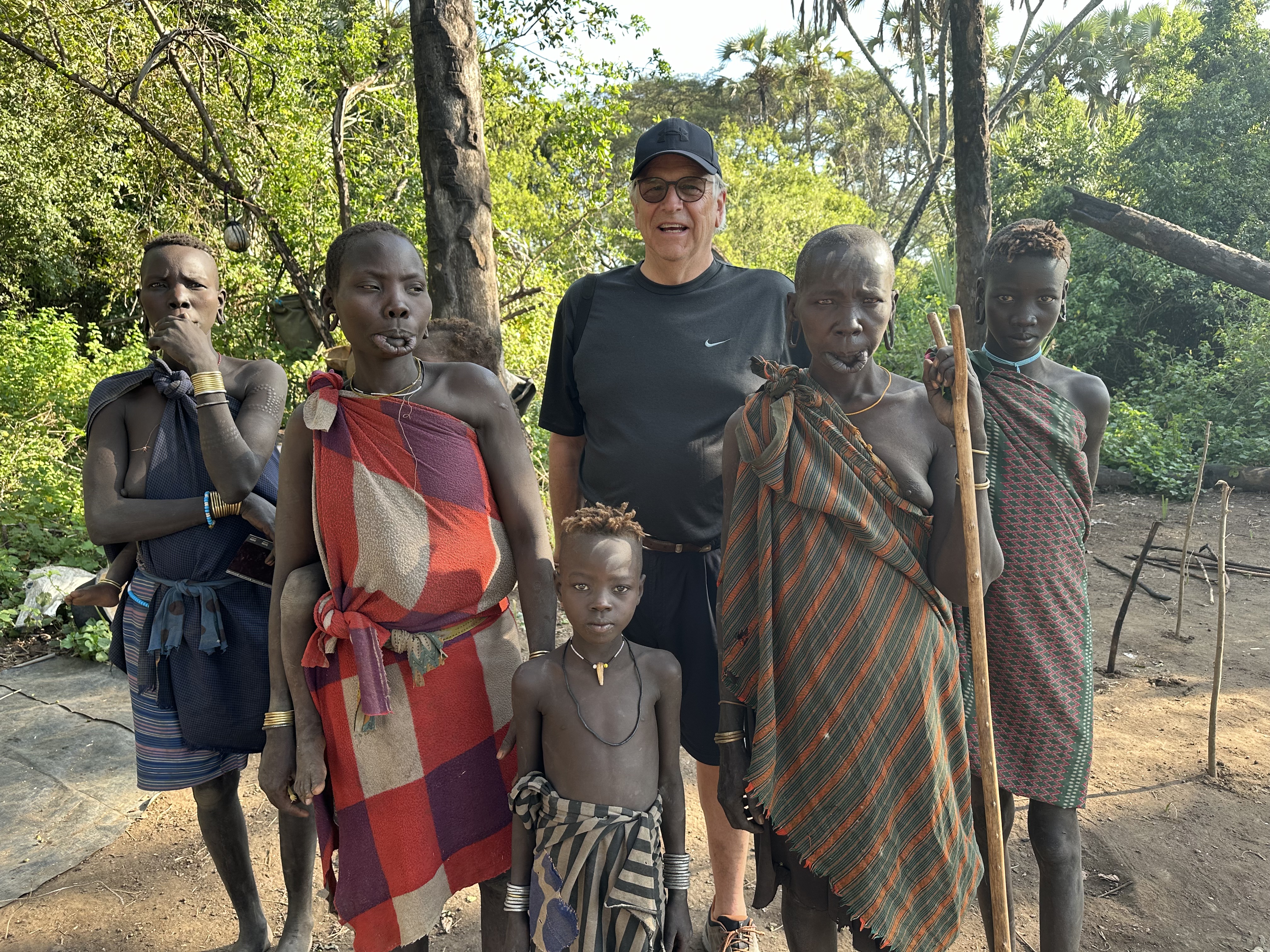
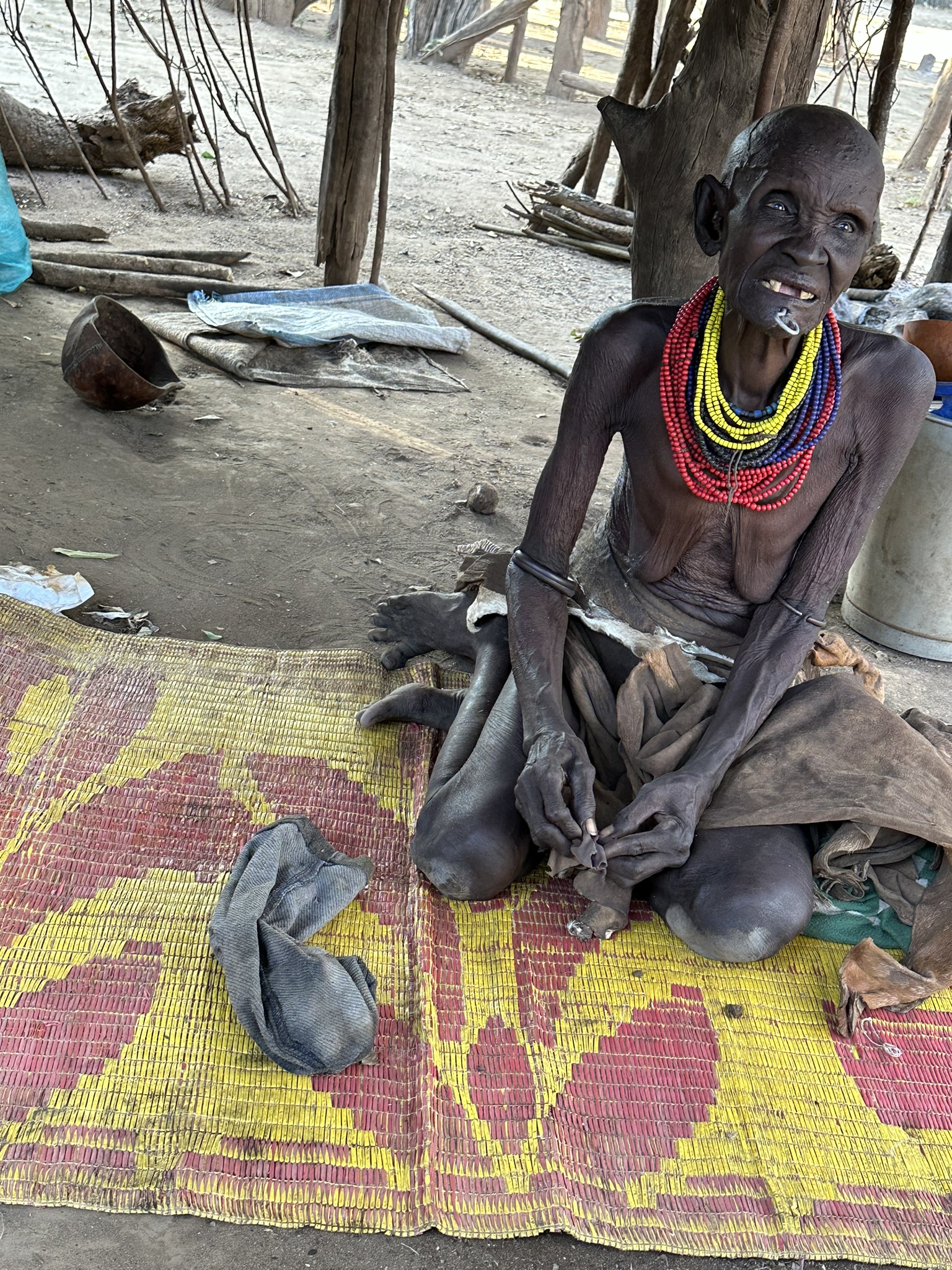
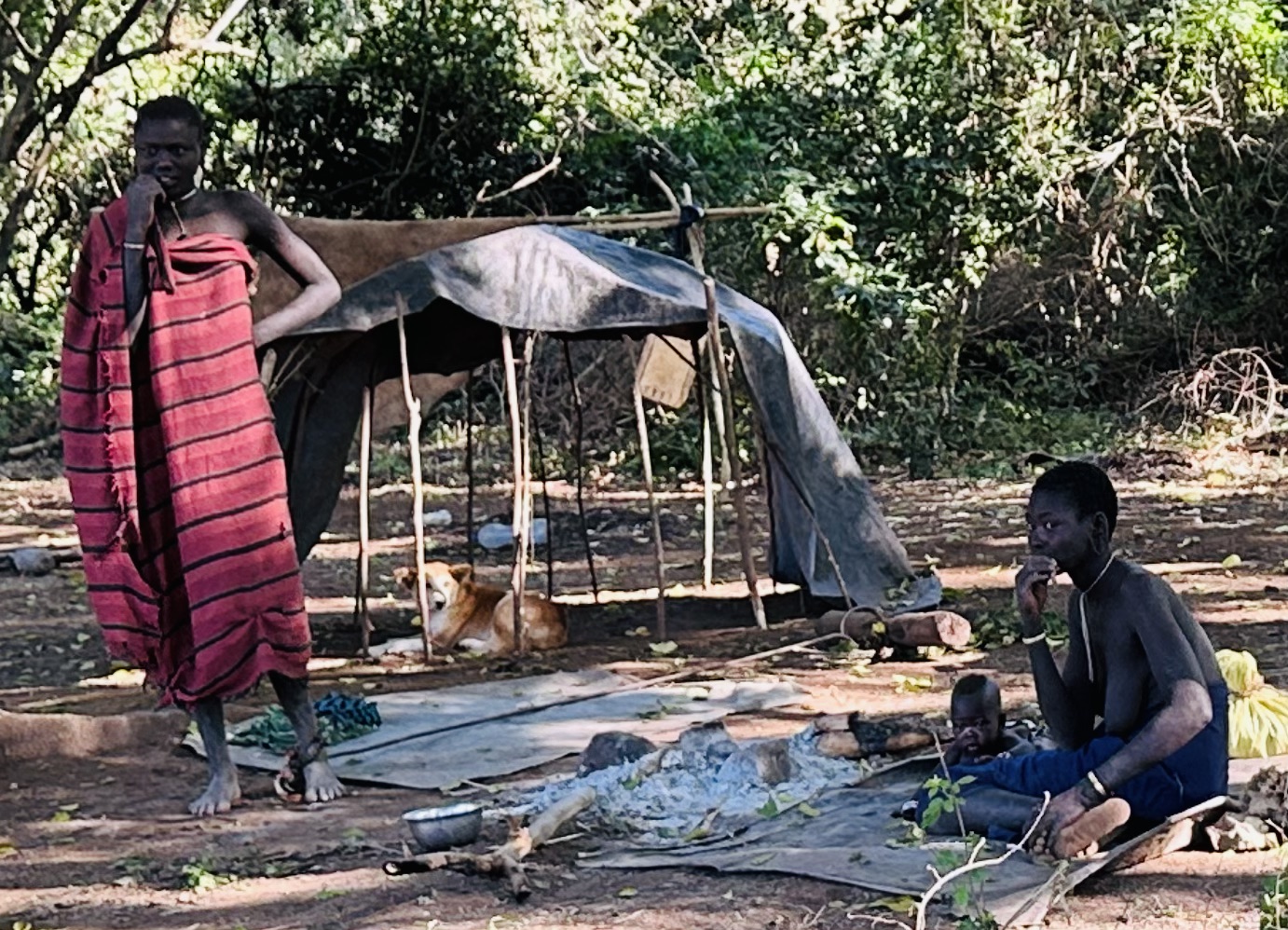
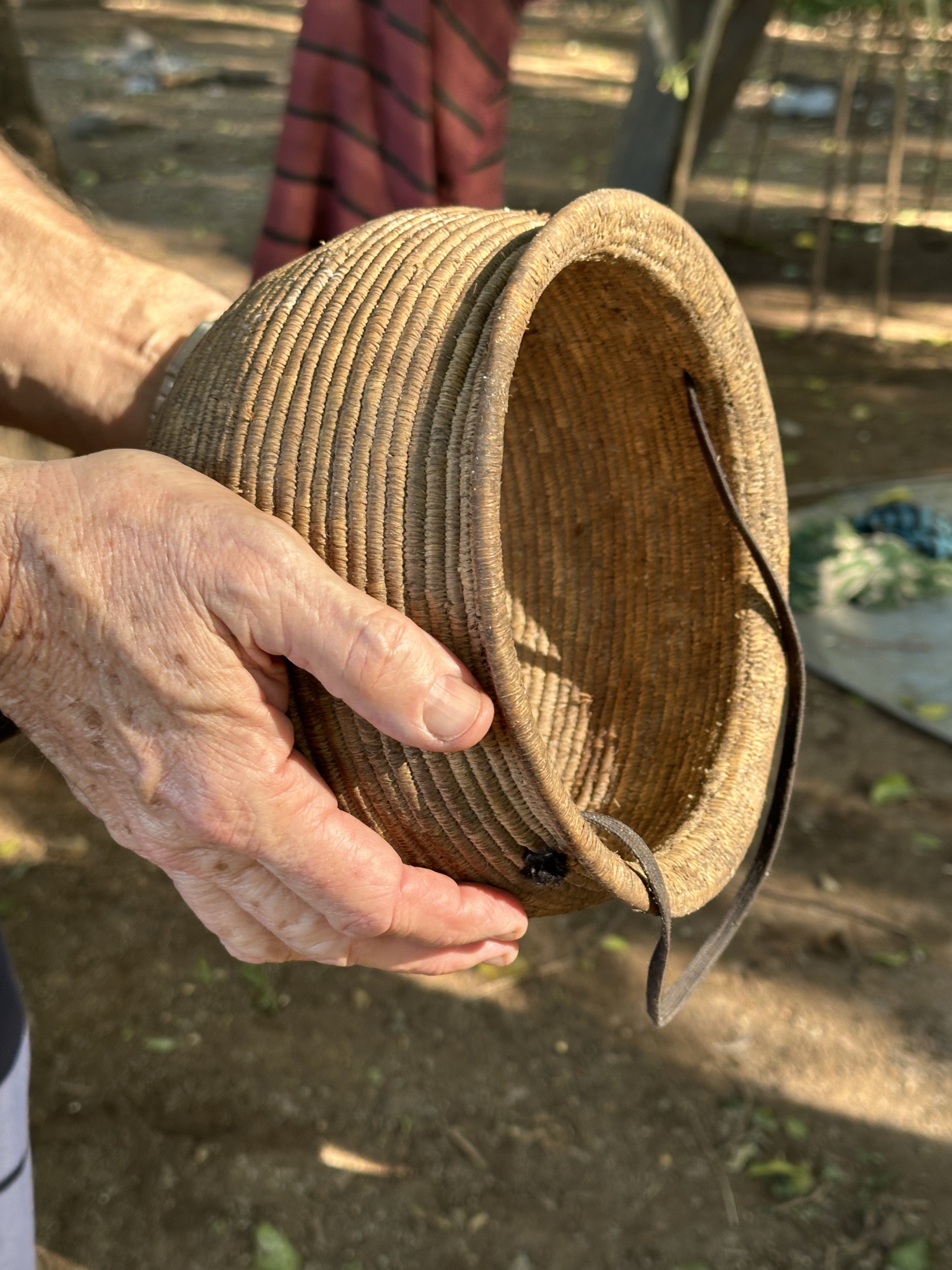
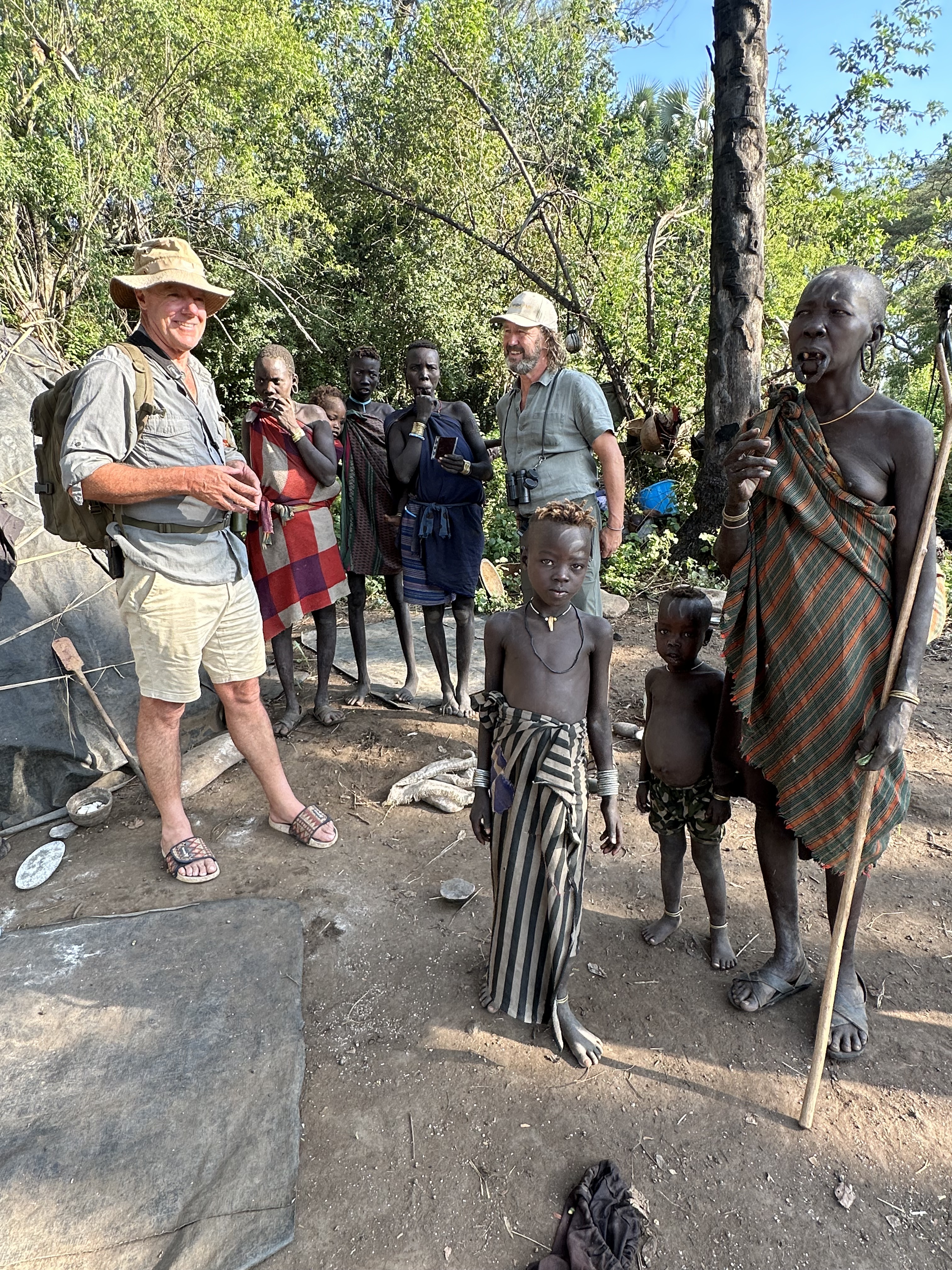
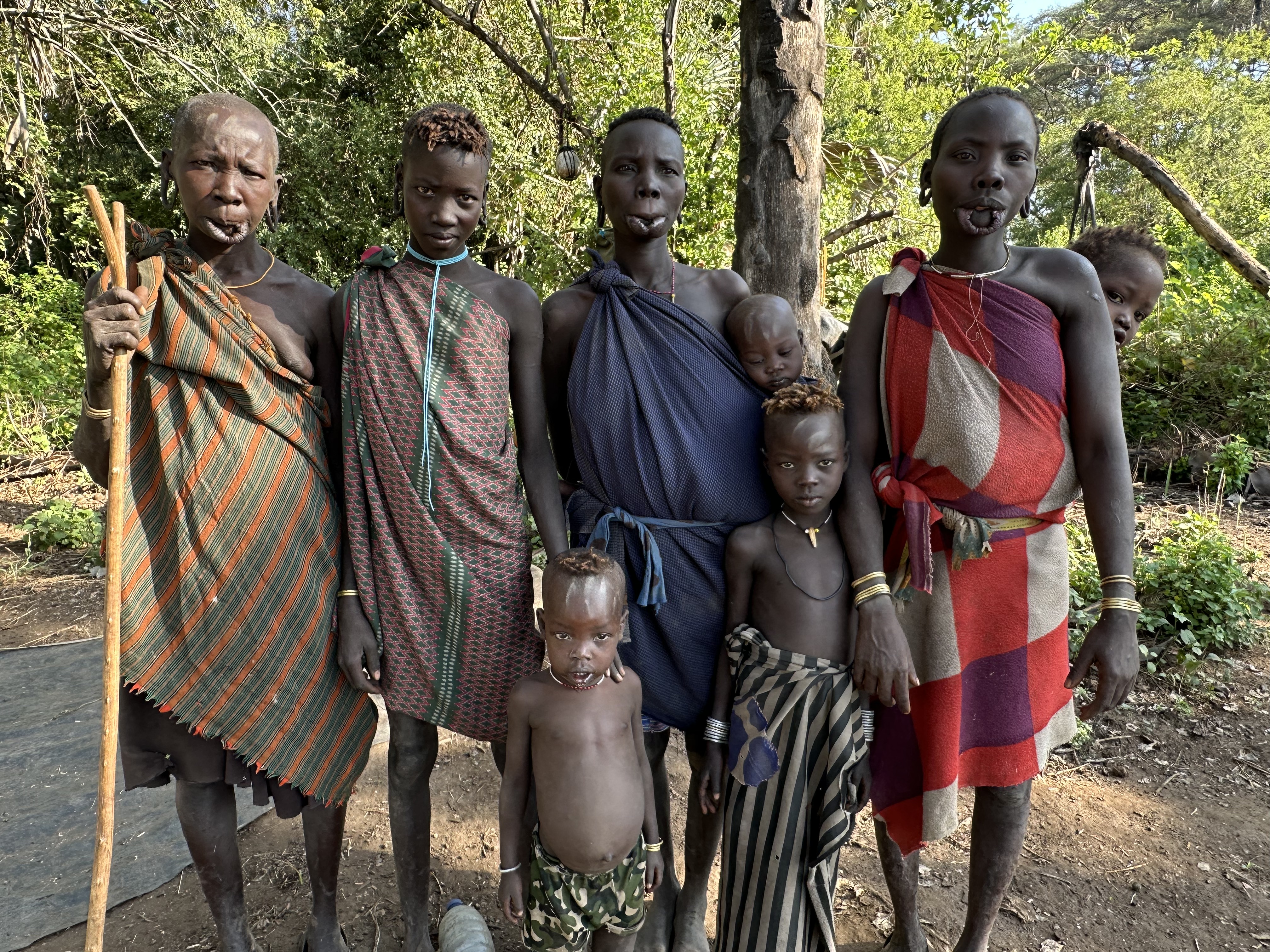
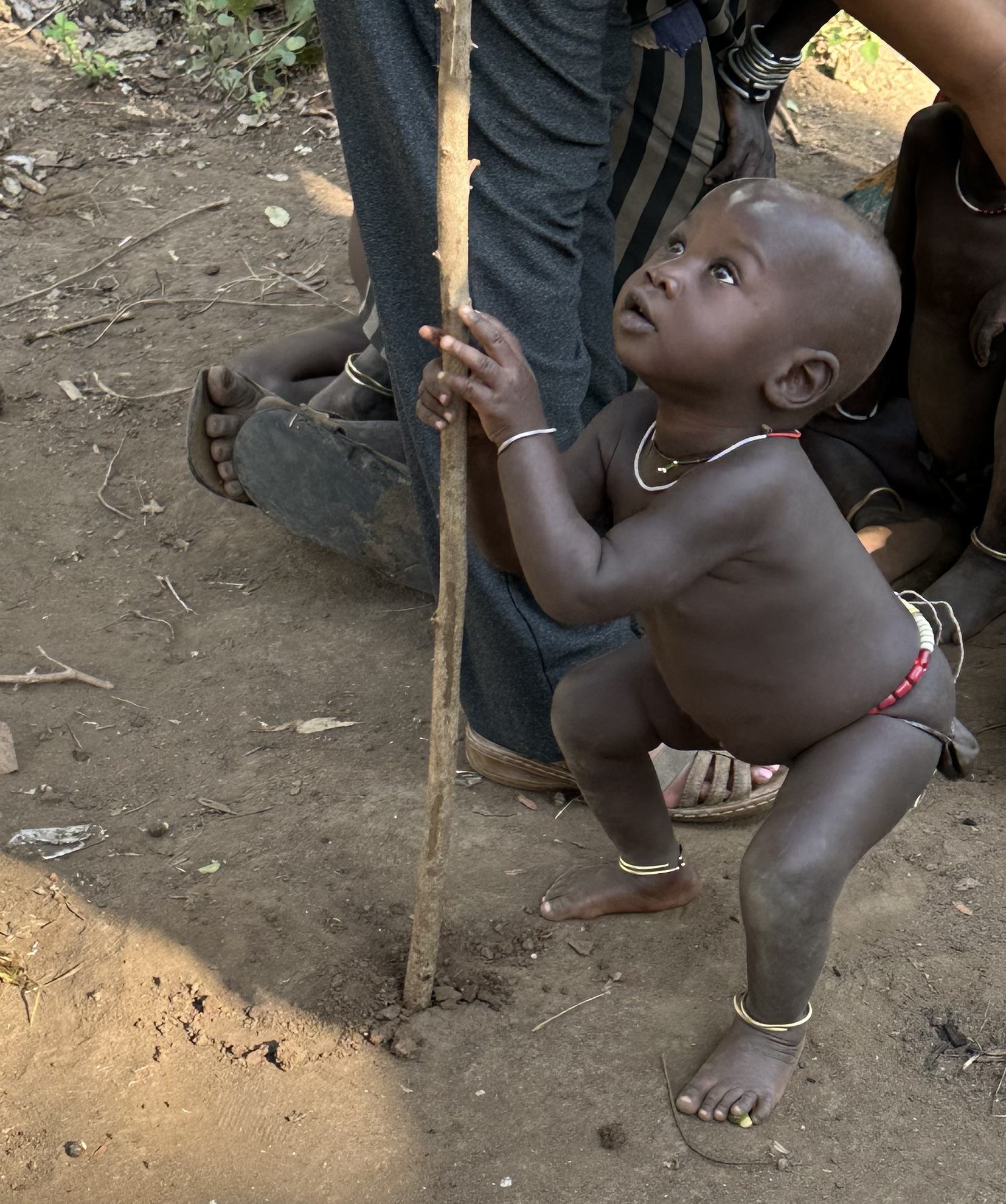
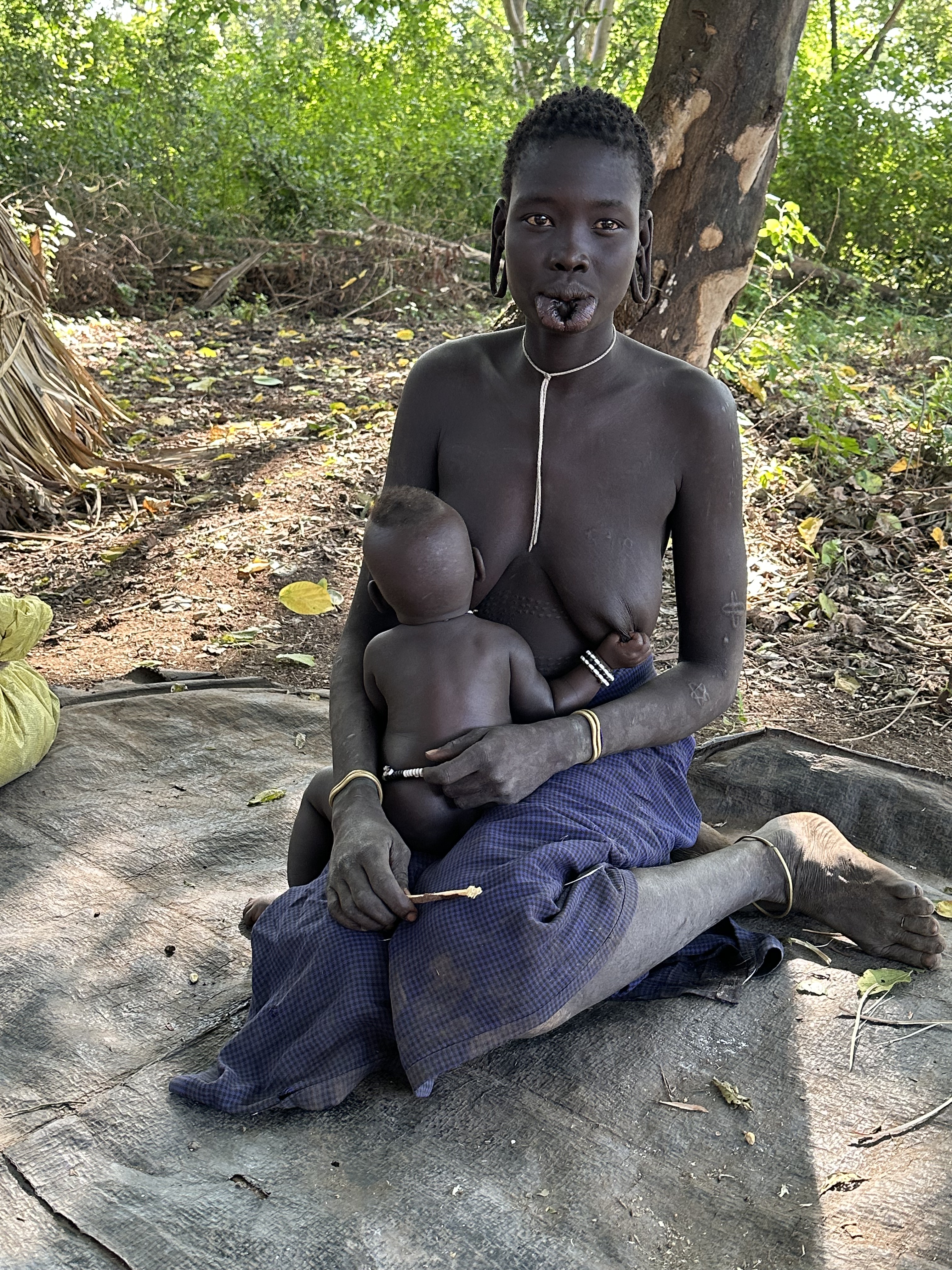
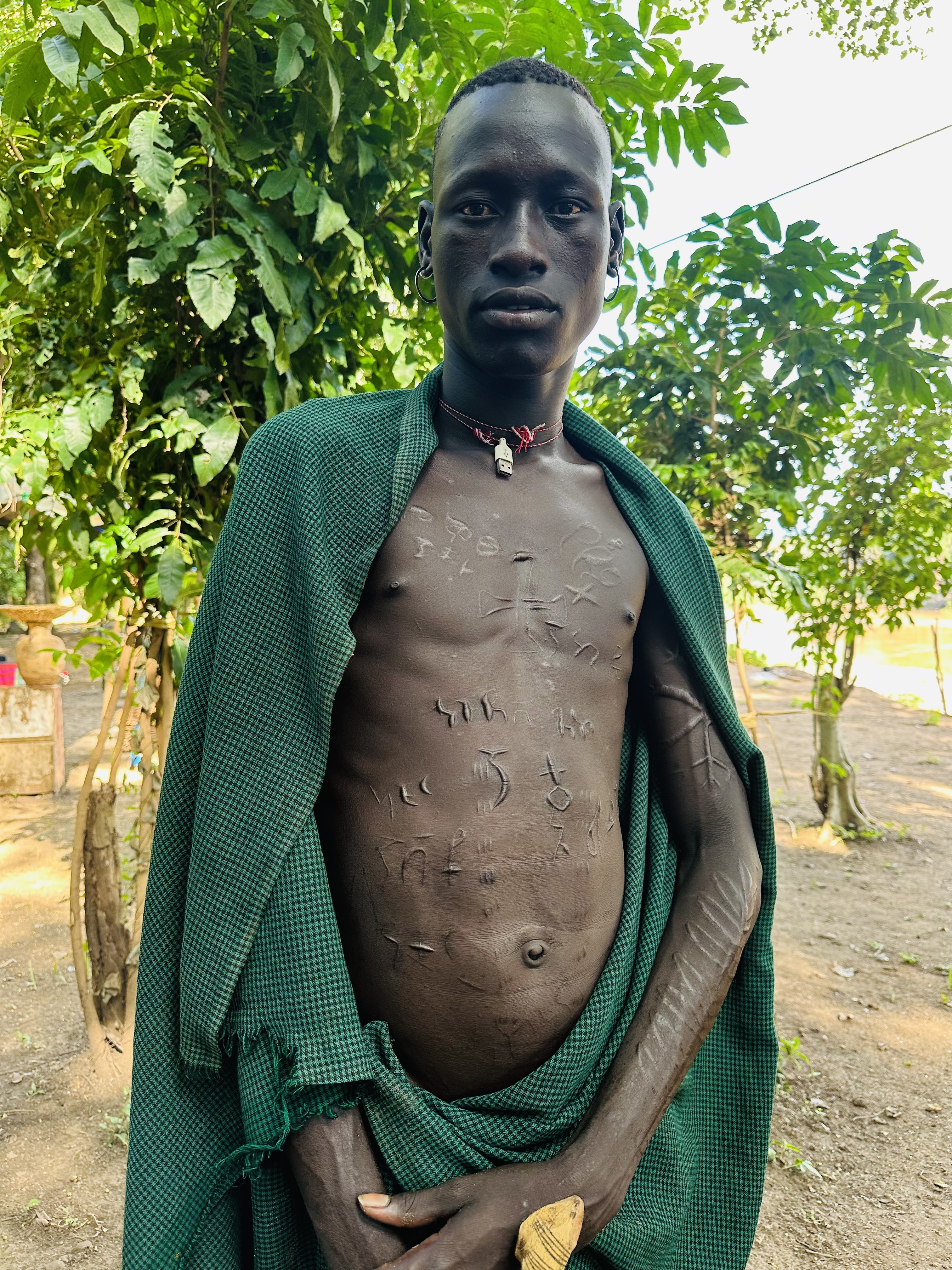
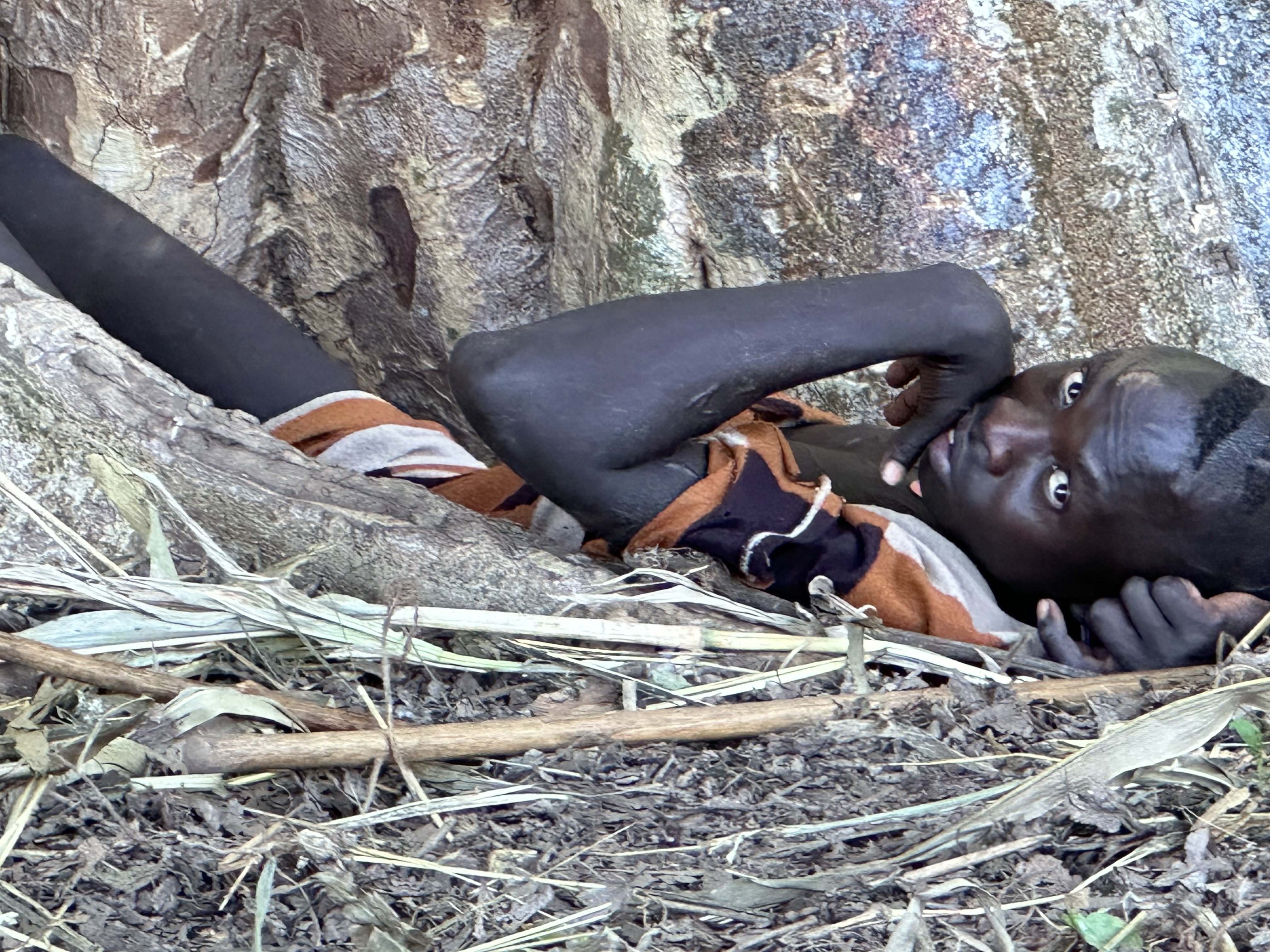
The Mursi people, whom we visit first, attribute overwhelming cultural importance to cattle. They wear bones, shells and skins and practice scarification. The women are known for their clay lip plates. The lip plates are a sign of beauty and are worn only when the wife is serving food to her husband. Women start cutting their lower lip when they are about 18 and expand their lip opening over time by sticking ever larger diameter sticks in the opening. It is a very painful process. All Mursi have their lower front teeth removed when they are small children to help them survive should they get lock jaw, which they get from tetanus, a common ailment within the tribe. Notice the image of the standing woman tethered to a log. She is unhappily married to an older man and has run away a few times. Sooner or later she will have to accept her fate. The basket is so densely made that it is water tight.
January 29, 2024
Finally, we landed at Murulle, a small dirt airstrip in the lower Omo Valley at mid-day. The temperature was 98 degrees and headed for over 100. We were met by 2 men named Aewl and Gater, who both worked for Graham, the owner of our first Omo camp, called Chem Camp. We road in a Toyota SUV on very bumpy dirt roads through acacia and tamarind trees and herds of sheep and goats for about half an hour until we came to a lovely, paved road that was built by the Chinese to deliver sugar cane from the fields to Addis.
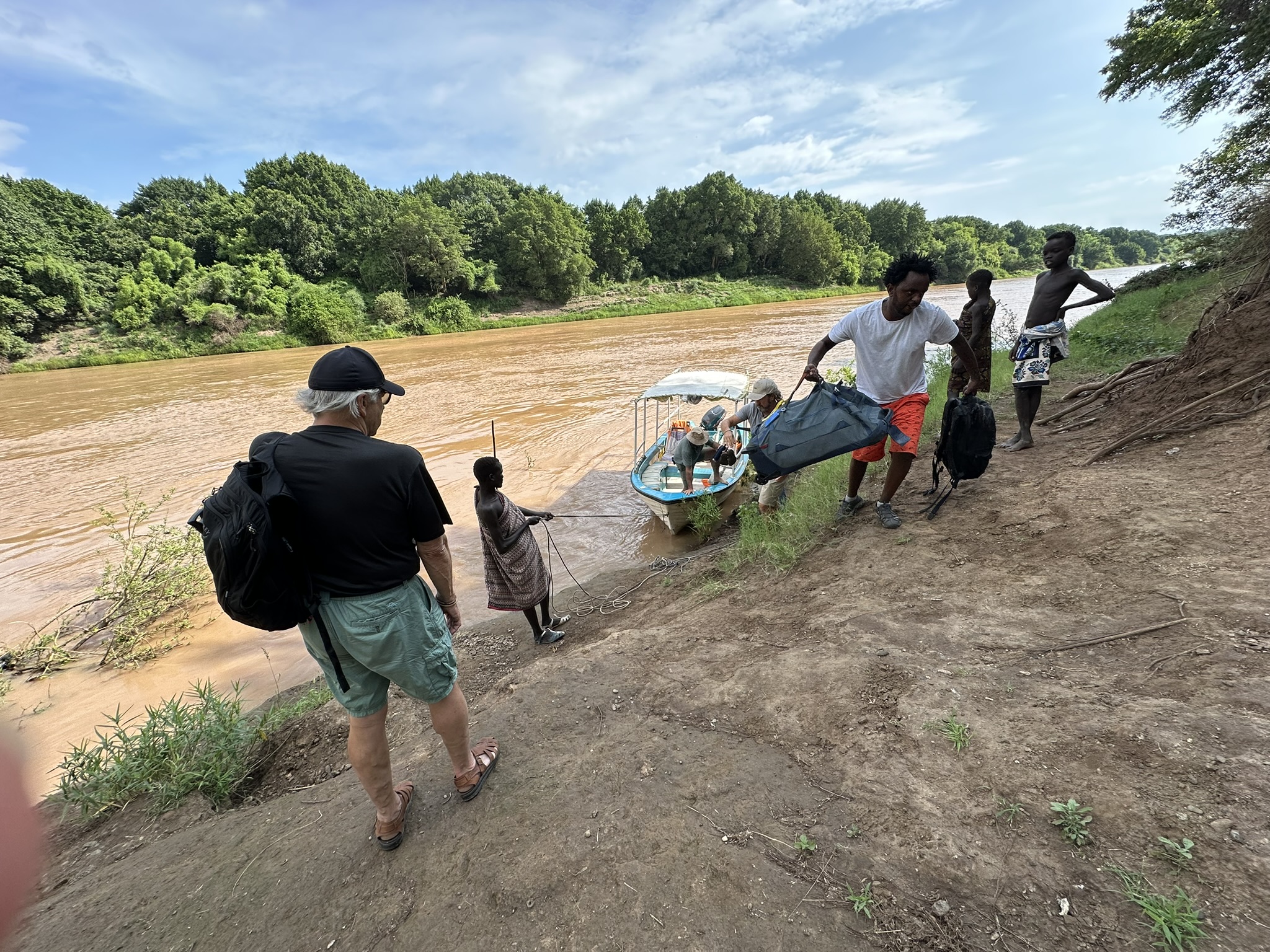
The landscape changed to fields of papaya, banana and open areas ready for planting. Anyone can rent the government owned land and plant crops. We followed that road in almost a straight line for an hour and finally reached our put in on the river. The group of people at the put in were members of a local tribe called Nyagatom. They were not friendly or welcoming, so we moved directly to the boat, where we met Graham, the camp and boat owner, and cast off. With the engine running and the wind in our faces, we were comfortable motoring upstream for the next couple of hours. Both sides of the river are covered with trees reaching down to the fast moving, light chocolate river. There were the usual birds and a few to add here: goliath heron, Egyptian plover, yellow-billed black kites and Northern Masked Weaver birds. We saw no hippo but there were several crocks along the riverbank. At last, we reached camp and moved into our tent under a large fig tree. The tent was a good size and had several screened air vents. The attached bathroom was open to the sky and had dried figs all over the floor. I pushed them out of the way, and we enjoyed the bucket shower with cool water. We were too hot to want a warm shower anyway. We slept well without bed covers most of the night.
January 30, 2024
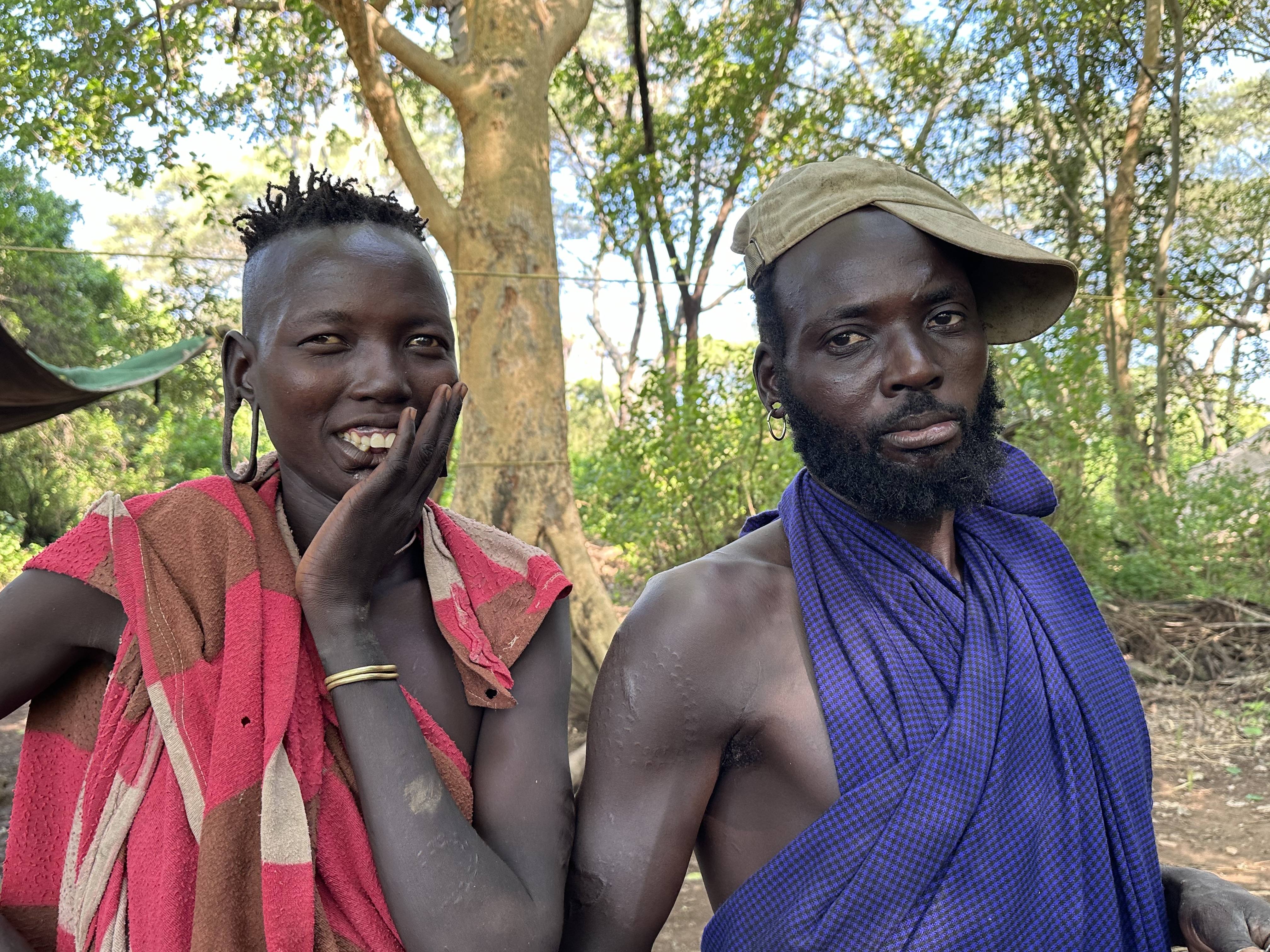
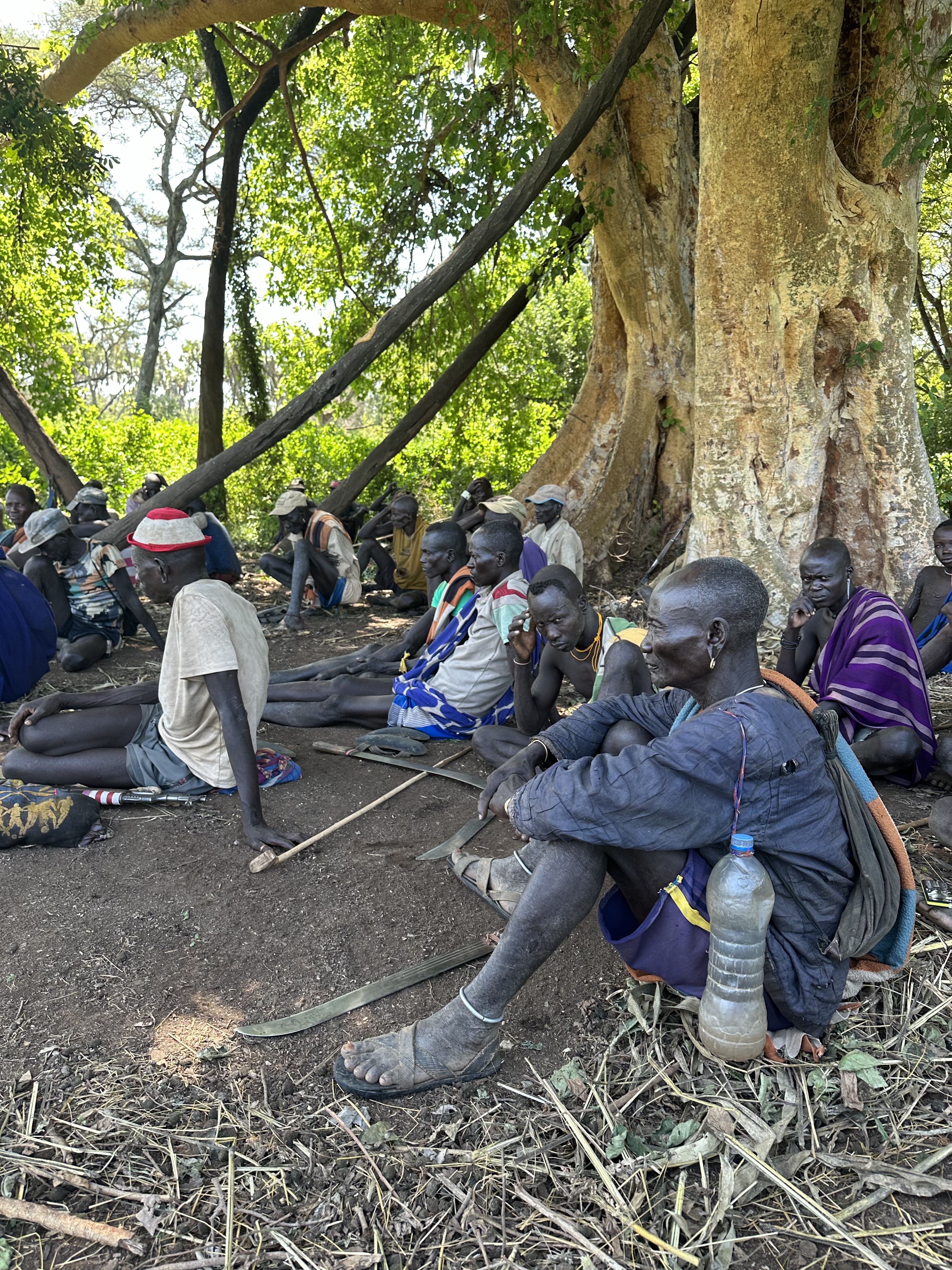
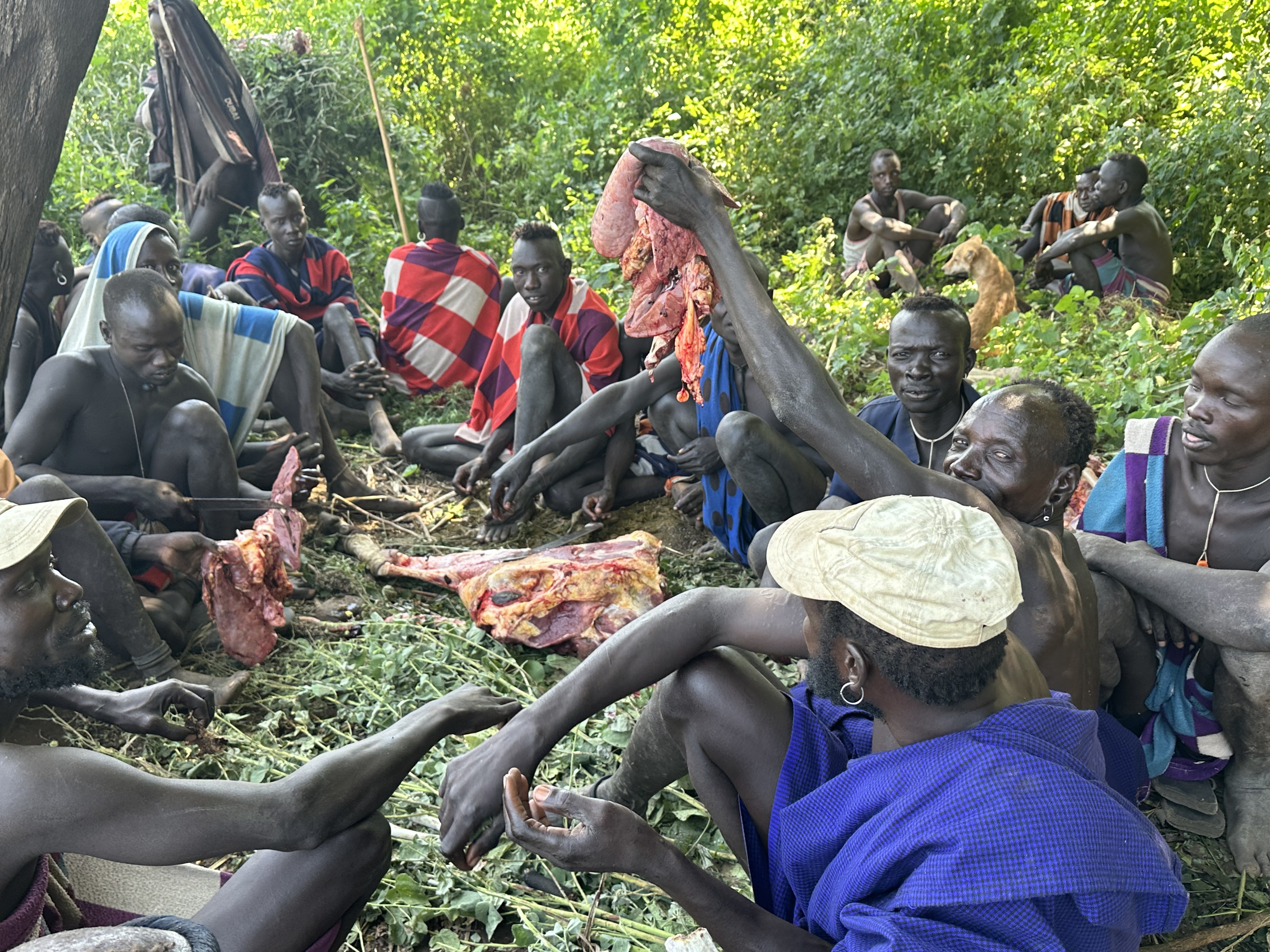
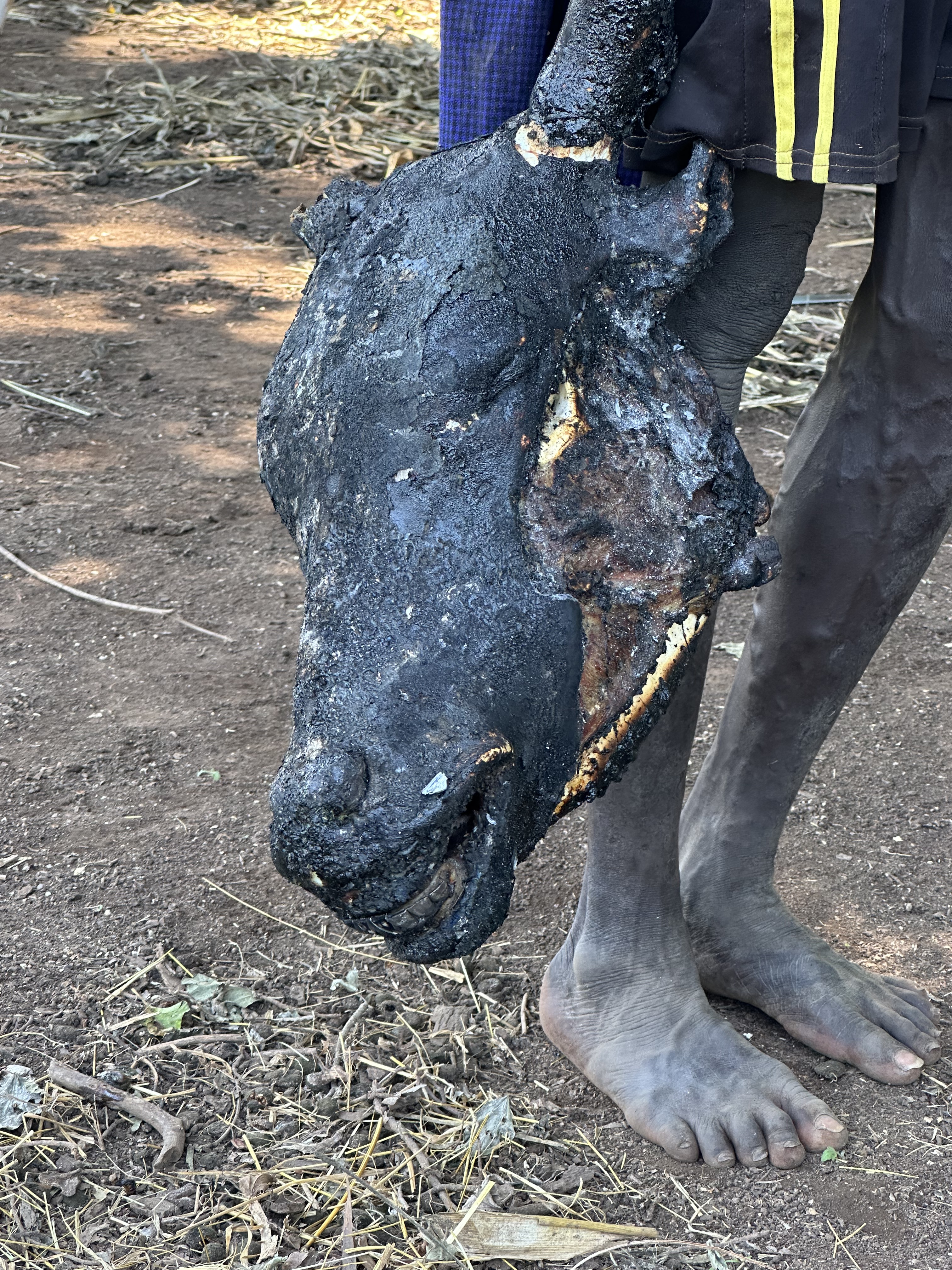
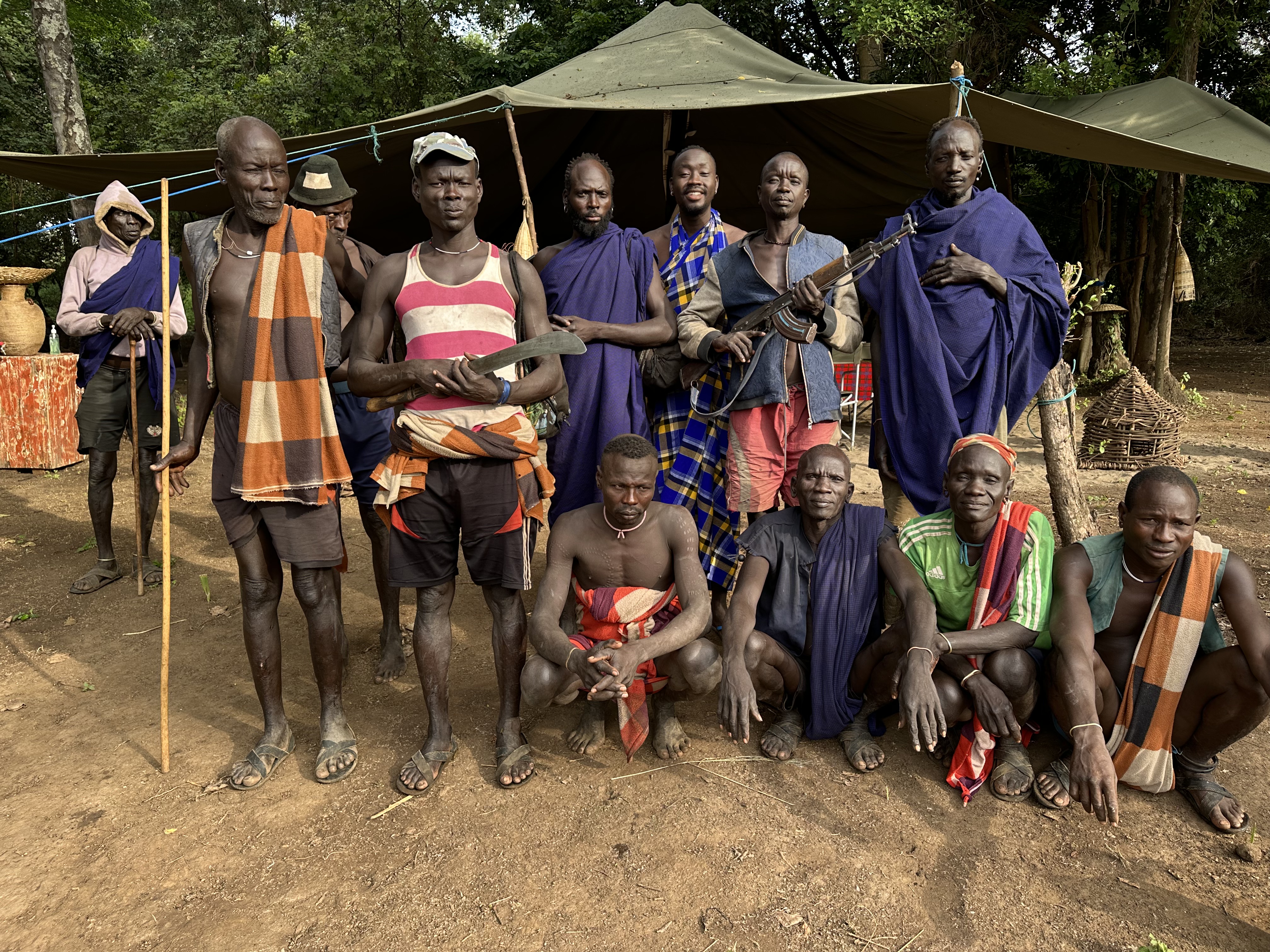
The only cool time is in the early morning, so we were up early to enjoy it. After porridge for me and an English breakfast for Mark, Will and Graham took us for a walk through the woods to a clearing where we met the Mursi people in a small encampment. My first photo of a Mursi was of a bearded man named Chamankoro and his wife. At the encampment the men were listening to a talk about allowing tourists into their midst and why they should be agreeable. Money, medicine and education are the reasons to allow us in. After the talking, a butchered cow was thrown onto a roaring fire and shortly the crowd was happily eating the meat. I noticed there were no women present, except me. We ate a small piece and found it very tasty.
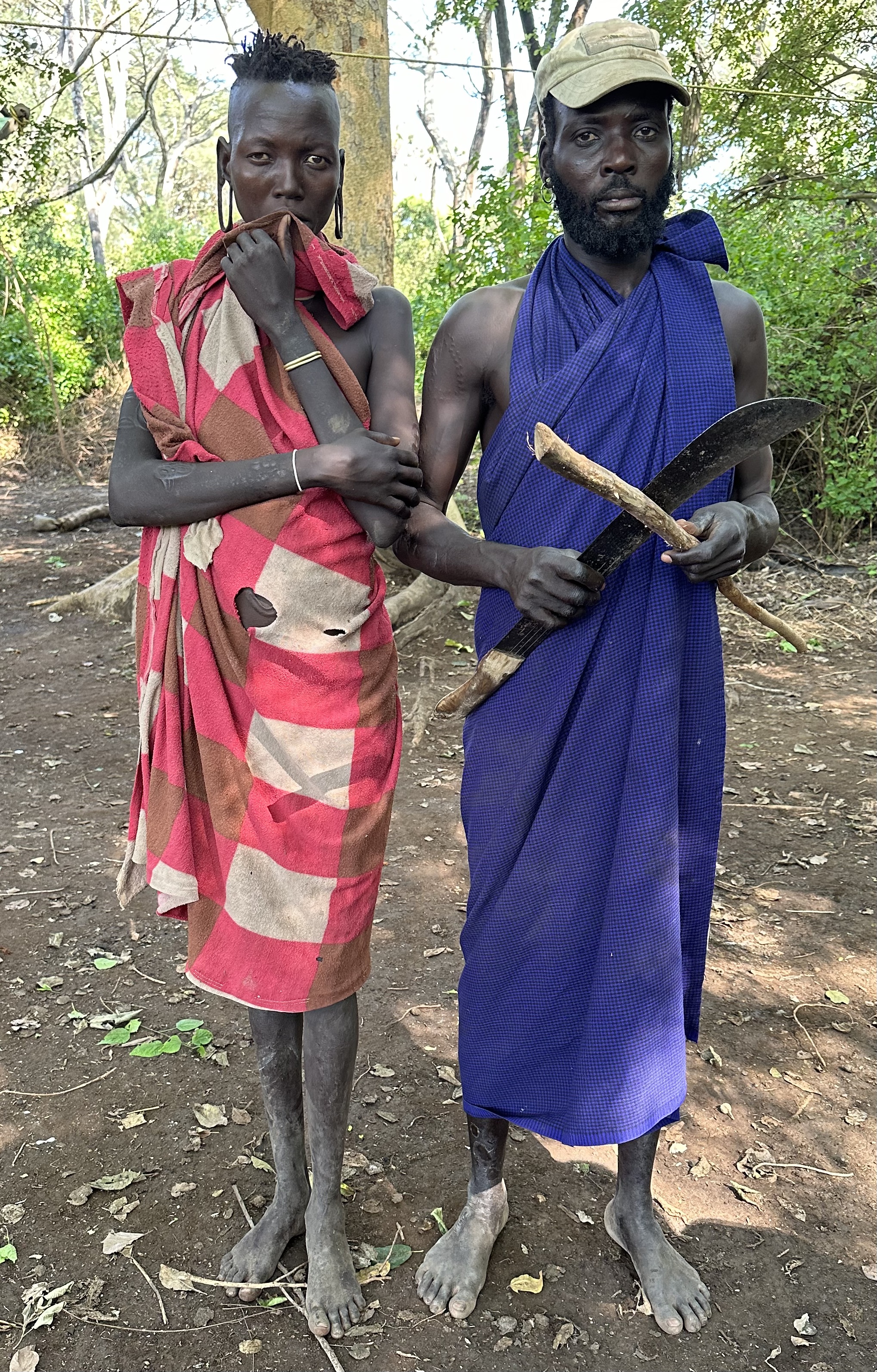
Chamankoro and his wife pose for me.
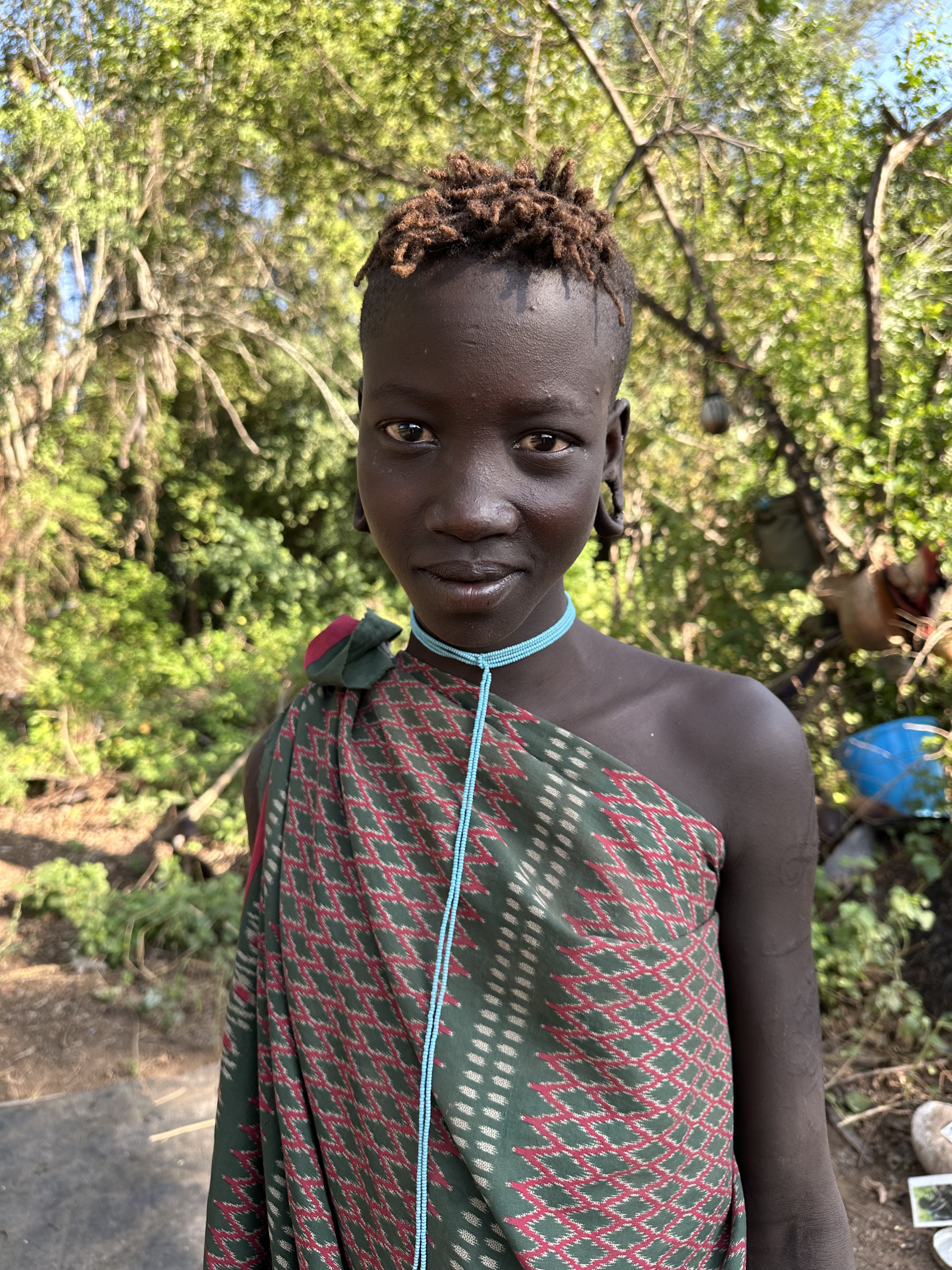
He also posed with Machetti Maron, who was the general manager of the camp. We were shown a basket made of densely woven palm fronds, such that the basket could hold water. It was very special, but too large to bring home. Nearby was a bush that had yellow hibiscus flowers that were very pretty. Some of the boys who were scared also posed for me.
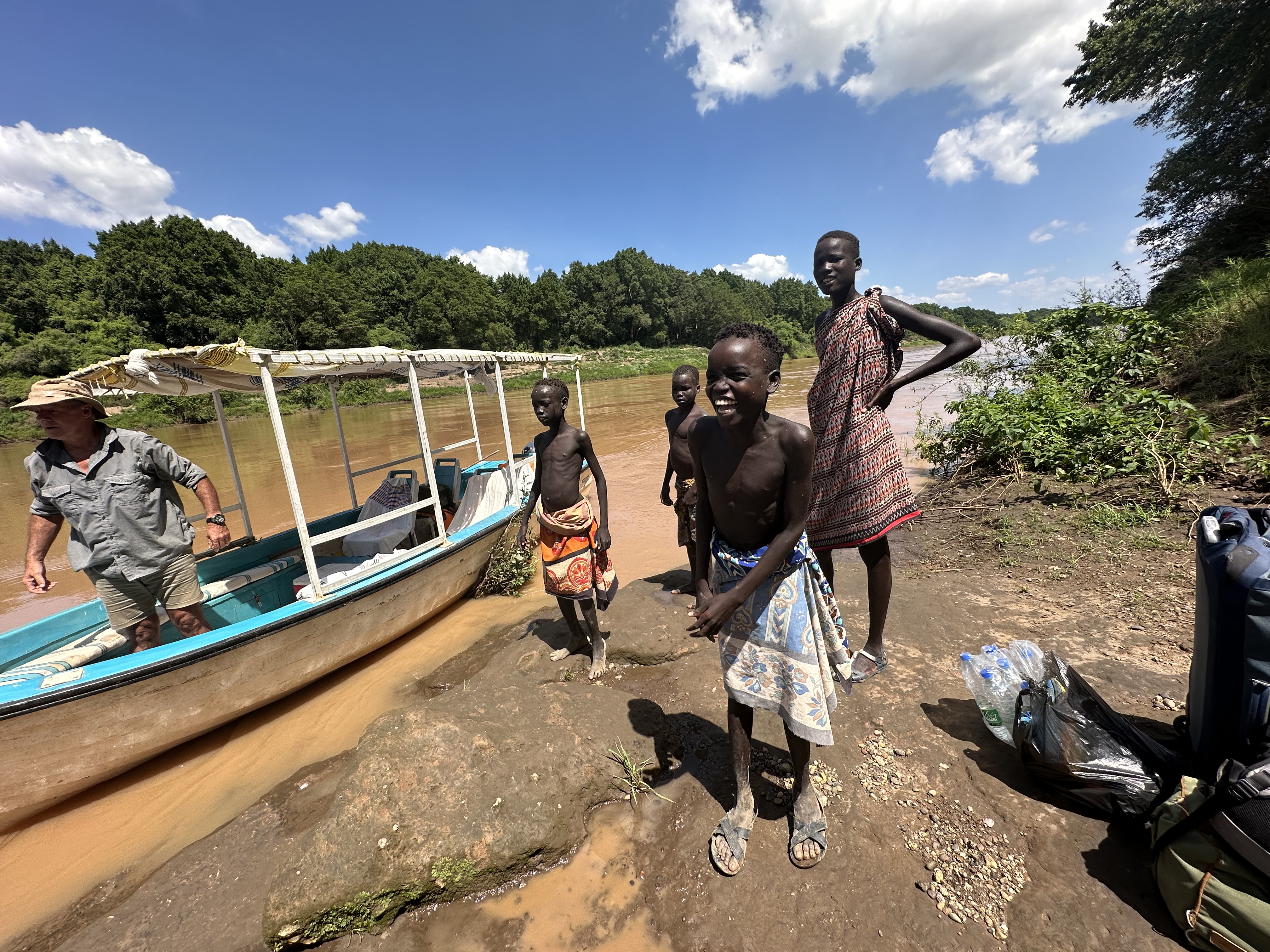
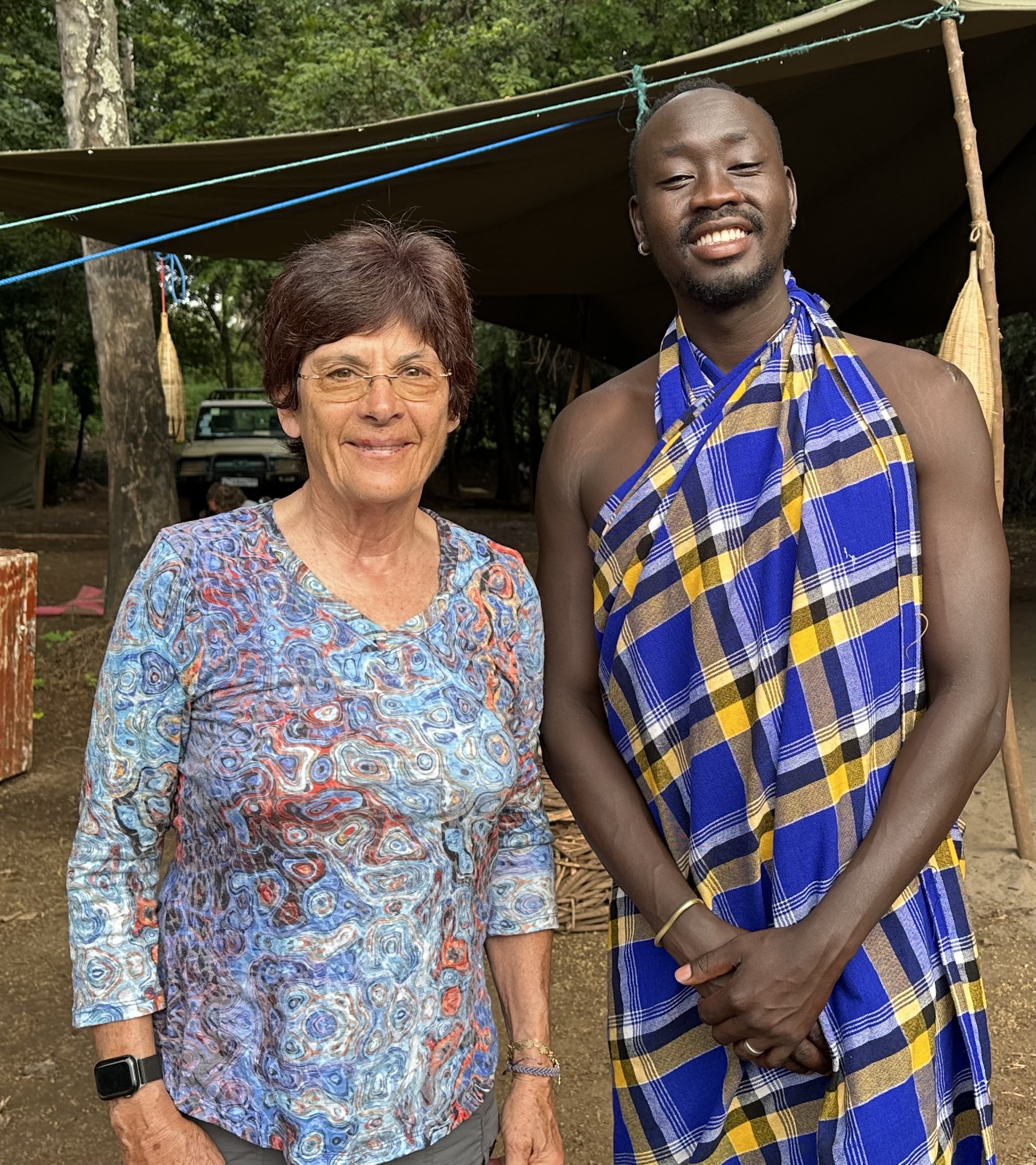
I was fortunate to have several conversations with Bardoley Tula. He was the only Mursi person who is educated and speaks fluent English. He is about 26 years old and was educated by missionaries. He was adopted by a missionary family from Virginia and educated in Addis University. He has a master’s in Anthropology and in Theology. Currently, he is working for Graham as a language consultant, and “An African Canvas”, with whom he is supporting 40 Mursi students through high school. Next for us is the Chem camp crew saying posing for a good buy photo and then waving as we float away.
He told me there are 25,000 or more Mursi, despite what commercial publications say that the population is at no more than 10,000. The Mursi are not nomadic. The men have cattle farms away from the family encampment where they live on a diet of cows’ blood and milk. When in camp, they and their families subsist on sorghum, which they grow on the banks of the Omo River. They are, therefore, agro-pastoralists who they love and respect each other. They have a somewhat pagan belief system. They believe in nature and evil spirits who must be appeased. There is no life after death, but there is consideration paid to ancestors. Burials take place immediately after death, but mourning lasts for 4 days for men and 5 days for women. During the mourning period rituals take place to appease evil spirits.
Bardoley told me about a favorite game the Mursi play called Donga. It is a bit like sword fighting, but with long wooden sticks. Both parties cover themselves to keep from getting hurt and generally no one does get hurt badly. They try to bash each other until the referee declares a winner. It is supposed to be good fun. Certainly, the audience loves the game.
In recognition of Graham’s efforts to improve their circumstance, the Mursi were having a bull ceremony. At 11:30 am we walked 20 minutes through the woodland to a clearing where about 40-50 Mursi men were having a discussion about the effects of allowing tourists in their midst, while a fire roared in preparation for cooking a large bull. Someone was waxing on with questions about why should they allow tourist into their area. Then Bardoley got up and spoke about the benefits of having tourists, especially for medical assistance and schools, which are very difficult to get. The government had promised such facilities but failed to deliver. A School teacher had been unwilling to stay very long and the monthly medical clinic has not materialized. As Bardoley spoke, slabs of beef were thrown on the hot ash and cooked very quickly. When he finished, the meat was pulled out of the fire and consumed by the men using their machete’s to carve off pieces. To keep the meat clean, large bunches of green brush were used as tables to hold the uneaten meat. It smelled so good, we each had a few small pieces too. We took a lot of photos and then headed back to camp. One last image was taken of a lonesome boy at the edge of the clearing. Bardoley told us he had owned the bull and was sad about it being killed, even though he was paid for it.
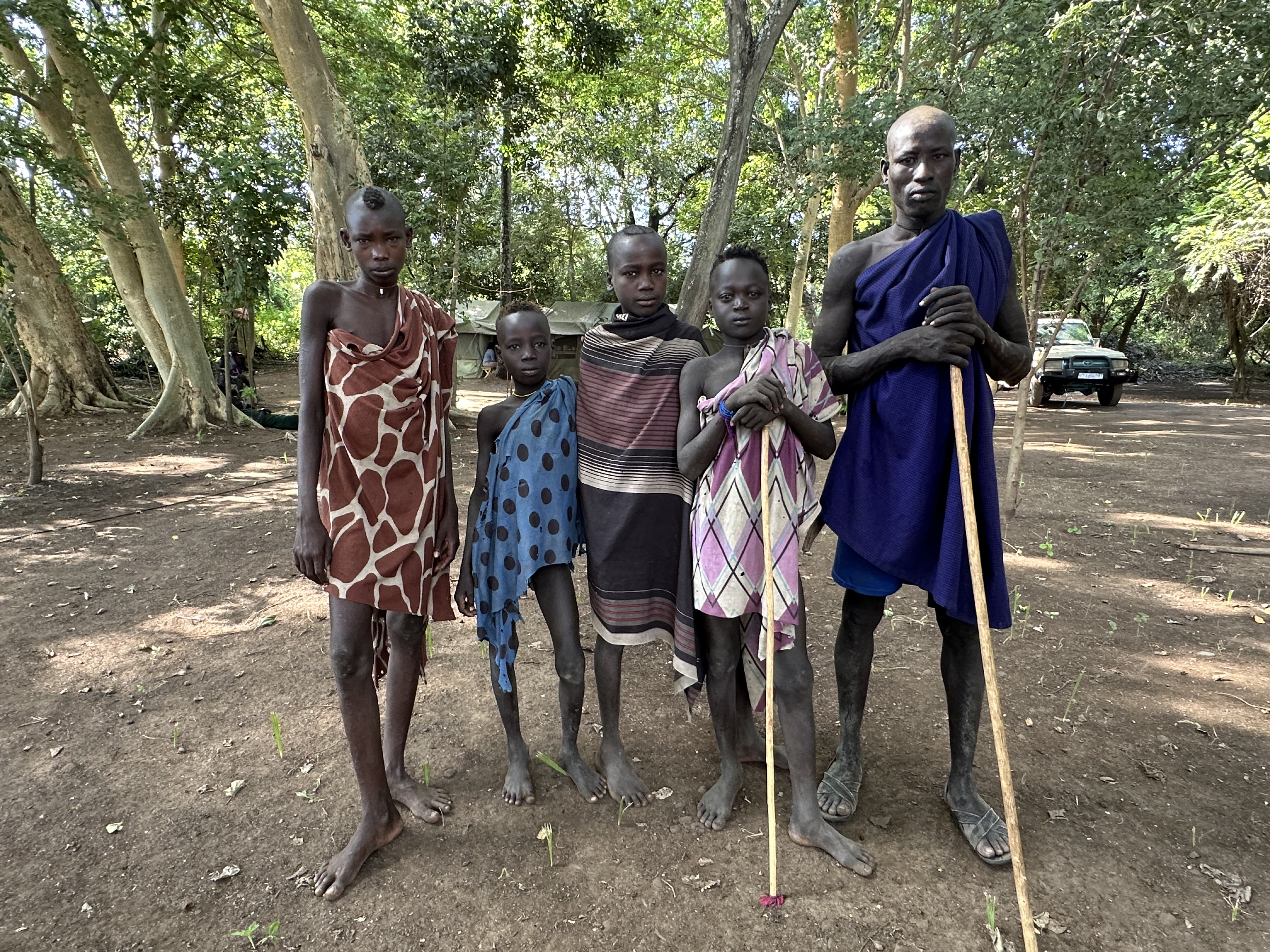
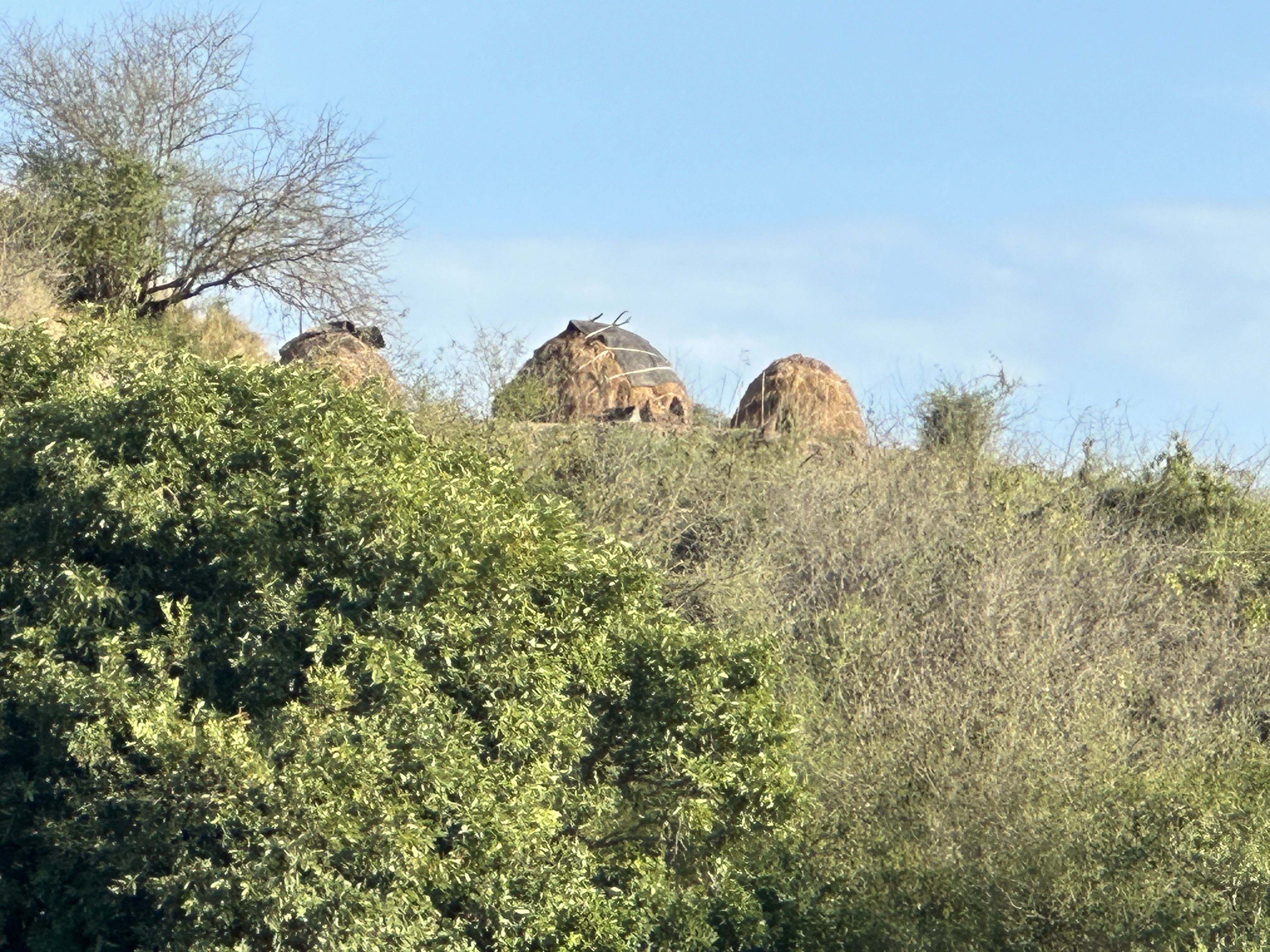
As we left the camp area we saw some Mursi huts on the hill top. In the late afternoon we motored upriver looking for birds, monkeys, and crocks for about 2 hours, then floated down stream back to camp while drinking our beers. We saw one big crock, who did not run into the river. There were colobus monkeys, and some birds like: Bataleur and Open billed storks. The Mursi had their sorghum fields on the left riverbank and the Nyagantom Tribe had their fields on the right bank. We spent very little time with the Nyagantom people as we found them very unwelcoming.
Back at camp we had cocktails, dinner, nice cold showers, and bed.
My travel experience began at 19 when I was an exchange student to Germany. After college I wanted to travel, but had no money so the natural choice was to become a stewardess. I was hired by World Airways and traveled all over the world on the non-scheduled carrier. It was exciting and wonderful and made me want to keep traveling even after I quit the airborne waitress business. At one point I realized that I liked flying as much as I liked traveling and earned my pilot's license at the age of 30. Since then I fly and travel as much and as often as possible. I used to write about my early travels in long hand but they were not legible. Now, with the aid of this computer, I am able to share my experiences. I hope you enjoy them.





















 Adventures with Julia