
December 22, 2018
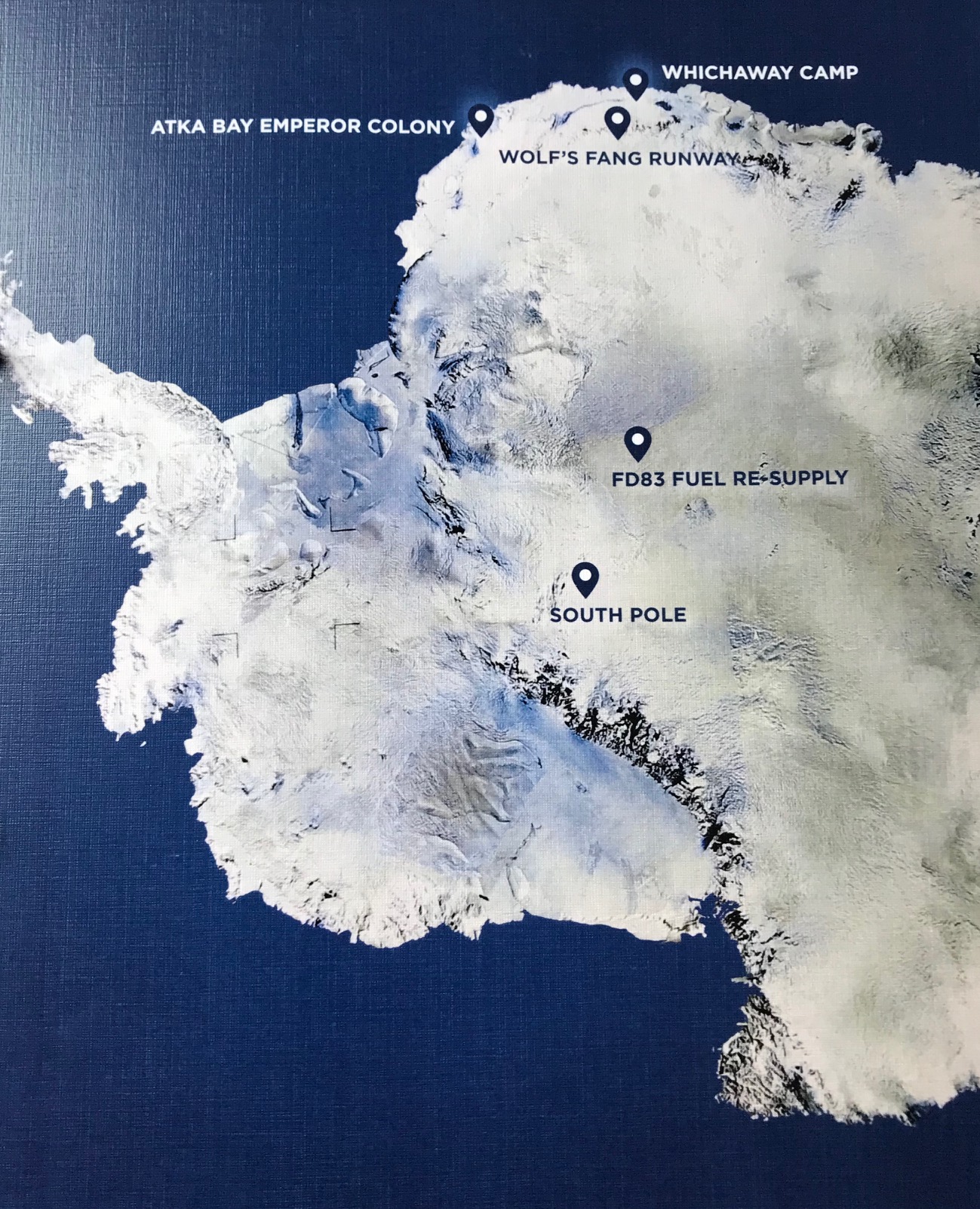
Map of Antarctica with White Desert facilities marked.
Mark and I were picked up at Ellerman House at 4:15am on the 22nd and driven to a building on the General Aviation side of the Cape Town International Airport, where we met the other members of our group and had a cup of coffee. Once everyone had arrived, we were then driven together to the international terminal, where we went through immigration to exit South Africa and a security check, both processes of which were expedited. Another short bus ride brought us to the Gulfstream 550 and everyone piled on. I was assigned seat 9, facing aft and Mark was assigned seat 13, facing sideways on a sofa. Lift off was at 6:15am.
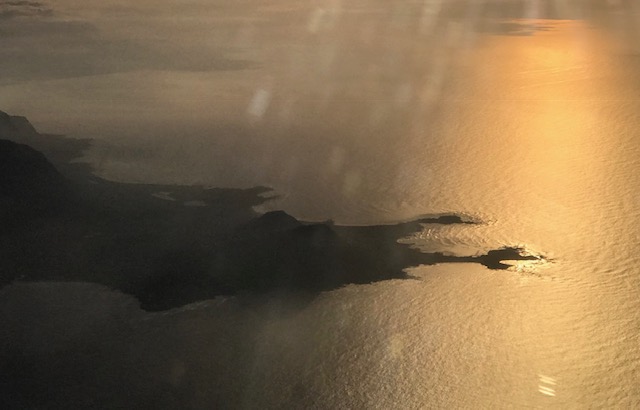
The Cape of Good Hope as we leave Africa.
I managed to get a sunlit photo of The Cape of Good Hope as we passed by it heading south. Once the plane leveled off, people moved around to chat and get acquainted. Besides us, two of them had been to North Korea and one had been to the North Pole. Where is there to go when you have been nearly everywhere? Everyone speaks English, but not everyone lives in the US. One woman is Ugandan and lives in Kampala, but does not yet know of The Kellerman Foundation. Another is German and lives in Dubai. A father and son live in Boston. Three people live in San Francisco, one lives in New York, three live in Tokyo. And us. Thirteen in total.
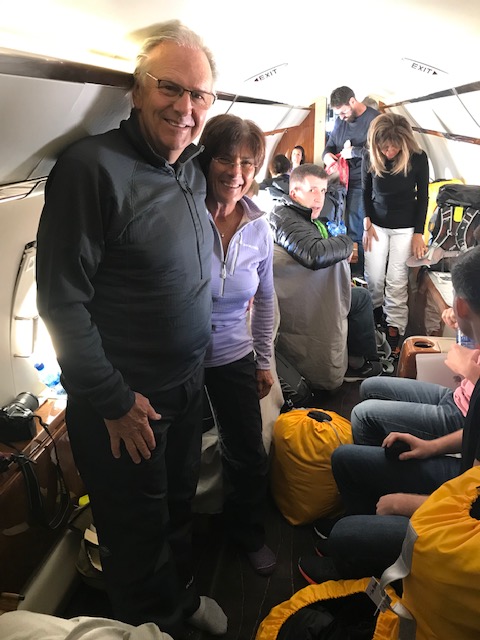
The cluttered cabin in the Gulfstream.
A cabin attendant served us box lunches and drinks. The flight lasted just over 5 hours with everyone chatting to get acquainted. Thirty minutes out, everyone was scurrying around putting on warm clothing and South Pole gear provided by the tour operator, White Desert—Baffin Boots and a super padded down jacket. The inside of the cabin looked like Christmas right after 13 kids had opened all their presents. The cabin attendant was having a fit. We managed to get organized just before landing at Wolf Fang airstrip in the far north of Antarctica.
-
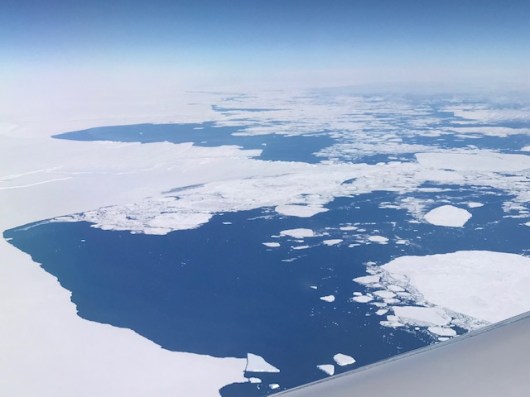
- Sea ice as we approach Antarctica.
-
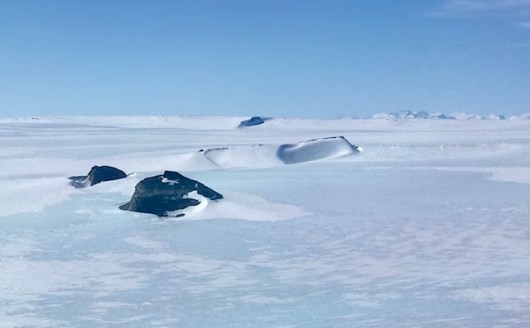
- Antarctic hills and plateau as we near Wolf Fang Airport
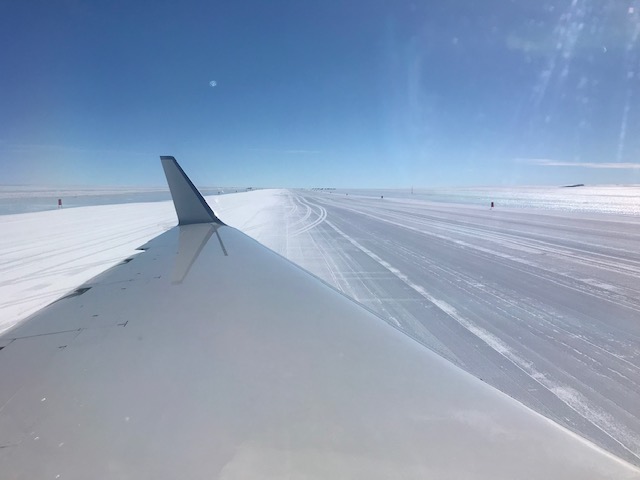
The corduroyed Wolf Fang runway as we begin to taxi back after landing.
Once outside the plane, we were glad to be wearing all the gear, but were soon surprised that the day was bright, sunny, wind free and almost warm.
-
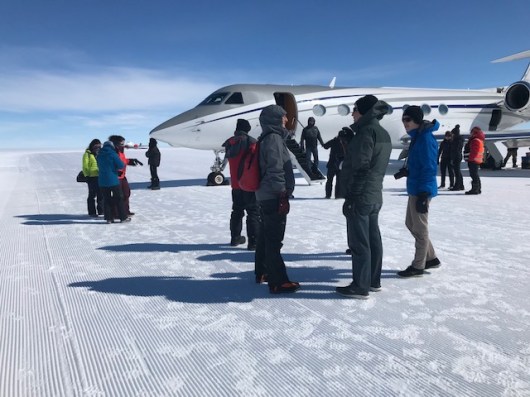
- Enjoying the balmy weather after exiting the Gulfstream
-
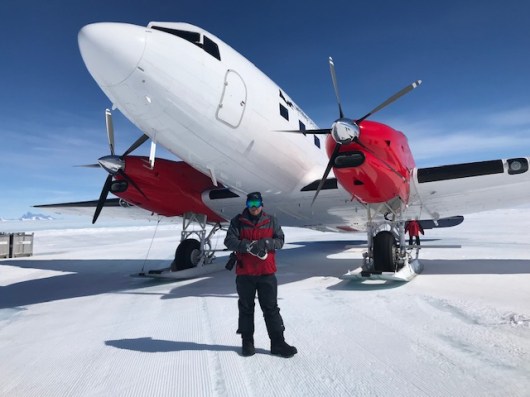
- Mark in front of the Basler 67
-
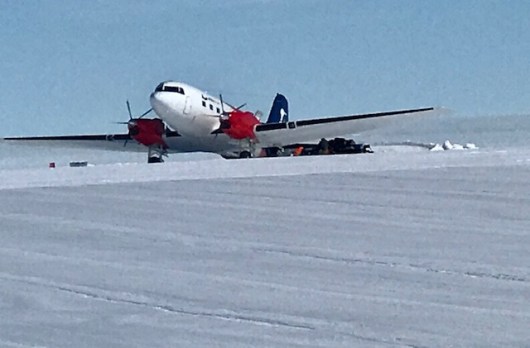
- The Basler 67 is waiting for us
It was a balmy 30 degrees Fahrenheit. Feeling completely comfortable, my anxiety evaporated as we looked around at the all-white scenery with a few snow free, rocky peaks in the distance, including Wolf Fang. We walked down the recently corduroyed runway, similar to what is done on icy ski slopes, to the only other plane on the field, a Basler BT-67 fitted with skis for our next leg of the journey. It is a retrofitted DC-3, originally built in 1946, and Basler is the company that provided the modernization.
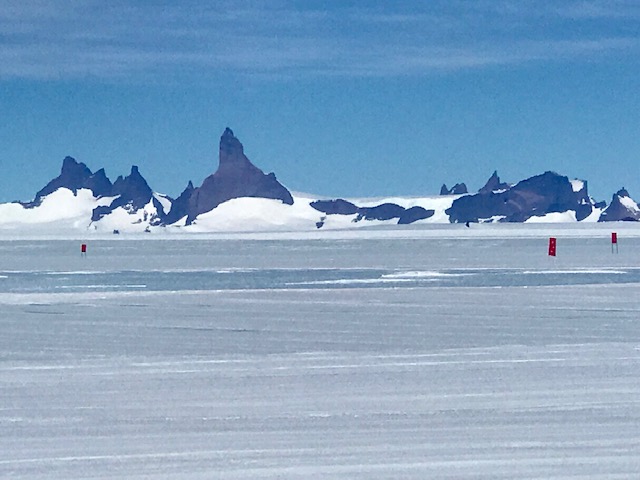
Wolf Fang Mountain from the runway.
One enters at the back and walks uphill to the seats. The plane has been retrofitted with new, turbo prop engines, but is not pressurized. it is mostly heated, depending where one sits. The warmest seats are nearest the cockpit. Luggage is stored on one side of the cabin.
It is a tight fit with poor window visibility. Mark and I ended up in the last seats on the first flight and could see almost nothing. The plane is noisy, slow, cold and not very comfortable. One benefit. We were the first ones out when the plane landed, after 25 minutes, at an airstrip very near Camp Whichaway. We piled into two big trucks with huge tires, a 4×4 and a 4×6. I needed a ladder to get into either one. The drive to camp was slow going over bumpy ice and snow. We hit solid rock just as we entered camp.
Once at the Camp, we were welcomed into the living room, served champagne, given a short briefing and told to change our clocks to Greenwich Mean Time for the duration of our stay in Antarctica. Then we were served tomato soup for lunch and assisted to our rooms.
-

- The main entrance to camp
-
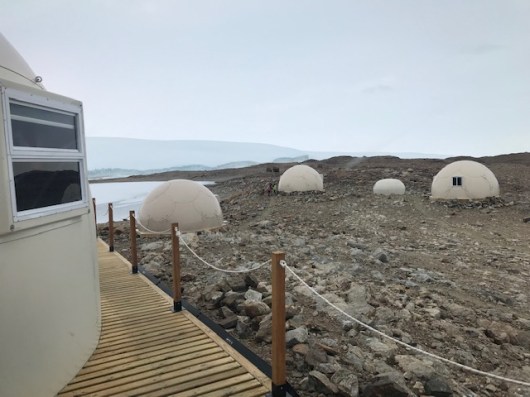
- Camp from the common area. Our pod is at the right
-
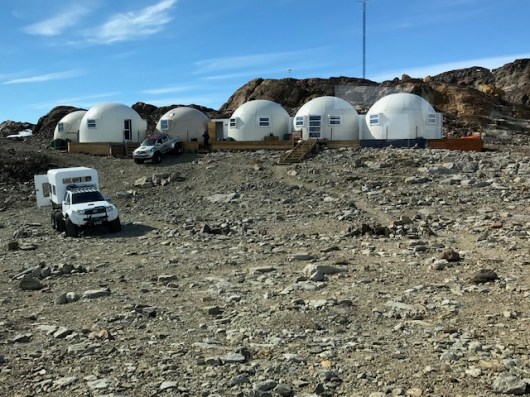
- The public pods, trucks and rock walk from our pod.
-
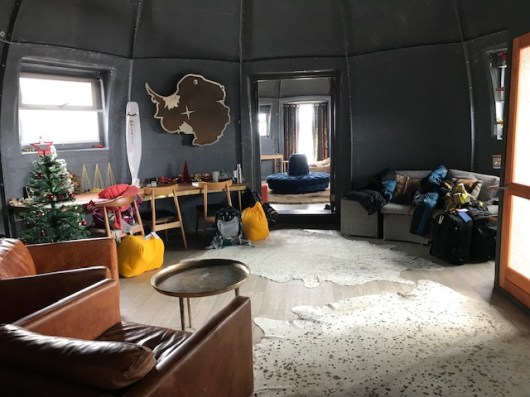
- Library, looking toward Living Room
-
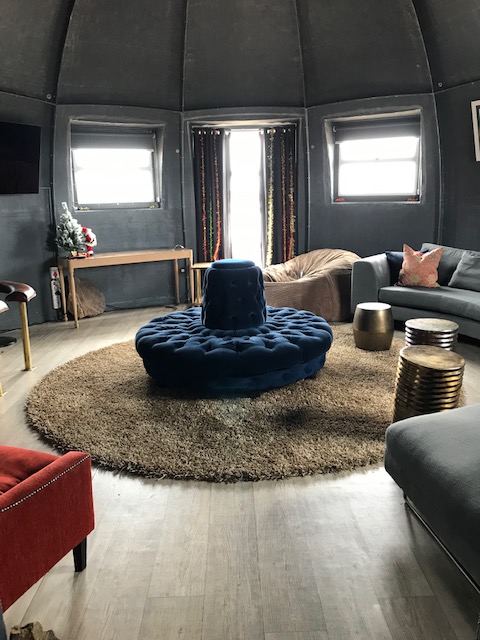
- Living room
-
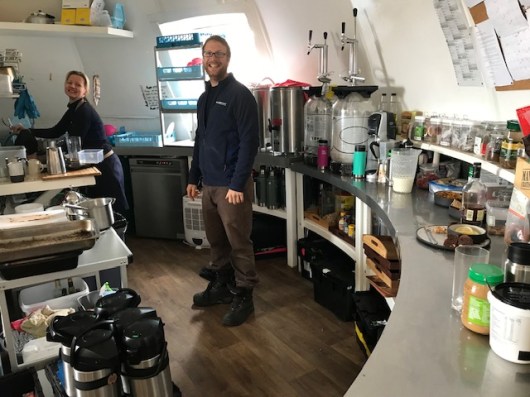
- Chef Antony and assistant Yolanda in their kitchen pod
A sign near the entrance told us we were at White Desert’s Whichaway Camp at 70*45’49”S by 11*36’59”E, well within the arctic circle, which starts at 66.5 degrees south of the equator and circumscribes the southern frigid zone. The elevation at camp is 480 feet above sea level.
There are 7 pods scattered about the camp as well as a connected set of 4 pods for living, library, dining and kitchen. A separate pod next to the kitchen was nicely heated and contained three private shower rooms and additional bathrooms. Mark and I were assigned to the Cook pod, named after Captain Frederick Cook, an early arctic explorer. The slightly elevated pod is 20 feet in diameter with a dome that curves gently from waist height to 20 feet. Inside is a king size bed with down comforters, a desk and chair, a dresser, shelves and rack for clothes.
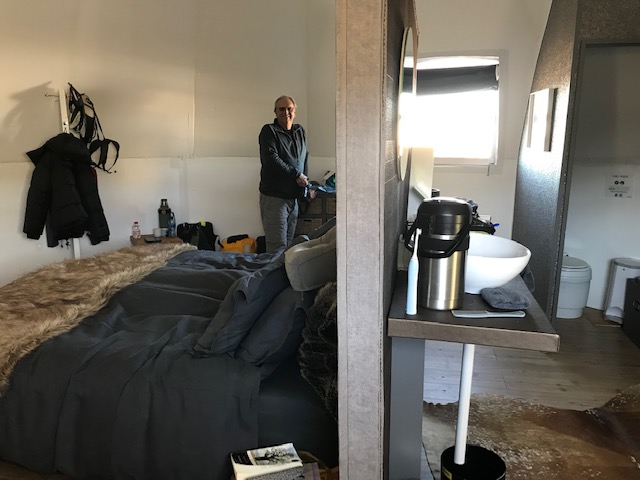
Inside our pod, divided by a partition into bed and bath.
-
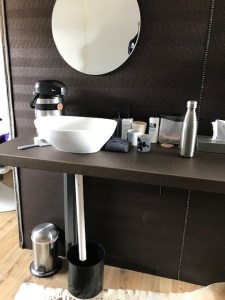
- The vanity area in our room. Warm water comes through the hand pump dispenser into the sink, then down the drain and into a bucket. Not great, but workable.
-

- The toilet arrangement. The poo toilet is on the left, a used TP container is in the middle and the pee toilet is on the right.
Behind the bed is a table with a sink and room for toiletries and a bathroom. Water for the sink is provided by a large hand pump thermos with warm water. The sink drains through a pipe into a bucket on the floor. There are 2 toilets, one for pee and one for poo, and a closed bin for used toilet paper. Do not confuse what goes where. And for goodness sake, do not pee in the poo toilet. It took a couple of uses to get coordinated with the operation.
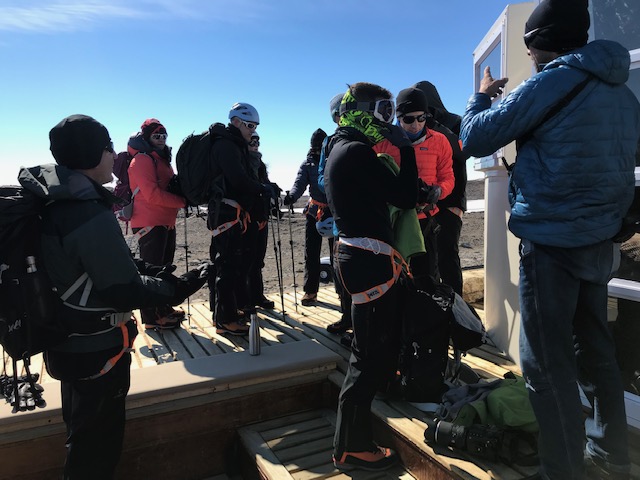
Getting outfitted for all our activities
After unpacking, we met in the living room pod at 4:30 GMT. With constant daylight, it is weird to adapt to such long days. The plan was to go for a “short” hike. First, we were each outfitted with crampons, harnesses, walking sticks and helmets. As the day was sunny with almost no wind, we did not need heavy clothing. Then we started walking right from camp over a rock and boulder field.
-
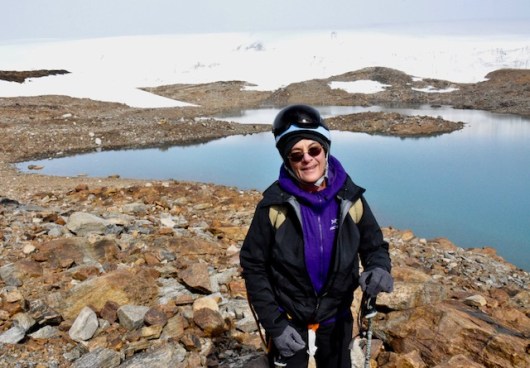
- Braving the rocky field.
-
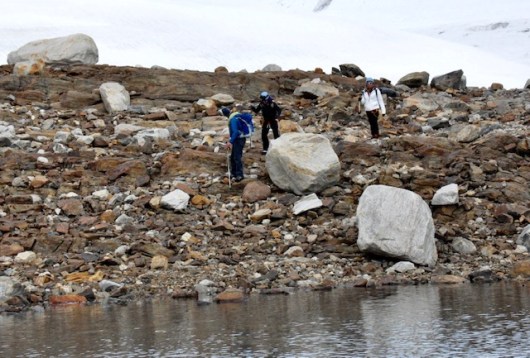
- Me struggling through the rocky terrain
I had a hard time between my bad knee and poor balance, but I was determined to go. I soon fell behind. One of the guides noticed and gave me his walking stick so I had two. That helped. Still, I was slow. Finally, after half a mile of rock, we reached the snow and ice pack and put on the crampons. I was thrilled to walk comfortably on the ice and snow.
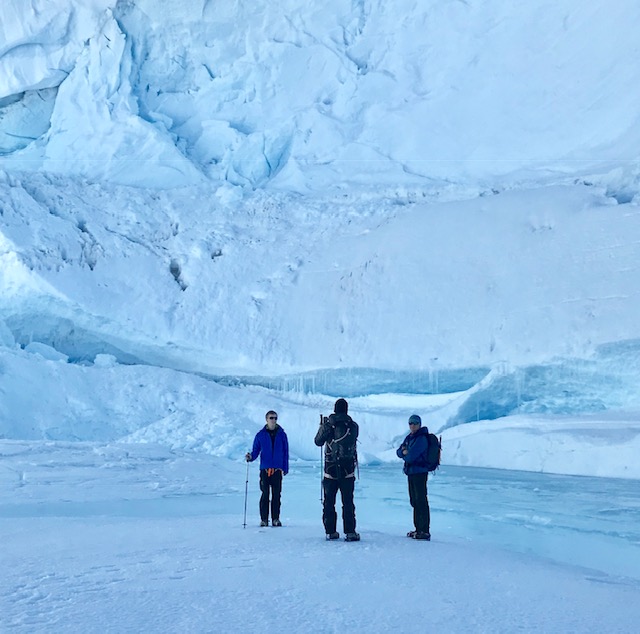
Some perspective on the glacier scene
-
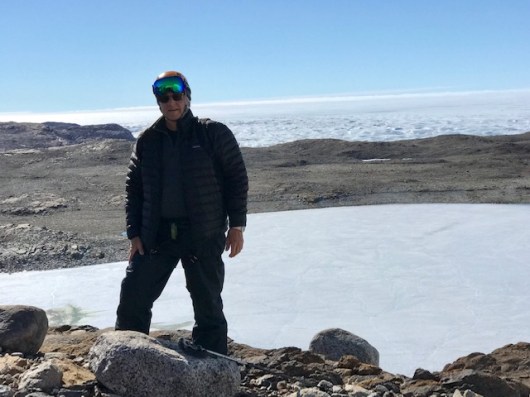
- Mark overlooking the ice waves in the distance.
-
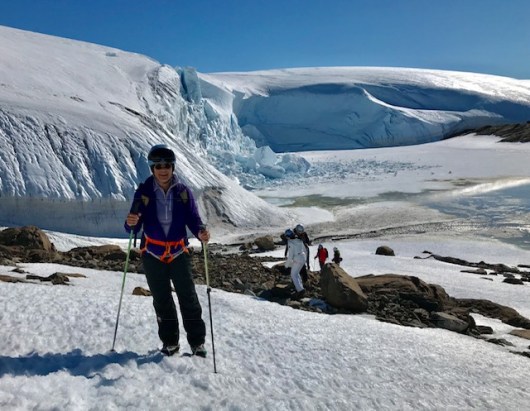
- Much happier with crampons and no rocks. THe glacier behind me continued to crack during our week in camp and a large piece broke away a couple days before we left.
-
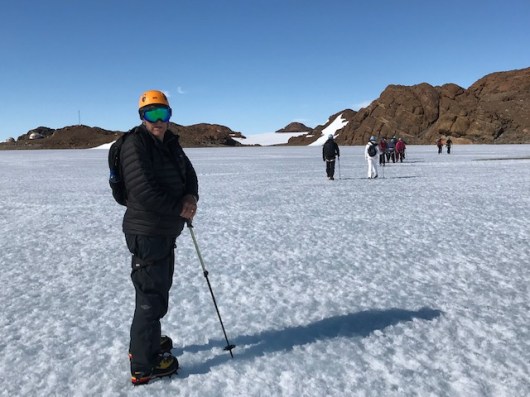
- Mark cramponing through the snow and ice.
-
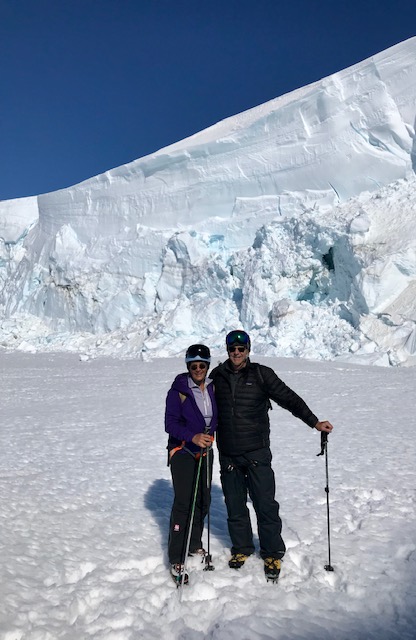
- Us in front of the glacier.
-
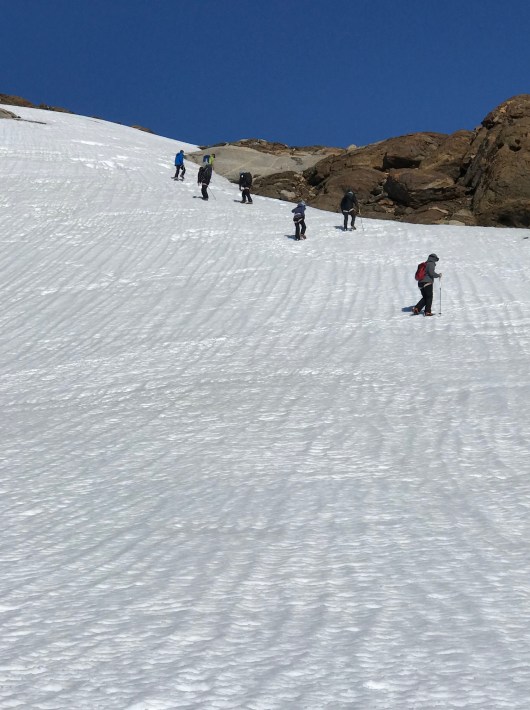
- Zig zagging our way up a steep hill
These were serious crampons. We walked up hill and downhill taking in the view and gradually made our way back to camp. It felt great to be outdoors and get some exercise. Dinner was ready when we returned. Slowly we are getting to know each other and remember names. It is a strange mix of folk, and there was little conversation the first few meals.
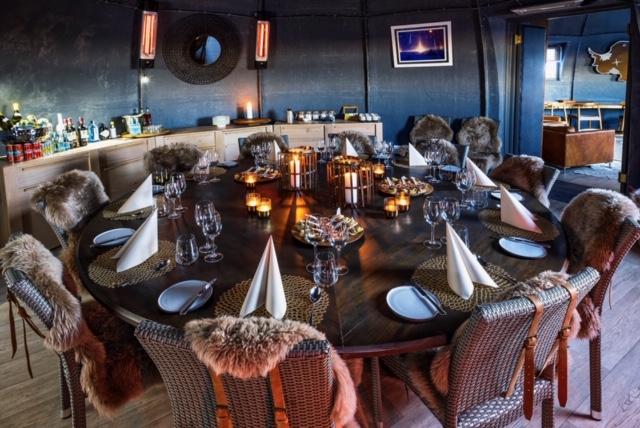
The dining room table set for dinner.
After dinner, John, the camp manager, informed us that the weather was perfect for us to fly to the South Pole the next morning and to be ready for breakfast at 9:30am. Although we were only beginning to adjust to being at the camp and we were all tired, there was sudden rejuvenation. We went to our pods to prepare for the overnight journey to the pole and then dove under the comforters on the very comfortable bed.
December 23, 2018
We were all ready to go, when John told us there was a delay and to relax until further notice. So, at 11:30am, he gave us a slide presentation about White Desert. First there was a super map showing where everything we wanted to know about was located. (See the map at the beginning of this post). Antarctica is twice as large as Australia. It covers 8.9% of the earth’s surface. The highest peak is Mt Vinson at 16,066 feet high and the lowest point is in the Bentley Subglacial trench at 8,383 feet below sea level. The visible mountains are located generally on the edges of the continent with 95% being covered by the polar plateau, averaging 5,249 feet, almost a mile, thick.
Then, he told us how things work in the Antarctic and why the cost is so high. Most importantly is the fuel. There has to be enough of it and it has to be where it is needed. There is a ship depot that brings fuel to the edge of the ice on the north coast. White Desert, as well as other users such as scientific stations pick up fuel at this depot and transfer it to where it is needed. For example. the Basler, using skis, takes on fuel and flies it to the Whichaway skiway for use at camp. For every gallon of fuel delivered for use, two gallons are used getting it there. Fuel is also transferred by sled from the ship depot to Wolf Fang Airport, one of only 6 capable of handling large aircraft with tires in all of Antarctica, as well as to Depot 83, where the Basler stops to refuel to complete the trip to the pole. The 2018 ground transfer to Depot 83, 1,740 miles from the coast where the fuel was offloaded from a ship, took 28 days. White Desert has no access to fuel at the pole, so the Basler must carry enough to go and return from Depot 83 (at the 83rd parallel).
Then there is maintenence of the aircraft, vehicles and camp facilities, collection and purification of water, delivery of food, management of waste and more. No wonder the trip was so expensive.
-
- Mountains seen shortly after take off from the Basler. Prop is too slow for the camera to miss.
-
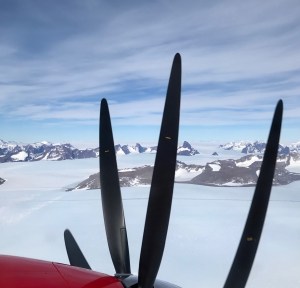
- Another mountain scene.
-
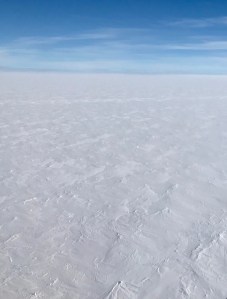
- The polar plateau. Hours and hours of the same scene.
Shortly after 1pm, we drove to Whichaway skyway and flew to Wolf Fang to top off the Basler. Then we head for Depot 83, where we will refuel again.
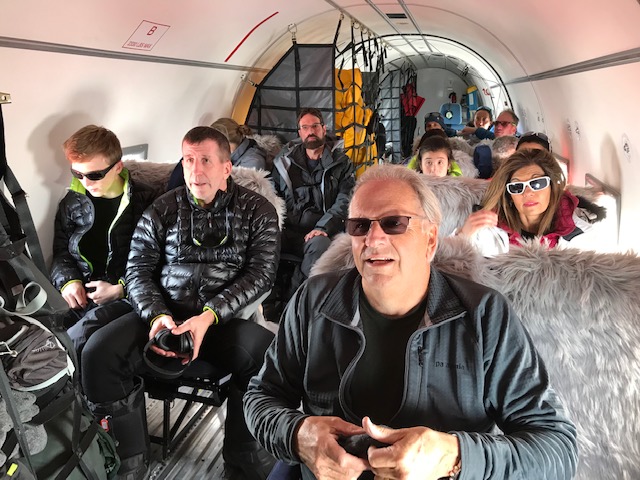
Inside the Basler. A tight fit.
Mark and I get the two seats in the front of the plane and have a good view out the window and toasty warm heat. Shortly after takeoff we saw a large mountain range poking through the ice cap. Then there was nothing but the polar plateau the rest of the way to Depot 83 and the South Pole.
-
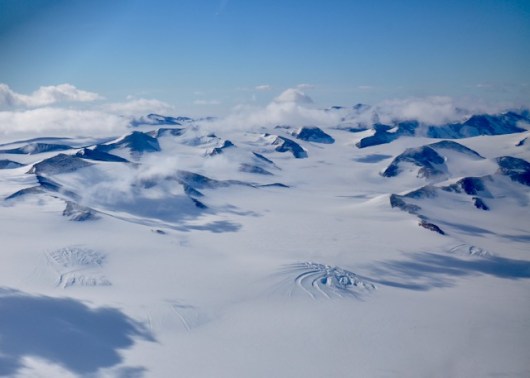
- Mountains as we head out to FD 83.
-
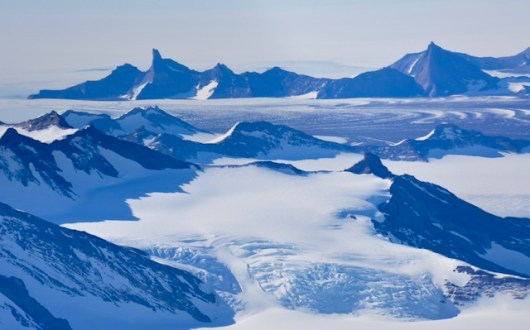
- Spectacular view of mountains and glaciers.
-
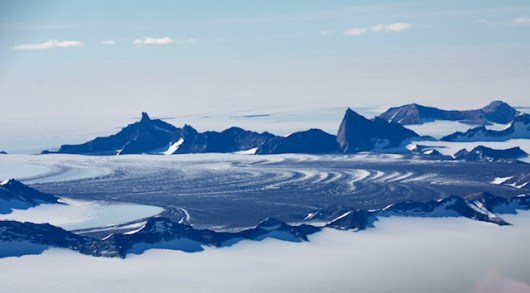
- Another view of mountains and ice flows
-
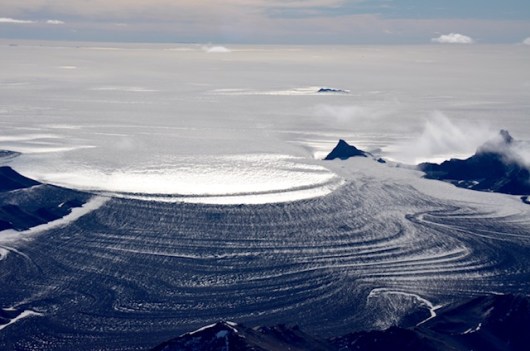
- Close up of ice flow. Then only the ice and snow plateau.
At Depot 83 we land at 5:50pm. The plane was fueled, the pilot received his legal 9 hours of rest and we spent the time keeping warm, eating freeze dried food with boiling water added to make it palatable. Then trying to sleep in private tents. The sleeping bags provided were very warm and with our blowup pillows, Mark and I managed some sleep. Unlike some of the group’s experience, our 6” high cots did not collapse. Several people said they did not sleep at all.
-
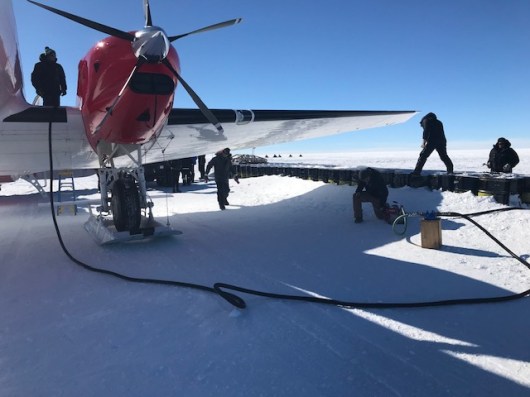
- Refueling the Basler at FD 83
-
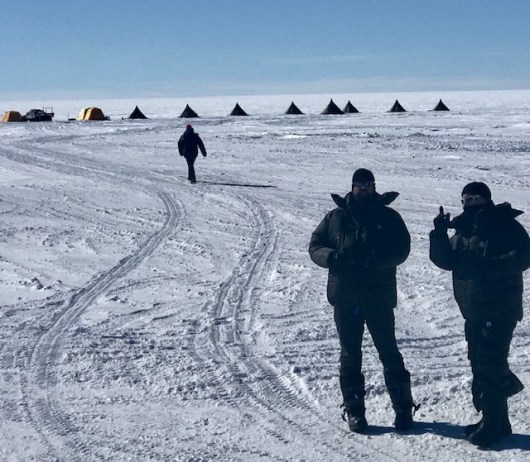
- The walk from the Basler to the tented camp. The snow cat was helpful.
-
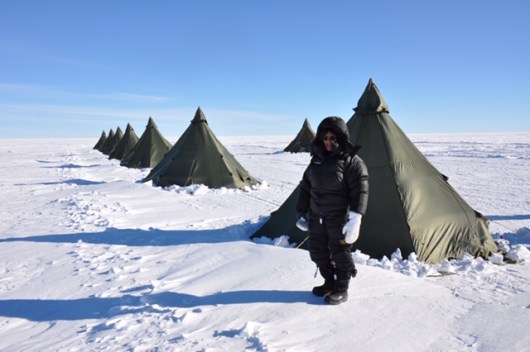
- Me in front of a tent. They were not yet assigned.
-
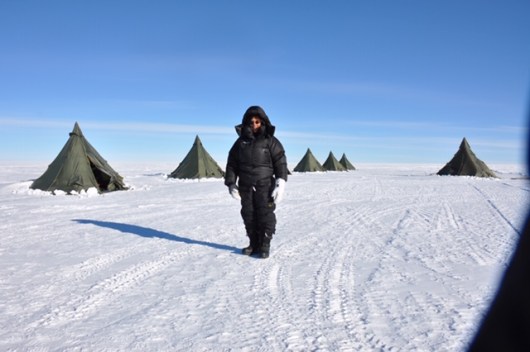
- Our tent is to the right of me.
-
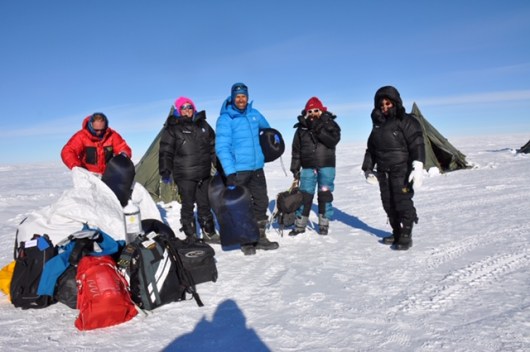
- Our collective gear in a heap.
Two difficulties were the altitude, 8,200 feet at the depot, and the very bright daylight. It was certainly the most difficult time of the trip. I wasn’t even sure if it was day or night. At 2 in the morning, Mark jerks me awake and says its time. I felt like I had just fallen to sleep. Up and out it was. We took off from the depot at 3:15am. It seemed like it should be night instead of day. Never mind. We are on our last leg to the South Pole.
Christmas Eve at the South Pole, 2018
-
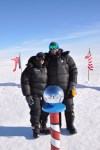
- Julia and Mark at the Ceremonial South Pole.
-
- The NSF Logo for the US Antarctic Program.
-

- Us reflected in the ceremonial pole with 12 flag around
-
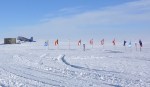
- The Ceremonial Pole and flags of 12 treaty signing countries. The Basler and Visitor Center are in the left rear.
-
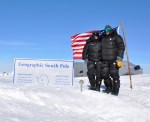
- Julia and mark at the Magnetic South Pole. The residential facility is behind us and the small pole in front.
-
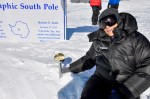
- Holding the Magnetic South Pole Marker.
-
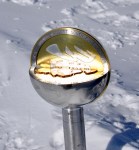
- The Magnetic South Pole marker. Obsolete on January 1, 2019.
-
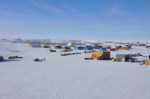
- Science equipment at the South Pole.
-
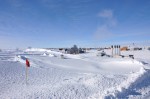
- Wish we knew what we were looking at.
-
- Another equipment scene.
-
- Underground storage facilities.
-
- The small, but warm and welcoming visitor center at the Pole.
We arrived at the pole at 5:45am. The temperature was minus 20 F. it was a bright, sunny day with a 20-knot wind. The elevation is 9,301 and we were given 2.5 hours to walk around and take in everything we could.
First stop was the ceremonial South Pole with flags from the original 12 countries that first signed the Antarctic Treaty, IAATO, in 1961, reserving the continent for science only. It is colorful and appealing, but not the real thing. We all took many photos anyway. Second stop was the Geographic South Pole, which location is changing slightly every day. A lovely marker indicates the spot as of January 1, 2018. In just a few days, a new marker will be planted in the correct, readjusted Magnetic location for January 1, 2019. This Magnetic Pole is the location that Amundsen reached on 12/14,1911 and Scott reached on 1/17/1912.
The place gave me pause to reflect on the polar explorers and what it took for them to succeed in reaching the bottom of the earth. Even arriving by air as we did, was not a snap.
-
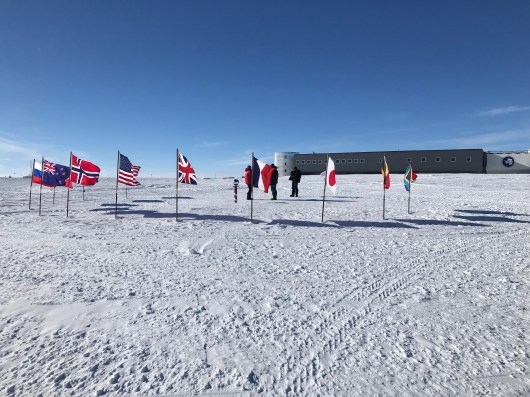
- The Ceremonial South Pole with 12 flags with the residence hall behind.
-
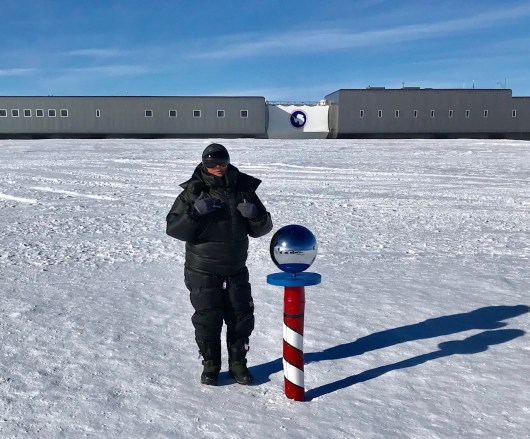
- Me next to the Ceremonial Pole with the Residence huge hall behind me.
-
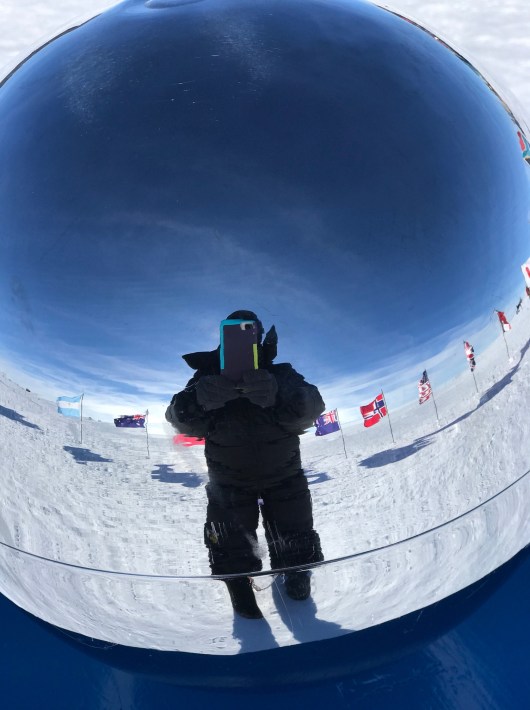
- Instead of my face, I got the camera.
-

- The 2018 Magnetic Pole marker. Due to be replaced on January 1. They are different every year. There is a collection of all the markers since the 50’s when they were first conceived.
We walked around the huge housing facility that accommodates 150 scientists plus staff, kitchens, dining rooms, living rooms, sports facilities, a movie theater, even a full basketball court. As it was Christmas Eve, no one was outdoors or working and we were not allowed into the residential facility. Although disappointed, I could not begrudge them wanting their time off. Apparently, the science projects are all outdoors. Although we could see several piles of equipment and machines, we had no idea how or why any of it was used. I wanted to stay longer and linger with my thoughts. Unfortunately, our time was up and we had to return to the plane.
We departed the Pole at 7:30am and landed back at Depot 83 at 10:10am. Several of us were feeling reflective about what we had seen and felt. There was a lot to absorb is such a short time.
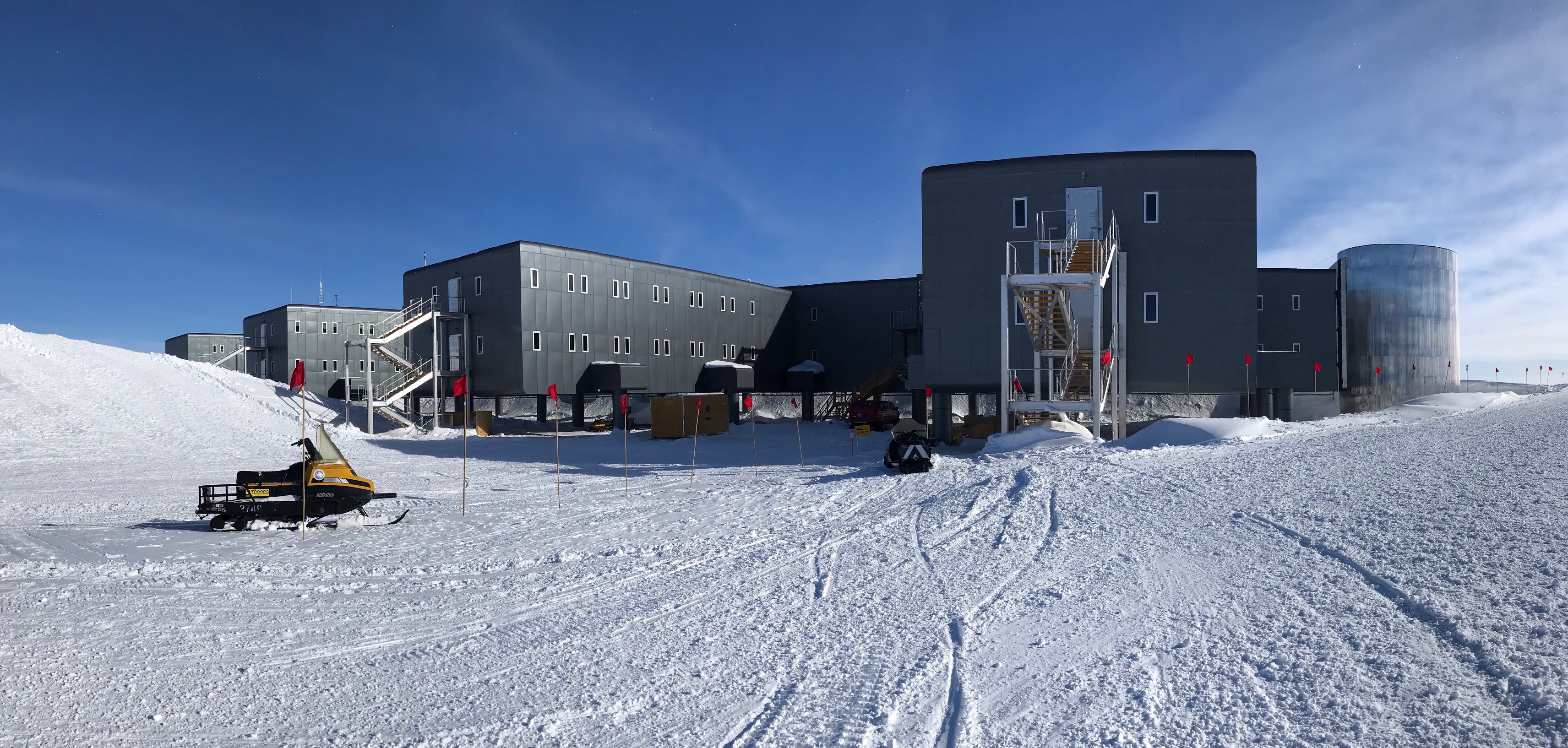
Side view of the residential building. There is room for 150 scientists at any one time.
Refueled and departed FD 83 at 11:30am and arrived back at camp at 4:10pm. It had been a whirlwind 1.5 days with virtually no sleep.
Everyone lined up for showers, had a very nice Christmas Eve Dinner of ham and a variety of fixings and went directly to bed.
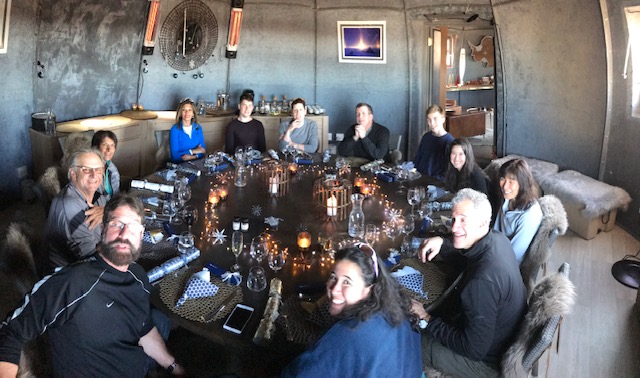
The dining room table will seat 13.
Christmas Day with Emperor Penguins, 2018
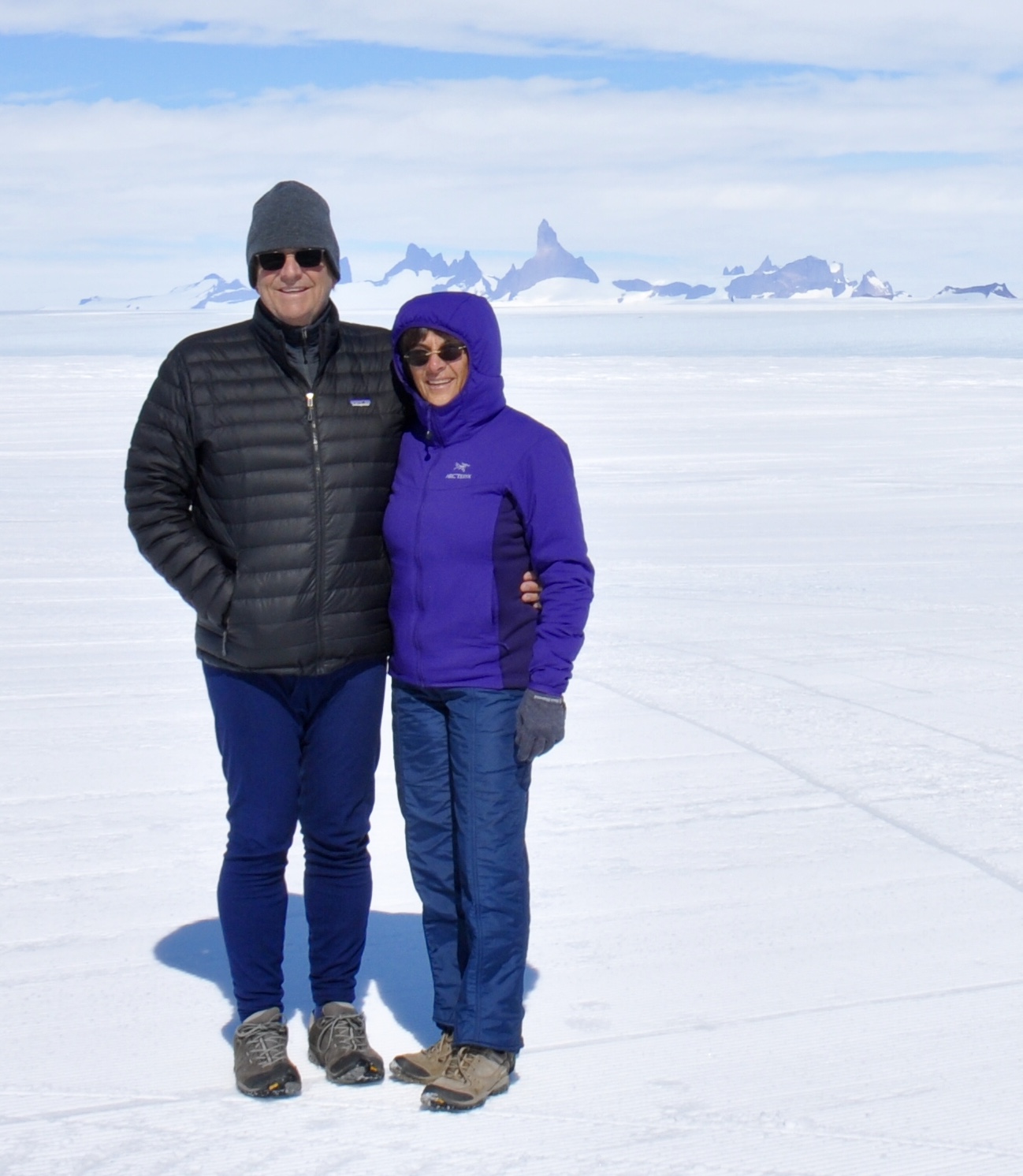
Waiting to board the Basler to see penguins. Wolf’s Fang is behind us.
-
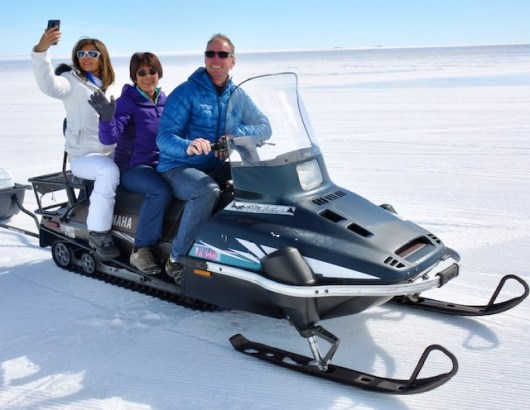
- Catching a ride from the Basler to the warming hut at Wolf Fang Airstrip.
-

- The staff tents at Wolf Fang. The ice Christmas Tree made me smile and appreciate the people who stay in such conditions all season long.
The weather is still holding up—warm and sunny with little wind. We celebrated Christmas with the Emperor Penguins. Breakfast at 7:30. Depart for airstrip at 8:30. Lift off at 9:15am.
-

- Spectacular mountains and glaciers.
-

- Wolf’s Fang up close.
-
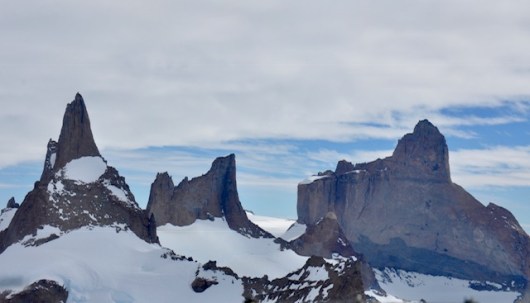
- Wolf Fang mountains from the Basler cockpit
-
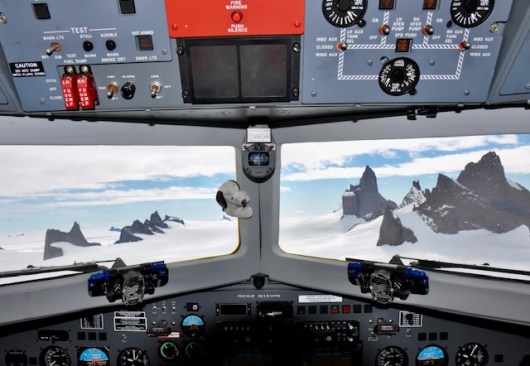
- Cockpit view of mountains as we circle them.
We flew to Wolf Fang—the airstrip there is 9,600 feet long–for fuel, then climbed to 8,200 feet for a mountain tour before heading for the flightless birds. We flew around Wolf Fang Peak and several others with Norwegian names. I was in the cockpit for most of the flight and enjoyed the views and the conversation with the crew. Gradually they descended to 4,000 feet before landing at a ski strip near the rookery.
Upon landing everyone climbed onto 2 6-passenger sleds and were pulled to the penguins by snowmobiles. There were at least 2-3 thousand animals in 2 different
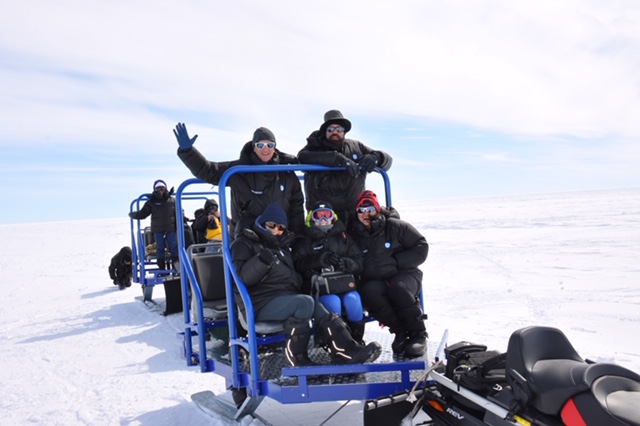
Sledding from the Basler to the Emperor Penguins
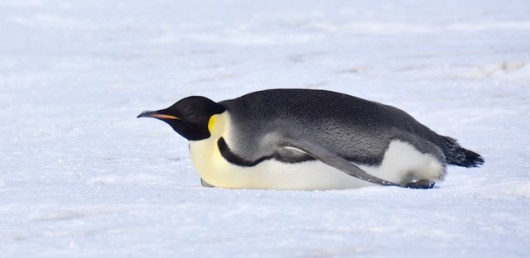
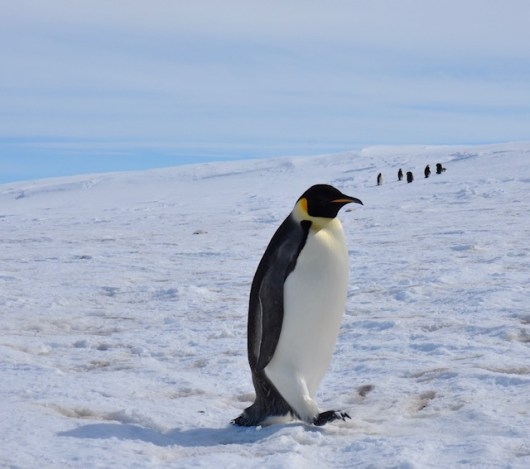
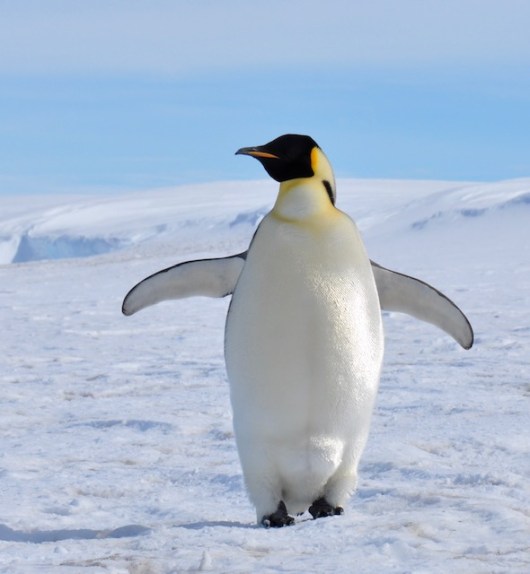
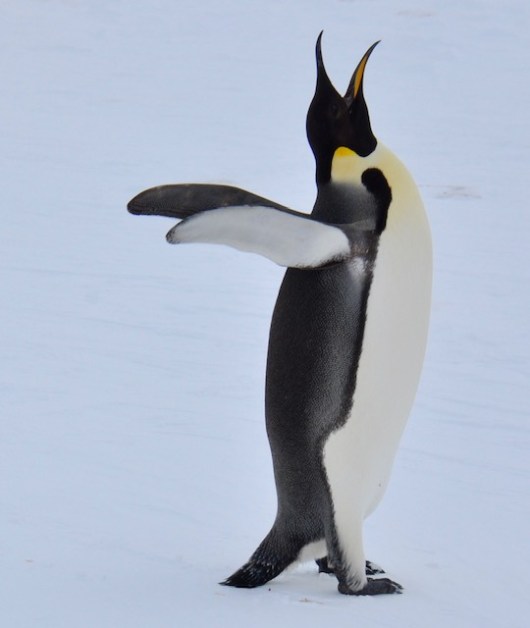
rookeries socializing with each other, feeding babies, wandering around on their bellies or by foot. We walked around and approached the penguins to about 50 feet. Then we sat down on blankets and watched the action. Several animals walked very near us. We were with the birds for about an hour and a half and took photos like crazy.
A bit about Emperor Penguins:
They live in the high Antarctic only. There are about 40,000 breeding pairs.
Are deep divers going mostly to 165 feet, but able to dive to 800 feet. Longest recorded dive is 18 minutes.
Their diet is 95% fish, 3% squid and 2% crustaceans.
They breed on the sea ice in the coldest conditions and can be independent of land.
They have no territory except the ice around wherever they are standing.
On land, they travel much faster on their bellies.
One egg per couple is laid in May/June, at the coldest time of the year and are incubated by the father until the eggs hatch at between 62 and 66 days. The father feeds the chick its first meal of fat and protein. By this time the father has lost 45% of his weight and leaves for the sea as soon as the mother arrives and takes over feeding. When the dad gets back the parents share the feeding. The chick fledges in spring at 5 months. In good weather the chicks are carried out to sea by the collapsing sea ice.
Chicks stay in the ocean until sexual maturity at 4 years and then generally head for their natal colony.
There were many dead babies laying around and several that looked near death that were apparently abandoned. Many chicks were alone waiting for parents to return
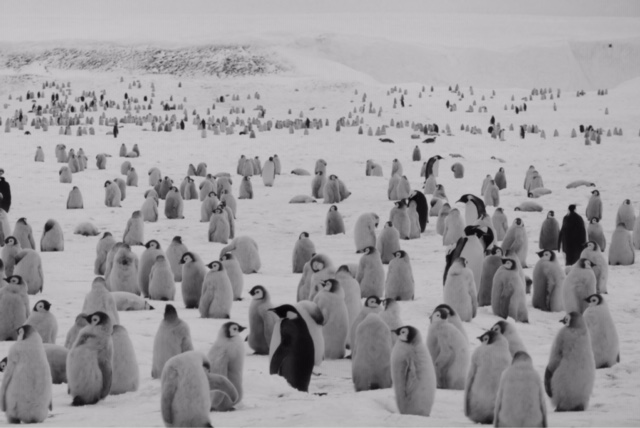
A huge colony of Emperor Penguins as far as the eye can see.
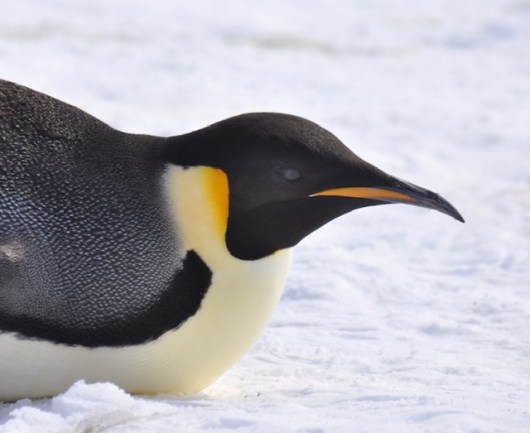
with food. Some parents were there feeding chicks. One bird was apparently trying to sleep. I would have loved to be there longer to take in more of the experience. There are no captions as the images speak for themselves.

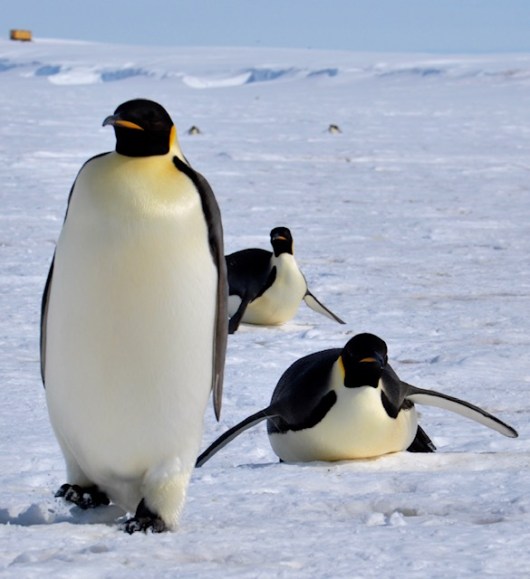
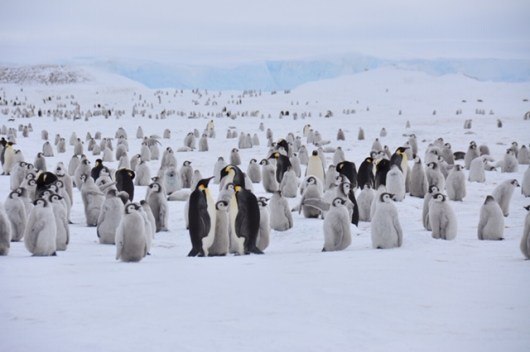
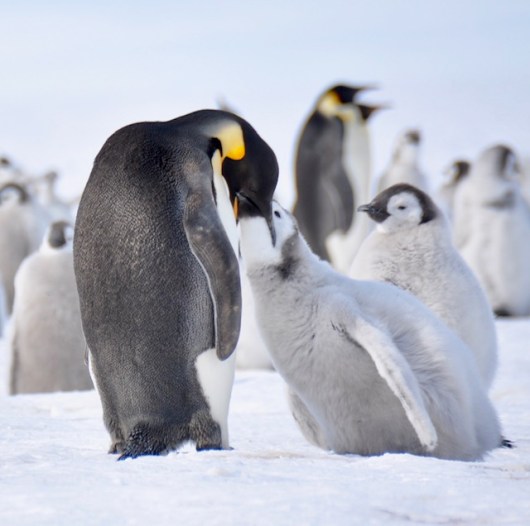
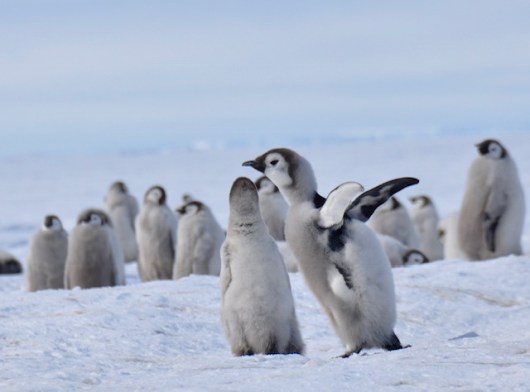
-
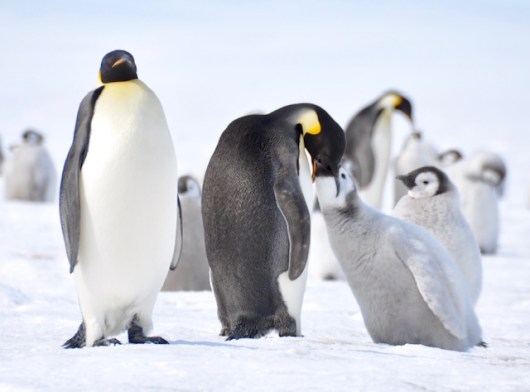
- Father is watching.
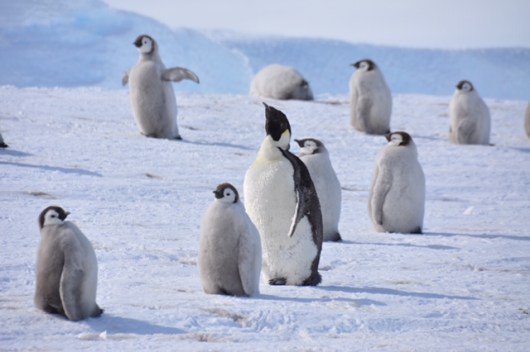
-
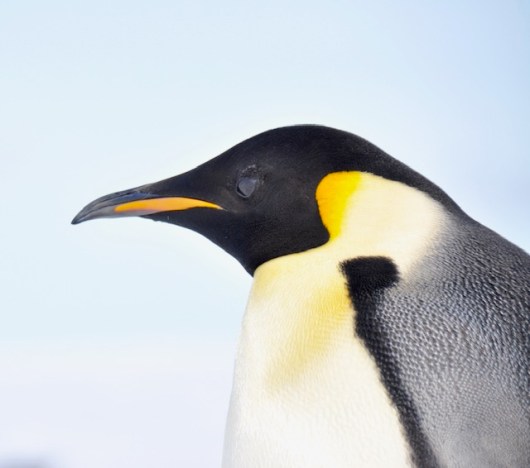
- Try finding the eye.
-
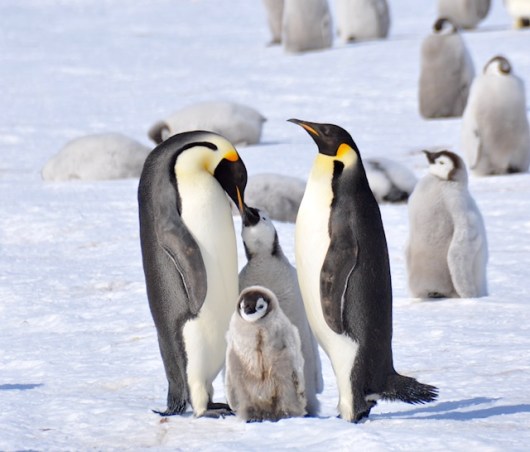
- A family photo
-
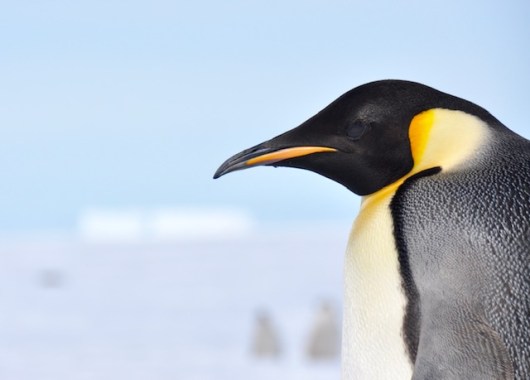
- Even when you find the eye, there is no twinkle.
-
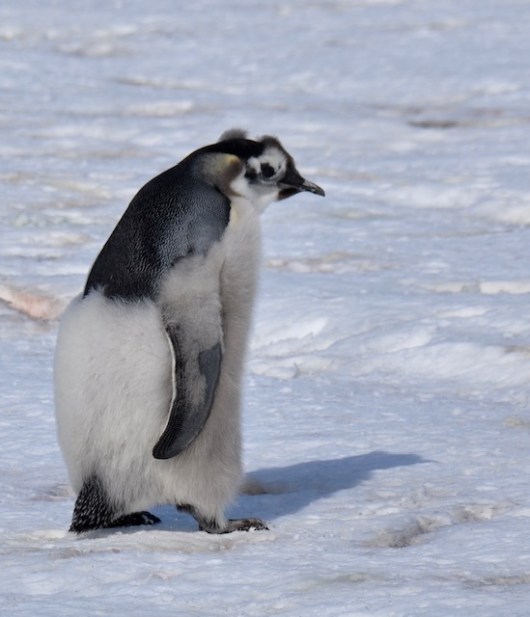
- This teen aged chick is molting.
-
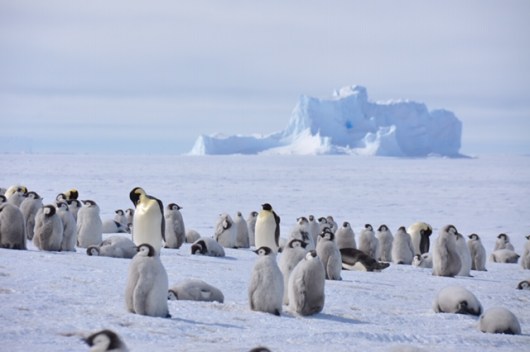
- I liked the iceberg in the background. It looked like a castle.
-
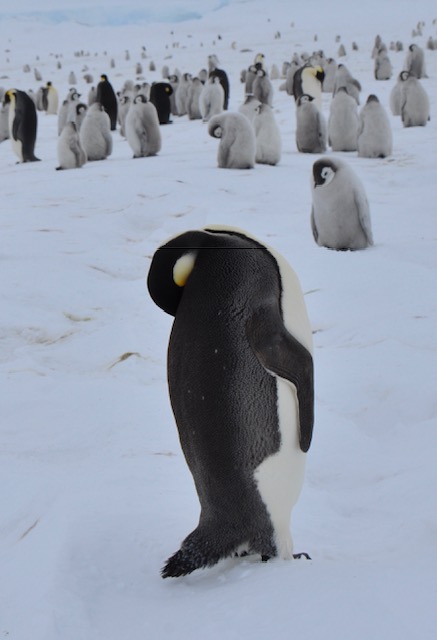
- This one kept trying to sleep.
Soon we were off in the sleds to find Wedell seals. It was a long bumpy ride over the ice shelf before we found any. I was trying to imagine what such a ride might be like if I was trying to get to the pole over these conditions. No fun. Eventually we found 10 seals laying about napping.
-
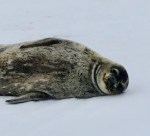
- Wedelle seal.
-
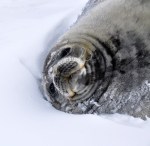
- Wedelle Seal
-
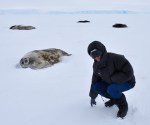
- Next to Wedell seals.
They did not budge even when we got close. Another fast ride back to another rookery for 15 minutes, then off to the plane for the return flight. This time we flew to the ship depot for fuel and have now seen all of White Desert’s fueling stations. We left there at 6:45pm, flew to the camp strip, returned to camp and had a very uneventful Christmas Dinner. I had wanted to offer a prayer, but was told not to as it would make some people uncomfortable. I finally gave up the notion and proposed a toast in thanksgiving for the penguins. I may be the only one who cared about Christmas. The staff had put a party favor at each place, decorated a small tree and put a few decorations around. Nothing religious. I had a copy of the Reflections of Father Bill with me and read his Christmas homilies to myself.
December 26, 2018
With the big events behind us, we could focus on activities around camp. On the 26tha group of us went on a hike to the nearby nunatak, an exposed hill with no snow on it. First they were to hike over rock, so I bailed on that part. Driver Matt, took Francois and me by truck to an area where I could climb the snow covered hill with crampons. We had a very nice hike and got to the nunatak at the same time as the others. Then we all hiked the short distance to the top of the hill. Very nice views. On the way back Francois and I took a different route and ended up hiking through thin ice with flowing water underneath. We walked very fast in the wet parts and did not get much water in our boots. The air is so warm that the snow is turning into rivers of melt water. Did not feel like the Antarctic to me.
-
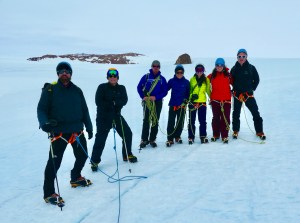
- The big group that hiked to the top of the local Nunatak. Francois and I went another way.
-
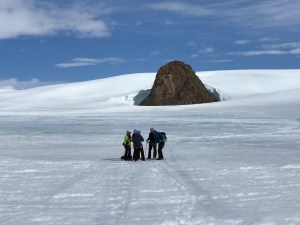
- The group walks to the Nunatak. We climb the knob from the back side.
-
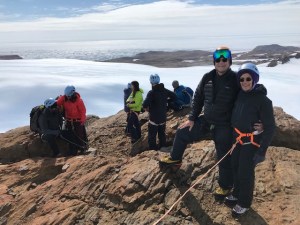
- All the hikers at the top of the Nunatak.
-
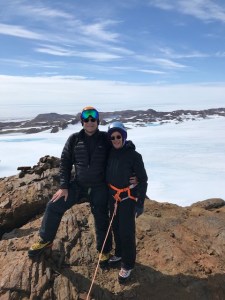
- Mark and me at the top of the Nunatak, a snow free, rock outcrop.
-
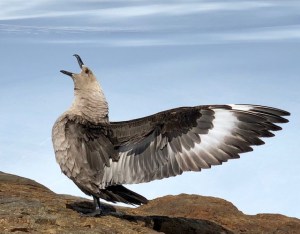
- Sub-Arctic Skua-common around camp and the hills nearby. Mark caught this image on the Nunatak.
-
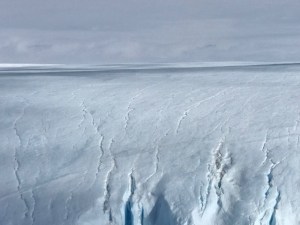
- The glacier hill opposite our camp. It cracked and some broke away during our warm week in camp.
-
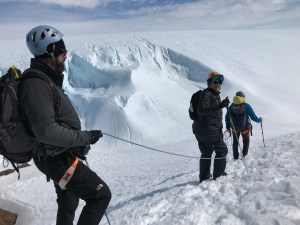
- Scott, mark and Manu head out to climb the glacier.
-
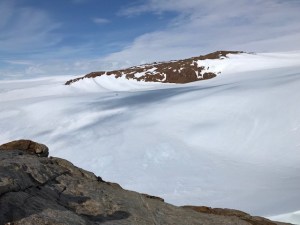
- A lovely view of the snow from the top of the Nunatak.
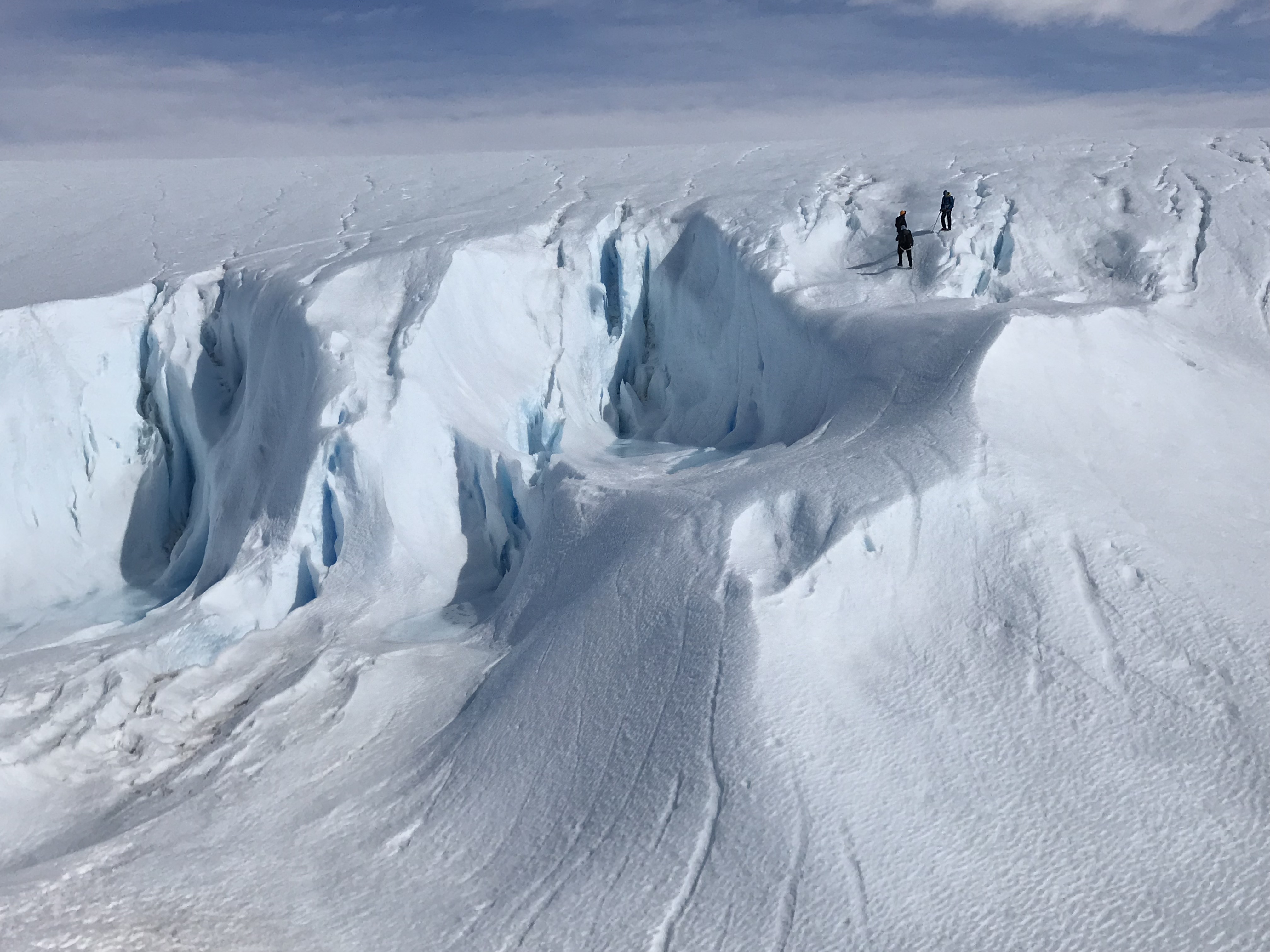
Climbing the glacier while avoiding crevasses. They are not far away, but distances are very deceiving. They are the black spots in the top center right.
After lunch and a rest, another group of us went to see a nearby ice cave. The entrance was partially blocked by running water, so the guides rigged rope so we could straddle the 10 feet over water into the dry part of the cave.
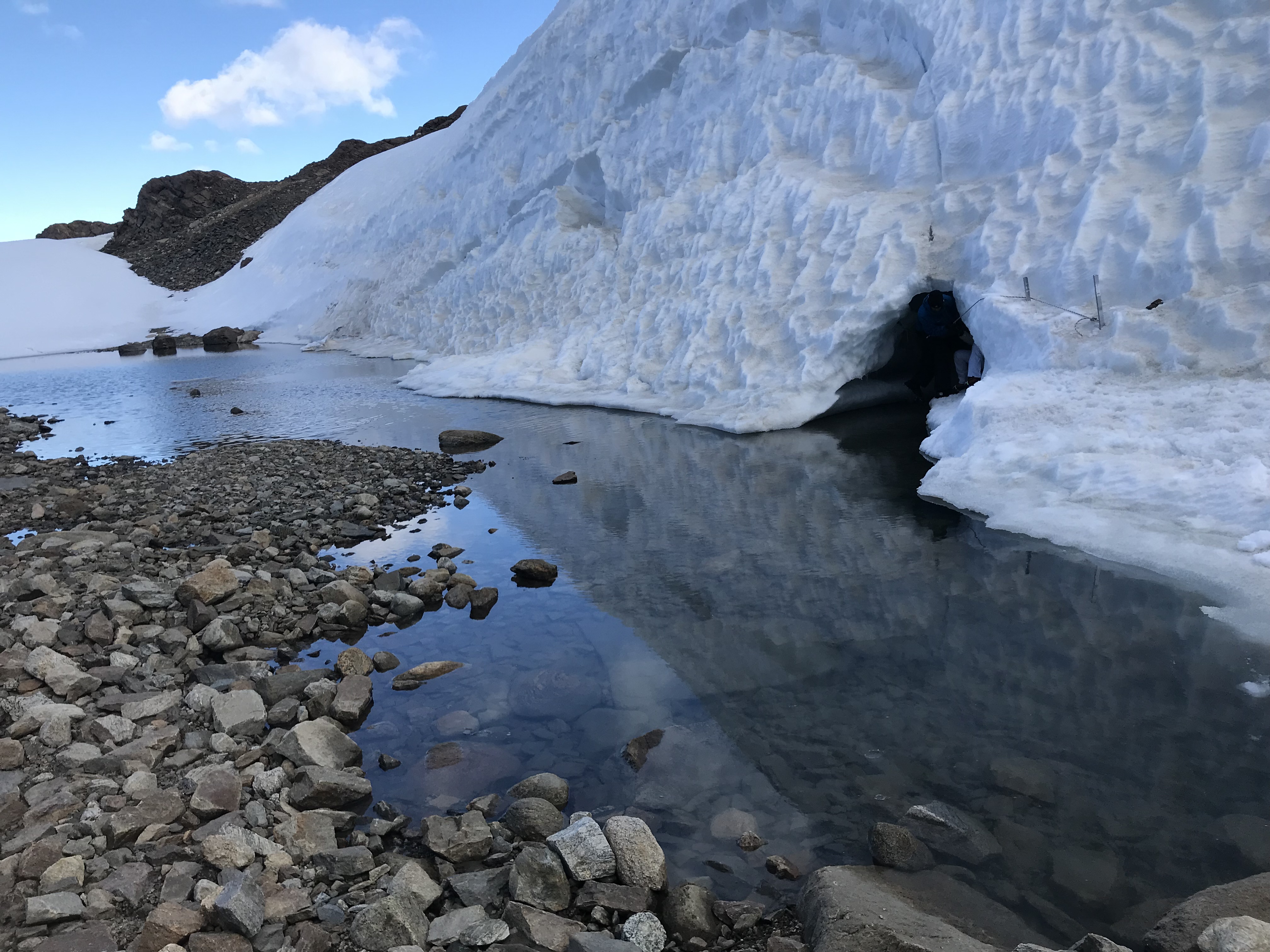
Entrance to ice cave. Not easy to straddle the opening and stay dry, but we all managed.
It took a lot of sliding on my butt and pushing against the rigged ropes with my feet to move along. Taller people had no problem. Once inside, the ice was a bluish grey color with ice crystals of every shape and size hanging from the ceiling just above our heads. I felt like I was in a wonderland.
-

- Sam, one of our group with a much better camera than a phone, shared this image.
-
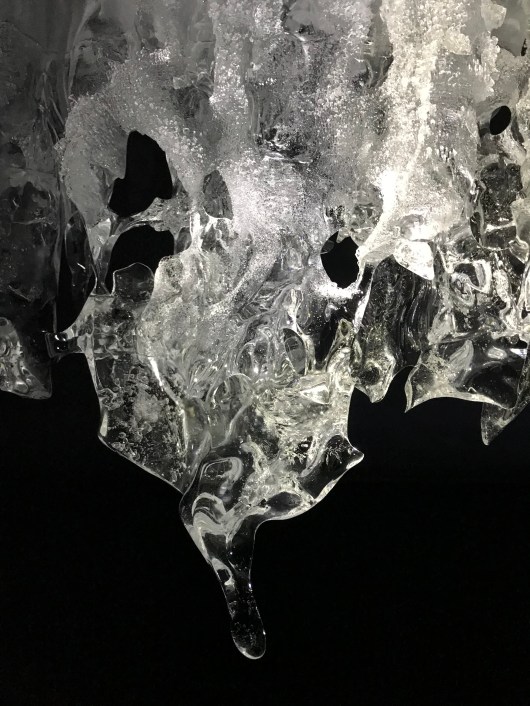
- Clear ice crystal formation.
-
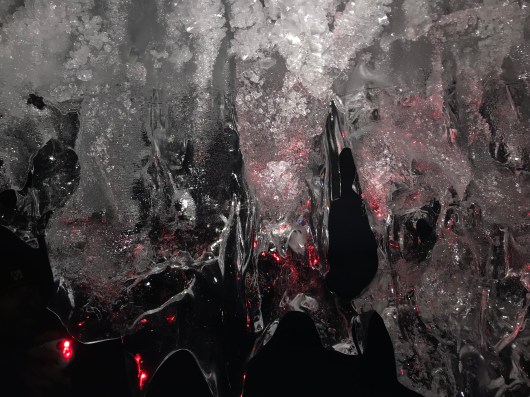
- More clear crystal under red light.
-
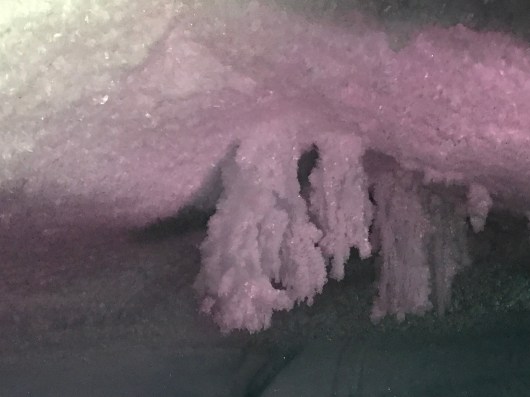
- The end of the cave in natural light.
-
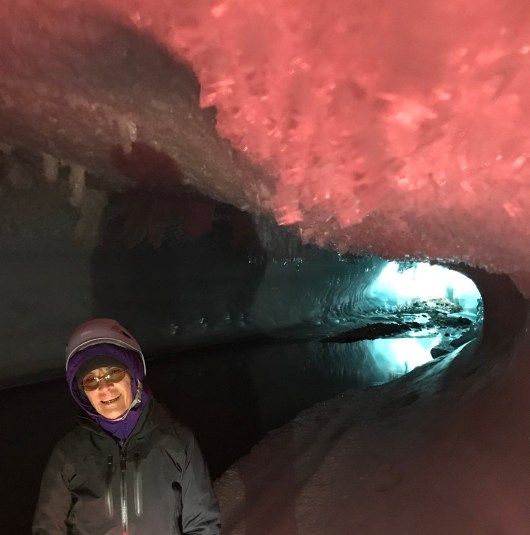
- The back of the cave under red light. The exit is not passable with so much water..
-
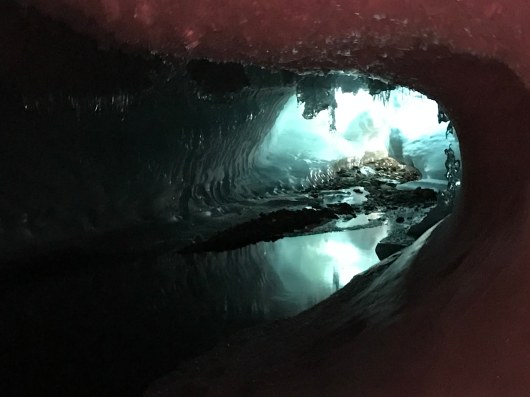
- The end of the cave in natural light.
-
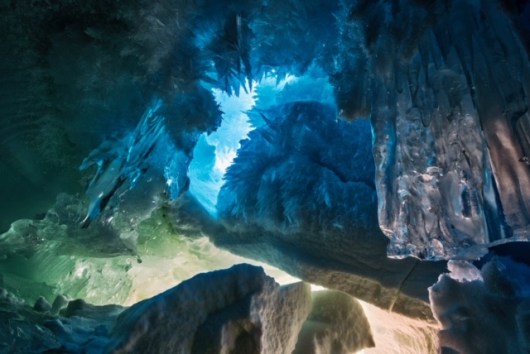
- Sam, one of our group with a much better camera than a phone, shared this unusual image.
-
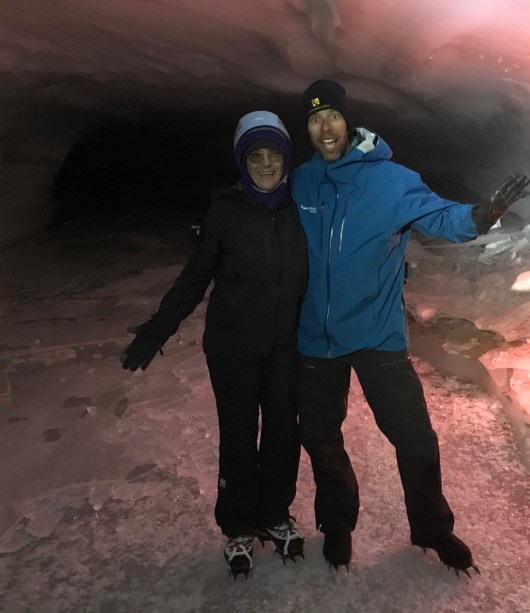
- Julia and Francois share a successful day of hiking without injury. Many thanks to him.
Everyone was a bit giddy and delighted with the experience. No one wanted to leave. The guides played “The Sound of Silence” and did a mini light show with a multicolored wand. For a moment the group was speechless. Then everyone went crazy trying to get good photos, including me. I was sorry Mark had opted out of this activity. Getting out of the 80’-long cave was easier as I understood what needed to happen and my eyes had adjusted to the dark interior light. The water running passed the cave entrance was at least 2 feet deep and running fast. Would not have wanted to fall into it. By the next day the cave was totally filled with water. It had been a lucky adventure.
In all, it was a very fun day with much exercise, fun activities, no airplanes and good weather. The group was lively during dinner. Several of us got into a bottle of Shackleton scotch. It was so good we eventually went through 5 whole bottles of the blend and wanted more. The story on the label was that 11 intact bottles were found in Shackleton’s cabin 100 year’s after his death. Originally ordered by Shackleton, the spirit had been provided to the 1907 British Antarctic Expedition led by the great explorer.
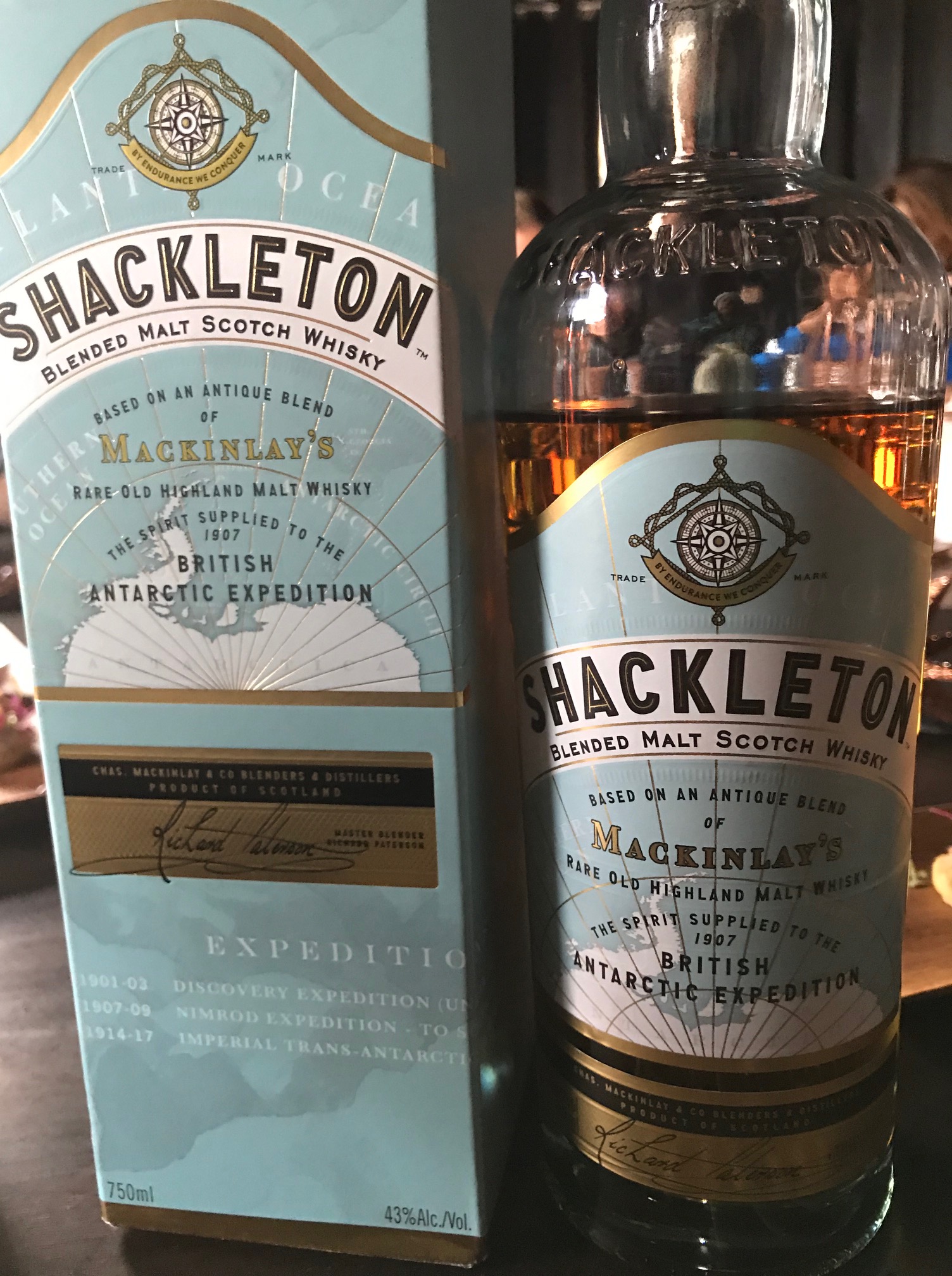
One of the 5 bottles of Shackleton our group consumed.
The Master blender of Mackinlay’s, the original creator, spent years reproducing “an enigmatic blended malt” that matched the spirit in the remaining bottles “with real warmth and depth at its heart, like Shackleton himself.” Really good scotch. We hope to be able to order it when we get home.
December 27, 2018
Another sunny, warm, nearly windless day. It is very spoiling and special to have so many good days in the Antarctic. The staff keeps telling us how lucky we are to have such good weather.
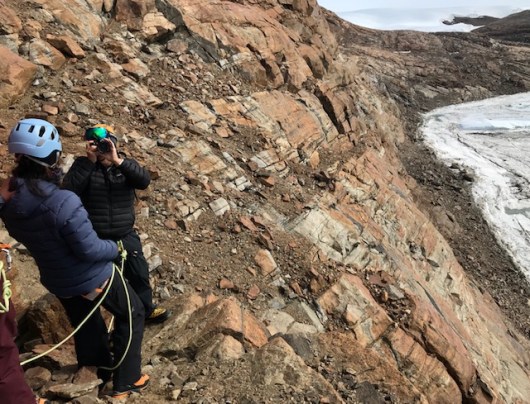
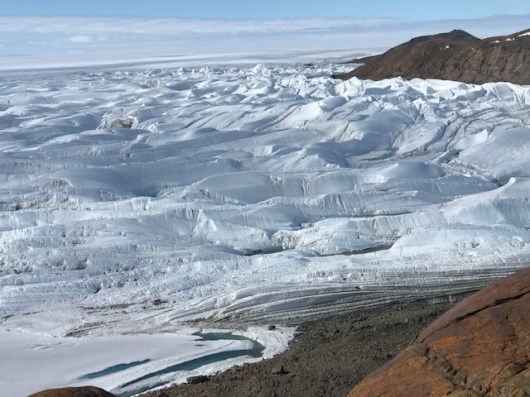
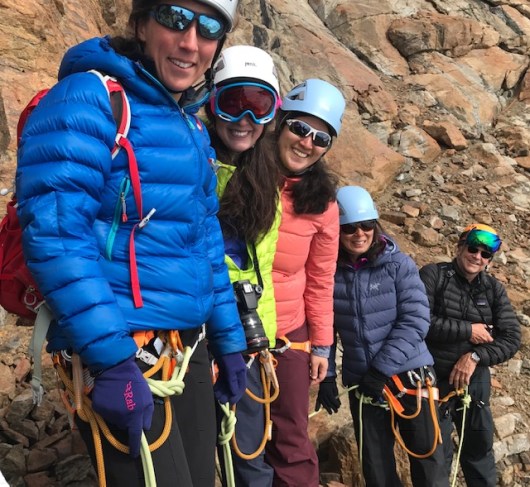
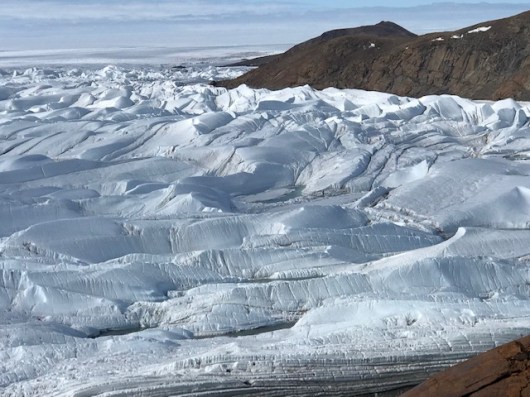
Six of us went on a hike to see ice waves, sea ice that has been compressed against the shore and is now frozen into the shape of waves. We drove about 25 minutes to the beginning of the hike. We needed our helmets, hiking boots, liner gloves, harness and light jacket. No crampons, poles or other gear. We did have to hike up and over a rocky hill to get to the start of the main reason for the hike. Our guide, Manu, let me use my poles for walking through the rocks. Then he took them away from me and put them in his pack. From then on, I could not have them as they would be in the way. As he attached harness gear to each of us and a long rope connecting us to each other, he did not tell any of us what was coming, except that it was a cliff edge we would be walking on to overlook the waves.
-
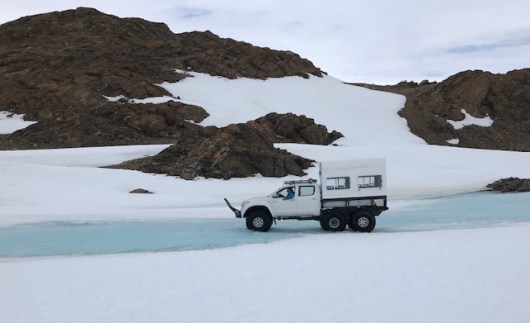
- Crossing the river on the way to the hike. Matt tested the river bottom before taking us along.
-
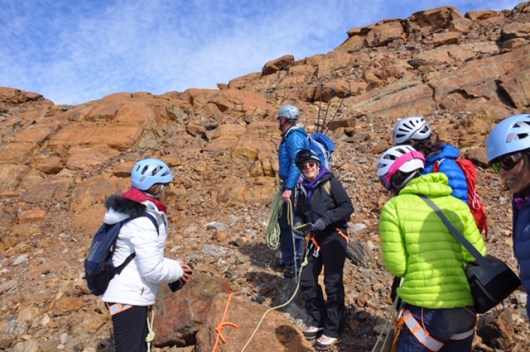
- Starting out on the difficult part. I had no idea what I was getting into.
-
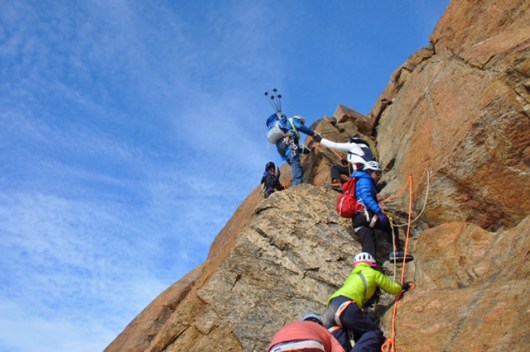
- Negotiating a steep cliff.
-
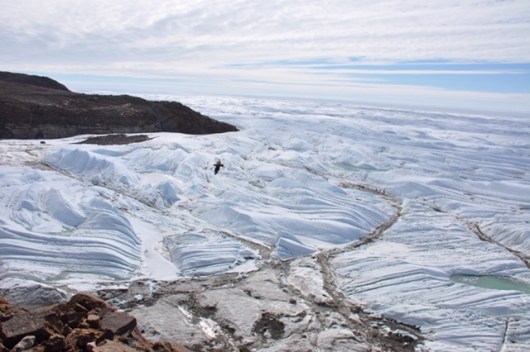
- Ice waves created by pressure pushing the frozen snow into peaks.
-
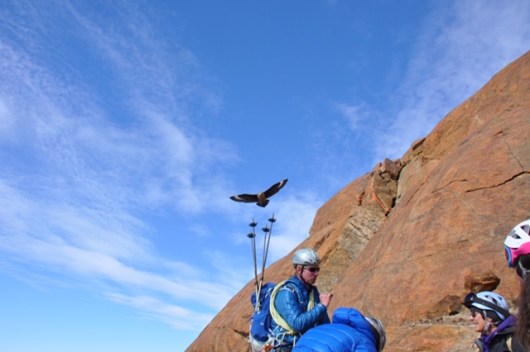
- Manu in the lead, guides us up, down and around the cliffs. A skua flies overhead.
-

- I am momentarily in the lead as Manu helps Farida up a hard spot.
-
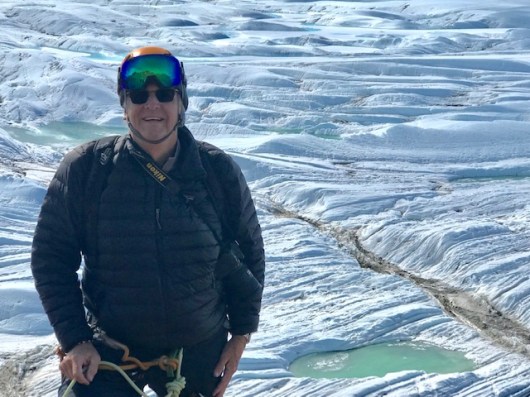
- I capture Mark during a quiet moment.
-
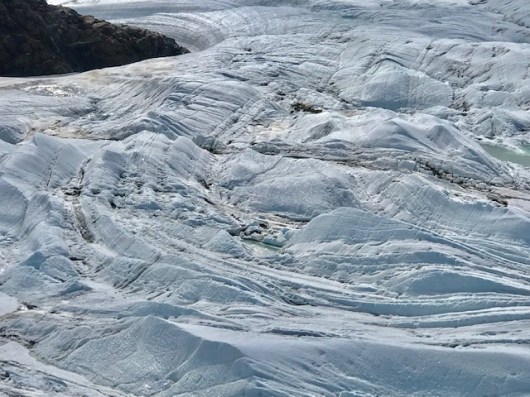
- Ice waves. They are very interesting to stare at.
-

- Not a good idea to look down.
-
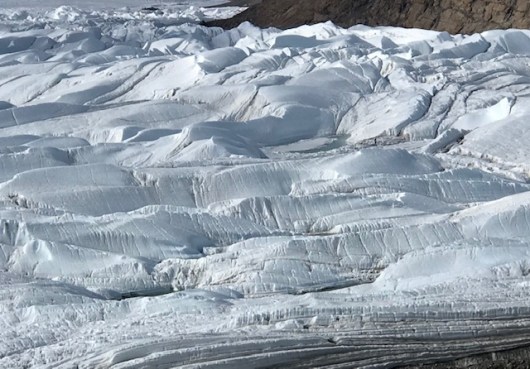
- Ice waves. Sets my imagination to creating different images.
-
- Looking back, I wonder where the path was. No wonder I was frightened.
-
- These waves are extraordinary.
-
- The group behind me waits patiently. I am definitely the slowest hiker, which is why Manu put me immediately behind him. Mark, the strong one, brings up the rear.
-
- Between the waves are rivers of water.
-
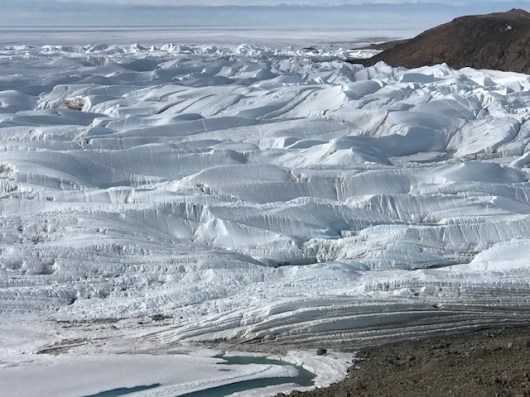
- More ice waves. It was hard to find safe places to stop and take photos or just look at the ice.
-
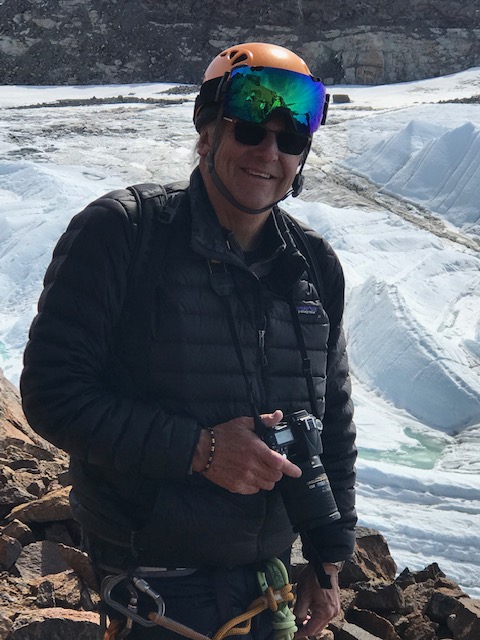
- A ledge wide enough to take some photos.
-
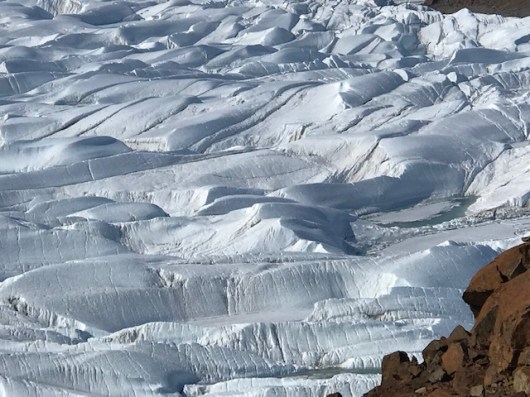
- More ice waves.
-
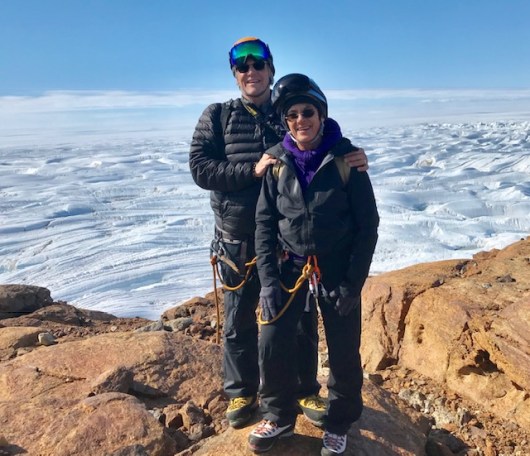
- Near the top. The worst is over, but there was much more rock to negotiate before getting back to the car.
-

- Francois and Julia celebrate finishing the hike. It was exhilarating to have completed such a difficult adventure.
-

- On the way back, the truck has a rough time negotiating all the melted snow and ice.
Very shortly, the cliff edge was anything but flat or even slightly wide. I was clinging to the rock wall for dear life. With each step, I became more frightened as I began to see ahead that there was no cliff edge at all. Where were we going and why is this happening to me? Manu had put me immediately behind him and the rest were right behind me. I could not go back. He began to tell me where to place each hand and foot. Terrified, I did what I was told. We came to a rock wall we had to get down. A red rope with a knot in it every 3 feet hung from the top of the wall.
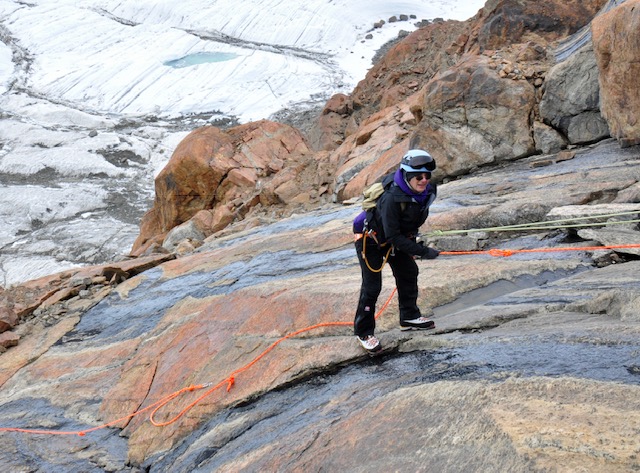
The first steep pitch I had to negotiate backwards. I just kept watching Manu talk me down. I was afraid until I realized that it was not so difficult, I just had to focus and trust–and not look back.
Manu instructed me to grasp the rope and walk myself down the wall. I faced the wall and looked into his eyes as I did what he said. It got a little easier as I descended and before long Farida was coming down the wall above me. There was a small ledge at the bottom where I waited for everyone to descend. We all turned around to look at the waves and take a few photos. After all, wasn’t that the point of this expedition?
I asked if the worst was over and Manu just smiled. Oh dear. What’s next. I was told to hold onto a notch in the rock wall next to my head and feel for the out of sight foothold below the rock. I found one foothold and placed the left foot on it. Now move the right foot next to it and find the next foothold to the left and so on for 4 or 5 steps. Then he took my hand and guided me to the next rock hold so he could help everyone else. When I looked down there was nothing but air for about 100 feet. I vowed not to look down again. Once everyone was around that spot, we continued with passages nearly as difficult for a time, taking photos of each other and the waves as we could. We next had to pass through a crack in the rock wall. That was an easy one for me, but Mark had a hard time getting through. Then we began to climb up the walls of rock. My knee was not happy about the steep pitches.
Suddenly I saw another red rope and that got my attention. Now what? Manu tells me I have to pull myself up the rock wall. I can’t even begin to get a grip on the wall. Finally, Manu gets behind and pushes me up to get me going. I get only so far and have to wait for Farida, who is tied behind me, to catch up. She cannot pull herself up either and gets a hoist from Manu. Everyone else is stronger, not to mention younger, and more able. Once up that wall, the worst was over. We still had to climb the rest of the way up the rock hill, down the other side and over another hill to get back to the vehicle. The walk had taken 3 hours (from 11am to 2pm) and we were all exhausted and exhilarated. I would not ever choose to do that hike or anything like it, if given the choice. But having done it, I was pleased to have completed it, even with a ton of help from Manu. The waves were only a small aspect of the entire experience. It felt like a thrilling accomplishment, even if unexpected.
Back at the camp, my whole body ached. I collapsed into my seat for lunch. While having lunch, Manu and Francois suggested we go zip lining. They have rigged a line near the camp and it would be a breeze. By 4:30 I was feeling better and joined the same group. This was fun and laughs. Nothing scary, thankfully.
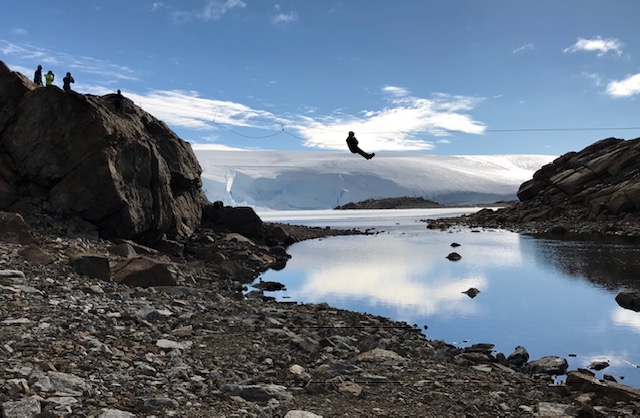
Mark zip lining across the river. Nice and benign. I did it too. The melting glacier is in the background and camp is just to the right of the image.
After dinner and more Shackleton, John, the camp manager, came into the dining room to tell us we would not be flying home the next day as the weather was not good at the Whichaway skiway, nor at Wolf Fang Airstrip, where we would pick up the jet to fly us back to Cape Town. The decision was final. The powers that be would try again for the next day. Although we were all ready to leave, we knew this weather delay was a possibility and had planned an extra day in Cape Town as insurance.
December 29, 2018
Although the guides had more activities planned and some of the group participated, Mark and I had had enough. The weather changed to overcast, windy and cold. I was happy to write and he was happy to read. Our last day in the Antarctic was a quiet one. We appreciated seeing a change in conditions as we were beginning to think summer in the Antarctic was a balmy affair. Until this day, we did not need to wear the heavy parkas or mittens we had been loaned, or extra layers of clothing.
Dinner was a celebratory affair. The chef, Antony, had prepared good meals all week long and this last evening was no exception—tomato and red pepper soup, rack of lamb with squash risotto and perfect lava cake for dessert.
This time John said the weather was good enough and our departure was immanent. We were ready.
December 29, 2019
Up at 5am. Breakfast at 6. In the trucks at 7. In the Bassler and away from Whichaway at 7:30. Land at Wolf Fang at 8am. Weather was really cold, windy and overcast. First time we have had such weather since we arrived. We wait in the warming shack until the jet arrives and unloads the next group of guests. For us it was up and away from Antarctica at 10:10am.






 Adventures with Julia