
September 25, 2019
Immediately after sending the last post, Mark commented he had some temple photos to share. So here are his shots that certainly enhance mine.


Our flight from Amritsar to New Delhi left at 3:20 on Vistara Air, a new, discount airline for us. Arrived Delhi and went directly to our hotel near the airport. Dinner, bed and up early for an 8am flight to Leh. Arrived Leh at 9:30am on the 26th.


September 26, 2019
The elevation was 10,911 according to my iPhone. So we were back to moving slowly, allowing others to carry the bags and observing the new scenery, which is not unlike the scenery in northern Pakistan.
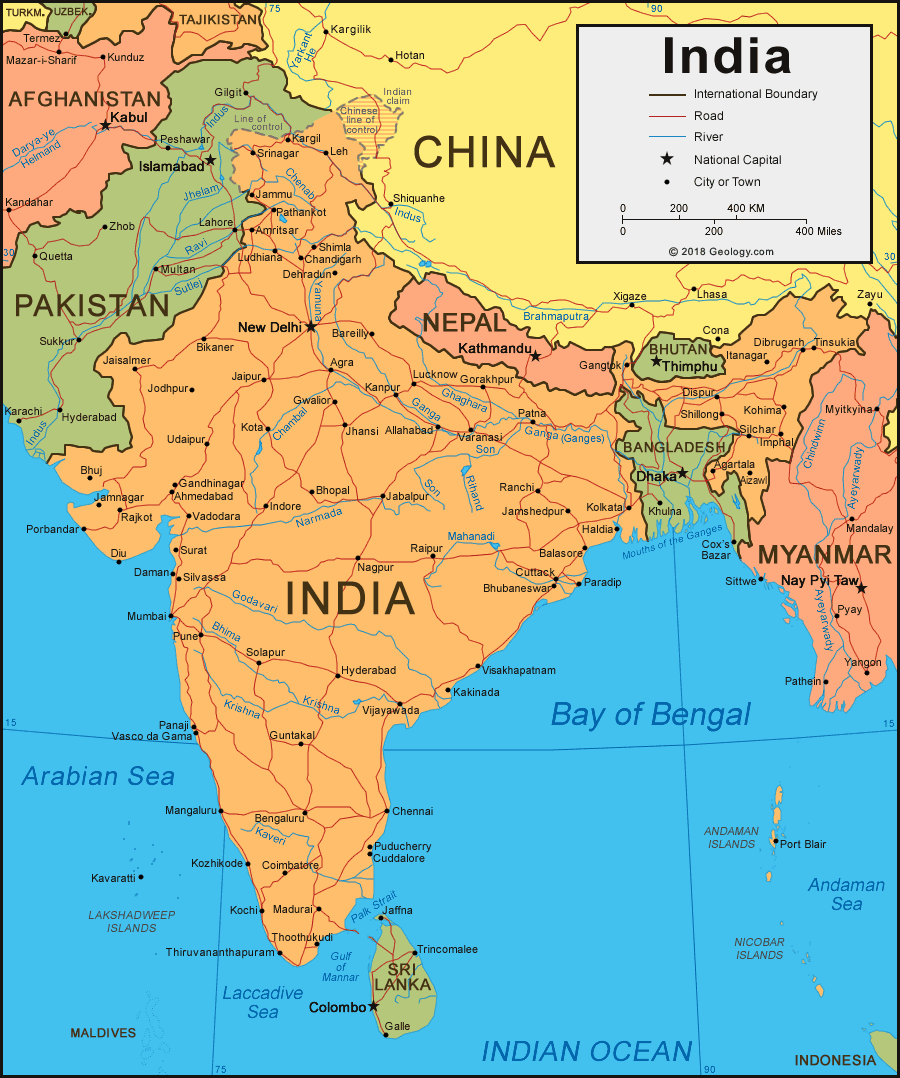
A map of the sub-continent. Lehore and Amritsar are marked just south of Islamabad. New Delhi is south and slightly east of Amritsar and Leh is in the far north, due east of Srinagar and Islamabad.
Ashim, Mark and I met our local guide, Karma and we were off to Thiksey Chamba Camp to check into our tent in time for lunch and a needed rest to recover from the altitude.
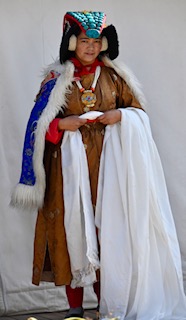
A young lady dressed in traditional Tibetan costume greeted us with ceremonial shawls.
We were greeted by young ladies dressed in traditional Ladakh clothing and presented with ceremonial scarves of welcome.


Late in the afternoon we drove into the very delightful town of Leh, parked and walked through the pedestrian streets. We visited one of many Pashmina stores and considered the options–quality vs price. Decided not to decide until later.
Along the walk through town, Karma filled my head with lots of information. First, about Karma himself. At 29, he has completed a 6 year program in traditional medicine and works in that field during the winter. However, he prefers to work as a guide during the summer as he learns a lot from tourists and makes better money. He and his family are Tibetan refugees who have settled here to be close to Tibetan Buddhism. Leh is the next best Tibetan place to live next to Lhasa, which is not accessible. He is assigned to Refugee Camp 8, but does not actually live in the camp. He and his family have done reasonably well and live in a small house. The Tibetan population of Leh is 10%, with all of them being refugees.
-
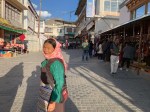
- A Ladakh lady smiles at me as we walk into Leh.
-
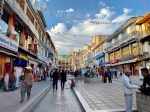
- The main pedestrian street in Leh.
-
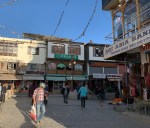
- Approaching a cross street in Leh.
-
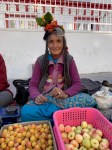
- The flower hat means this lady is from the local Dha-hanu tribe.
-
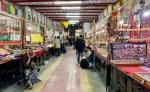
- A Tibetan shopping arcade
-

- A Tibetan woman knitting while she minds her store.
-
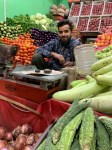
- A Ladahk vegetable vendor.
As we walked through the charming pedestrian streets, he pointed out Tibetan businesses. He is very religious and follows the Dali Lama’s activities with great interest. Until this year, the Dali Lama came to Leh every year for special prayer services. He has stopped coming because of his health and the altitude.
From Ashim, I learned there are 28 states in India and 9 union territories, which are managed by the federal government. These 9 territories are the source of many problems, especially the territory of Ladakh and Jammu-Kashmir. Recently the Indian Parliament has voted to divide the two areas into separate unions. Ladakh will be one union, which is pro Indian. Jammu-Kashmir will be another union, which is where all the trouble is. Apparently the Muslim majority do not want to be in India and the Indian government troops are trying, with difficulty, to keep the peace. India has currently blocked all cell communications outside the area and imposed a curfew. Children are not attending school at the behest of parents who think their protest will bring some results. The embargo/curfew has been going on over 50 days and is causing a great deal of consternation in Pakistan. Indians seem not to be taking much notice. There is much to be learned, if you care to google Kashmir.
According to Ashim, the products India needs to import are crude oil, machinery, chemicals, fertilizer, iron and steel . Another import, interestingly, is gold, for jewelry and investment. Indians love gold jewelry. The biggest exports include petroleum products, machinery, technology, and pharmaceuticals. Behind them are textiles and spices.
By the time we left town for our Camp, about 7 miles out of the town, the sky was dark and the air cool. However, it was not been as cold as we expected. The daytime temp was in the high 60’s and the evening temp was in the low 40’s. Unlike Shifa, Ashim does not join us for meals, so we were on our own for dinner in camp. Our tent is quite comfortable with its own HVAC unit and hot water tank. The bed is very firm and that made us content.
September 27, 2019
Our first activity was a visit Thiksey Monastery, also known as Little Potala, as it is similar to Potala Palace in Lhasa. We had a clear view of it from our tent. To hear the monks chanting and praying, we had to leave Camp at 6am. We were the only people who showed up besides the monks. It was a lovely experience. We learned the monks were beginning a two day holiday after having completed 6 weeks of intense retreat and the Monastery was closed but they let us in anyway. The energy was high and the younger monks were busily serving the elder monks butter tea, barley and rice. They even served us a handful of barley. It tasted pretty bland, thankfully. They did not seem to mind that we were there and had no problem with us taking photos. There was a life size photo of the Dali Lama at the front of the prayer hall, which was nice to see. It also reminded us that this is the Yellow Hat sect.


Back to camp for breakfast and then out again to see the 5-story, Shey Palace, 15 km to the east. It was built in the 1600’s by Singay Namgyal, a king of Ladakh. He killed many people to increase his territory and then had a change of heart and promoted Buddhism, especially the Drukpa, red hat, sect. Today 75% of Buddhists in Ladakh follow this sect. The palace was used by the royal family until 1834, when they moved to the nearby Stok Palace. Afterwards the Shey Palace was opened to visitors to see the Buddha.
Between Karma and Ashim, we learned that stupas, of which we saw many in all sizes and shapes, symbolize the wisdom of Buddha. Statues of Buddha symbolize physical knowledge and scriptures, as expressed in the 108 volume Kangyur, or book, of Buddha, symbolize speech.
Worth noting are some Antidotes as expressed in the Kangyur including; the antidote for attachment is impermanence; for anger is compassion; and for ignorance is emptiness–the highest level of Buddhist education.


Most interesting was our encounter with the artist who had recently painted the Buddha with liquid gold. He studied for 6 years to be able to do such work and was still studying to do more intricate painting.


After lunch we visited the Leh Palace situated above the town. It was built in the Tibetan medieval style in the early 1600’s by “the most illustrious king of Ladakh” and was, at 9 levels, considered the tallest building in the world at the time. The lower levels were used for storage and servants. The upper levels for the royal family and public and religious uses. The royal family moved to the Stok Palace in the 1950’s and the Leh Palace was abandoned until 1982 when restoration began by the Archeological Survey of India.


Before the day was over, we visited the Shanti Stupa at sunset. It was completed in 1991. Was nice to see something almost new. On the front of the stupa is the Buddha Wheel of Dharma and a statue of the teaching Buddha in the posture of “Untying the knot of Ignorance.”
Finally, we ended the day back at camp, had dinner and dove into bed. The cold I had been holding off, hit me full force. Mark kindly gave me an Excedrin PM and I was out.
 Adventures with Julia