Category Archives: 2019 Aug-Oct: China/Tibet/Pakistan/India

Urumqi, Xinjiang Province

August 31, 2019

We arrived in Urumchi after 9pm on the 30th, met our new guide, Hassan, and drove through town to the hotel, with Hassan talking all the way.  Beijing time does not really work so far west, even though it is the only official time zone allowed.  Hassan told us Urumchi locals use an hour and 45 minutes earlier to make life more comfortable.  So at 9pm, Urumchi people would use 7:45.  He also told us Urumchi is the Chinese name for the city and Urumqi is the Uyghur name.  It sounds the same to us, but is spelled differently.  There are currently about 4 million people living in the greater city, which is at the heart of Xinjiang province, the largest in China.  The province is divided into North and South by the Tianshan (Chinese) or Tang ri Tag (Uyghur) Mountains, which means Mountains of God.   There are 10.6 million Uyghurs in China with about 900k-1M in Urumqi.  We learned that Hassan is Uyghur, Sunni Muslim, married with 3 kids ages 13,10 and 5.  We decided on a sightseeing plan for the next day and said good night at the hotel.   We both enjoyed him better than PinPin and looked forward to our time together.

Hassan picked us up at 9am Beijing time and off we went to the National Peoples Park, aka the Red Hill Park in the center of the city.  The park was started in the late 1700s and boasted a Red Hill Temple in 1790 at the top of the hill. 

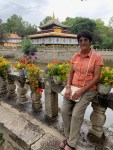
Although the Chinese stopped worship in the temple some years ago, there are several interesting statues, which are very different from the ones in Lhasa.  Wandering around the park, we enjoyed the colorful flowers and shade trees and, on reaching the red pagoda at the top we took a few photos.  

Then we drove to the Urumqi Grand Bazaar and mosque.  We enjoyed walking through the bazaar, eating freshly baked Naan, taking photos of statues and people, especially people. 

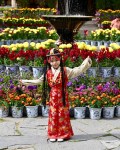
I started observing that many women were dressing in a peculiar fashion with short, tight fitting underskirts and long flowing see through overskirts, some even made of netting,  Many wore shirts that did not go with the skirts and many wore tennis shoes as well.  Weird.  So I started photographing the ones I could capture unawares.  Eventually I ran across a sophisticated group of ladies dressed in the fashion and approached them about the style.  Some of them work for a conglomerate business called “Wild Horse” and their job was to show off their clothes in the bazaar.  I chose to be enthusiastic about the style.  Their outfits ranged from $500 up.  Here are a number of shots I took over 2 days in Urumchi of these decidedly Chinese ladies.  

Mark wanted to buy a knife, so we made some effort to find one we could get through customs.  We finally found a store that sold knives, but they resisted selling to Mark.  Finally we got down to the smallest possible knife, about 2 inches long, and they let him buy it.  He only wants it to peel fruit in our room.

Finally, we were hungry and walked to a well known Uyghur restaurant called Herembag.  Mark and I ordered Polo, like the meal Rashida made for us, and Chao Mian, the dish we had watched being made with square flat noodles.  We were very happy with our selections and ate it all.  Only wish we could have had a beer with it.  While reading the menu, Hassan told us there are 32 characters in the Uyghur alphabet; 28 from Arabic and 4 from Persian.  The language got started during the 7th century and the name Uyghur mans “union” or “united”.

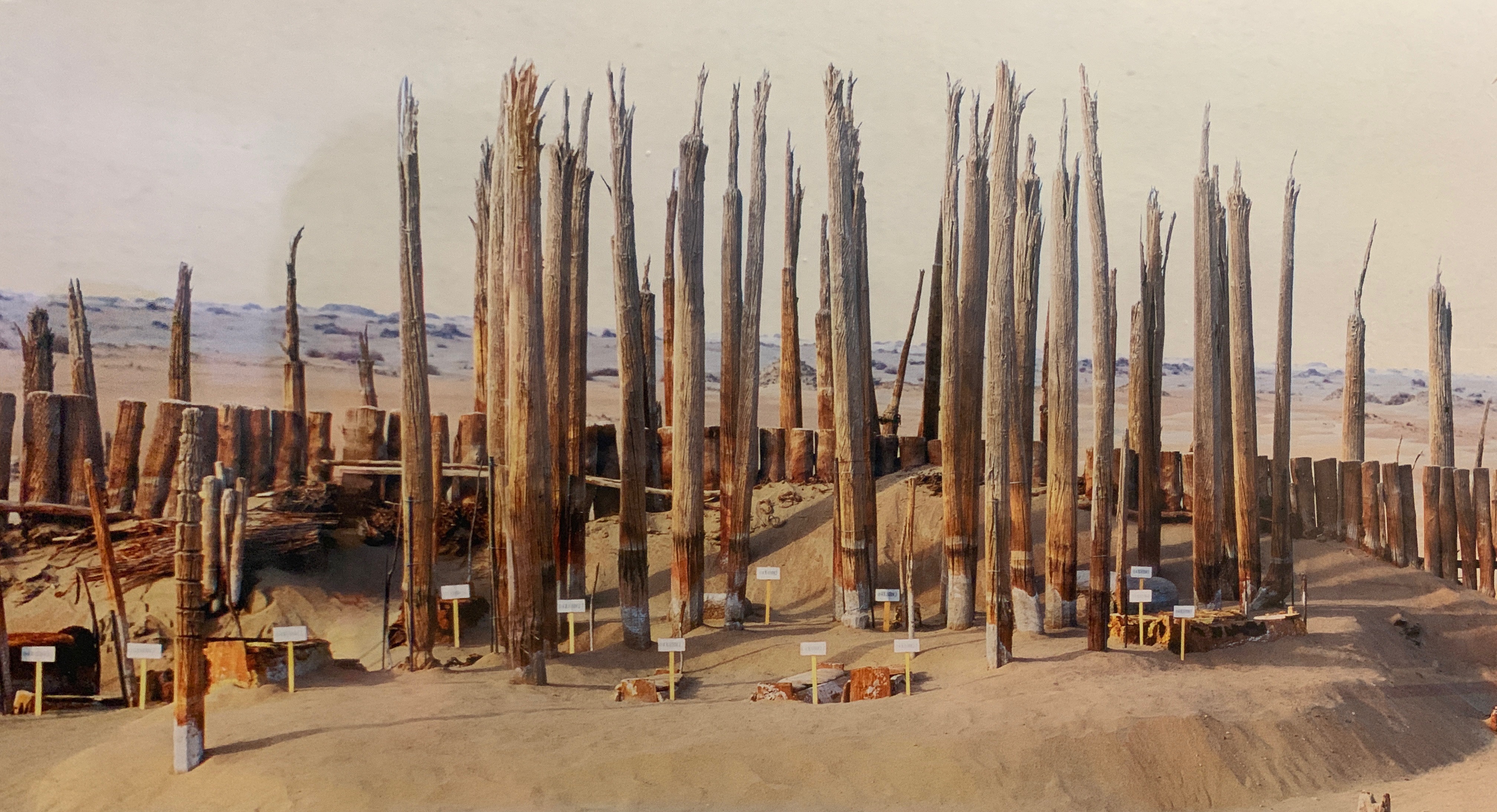
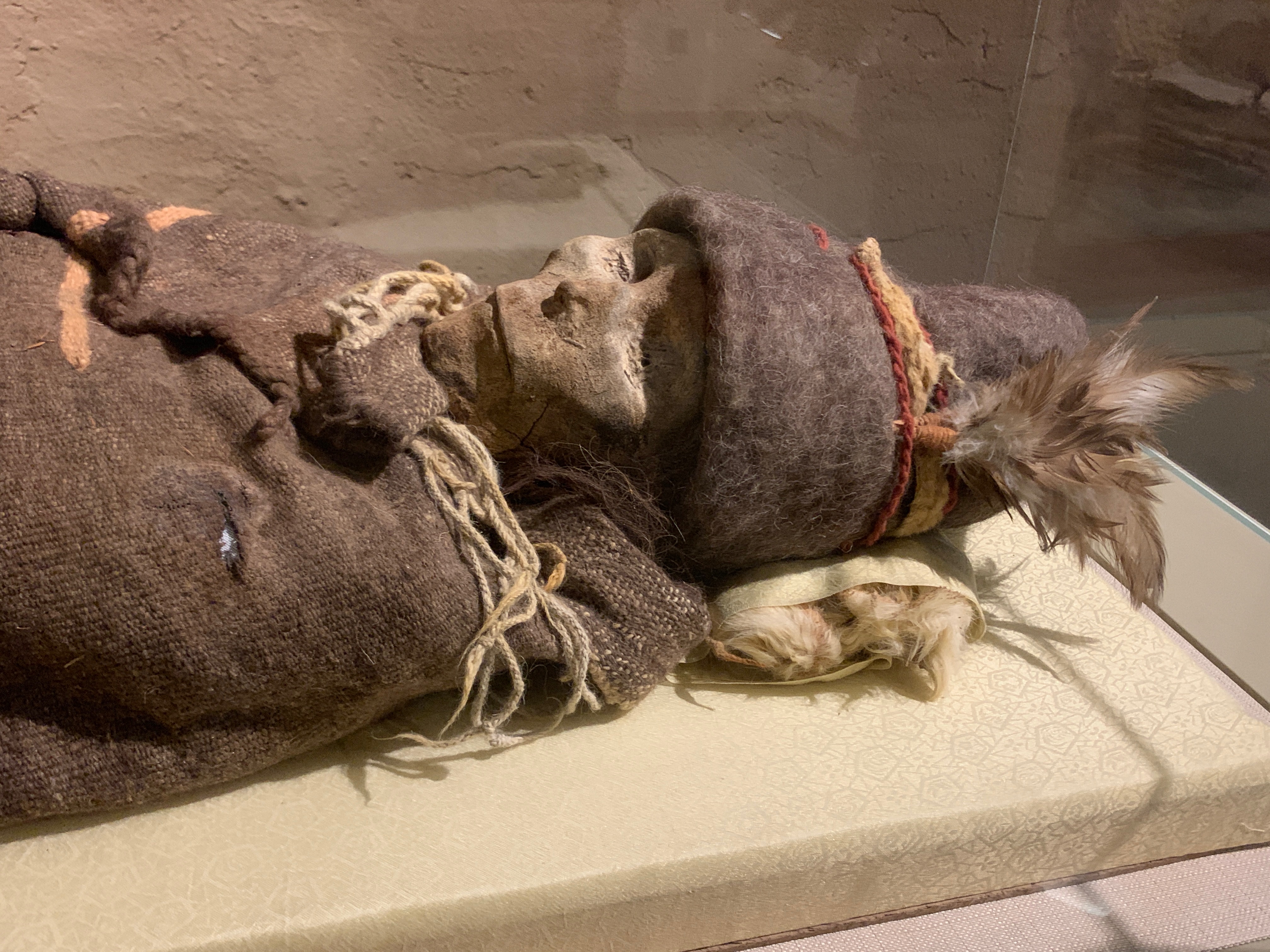
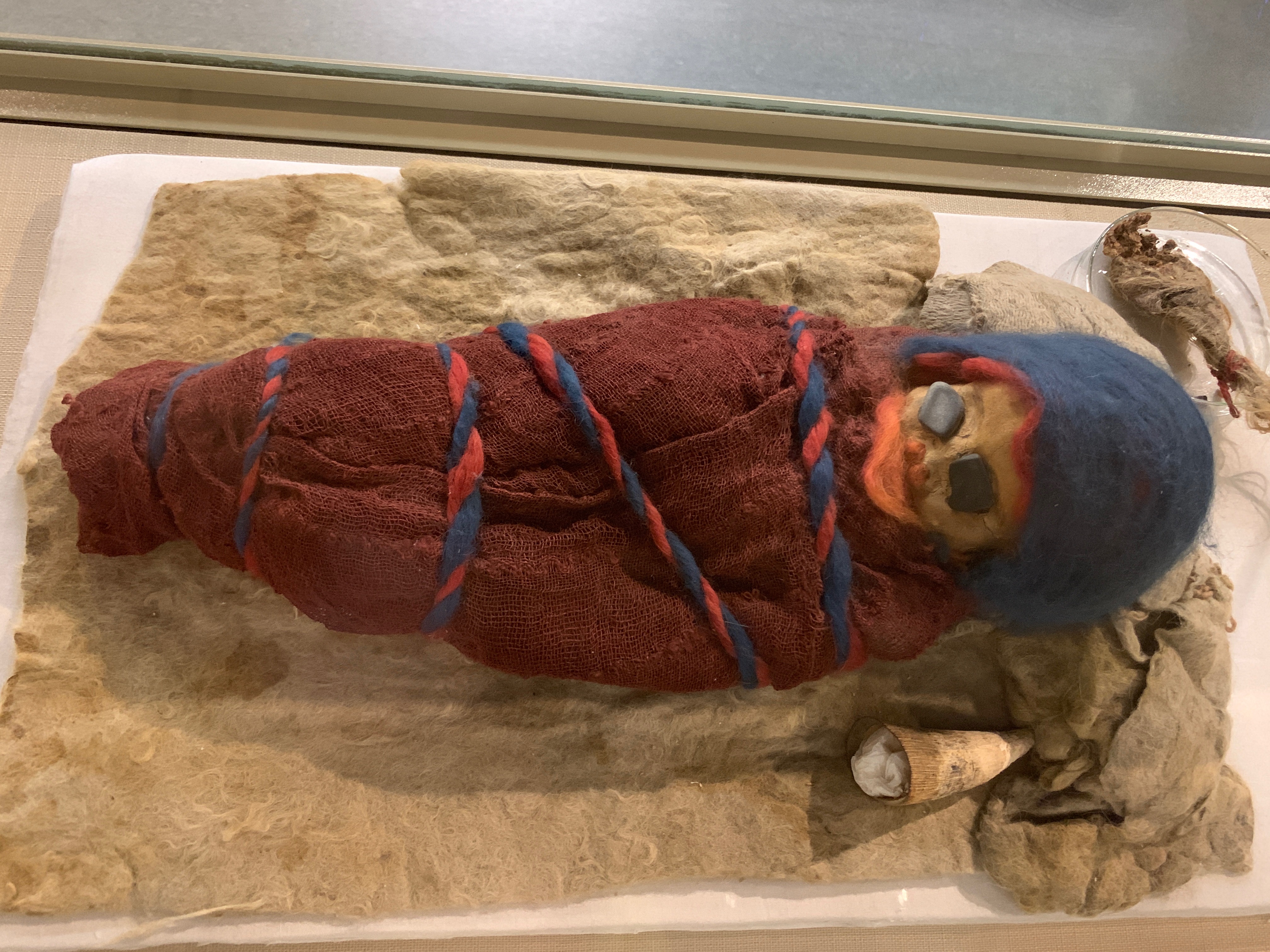
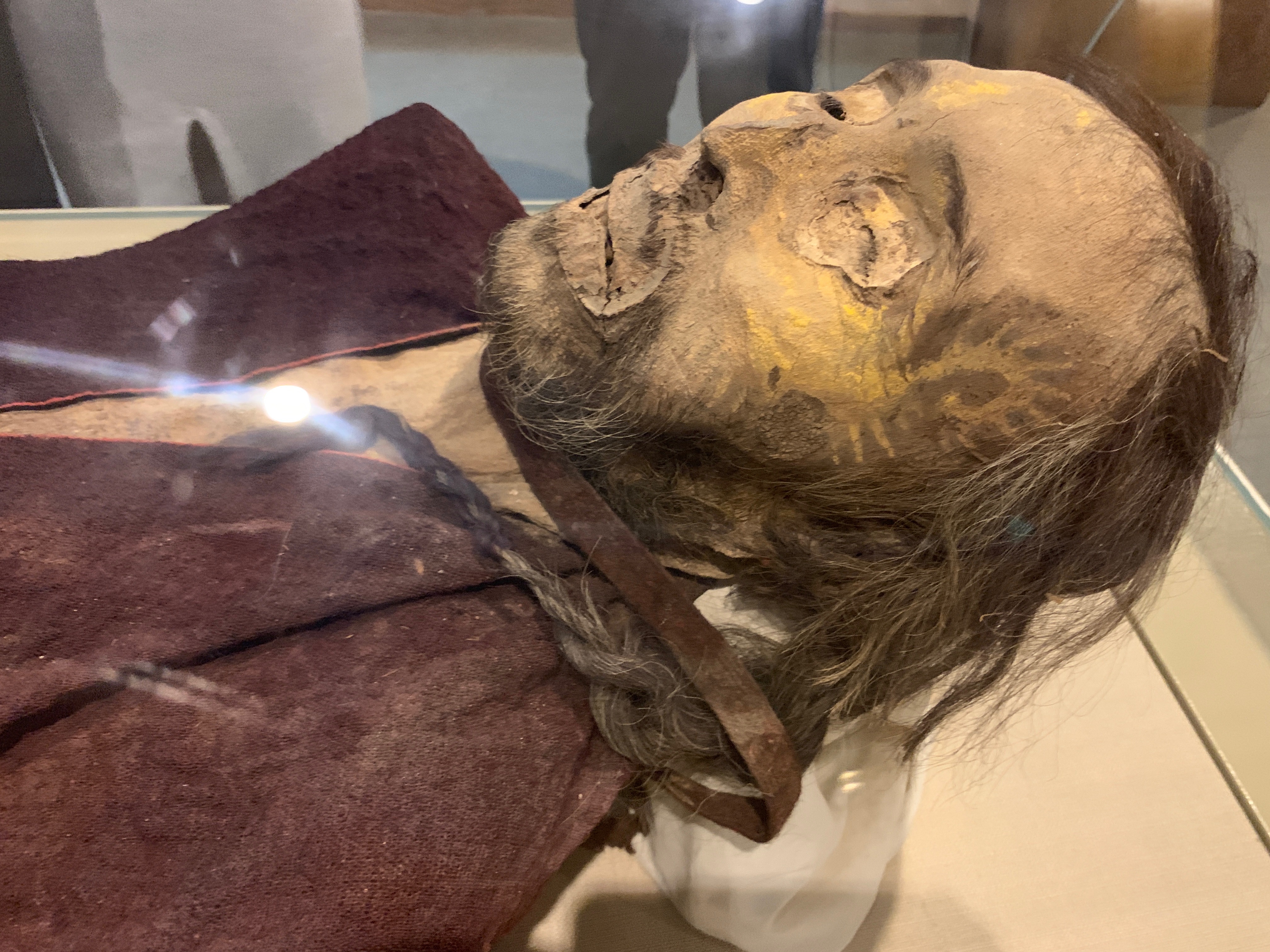
After lunch, our last stop was the xinjiang Autonomous Region Museum, which houses a special collection of mummies.  

There were just a few things that caught our eye in the Museum as well as the mummies, which were quite well preserved.

Ancient cemetery with logs on end as grave markers

Lowland Beauty (age 40-45) 3500-5000 years old. Full and head of Mummy and drawing of her face

Face of female body 3800 years old

Infant 2800 years old


Body guard with tattoo. 1100-1400 years old.

Out of time.  More later.


Valley of the Drakyerpa Meditation Caves

August 29, 2019

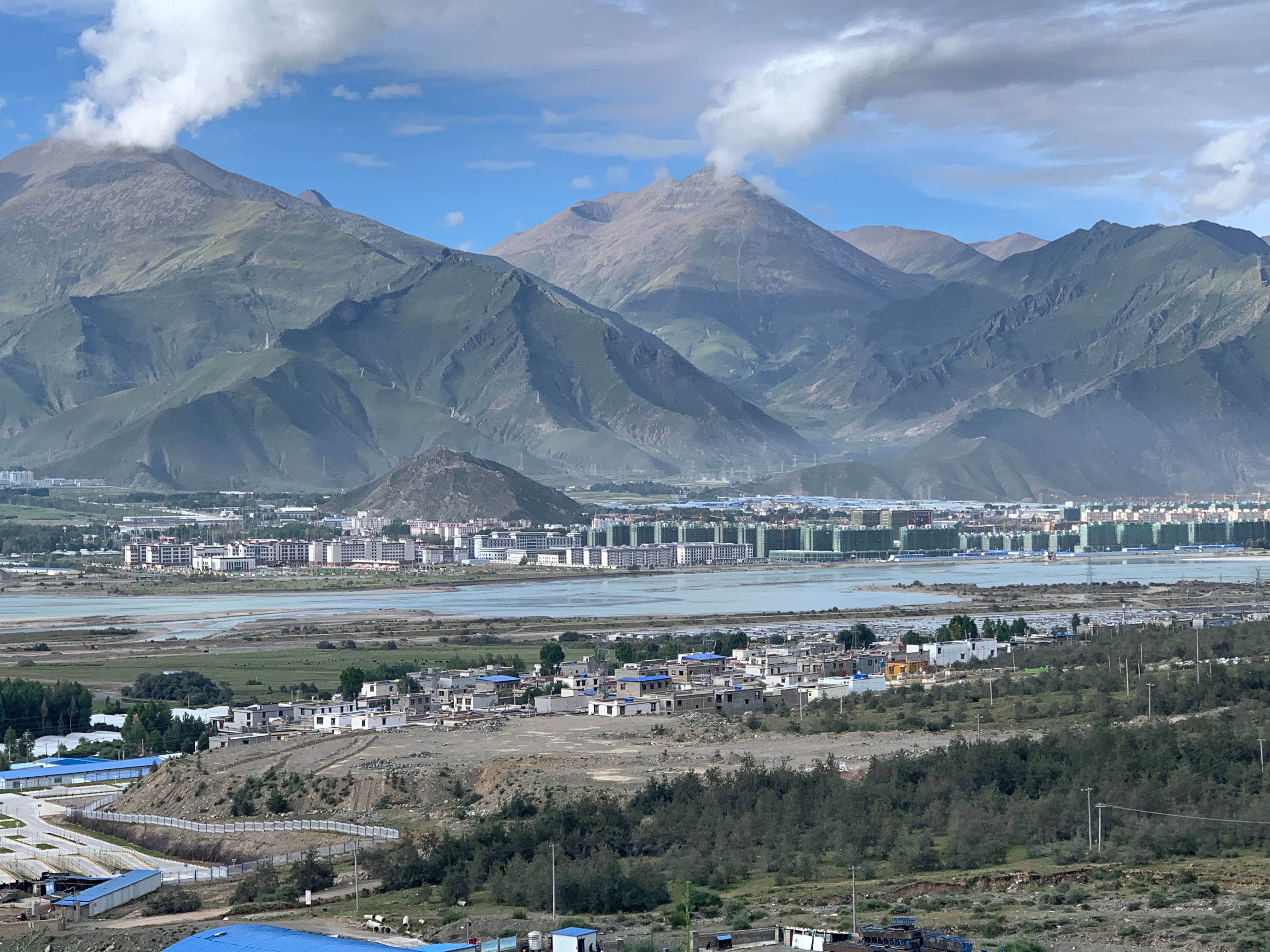
Beginning the climb out of the Lhasa Valley. Many Chinese high rises under construction, as everywhere around the city.

Beginning the climb out of the Lhasa Valley. Many Chinese high rises under construction, as everywhere around the city.

Another 9am start with PinPin, pronounced PeenPeen.  This day we are off on a 47 kilometer drive to a cave monastery up in nearby mountains called Drakyerpa Meditation Caves.  The scenery is lovely once we get away from the city.  We pass fields of wheat, corn and barley and gradually begin to climb into terraced hills. 


Soon we reach Big Nose Pass, where there are thousands of Prayer Flags fluttering in the breeze.  We stop to photograph the scene, and remembered other hillsides with many prayer flags—especially the hills of Bhutan.  However, nothing so intense as this.  

Shortly, we can see our destination in the distance and I am wondering how I will manage the climb.  Even at city level the elevation is 11,992 ft.  By the time we arrive at the car park the elevation is still 11,992.  How curious is that?

It is a little after 10am when we begin the climb.  PinPin takes my hand and helps steady me as we go up the irregular and often steep steps.  After a short time we loose the tile steps and are going up partially carved dirt.  Not east for sure.  Thank goodness the path is not wet.  Every few steps I must stop to catch my breath.  Why am I doing this, I think to myself.  After a hundred feet or so, we pick up the tile again and I am relieved.  The view down the Valley of Drakyerpa is lovely and the monastery buildings and caves above are inviting.  Up we go.  Finally, we reach the first buildings, inside which are several caves.  Each cave is a blackened rock enclosure with a nitch for meditating, one or more buddhas and candles.  Some are a squeeze to enter, others are comfortable sized rooms.   Women, some even with small children, have already come, deposited yak butter in the candles and moved on.  We continue up to the next building and repeat the process.  Currently, only 22 monks live in the whole monastery.   We must have visited more than a dozen caves, all inside charming house facades.  This place too was destroyed during the cultural revolution.  There is still much more to be rebuilt and crews are working away at making it happen.  The highest elevation we attained was 14,315 feet.  

We came down a different path on descent, but still encountered a ragged dirt path without steps.  While in that area we encountered several women carrying large, heavy stones up a wooden ladder.  It was hard to watch, but Pin Pin insisted they were young and willing to work for the money,  He said their husbands were probably home tending their children.  They are not forced to do this work.  Hmmm!

The sweet light of candles.

The sweet light of candles.

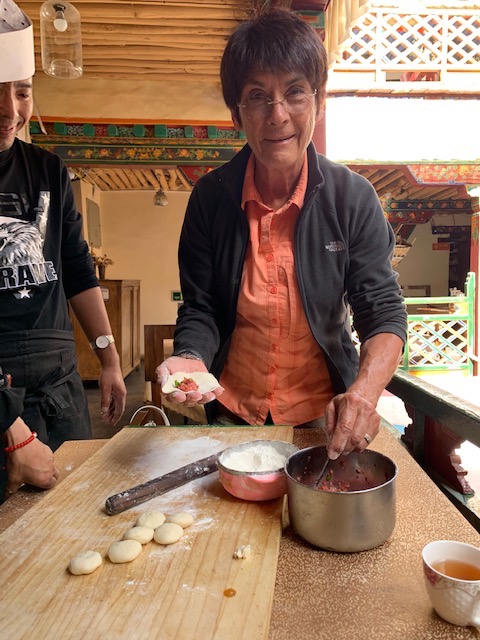
It was a relief to reach the parking lot and a restaurant…even if I wasn’t carrying stones.  We each had noodle soup.  I had mine with vegetables, Mark had his with yak meat.  It tasted great.  Never mind the dirty table.   By the time we got back to the hotel, it was 2pm and we had only 3 hours to relax before our next appointment.  I wrote and Mark read and napped.  At 5pm we met PinPin again for a momo, or pot sticker, making class.  Rather than noodle making, which we both already knew, we opted for pot stickers.  The Chinese word for it is momo. 

Learning to make momo, or pot stickers

Learning to make momo, or pot stickers

I tried very hard and almost got the hang of folding it.  Mark gave up early.  It did not take long, however, before my tired body wanted to stop.  So we sat down and waited for the momo to be steamed and served.  The dough was a little too thick, but the filling had good flavor, which, of course, had nothing to do with us.  We ate a bunch of them and called it dinner.  All we really wanted to do was crash.  I was in bed with oxygen at 8:15 and asleep soon after.  Woke up at 6:15 the next day.  

August 30, 2019

Up early and feeling more rested, if not completely caught up.  This was a travel day and I hoped to get a post off before we left the hotel at noon.  I had the text ready and most of the photos imbedded, but computer glitches slowed me down and I did not get finished.  Sure hope I have WiFi in Urumqi.  During our 2 flights I have continued to write and organize images, but am dead in the water without connectivity.

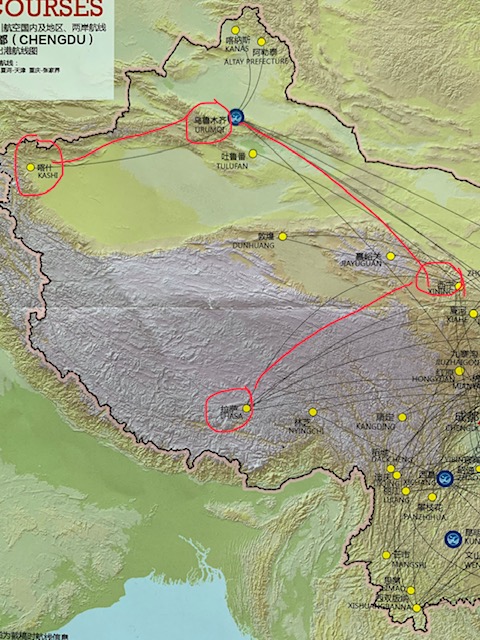
Strange flight plan we have had to endure.  We had a short 1.5 hour flight from Lhasa to Xining in the north east, which was the wrong direction for us.  Then a half hour layover in Xining before boarding another flight to Urumqi, this time the flight is going in the right direction, northwest. If you are following on a map, it will take 2.5 hours.  It will be dark when we arrive.  We will have only tomorrow to see Urumqi as we will fly off early the next morning.  

Riding on Chinese aircraft is a lesson in Chinese rules.  The English speeches are canned and very officious.  You are told that the speaker is the head Chinese Security officer and that you are to do what the hostesses say or you will be incarcerated for refusing to obey.  Even the usual speech about seat belts, exits, slides, etc. is presented very officiously.  I was using my computer as a typewriter during the flight and was told, more than 30 minutes out, to put it away as it was not allowed.  I told her it could have no affect on the flight crew, but she insisted I put it away anyway.  Once the cabin crew were seated, I started working again.  The young lady in the aisle seat called the hostess forward and I got another lecture—in Chinese. So I put it away, but was really incensed by the woman reporting me. How very Chinese.   I thought about it and, when we were on the ground I tapped her shoulder and said “Thank You,” with a big smile, “for teaching me about Chinese people.”  I think she understood, but I will never know for sure.  

I’m sure it was against the rules to tear a page out of a Chinese magazine, but I took the page that will help me give you our direction of flight, the places we are visiting and the idea of distances we are covering.  It was 1.5 hours from Lhasa to Xining, 2.5 hours from Xining to Urumqi and about an hour and 45 minutes from Urumqi to Kashgar.

A map of Xinjiang Province in far eastern China. THe Counter clockwise direction indicates our route of flight.

A map of Xinjiang Province in far eastern China. We flew from Lhasa in the south to Xining in the north east, then to Urumqi or Urumchi in the northwest.  Next we will fly from Urumqi to Kashgar or Kashe.  From there we drive west to Tashkorgan and into Pakistan.

Potala Palace, Jokhang Temple, Summer Palace

August 28, 2019

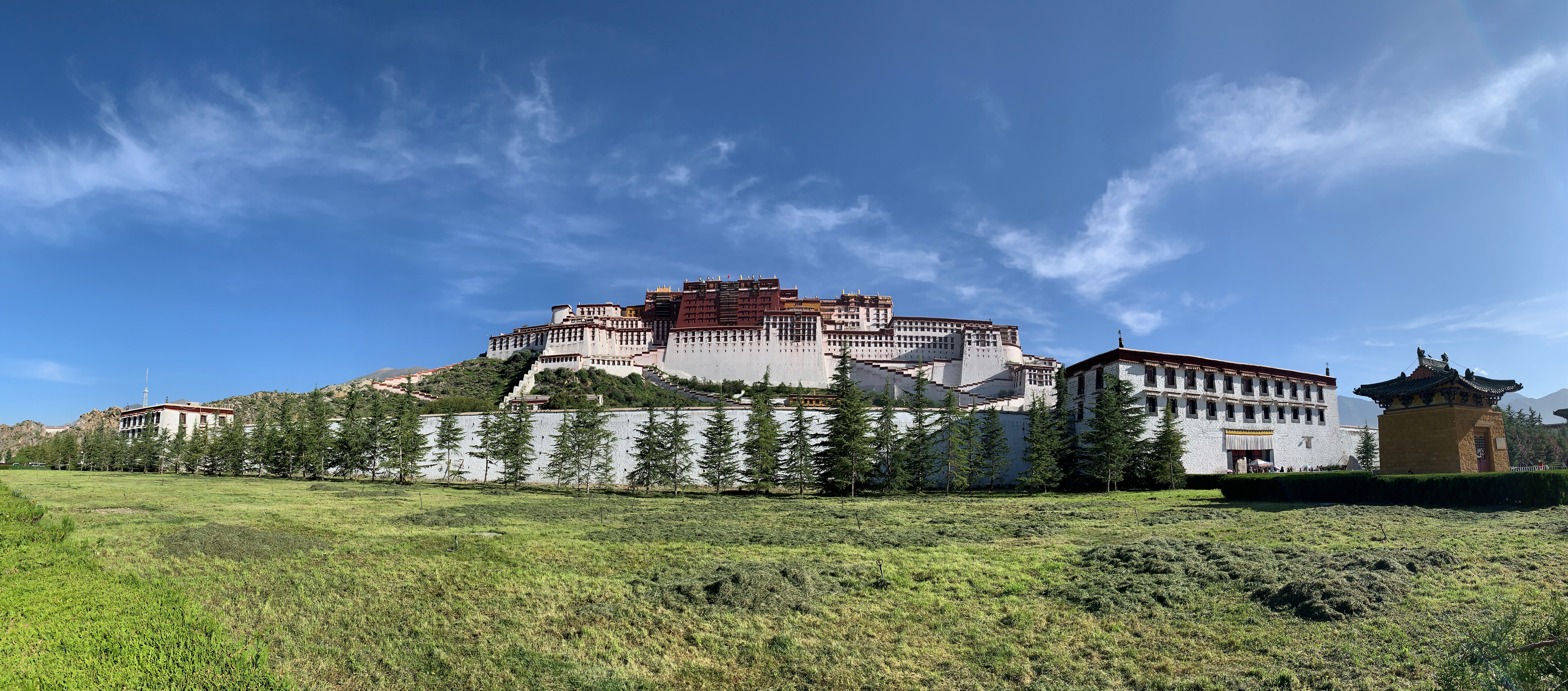
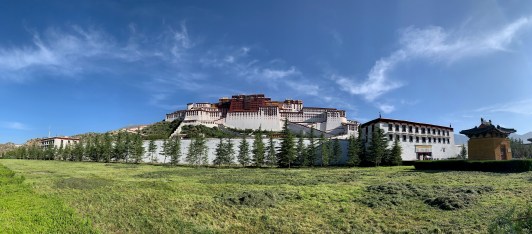
A panorama of Potala Palace

A panorama of the Potala Palace

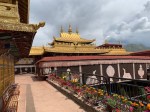
Buddhas are the name of the game for another day.  We start with the Potola Palace, which was the spiritual and governmental heart of Tibet until 1959 when the Chinese government sent in troops to capture the Dalai Lama, forcing him to escape in disguise at night.  The troops proceeded to kill many people in the process.  Today it is a living museum for the faithful and a treasure trove for historians and tourists.  When we first arrived there were hundreds of people walking clockwise around the facility saying mantras, using prayer beads and spinning wheels.  They all seemed very devout.  We walked with them for awhile and then went back to to the ticket booth to pay and begin the walk up into the Palace.

We started at 11,992 feet, the same as our room as it happens.  As we walked, we learned the Palace was founded in the 7th century by Songtsen Gampo with 2 chapels and slowly enlarged over time.  In the 17th century the Fifth Dalai Lama made extensive modifications and moved his residence and administration into the Palace.  Since then each Dalai Lama has made extensions and modifications.  The white part of the Palace buildings are for administration and politics the red part is for religious purposes.  It is clearly more administrative and political than it is spiritual or religious.

Without a guide, I would still be lost in the labyrinth of the 999 rooms.  After walking up long steep ramps in the sun, we arrived at the bottom of the 13 floor complex and began to see inside a room here and there until we reached the top, where the huge Assembly Hall is located.   I checked the altimeter again and it read 12,467 ft.  I was amazed so many people made the climb without assistance.  Just at the beginning, as a ploy to get us in the door earlier than our scheduled entry time ,our guide told the Chinese medical team that I might have difficulty walking and they all but carried me up to a shady place where they stuck a spray oxygen bottle in my face and wanted to check me out.  I insisted that I was fit enough to make the walk and eventually started walking up the steps on my own.  They stayed behind.  I was a bit embarrassed but in the door 20 minutes early.

Again I was not supposed to take any photographs so I do not have many unfortunately.  The attendants were vigilant.  Some of the incredible artifacts we saw included huge, jeweled burial tombs of the 5th through 13th Dalai Lamas (Dalai Lamas are always mummified), except the 6th.  Interesting story there.  He liked beer and ladies and was not a good example of a traditional Dalai Lama, so he was ostracized at his death and buried somewhere else.  However, he proved to be a very good writer and published books of poetry that, our guide said, could still be purchased today.   He is remembered more than some other Dalai Lama’s.  We also saw many chambers of statues of Buddhas and lamas, frescos and murals.  One special statue was of a Buddha that was over 2000 years old and had survived the cultural revolution.  One mural on a huge wall depicted the history of Buddhism.
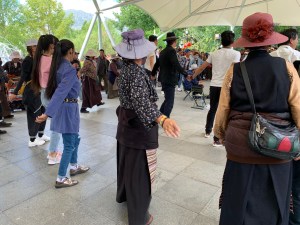
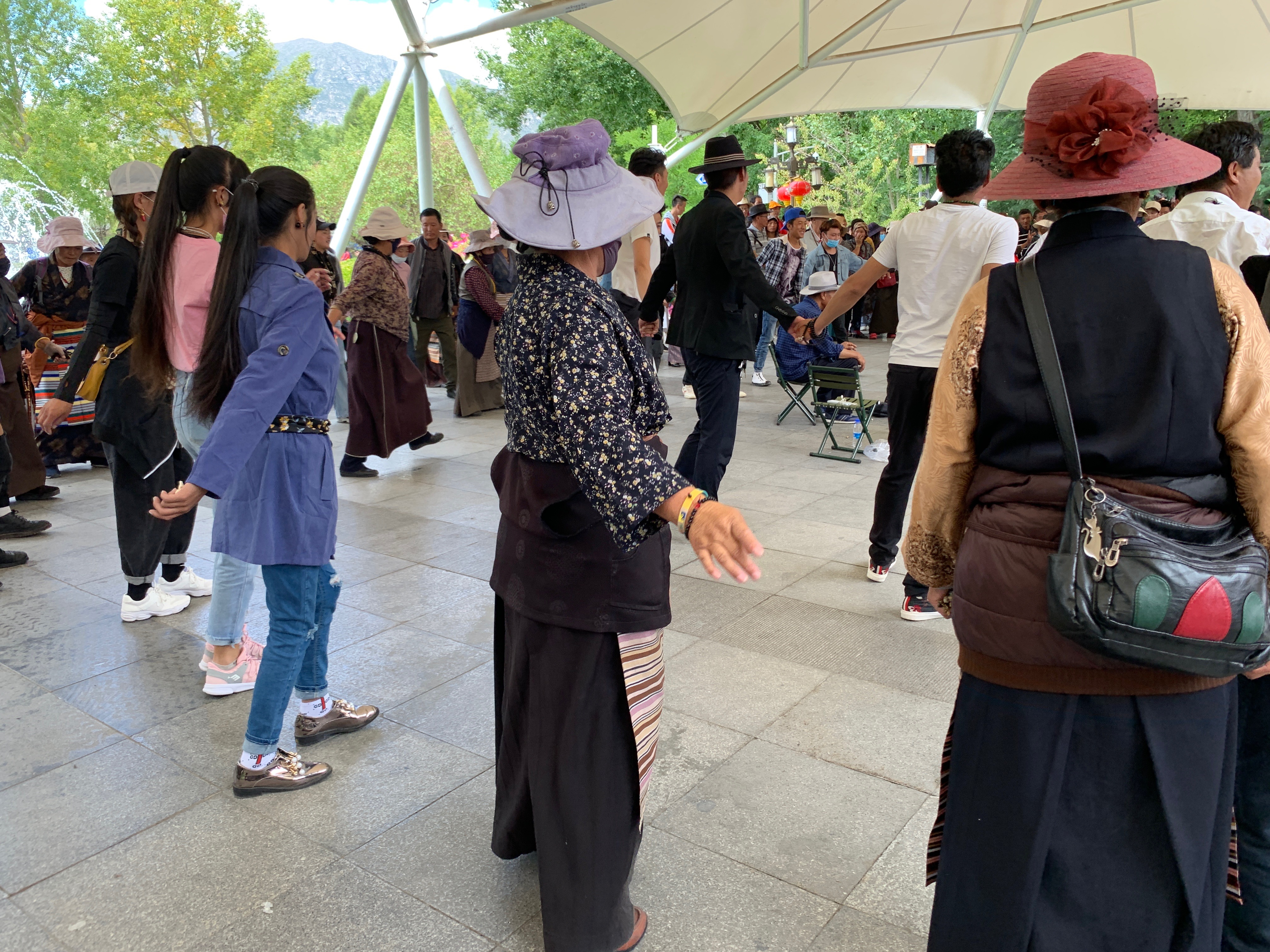
Line dancing in the park behind Potala Palace

Line dancing in the park behind Potala Palace.  The guy in white shirt is sporting big hair.

Back at the bottom of the Palace complex, we found ourselves in a park with a crowd of locals line dancing.  It was fun to watch as all ages and styles of dress were happily dancing away.  Several young men sported large pompadours and a few looked absolutely gay.

Our driver picked us up and off we went to a Tibetan restaurant for lunch.  We are both noticing how filthy restaurants, restrooms and public places are, not to mention the monasteries and the Palace.  Cleanliness is clearly not a priority.  The streets, meanwhile, are being swept clean all day long by people in orange uniforms.  We’ve also noticed that people are pushy, especially when lined up for something.  And while we are complaining, Mark added that men and women spit a lot without apology .

Although we were sitting at a dirty, but pleasantly located roof top table, our lunch was just ok.  Mark ordered a stir fried yak and vegetable dish.  I ordered fried eggplant to go with it and a dish of pot stickers.  The whole thing was pretty greasy. Time to get beyond yak, I think.

PinPin met us and off we walked through the Barkhor, Lhasa’s medieval Bazaar, to the nearby Jokhang Temple.

The temple was built in 647AD by King Songtsen Gampo, who also founded the Potala Palace, and is the holiest temple in Tibet.  It too was enlarged by the 5th Dalai Lama in the 17th century.  The story is that the King had 3 wives–a Tibetan, a Nepalese and a Chinese.  The Chinese bride brought a very old and important Buddha from China as her dowery.  When she arrived and found no place to install it, she threw her ring.  It landed in a small lake, so she had the temple built on the site of the lake to house the buddha.  The charming story is told on a mural inside the temple.  The king had only one son, who was from the Tibetan wife.   He died at age of 32 and the Chinese sent an army to take back the statue of Shakyamuni, the 2,500 year old, original, Present Buddha, which had been made in India in the 8th century BC.  The Tibetans hid the statue in a vault behind other statues in the temple and the Chinese did not find it.  It is in the temple today.

The Nepalese bride also brought a buddha for her dowery, but it was destroyed during the cultural revolution.

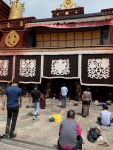
When we arrived at the front of the temple, we passed people praying in several ways including prostrating themselves or building mandalas.  The temple was, happily for me, on one level and there were not many rooms or statues.  Again, I snuck a few photos in spite of the rules.  There was a roof top level I did not climb.  Mark said the roof top was gold colored and probably was the real thing.  From the ground it certainly looked like a fancy gold roof.

We engaged with a few people in front of the temple and enjoyed the afternoon light.  But there was no time to linger as we had one more stop—the Summer Palace.

About 3 miles away, the Summer Palace was built in what gradually became an 89 acre horticultural park in 1755 by the 7th Dalai Lama, Kalsung Ghatso.  All the Dalai Lamas have used the Palace from then on including the current Dalai Lama.   We saw groups of people picnicking on the grass here and there under lovely shade trees.  Flowers were everywhere.  There are several palace complexes.  We entered the Truzing Palace of the 8th Dalai Lama and got to see an excellent Buddha of Compassion with 11 heads, 1000 arms and 1022 eyes.  Also there, was a statue of a buddha we had not yet seen, the Medicine Buddha from the 11th century.

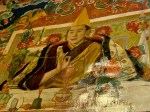
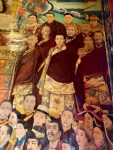
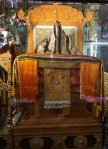
Finally we entered the 14th Dalai Lama’s Palace. It was built in the mid 50’s and he occupied it for about 6 months before escaping to India to avoid the Chinese government.   Unlike any other, it had twin staircases with modern handmade carpets and a clock that is stopped at 9pm, the time the Dalai Lama left for the last time.  There was a wall with a huge mural depicting he at the age of about 27 surrounded by family, teachers, mentors, dignitaries and many others.  Each face was very identifiable.  We saw his throne and living spaces including his study room, sleeping room, meeting rooms, bathroom and living room.  It was a very personal tour.

What I learned from PinPin about succession is:  in the normal course of time, the two next highest people under the Dalai Lama, the Pachenlama and the Karmapa, choose the future Dalai Lama under a very strict set of procedures.  In the current situation there are two Pachenlama.  The real Tibetan one, the 12th Pachenlama, is in prison, and the second one, who has been appointed by the Chinese, but is not recognized by Tibetans.  So the Dalai Lama and the Karmapa, who himself escaped to India in the early 2000’s, have been conferring on how best to decide on the next Dalai Lama.  It seems like the Karmapa will have to do it alone following a set of procedures he and the Dalai Lama have laid out.  The current Dalai Lama is 86 years old.  I wish him a very long life and fear for Tibet once he has passed.

Dinner for the third night we again ate fruit in our room.  We have lovely peaches, apples and bananas and lunches in restaurants have been less than satisfying.  Oxygen again to sleep.


Lhasa’s Monasteries and Palaces

August 27, 2019

Last evening, we went for a walk around the area. It was still very light out 7:30, but the sidewalks are mostly torn up for sewer or other repairs, so walking wasn’t very pleasant.  We did stop at a muslim shop with a handful of people making pasta squares for a popular muslim dish.  Most of the shops had Chinese flags flying, but not all.  Back in our room, we went to bed.  Mark dropped off quickly, but I was having trouble breathing while laying down.  Fortunately the room has a large oxygen generator and cannulas to go with it, so I hooked myself up to it and was finally able to fall asleep.

This morning we were waiting for our guide at 9am.  Mark corrected what I thought was his name.  It is not PingPing, but PinPin.  Off we went to the Drepung Monastery.

While on the way, PinPin told us the Tibetan language is based on Sanskrit, a fact Tibetan kids will not learn.  Today they are not taught about their history or culture, only the Chinese version of Tibetan history.  PinPin’s wife, a grammar school teacher,  is not allowed to teach the truth in her classroom.  No wonder Tibetans are distressed.  Changing the subject, he told us Lhasa has a population of 500 thousand and it has been the capital of Tibet since the 700’s.  The current local population of monks is about 10,000 with 400+ at Drapung Monastery, which is one of the”great three” of central Tibet and was founded in 1416.  It was home to 10,000 monks before 1959, when the Dalai Lama escaped to India with his life.  It was also the seat of central government until the Fifth Dalai Lama expanded the Portala Palace and moved his residence there.  Today there are about 400 monks living at Drapung.

These first images are of the outside as we ascended up and into the buildings.


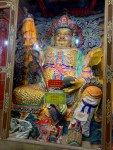
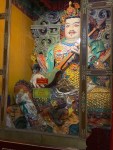
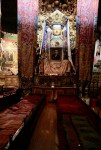
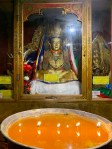
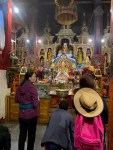
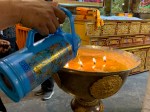
Once inside any room in any building, we encountered the smell of incense, wax, butter, dust and grime as well as people and buddhas.  Everywhere, people were carrying small bank notes, hot wax and yak butter in thermoses.  In front of each buddha, they would put a note worth 20 to 80 cents into a collection box and pour wax and or butter into candle holders intended to keep the candles burning.  Monks would collect the money periodically and pour out the wax before it overflowed the vessels.  We were not allowed to take photos, but I managed a few anyway.  Sorry I could not get more.  There were some spectacular objects and statues and tombs.  Here is what I captured.

There were the major Buddhas of Past Life, Present Life and Future Life repeated in every hall and space plus images of the different Lamas up through the 13th Dalai Lama.  Images of the current Dalai Lama were conspicuously missing.  In addition to the prayer halls, there were meeting rooms for the monks and at the top of the complex was the main Assembly Hall, which could hold many more monks than there are currently in residence.  I logged the elevation at the parking lot at 12,439 feet and again at the Assembly Hall at 12,629 feet–our record so far on this trip.

As we started down the steep, irregular steps, we heard musical sounds and followed our ears to an outdoor garden where a handful of monks were making music on oboe-like instruments.  They stopped when we arrived, so we had to coax them into playing more, which they graciously did.  Then we saw two very long, maybe 10 feet, horns on a tall rack and asked if they would play them.  Two other monks got up and played an entire tune in perfect unison.  I captured some of it on video.  We had a pleasant conversation with them through PinPin.  A large festival is coming up in a few days and they were practicing for it.  Finally, we left them and continued down the steps.

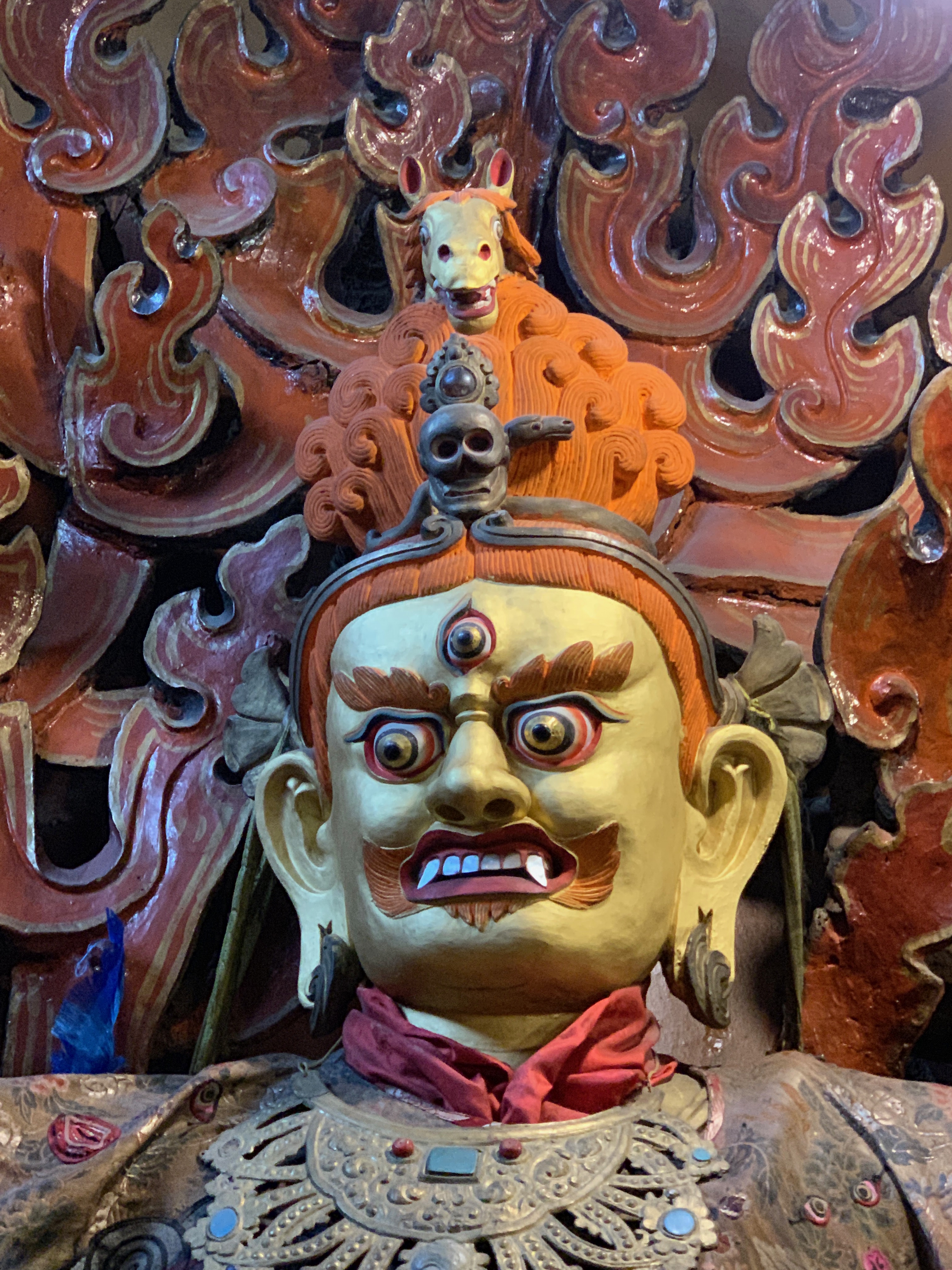
PinPin took us to a tourist  restaurant, not our choice, but we ordered yak curry. The curry was greasy, the meat fatty and the spices dull.  However, we did not get sick, so it counts as a success.  After lunch we walked to Sera Monastery, founded in 1419 and another one of the”great three”, it also houses about 400 monks currently and  5,500  prior to 1959.  Fortunately, this Monastery is not as high and has fewer rooms.  The special Buddha here was the Horse Buddha.  There was a huge line of people waiting to get a blessing from the buddha.  Again I was not supposed to take photos.

Horse Head Buddha, a favorite in the Sera Monastery

Horse Head Buddha, a favorite in the Sera Monastery.  The horse is at the top and small.

We happily walked on by and snuck in at the back entrance to see the buddha without getting a blessing.  The other interesting aspect of this monastery is that it sports 4 colleges with the topics: meditation, enlightenment, mantra & tantric, and debate.  At 3pm the debate school stages a performance for the public, so we went to the large courtyard where it is held and watched the process.  One monk is seated and answers the questions.  The other monk stands and puts the questions to the seated monk.  There is much slapping of hands and posturing and trying to make the seated monk “lose”.  It was a bit too staged for my taste, but it was mildly entertaining.  We watched for an hour and leaded down the hill.

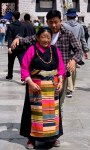
When we reached the level path, we met up with a couple of elderly ladies dressed beautifully in traditional Tibetan clothing, so I stopped and gestured that I would like a photo of them.  They surprised me by saying yes, so I took several photos and was about to depart, when two ladies in modern dress  approached.  They were obviously related so I showed them the images.  PinPin got into the conversation and we learned that the two ladies in traditional dress were sisters-in-law and one of the western dressed ladies was a daughter and the other was her daughter.  A few steps further along, we met up with the husband of the modern mother and her new baby. The whole family are members of the Chema group of Tibetans,  who live in the Marking area in eastern Tibet.  It was quite a family scene and we could have chatted for a long time if we could have understood each other.  Anyway, we all laughed and smiled and said good-bye.  I really love this kind of encounter, like with the musical monks earlier, and hope they happen more often.

That ended our first day of monasteries.  It was good to get back to our room, have a piece of fruit and relax.

Getting ready for Beijing

August 26, 2019

Things are very weird here in Beijing.  I had no access to Word Press while at the Peninsula Hotel or at the Apple store.  Now, at the airport, I have access through a Chinese server called BAI.  Hopefully it will hold.  But now I have no more time and must run to the gate.  Here is what I completed before we left home.   More as soon as possible.  Do not hold yours breath.

August 23, 2019

We are over Russian territory at 37,000 feet on our way to Beijing.  Our 7-week adventure to unvisited places in Asia has begun.  For the first time, I am feeling somewhat undone by the amount of time we have agreed to spend traveling.  Is my age the issue or have the stresses of work at home gotten the better of me.  I’d like to believe the latter.  For sure I am exhausted by all the stress.  In addition to difficulties finding a tenant for our Dickinson, Texas property and dealing with unfinished landscape issues at a property in Grass Valley, we recently entered into a purchase agreement for a house at Lake Tahoe. It is expected to close on October 22, but at the moment our financing is unsettled because the required appraisals have not been completed.  When we left SFO today, none of the issues have been resolved or even concluded.   Although we did make some progress with the landscaping repair problem at the last minute.  

Now that we are in the air, I am telling myself to relax, let go and lose myself in our coming adventures.  The stresses at home will naturally re-assert themselves the we return.  Maybe I should be grateful for seven full weeks in a different world where all I have to do is keep a low profile and stay away from trouble.  

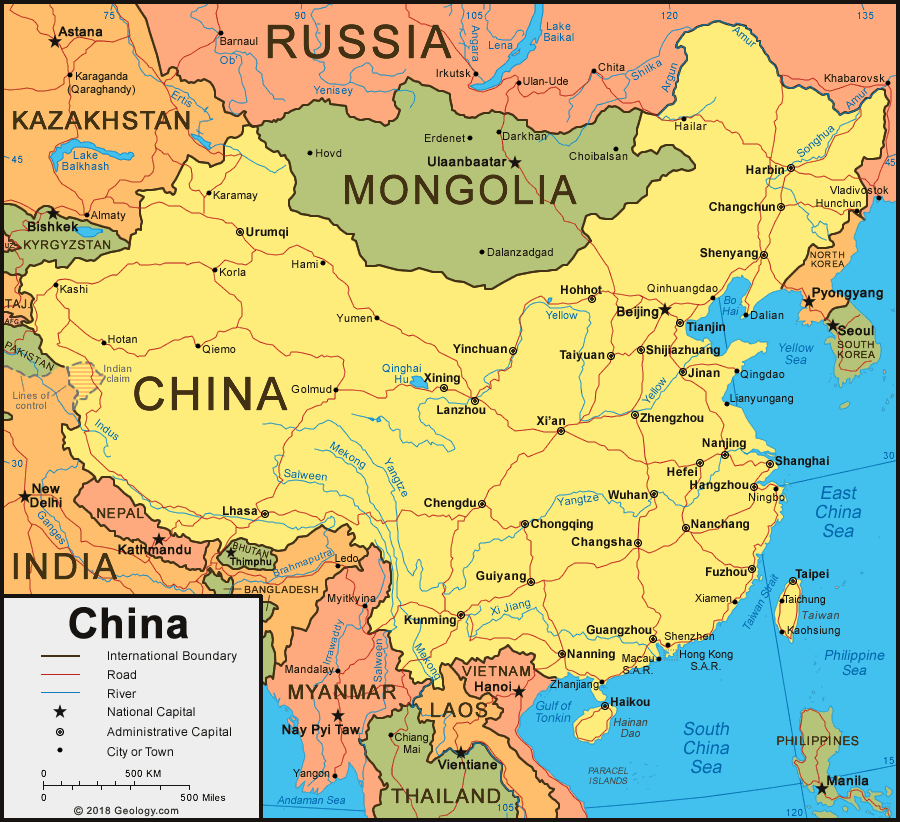
We cover China from east to west, mostly by air

We cover China from east to west, mostly by air

I have brought a lot of material to read about the places we will visit and hope I manage to get to the reading……soon.  To start, I downloaded a few maps, as many of you express appreciation for having them to study.  The first map is of China and shows all the places we will visit in that country.  We start on the east coast in Beijing and gradually work our way west across the entire country, albeit mostly by air.  After a day in Beijing, we fly to Lhasa in south central China and spend several days in Tibet.  From there we fly northwesterly across the country to a city called Urumqi, pronounced Urumchi.  It is the heartland of the muslim people known as Uighur.  There are about 12 million of them and they are in the news lately for being persecuted by the Han Chinese.  We will have a couple of days there and then fly further west and south to Kashi, aka Kashgar, where we will pick up a car, driver and guide and proceed by road into Pakistan.  The distance across China is much further than across the US.    

Back to our arrival in Beijing.  At the Peninsula Hotel we will rest and try to adjust to the 9 hour time difference.  The next day we plan a special meeting with the artist parents of a young woman we have gotten to know during the Classical Tahoe summer season in Incline Village on Tahoe’s north shore.  Her name is Zubaida Azezi, aka Zuby.  She is a violinist in the orchestra.  Her fiancé is Tim Dilenschneider and he is one of orchestra’s three bass players. During the regular season, they play in the Houston Symphony Orchestra. 

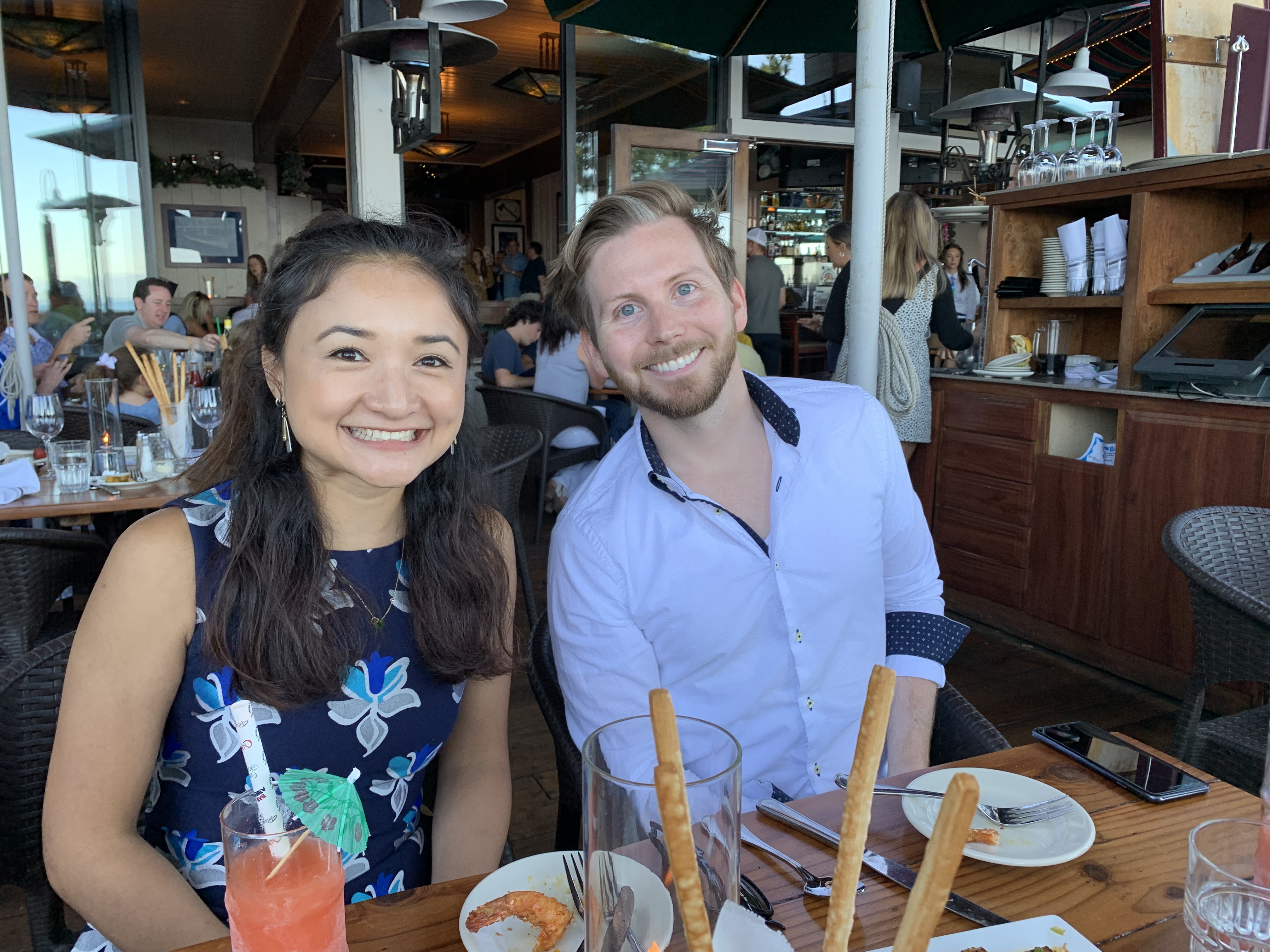
Zuby and Kim with us at Gar Woods.

Zuby and Kim with us at Gar Woods.

We took them out to dinner one evening after we had learned that Zuby is Uyghur and from the city of Urumchi.  We were surprised.  She was shocked that we had even heard of her city, let alone planned to visit it.    She identifies as Uighur and told us about the difficulties happening in her homeland, the Xinjiang Uyghur Autonomous Region in northwestern China, where the largest muslim minority resides.  She has not been there or seen her relatives since she was a young girl.  It is too dangerous for her to go back, but she is confident we will have no problem as tourists.  I asked if we could look up some of her relatives and give them her regards and a photo or two.  She declined, saying even that was too dangerous for her people.  Of the 12 million Uyghur population, 2 million are incarcerated in “re-education camps” similar to what Kim Jung Un is doing with his people in North Korea.  Very sad situation.  Last October the BBC released details of an investigation into China’s “hidden camps”.  Perhaps you can find more news about it.  

 However, she said she would love to have us visit her parents, who are English speaking artists living safely in Beijing and ask if they would mind meeting with us and showing us their art and the art community in which they live.  That sounded really good to us, so she called them, made the contact and the next thing you know we cancelled our other activities in Beijing and agreed to meet her parents.  So that will be most of our day.  The drive to her parents home is about an hour from our hotel.  In the evening we have dinner reservations and tickets to the Wind Orchestra Show at the National Center for Performing Arts. We have seen the building from the outside and it is quite a lovely space.  I am looking forward to seeing the interior, which was not open when we were last in Beijing.