
Thursday, May 21, 2026
I almost forgot to mention that we were part of a warning alarm that went off yesterday for about an hour. We learned that the drones were friendly Ukrainian ones, flying over Lithuanian airspace in route to St Petersburg.
Richard picked us up at at our hotel and we headed out of Vilnius at 8:30. By 9am we were out of the city and rolling happily through the countrywide. The nearly level ground was covered alternately in large cultivated fields of green grass or rape berry seed in full yellow bloom.

Every so often the fields would be replaced by forests of oaks, spruce and other varieties. The scenery was lovely to look at as we covered about 2 hours of road on the way to our first stop of the day, a town called Siauliai, to see the Hill of Crosses.
We learned that a cross was erected to commemorate the 25th anniversary of the Monestary of the Hill of Crosses of the Lithuanian St Casimir Province of the order of Friars Minor. Between 1941 and 1952, approximately 130,000 people were deported from Lithuania to Siberia, where they endured severe repression, and many never returned to their homeland. A sculpture on the site memorializes the painful chapter in Lithuanian history.
People had started leaving crosses at the site in the mid 18th century due to a sense of spiritual power in the area. Thousands of crosses in all different sizes have been placed there over the years.

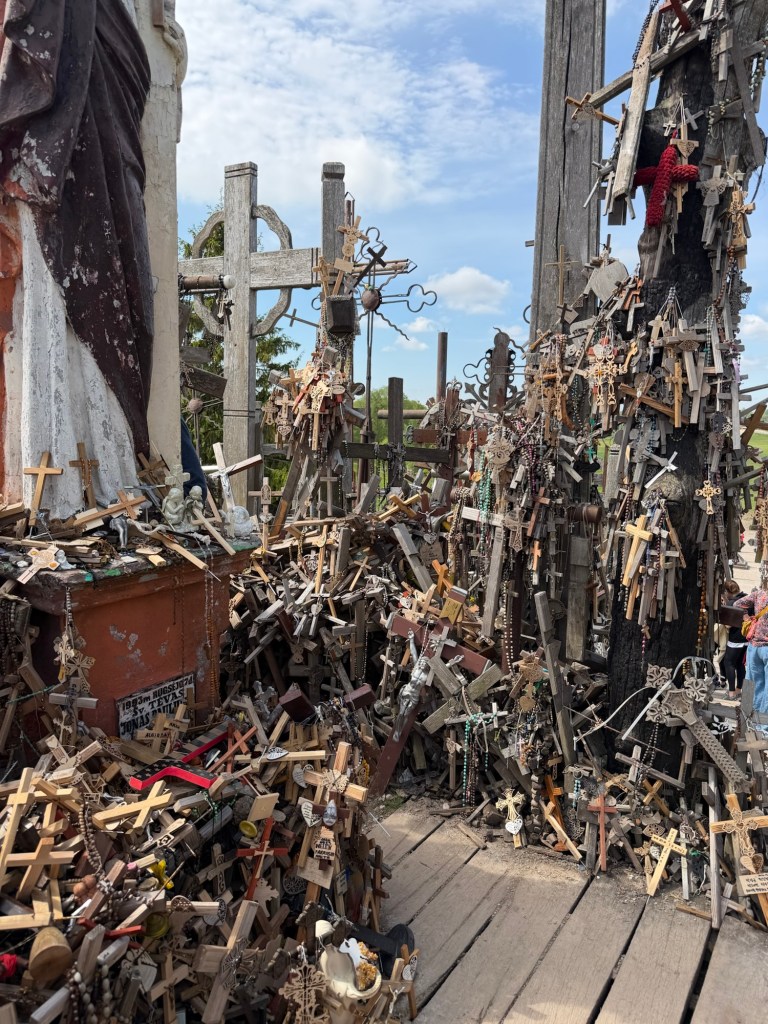
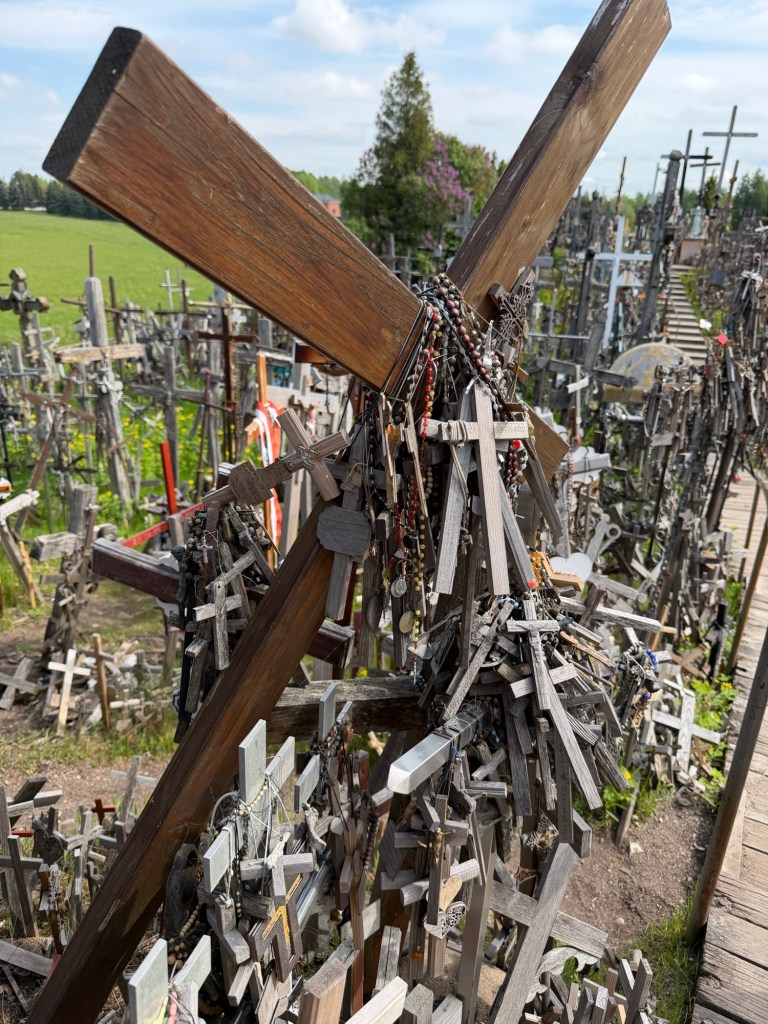


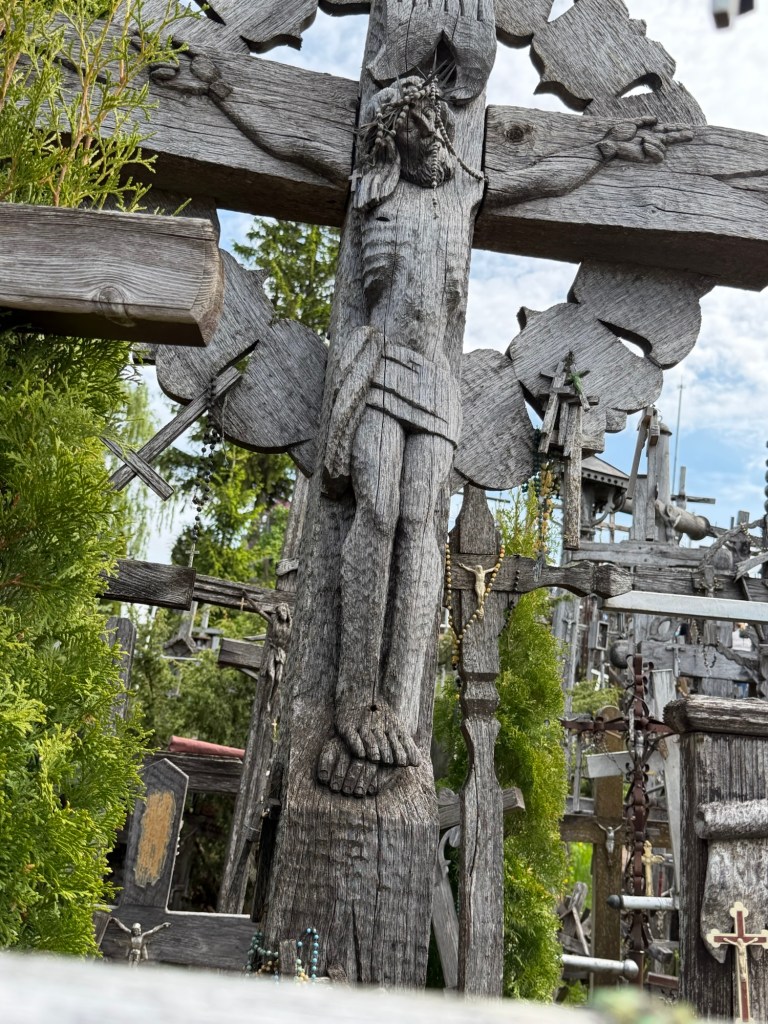
More than once the Soviets’ burned down the site and melted the metal fragments, but people replaced the crosses each time. The site received international recognition when Pope John Paul II visited it on September 7, 1993 and said Mass for thousands from a small altar built for the occasion. The alter still stands today.
After a 30 minute visit there, we drove on north through Lithuania and into Latvia and our next stop, the Rundale Palace Museum and baroque Palace in the Latvian countryside.
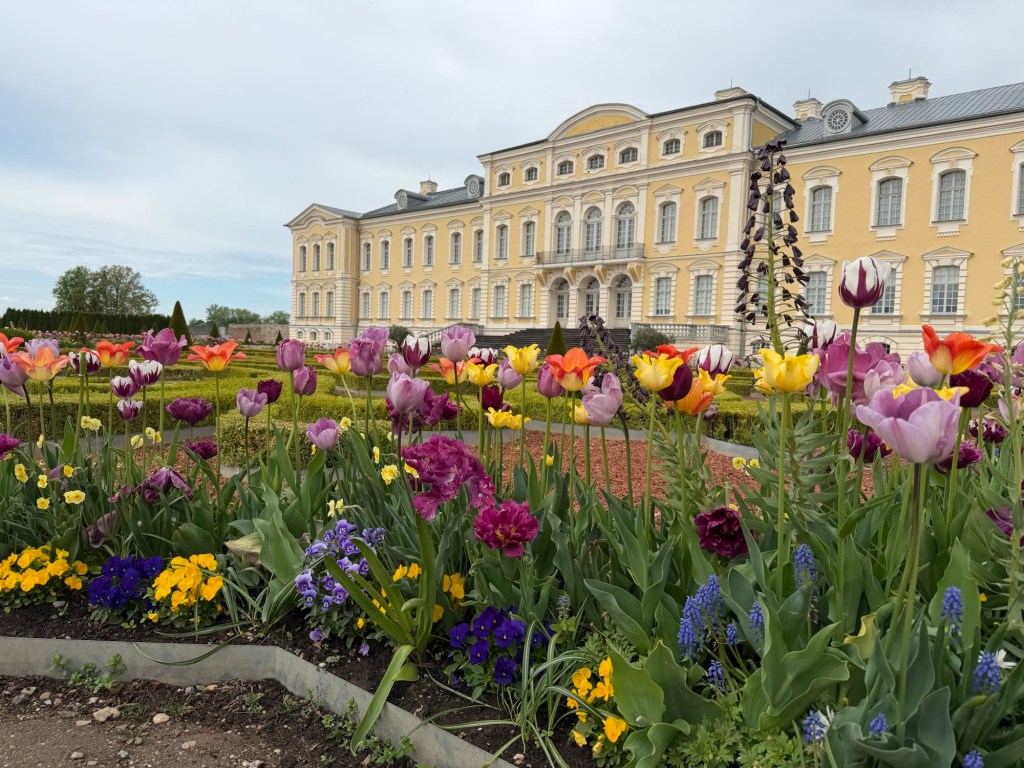
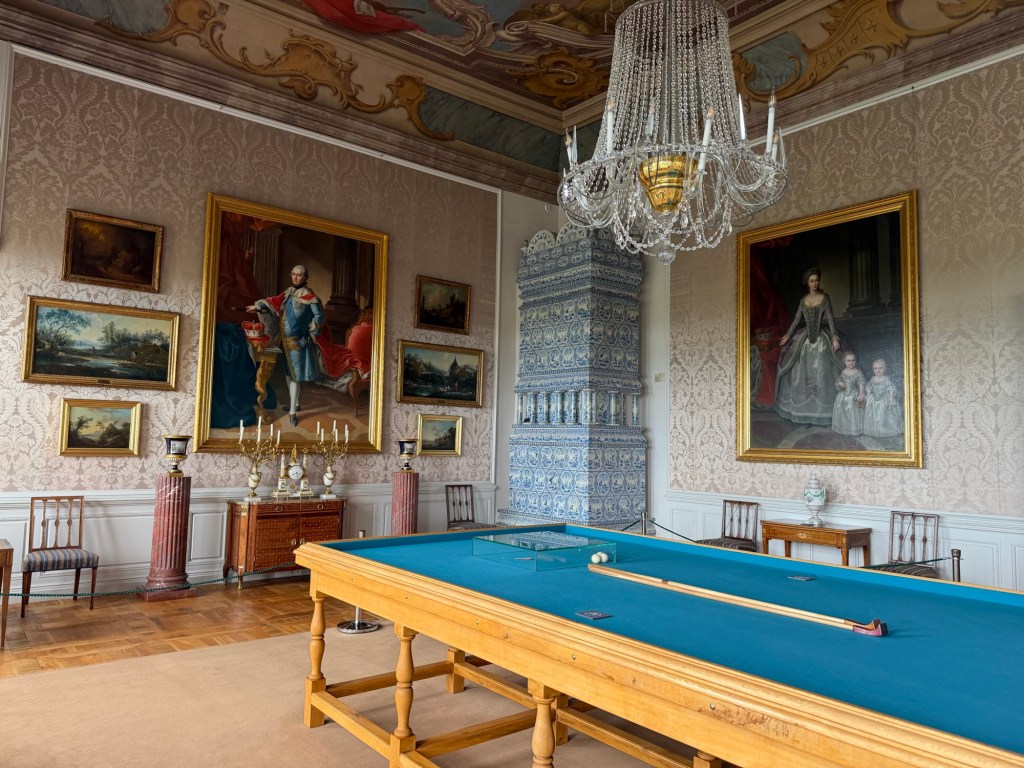
The palace was designed by the architect Rastrelli, and begun in 1736 as the summer residence for the Duke of Courland. The original design from the first phase of the Palace’s construction (1736-1740) survives in the artistic decoration of the facades, two state staircases and a small gallery. During the second phase of the Palace’s construction (1764-1768) most of the interiors were refashioned in the Rococo style.
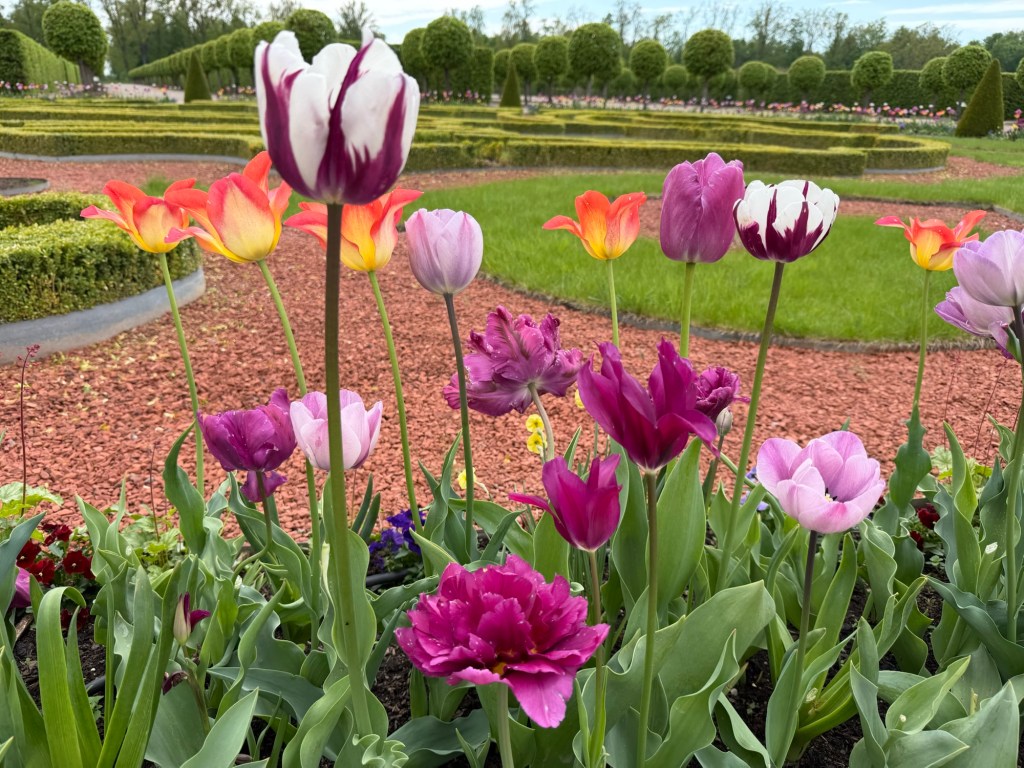
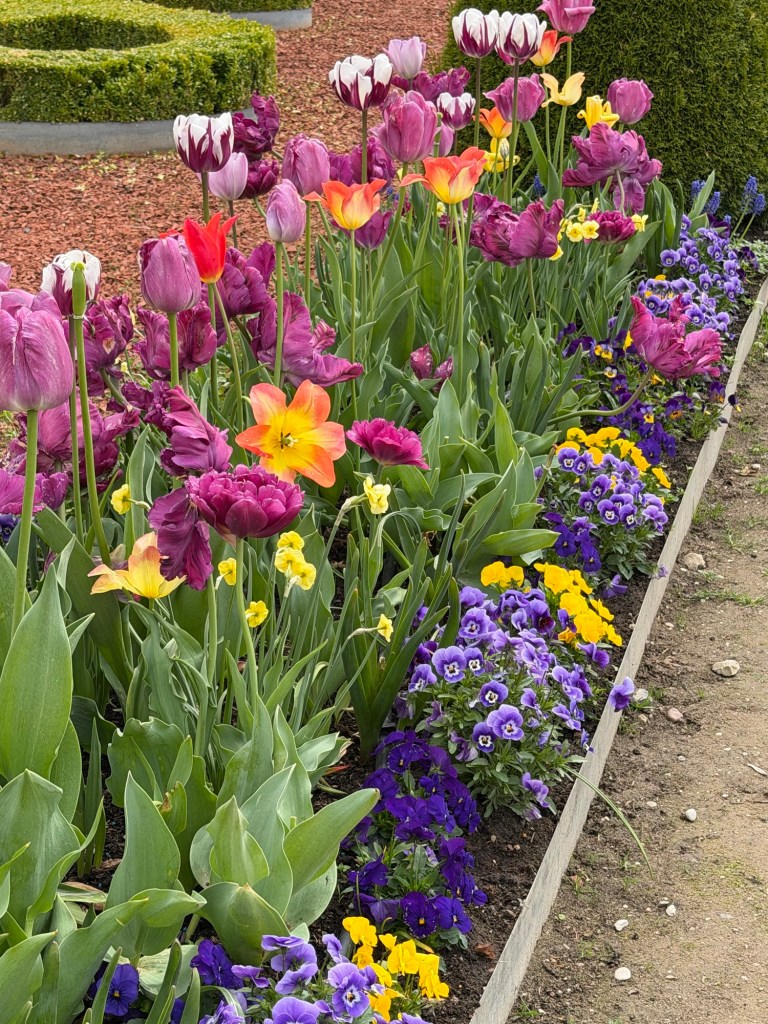
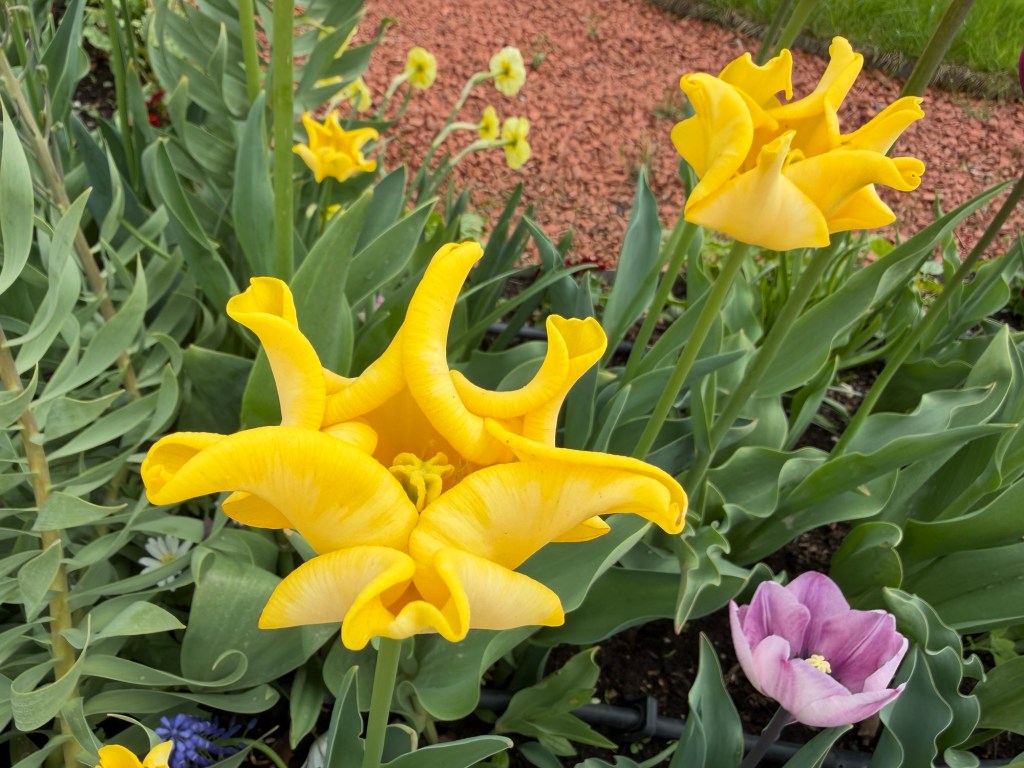


The Palace reminded us of other palaces we have seen elsewhere in Europe and found it uninspiring. I even forgot to take many photos. The garden, however was splendid and worth the time we spent there. Although it is famous for its roses, they were not in bloom when we were there. However, the tulips were a riot of color and in full bloom. Knowing me, you will appreciate the tulip photos. Otherwise, the hundreds of sculpted trees were also beautiful and remarkable. I would certainly revisit the garden during the rose season.
Our last stop before Riga was a private farm where guests are invited, for a fee, to experience life on a farm and have a home made lunch from local farm products. The place is called Vaidelotes and is owned by Daria and Acnolots Fatniedi. They own 400 hectares of land. 300 hectares are under cultivation. 100 hectares have been turned over to about 80 people who make up a village on the land. The land owners do not pay tax on this land. It is paid by the villagers using the land. This is an arrangement that happened during Soviet times. Everyone is used to the system now, although the land owners admit they would like to convert it back to agricultural uses. They have 5 sons and one of them would like to take over the farm at some point.
I learned that the farm was producing rape seed and using the seeds to make oil, the family uses for vegetable cooking. I also learned that dandelion flowers are used to make a healing tea.
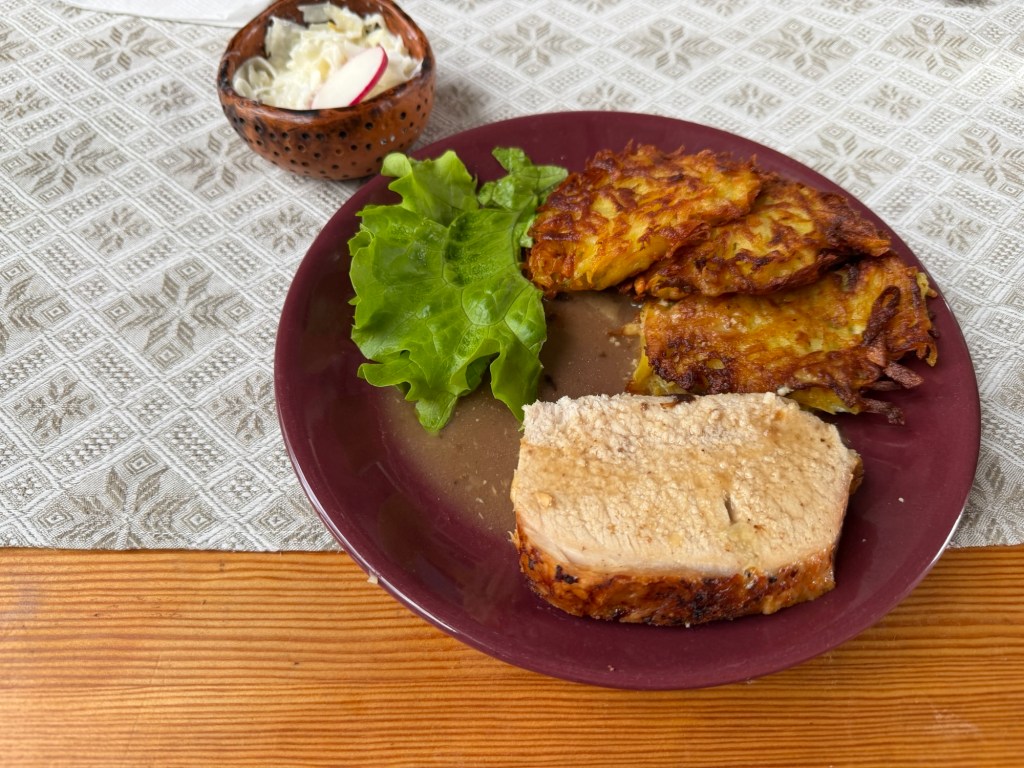


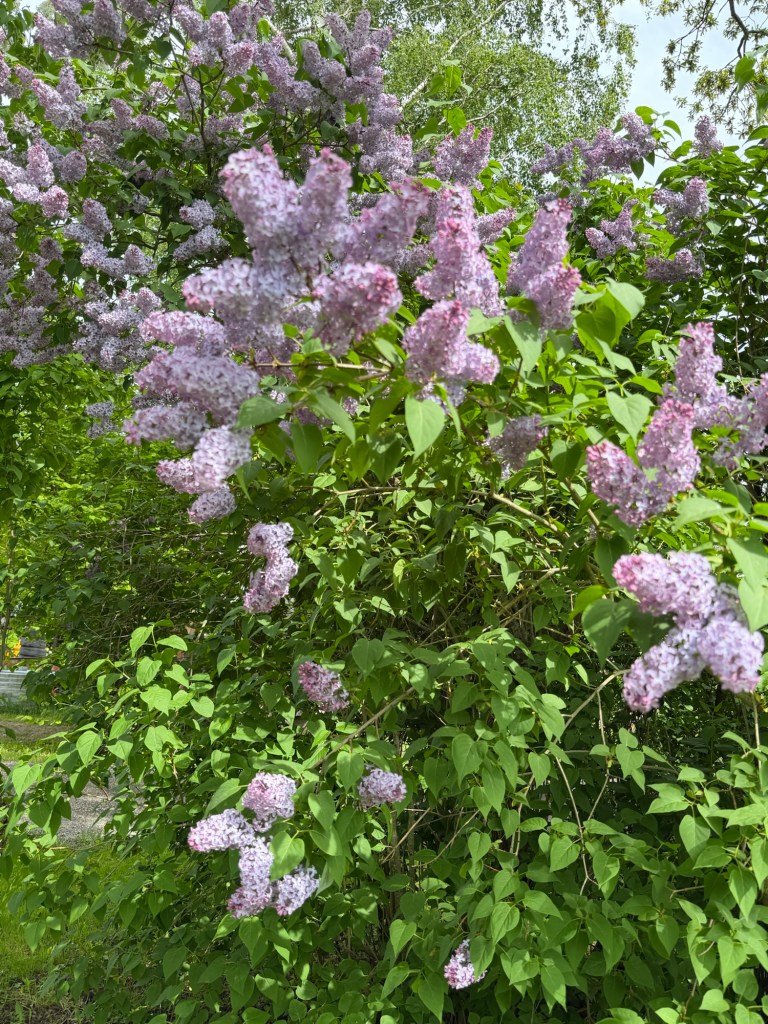
We were offered lunch, but had eaten at the Palace and were not hungry. After a walk about the farm property, while chatting with the lady, Sanita, hired to talk to the visitors, we ran low on things to say, admired the huge oak in the yard and the white storks in the field and headed for the car. Richard was, thankfully, ready and waiting, so we smiled and departed.
An hour later we were in Riga, pulling up to our hotel for the next three nights, the Grand Hotel Kempinski. After settling into our new digs, we went for a walk around the Old Town.
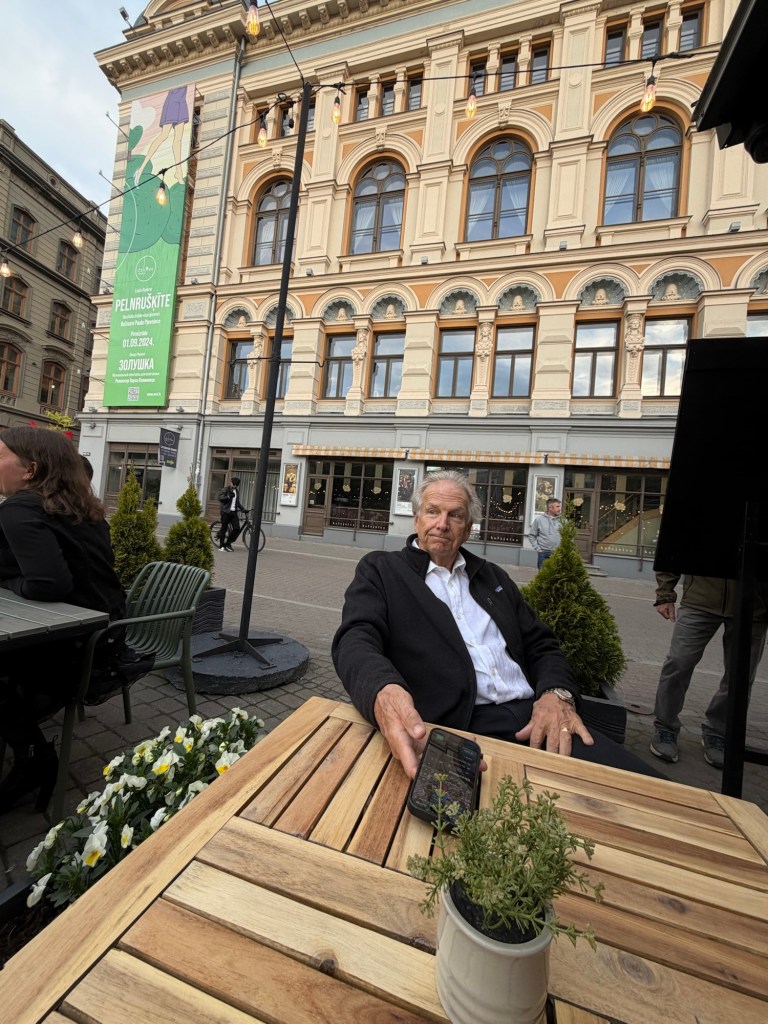
The cobbled streets were very similar to the streets in Lithuania, and many of the buildings had a similar feel too, especially the churches. However, the energy was very different, There were more people wandering about and they tended to be younger and full of life. The Cafe’s were busy and many of them were full. Music was being played in various locations. We found seats in an outdoor cafe and had a snack.
Friday, May 22, 2026
Met our next guide, Daiga, at 9am and walked around much of the Old Town by 2pm, when her time was up. We learned that the population of Riga is around 700 thousand and the country is 1.8 million. Considerably fewer people than Lithuania. Latvia is about the same size as West Virginia. The three Baltic states together are about the same size as Missouri.

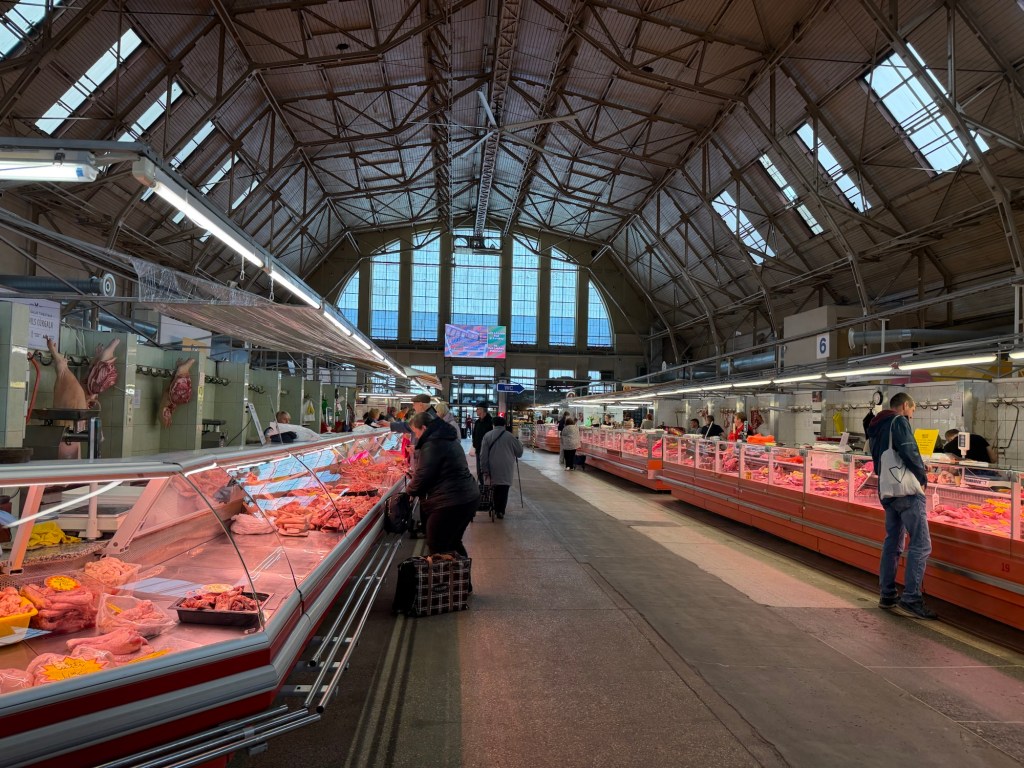
We saw the very picturesque Art Nouveau Italian Embassy, one of 800 Art Nouveau buildings in the city, and were soon at the 5 zeppelin hangars which had been built by the Germans during the First World War to hold blimps and were no longer needed so they were relocated to Riga in 1930. The hangars are currently used as the central market place for everything from food and flowers to clothing and miscellaneous goods. They are spacious, clean, light and airy compared to markets we have visited in other countries.

We visited a Stalin style building constructed in the 50’s and currently used as an academy of Science. It was built to be office space on the lower floors and a hotel on the top. The hotel never materialized. Apparently Stalin had nine other larger buildings identical to this, eight built in Moscow and one in Warsaw.

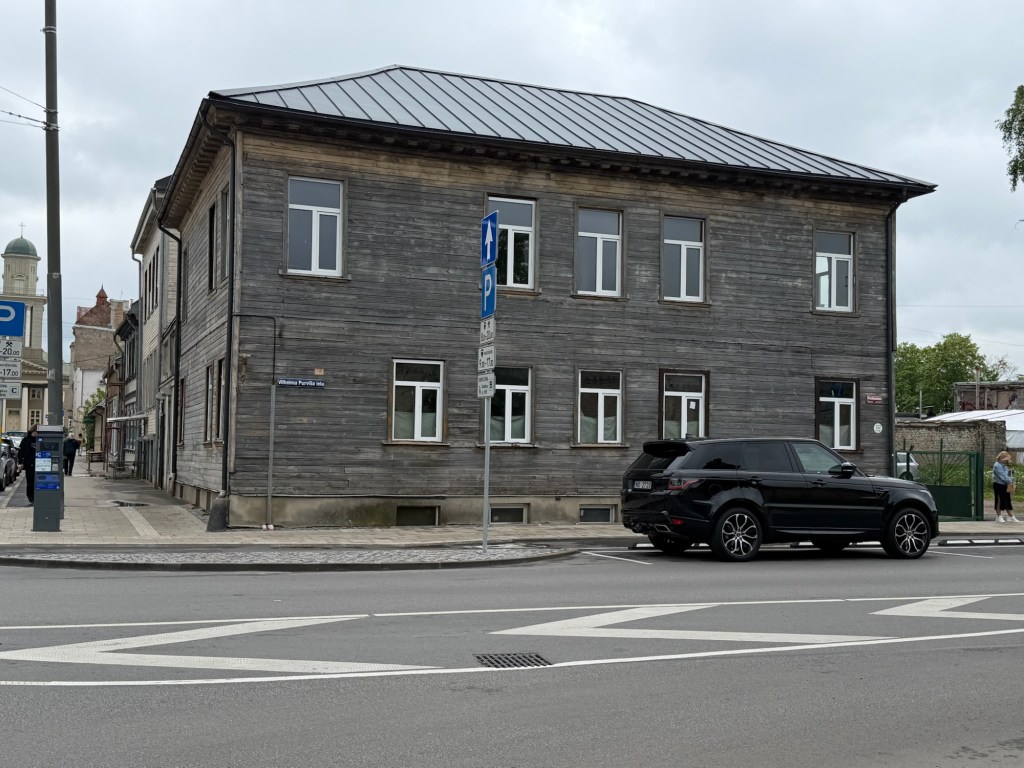
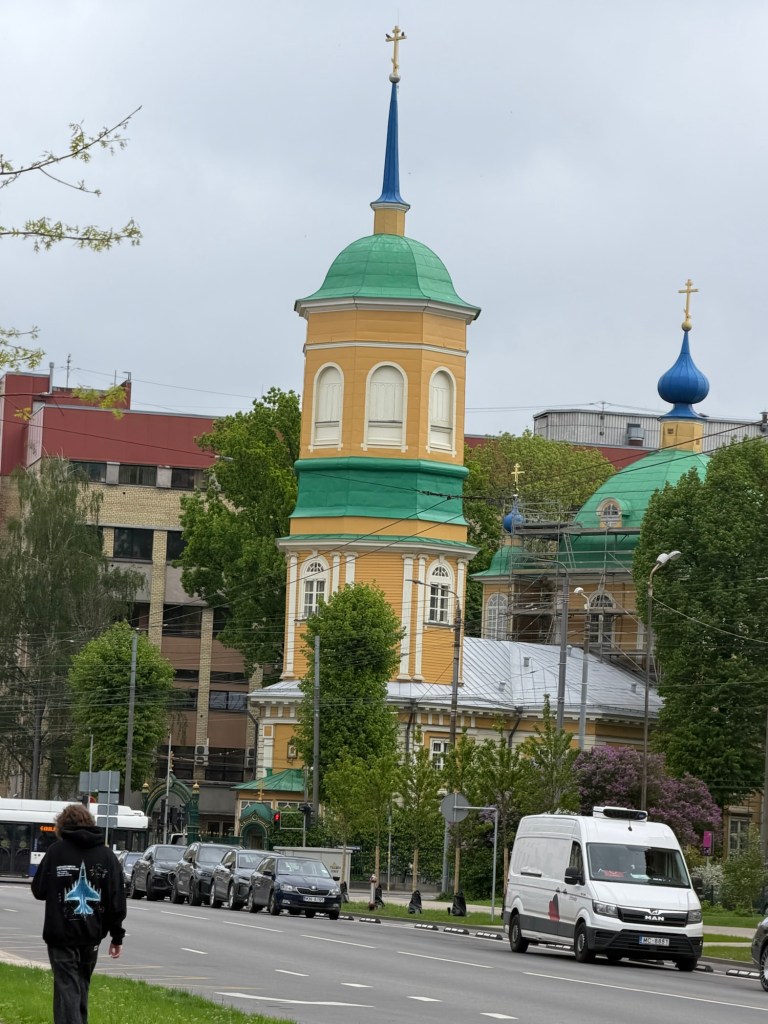
Opposite this “wedding cake” building was a simple 17th century wooden Lutheran church along with a nearby yellow wooden Russian Orthodox church from the same century.
There are many eateries near our hotel in the heart of the Old Town. Our first night in Riga, we had a snack in a busy outdoor cafe, Last night we had dinner in an Uzbekistan restaurant. The food was just ok. Tonight we have made reservations to eat in an Italian restaurant.
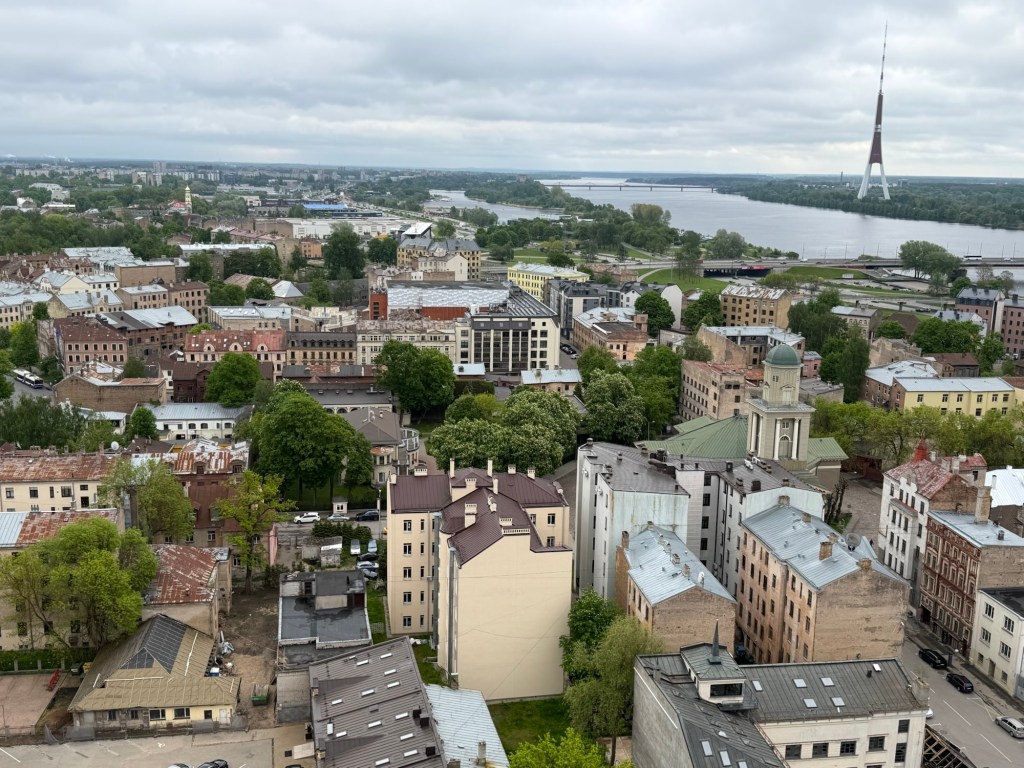
Very nearby was the Daugava River, which forms part of the Riga port, but is not navigable by today’s ships. The TV tower is in the background
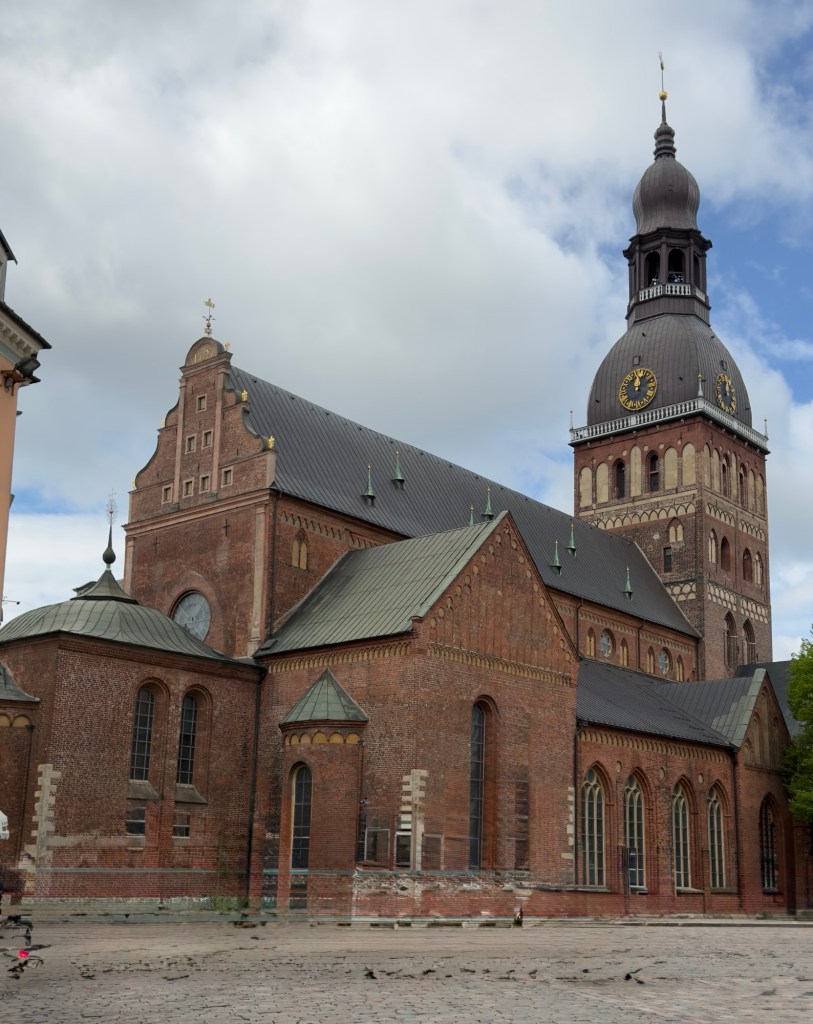
Buildings we saw included: Riga Lutheran Cathedral in front of Dome Square;
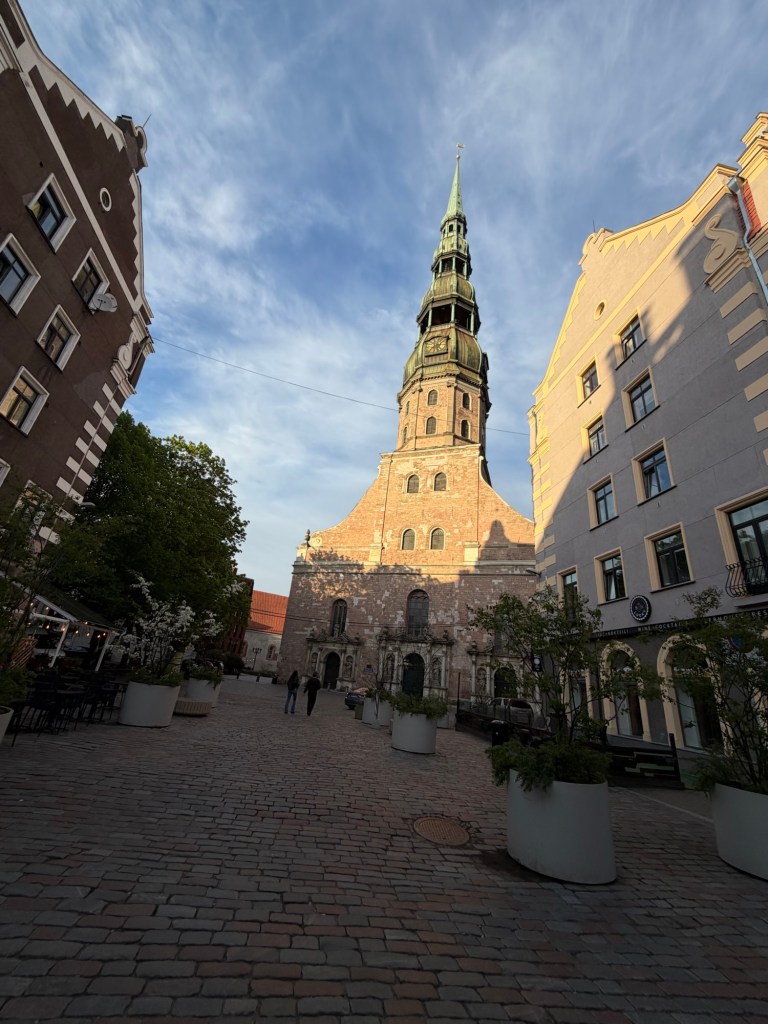

the Reformer’s Church; City hall in the Town square

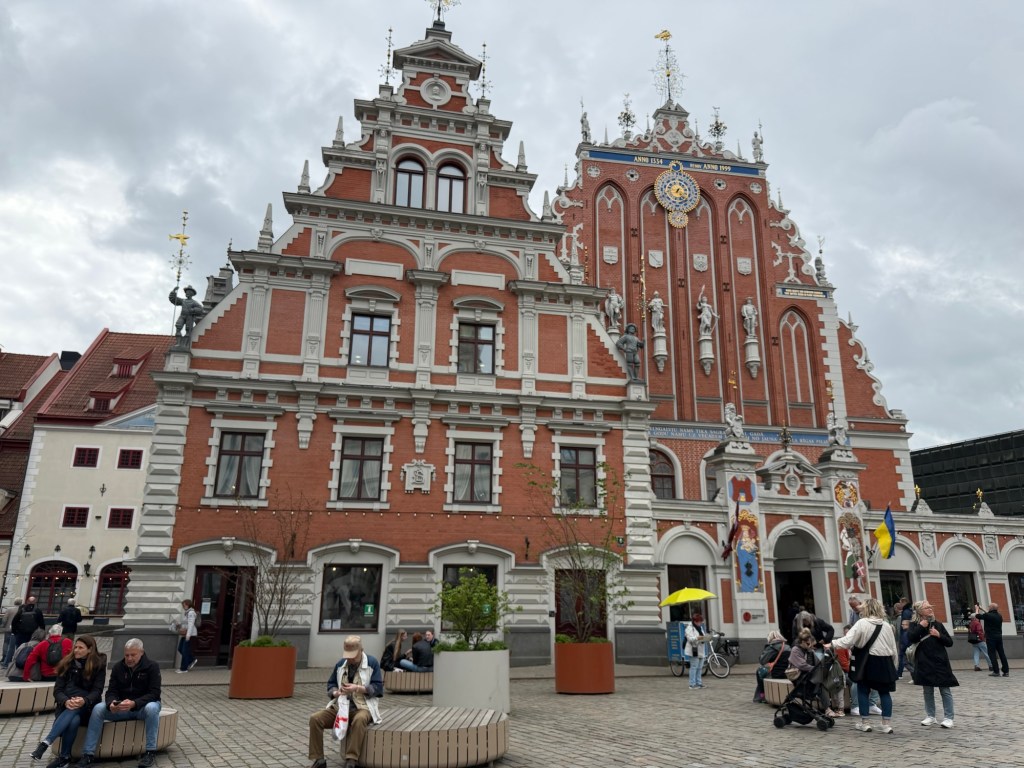
; the House of Black Heads, a brotherhood of traveling merchants, which was originally built in 1334, bombed by the Soviets in 1941 and rebuilt identical to the original in 1999;
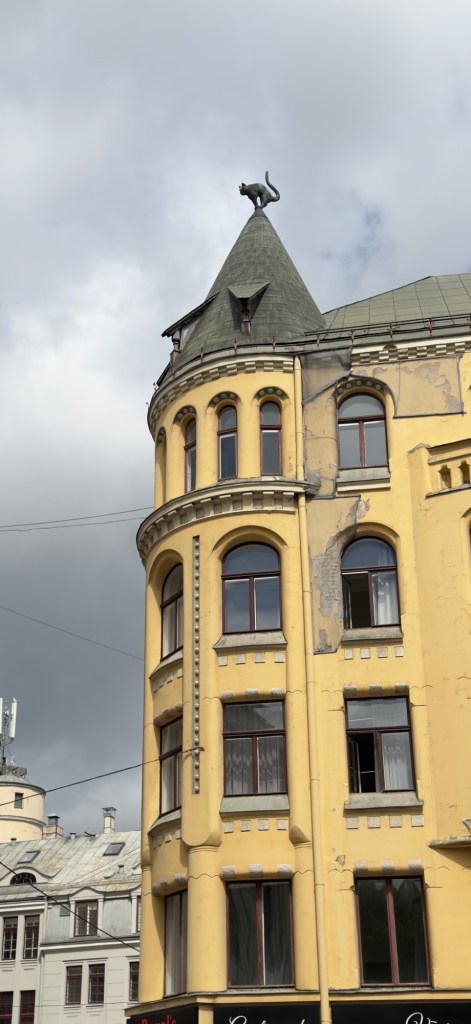
the House of Cats with 2 perched on the roof facing the merchants guild, now the home of the Riga Philharmonic. The tail of the cat faced the large merchants guild because the members of the guild did not like the merchant and would not let him join their guild. The merchant turned his cat to piss on the guild. Now that the Philharmonic is in the guild house, the cat has turned its head toward the music.
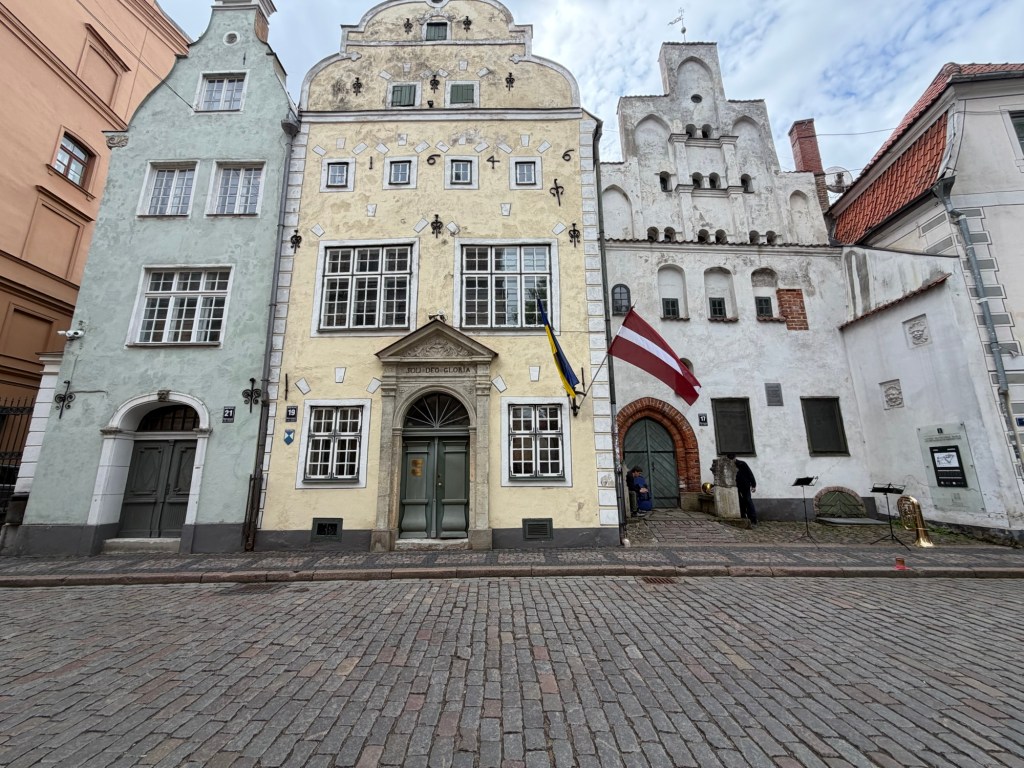
the oldest standing buildings in Riga are next to each other at #17 (15th century), #19 (1646) and #21 (an 18th entry merchants house.
After a lot of walking we stopped at the Black Balsam Cafe to taste the liquor created by Abraham Kunze, the owner of the former apothecary and wash it down with coffee.
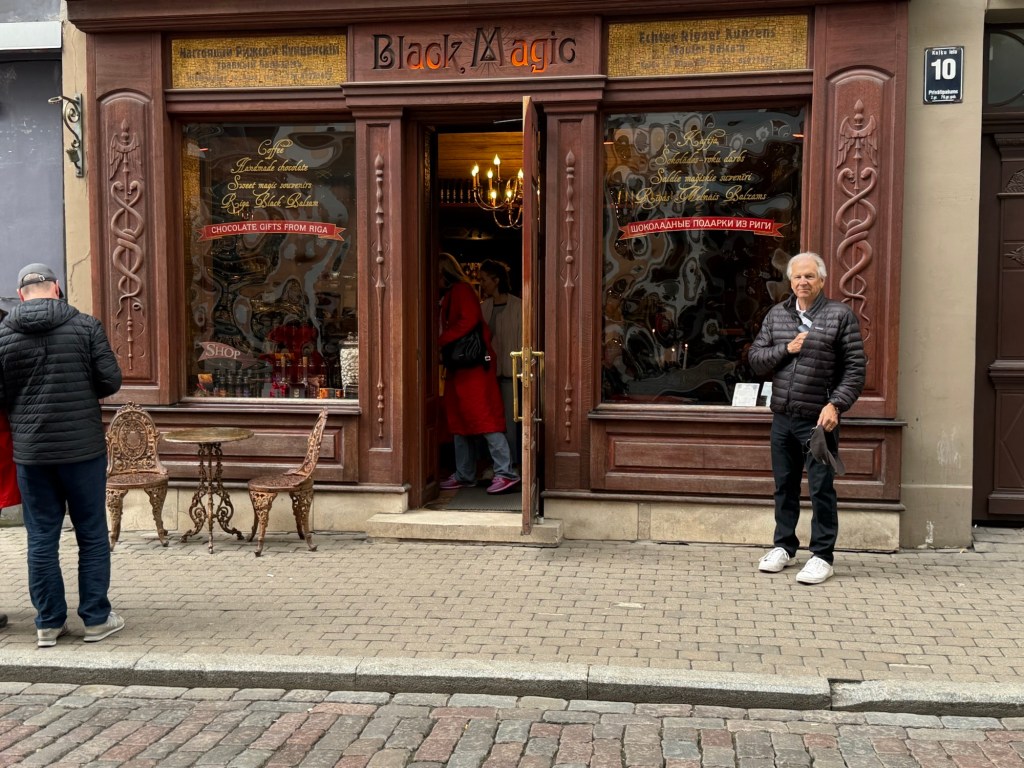

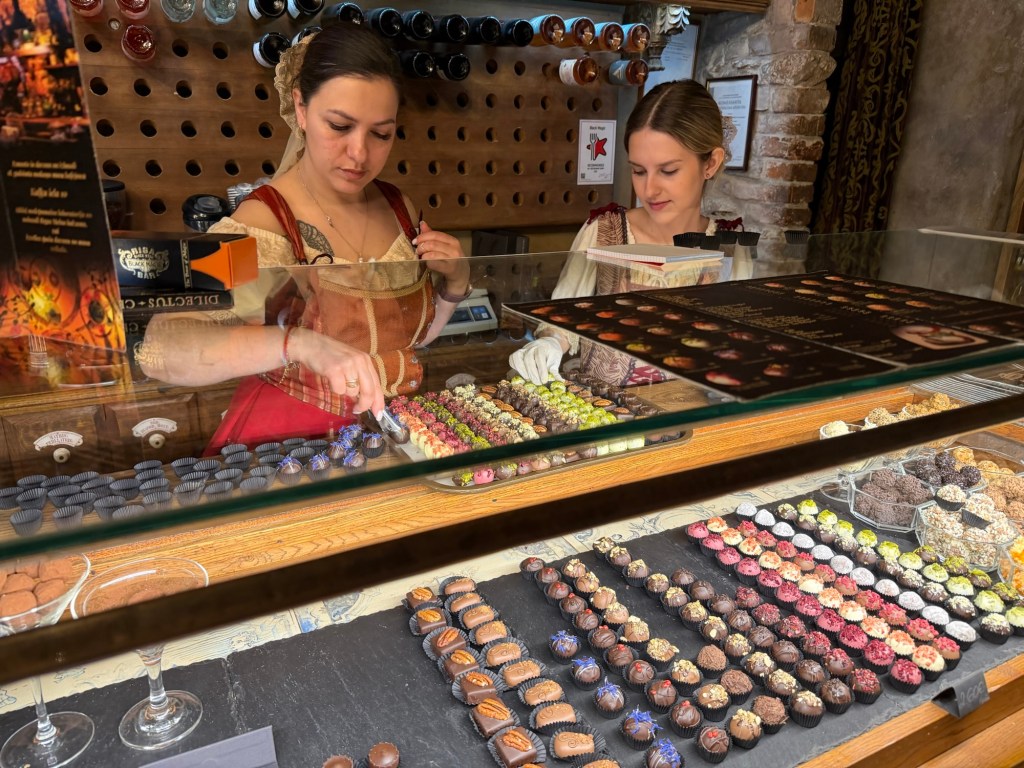
We were each given a shot of plain Black Balsam and another of Black Balsam with currant flavoring. The shot with the currant flavor was more pleasant, I thought. The 2 shots were pretty strong and I dropped off to sleep for a few minutes. But Mark woke me up and we were soon back on the street.
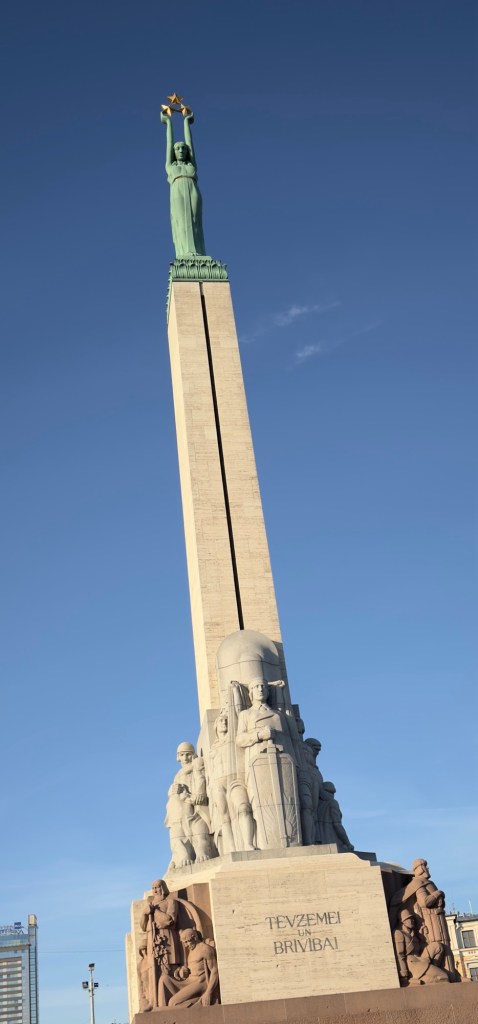
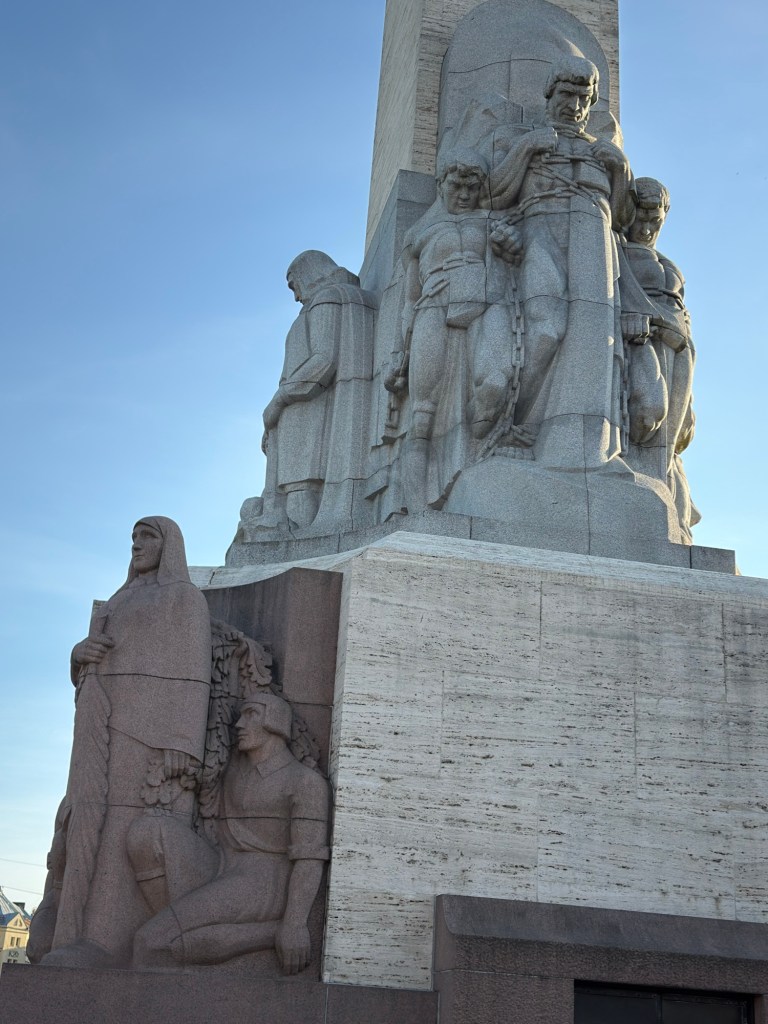
Our last visit was to a tall sculpture. It was a lovely Monument of Freedom to the Motherland and Freedom and honors the soldiers killed in the Latvian war of 1918-1920. We said good bye to Daiga until tomorrow. She is in her mid 60’s and very familiar with the recent world wars and their effect on the Baltic states.
Back at our hotel, I was able to get a pedicure and relax from all the walking.
Saturday, May 23, 2026
The weather has been cool since we arrived, but it is predicted to warm up today. We shall see. Daiga will be our guide again, and we have a car and driver too.
Daiga and our driver for the day picked us up at 9am and off we went in search of old houses.
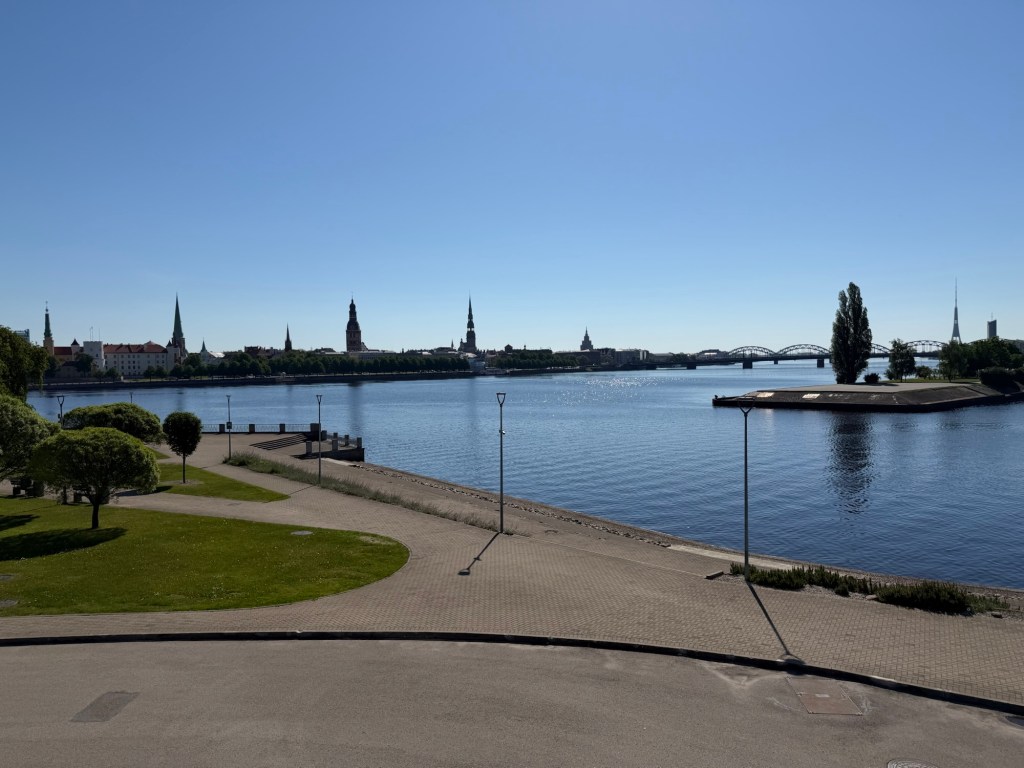


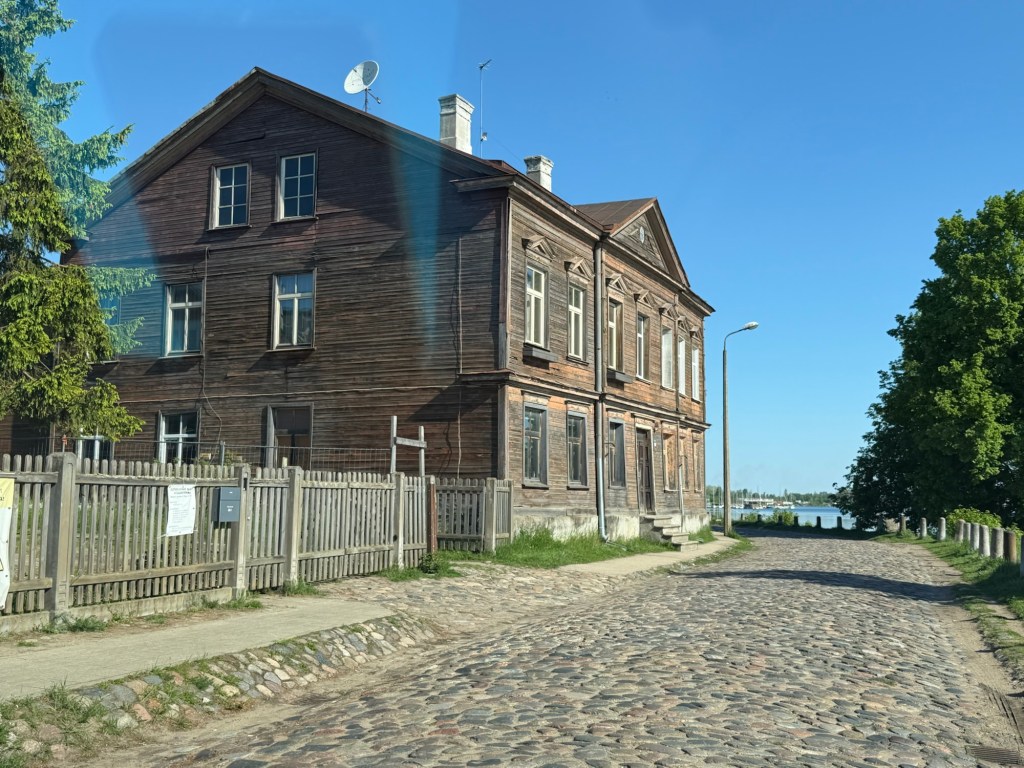


We crossed the River Daugava via a suspension bridge and entered an old cobbled street on the edge of the river to see wooden houses that had been relocated to this site from other old neighborhoods. Many had no style at all, but others had art nouveau, eclectic or modern features. They all had lovely views of the city across the river. We drove slowly through the area and saw many artistic houses.
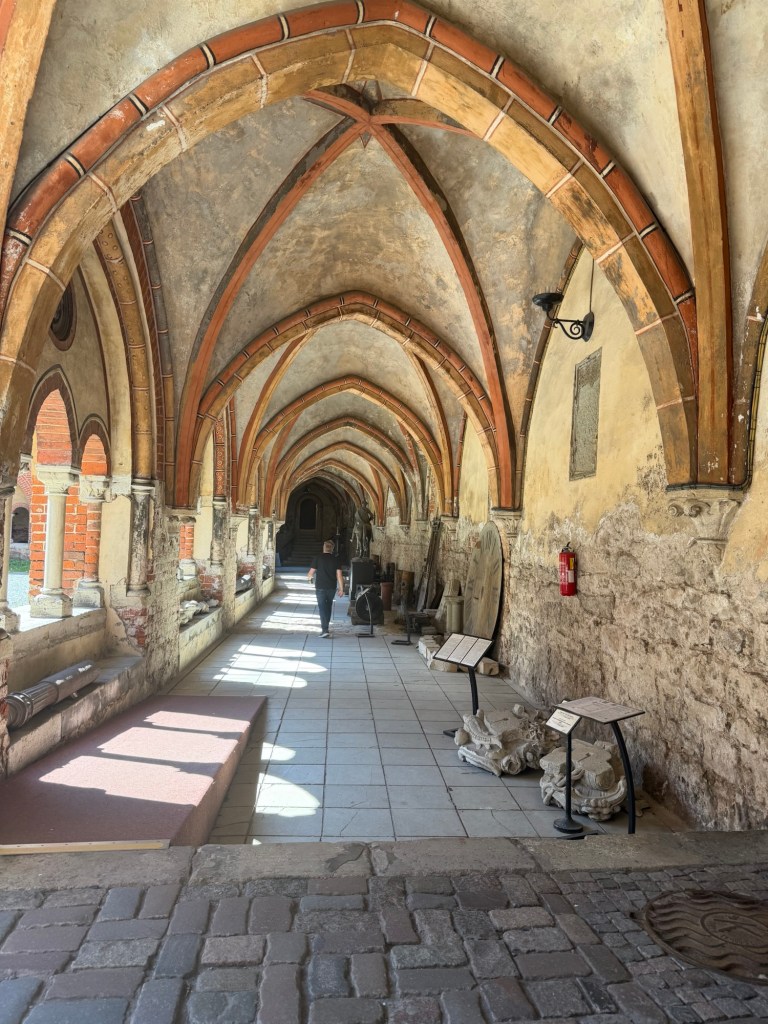
Back across the river we headed for the Lutheran church called the Dome Cathedral. We were reminded that the Lithuanians are mostly Polish Catholics while the Latvians and Estonians are German Lutherans. Construction on the cathedral began in 1211 and took a very long time being built. Rose windows were made in 1870-1080. Some were preserved during the war by being allowed to get very dirty and being covered in drapes, while others were removed and hidden for 30 years from 1959-1989. Some were bombed during the War and are still not replaced.

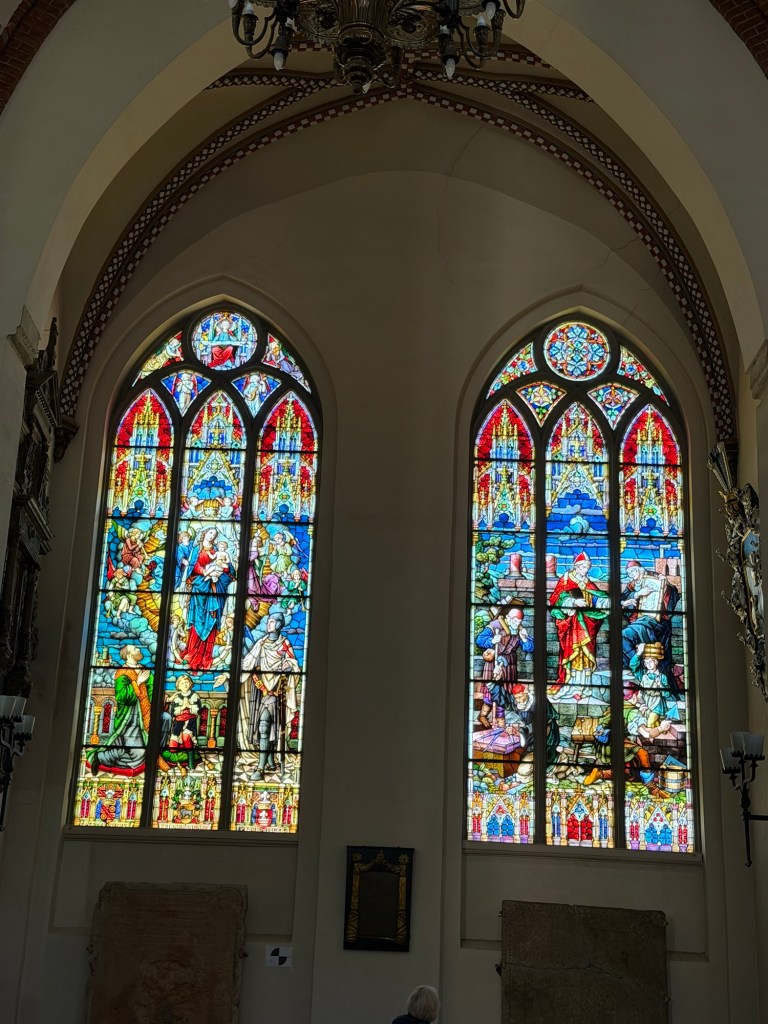


The oldest and largest pipe organ dating from 1601 was preserved because the Soviets converted the church into a concert hall and the organ was used for entertainment. Today there is a new pipe organ built behind the old one in front. The new one makes a lovely sound according to our guide. We did not get to hear it.
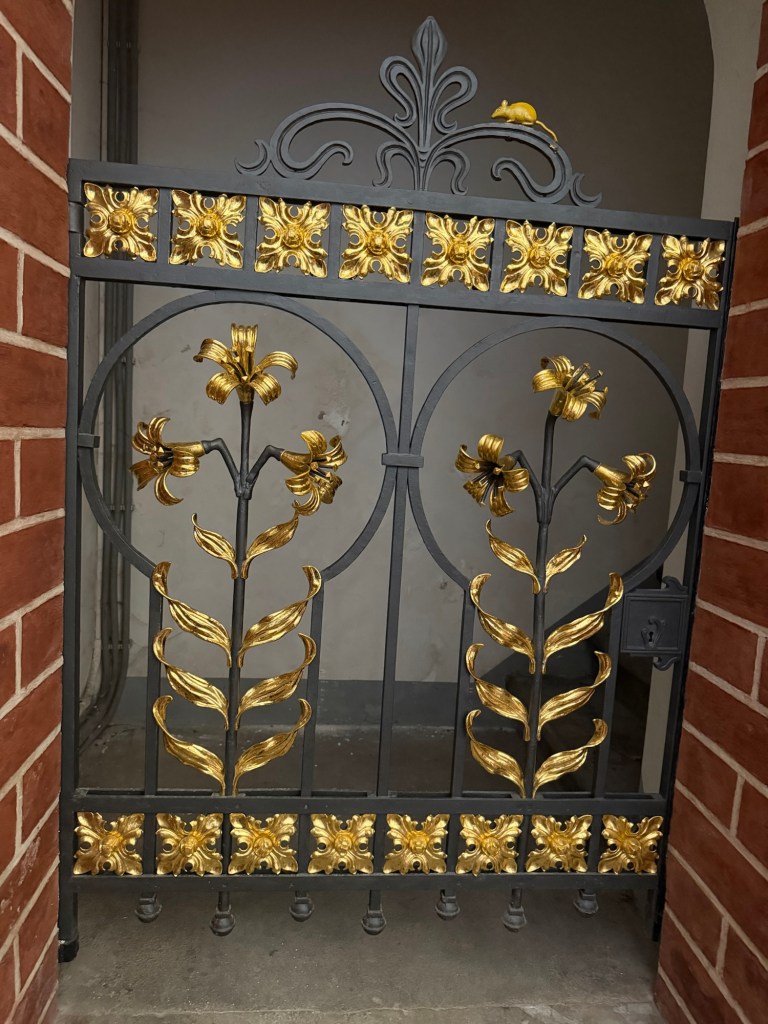
While wandering around the church, she showed us two animal creatures; the large rooster weathervane that originally sat on the top of the church tower; and a lovely wrought iron gate with a tiny gold mouse perched on the top of it. There is a reference to being “poor as a church mouse”.
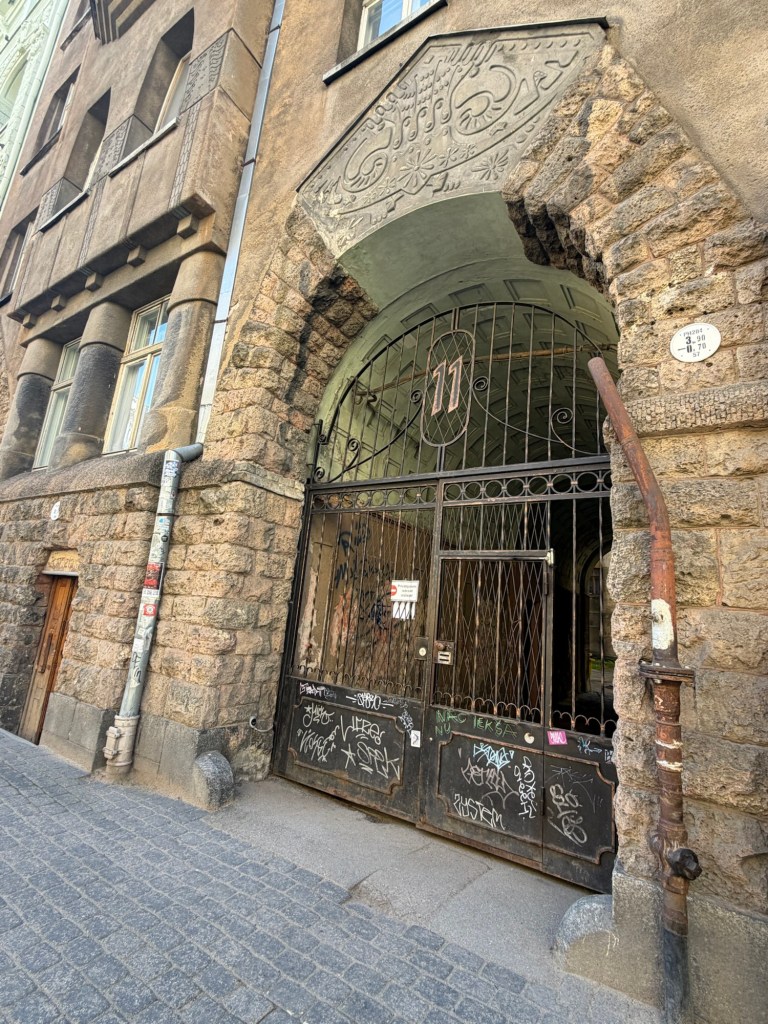
Back outside, we stopped at the Art Nouveau Museum, and walked slowly along Albert Street where many wealthy Art Nouveau buildings exist.

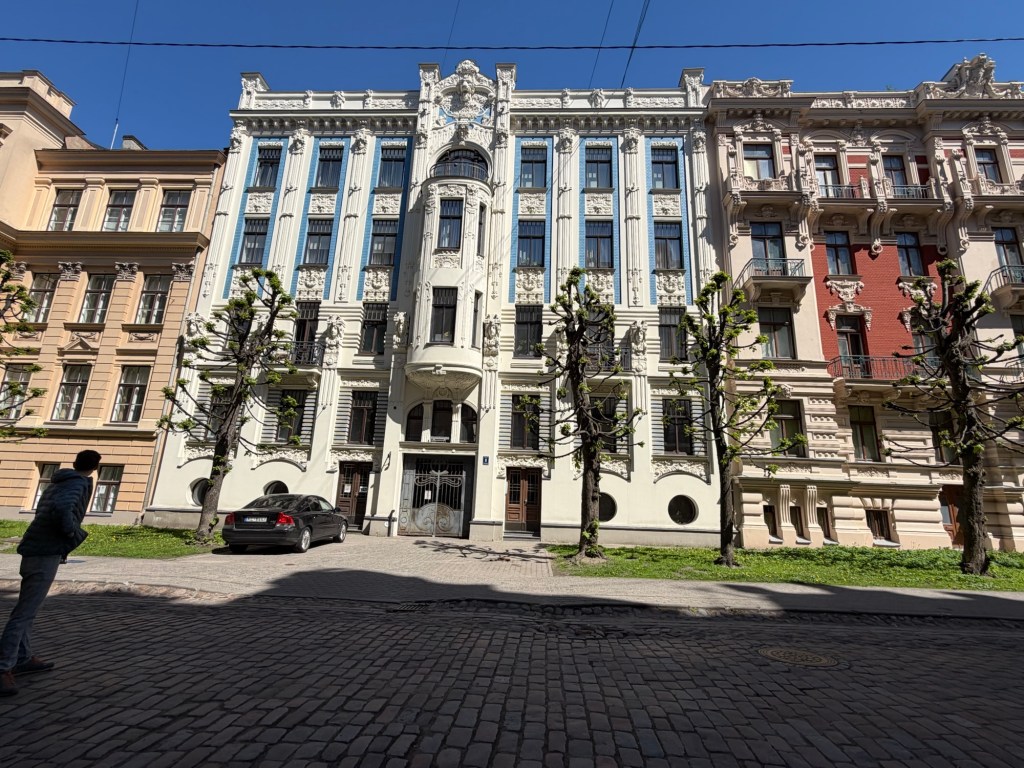

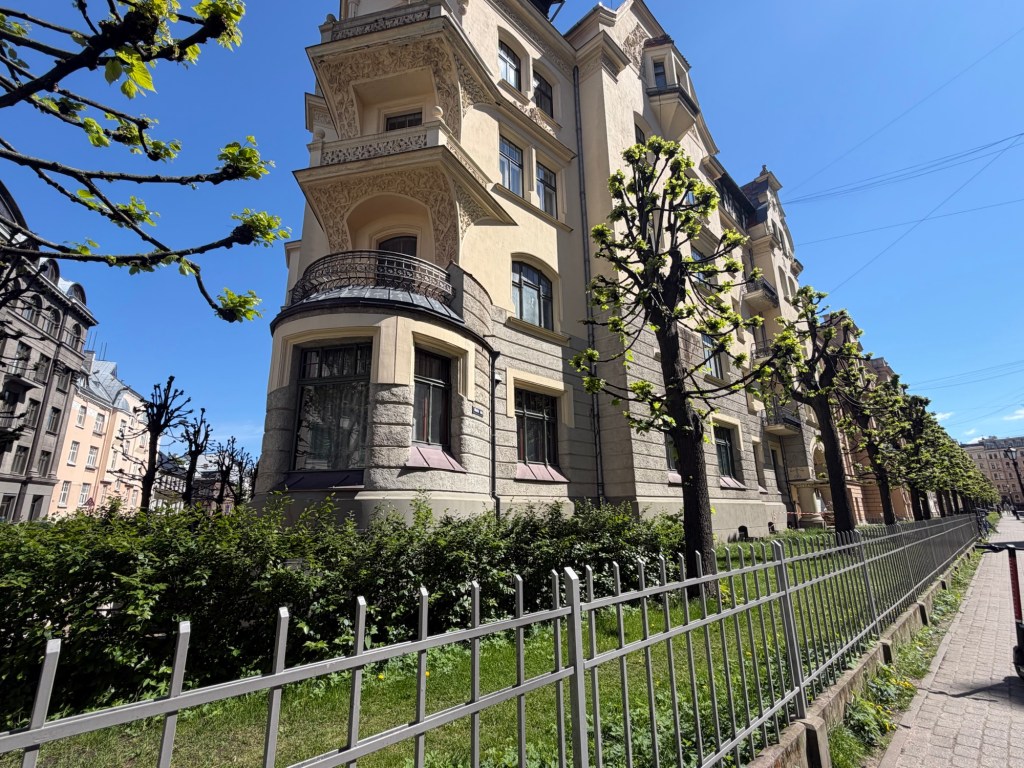
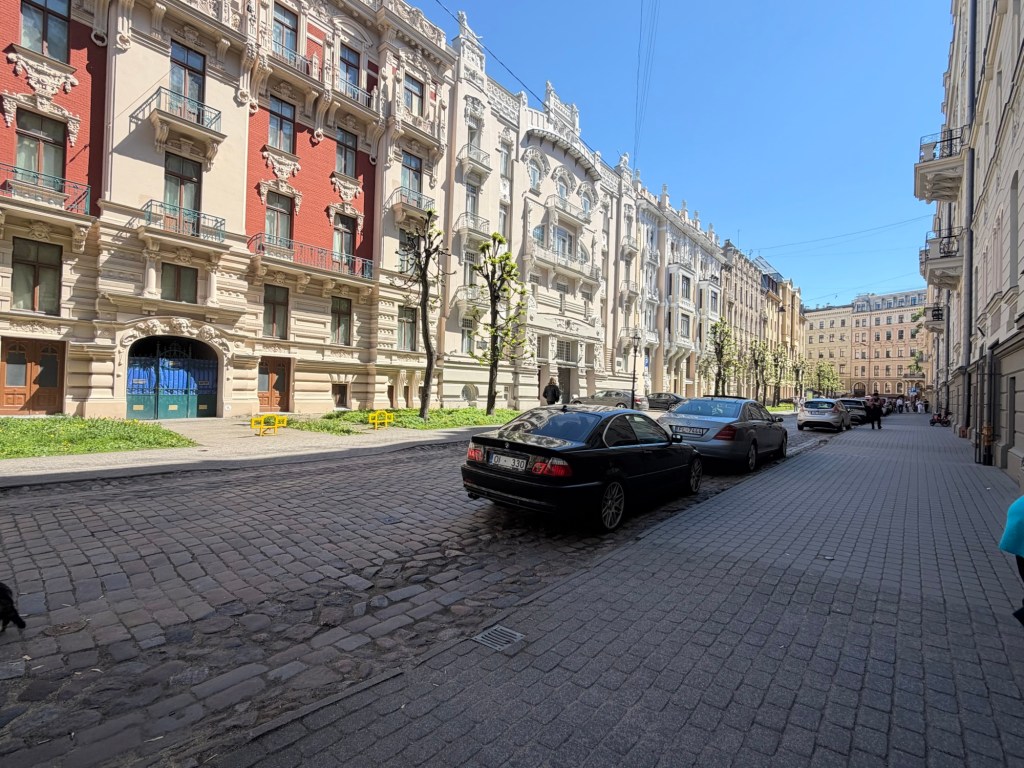
It is only one block long, but is worth the trouble to see so many beautiful houses side by side. The street name comes from Bishop Albert, who was the founder of Riga in 1201.
Art Nouveau and Nordic Art Nouveau were in style from 1890 – 1910. Then came Art Deco WWI – WWII. Baroque was in vogue from 1700 – 1750 and Rococo 1750 – 1800’s. Then there was National romanticism, which was similar to Nordic Art Nouveau.
After filling our heads with house decor inside and out, Daiga switched gears on us and took us to the Occupation Museum to follow the German and the Soviet Union occupations.

We had a special guide, Ineta, in the museum who was quite knowledgeable. From November 18, 1918 to 1940, Latvia was declared a democratic republic. Th war for independence ended in August 1920. The people built a state on pillars of education, culture and economic growth. They joined the League of Nations and wrote a constitution that guaranteed universal suffrage and rights of national minorities. Freedom of press, speech, assembly and association were guaranteed. This statement and other facts mentioned here were printed on documents read in the Occupation Museum.
On the 13th and 14th of June 1941, 15,443 people were arrested during the night and deported in cattle cars to distant regions of the Soviet Union. Families were separated and men sent to gulag camps. People were resettled in Siberia. The second mass deportation took place on the 25th of March, 1949. Latvia lost 42,125 farmers and their families. Latvians traditional farmstead system and the main national partisan support base were destroyed.
On June 22, 1941, Germany invaded the Soviet Union. One year under Soviet occupation caused the Latvians to see Germans as liberators until Hitler demands new victims. Latvia’s hope for independence was in vein. Within 6 months, 7000 Latvian Jews were murdered, 20,000 Latvians were shipped to Germany as laborers. And thousands were put in concentration camps. Men enlisted in volunteer legions and were subordinated to Waffen SS. The returning army included the 130th Latvian riflemen corp. Latvia becomes the battlefield where men are forced to fight each other. Almost half a million perish. Thousands flee west. By the end of the war, Latvia has lost a third of its population.
German forces enter Riga on July 1, 1941. By July 8 they occupy all of Latvia, the summer of 1941. Many Jews were walked out to the forest, shot and buried on the spot. 25,000 were killed between November 20 and December 8, 1941. 22,000 were killed between December 15-17. Many were deported from Hungary, Austria, Germany and other places.
Between 1941 and 1944 35,000 were killed including 20,000 Jews.
The Gulag chief administrator of corrective labor camps under the Soviet Union Interior ministry exists officially 1930 to 1960, but continues to function after reorganization.
The entire Soviet Penal system, criminals and political prisoners, comprises more than 18 million who have been detained there from 1940-1988. About 200 thousand residents of Latvia are currently held in the Gulog.