Gilgit, Astore and Shigar

September 13, 2019

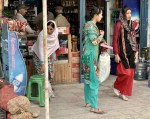
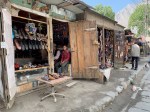
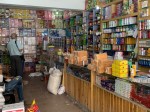
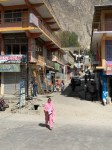
The morning was free and we enjoyed staying in the hotel and reading and writing.  Shifa was supposed to pick us up at 1pm, but he did not show until 2:10, very unlike him.  Our plan was to go to the old bazaar and look for fake ruby stones to make earrings for me.  After checking several stores we finally found two we think will work.  The stones are not exactly the same size, but maybe no one will notice when I have them on.

Old Bazaar in Gilgit. We bought fake rubies here.

Old Bazaar in Gilgit. We bought fake rubies here.

From the old bazaar we went to a department store looking for a Pakistani men’s shirt and bottoms.  Nothing fit.  Shifa thinks we will do better in Islamabad.  I would like to find an outfit for myself as well.  We shall see.

Then we went to a girls hostel in town for a prearranged visit.  It is called the KVO Hostel.   KVO stands for Khunjerab Villagers Organization, which consist of seven Ismaili villages near Khunjerab Park, which are the owners of the land acquired by the government for Khunjerab National Park. The agreement is that KVO receives 80% of daily park entrance fees received from foreigners visiting the park.  They also own and operates the hostel in downtown Gilgit for about 50 Ismaili girls aged 18 to 25, from remote areas in the Gilgit Baltistan province.  Ismaili girls in grades 11 through 14 are welcomed on a first come first served basis.  The goal is to provide housing at low cost so the girls can afford their school fees.  The students pay 5,000 rupees/month or $32.19.  Other living arrangements are considerably more expensive.   In addition to the Girls Hoste,l KVO supports other Ismaili community development projects.
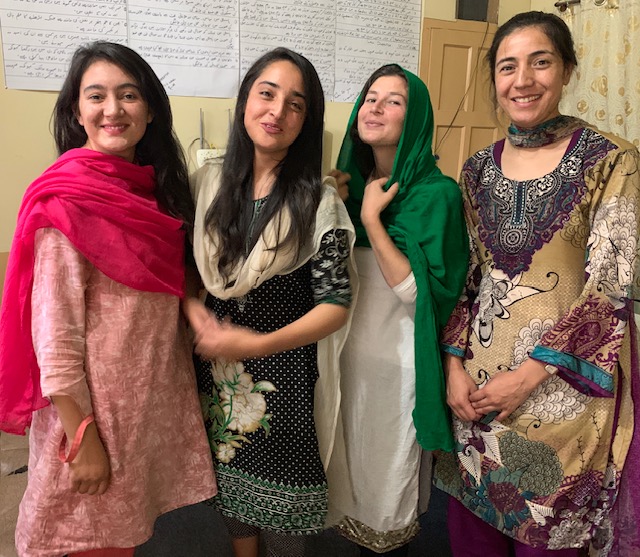
Some students in Girls Hostel in Gilgit.

After learning about the KVO and the hostel from the administrator, Sultanuddin, and the finance manager, Qudrat, who are on the hostel board,  I met four of the students and had a lot of fun chatting with them.  Most of them spoke reasonable English and they helped the girls who did not understand.  I also started to speak slower and that helped.  They all want to finish university and have parental approval to do so.  They all expect to have an arranged marriage after finishing school.  They trust their parents will choose well, even though they agree that not all arranged marriages work out well.  Some of their married friends are quite unhappy.  Nevertheless, they totally agreed that was what they wanted to do.  Sex before marriage is completely out of the question.

They toured me around the hostel and showed me their rooms, the study hall, kitchen, dining room and bathrooms. Other girls joined the parade.  The accommodations did not meat our standards by any stretch, but the girls were happy with their circumstances and appreciated the opportunity to get a good education, which their parents could not have afforded any other way.   I noted that there was no shower, only one exposed bulb in the study hall, and the grounds looked shabby.  I didn’t say much to the girls, but did notice that some of them smelled rather ripe even though they looked ok.

Back in the administrators office, I was asked what I thought could be improved.  I was pleased that he asked and immediately brought up the shower situation and the dim light making it impossible to study in the hall.  Shifa and the administrator  and finance Manager took my comments to heart and marched right over to the bathroom to see what options were available. While they were gone, Mark and I conferred about the situation and decided to give the school $500 to remedy the shower problem.  Both Shifa and the Administrator were pleased with our offer and said they could install at least 2 showers, improve the lighting in the hall and have a little left over.  It is so nice to have so little go so far in places like Uganda and Pakistan.  As we left the facility everyone was smiling.  I thank God for the gift of being able to improve the lives of even a few people.

That evening we had dinner at our hotel with Shifa and his family.  His wife, Gohar Nigah, spoke no English, but his daughters, Shagufta (18) and Shaista (16) spoke reasonably well.  The ladies all arrived dressed up and I was glad I had something appropriate to wear too.  We worked very hard to keep the conversation going and learned that both girls plan to finish university and have their parents select a suitable husband for them.  The younger girl wants to work in computer science and the older one wants to be a teacher.  They were both curious about our work and our interest in Pakistan and traveling in general.  The mother did not talk at all and that put a cramp on things.  After an hour, dinner was over and it was time to say good bye.  I forgot all about taking a group photo.  Am sorry now, but we were happy to get back to our nice cozy room and terrace.

September 14, 2019

Leaving Gilgit at 9am, we stopped very soon at the confluence of the Gilgit River, which had only a few kilometers before overtaken the Hunza River, and the Indus River, the largest river in Pakistan.
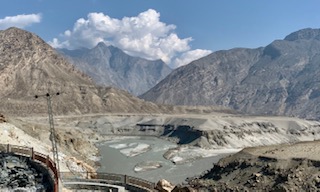
Confluence of two river and three mountain ranges.

Confluence of two rivers-Gilgit and Indus and three mountain ranges-Hindu Kush, Karakoram and Himalaya.  Pretty heady sight to ponder.

At that same point we were looking at the confluence of three mountain ranges:  Hindu Kush on the left; Karakoram in the middle; and Himalaya on the right.  The highest peak of the Hindu Kush is Tirch Mir at 7,800 meters; of the Karakoram is K2 at 8,611 meters (the 2nd highest in the world); and of the Himalaya is Everest at 8,848 meters.  All were out of sight at this juncture, but a mile down the road we got our first glimpse of an 8000 meter peak, Nanga Parbat at 8,125 meters.  Shifa told us the wind is so strong that snow does not stick to the mountain.  Nanga means “naked” and Parbat means “snow”.  It was first climbed in 1953 by a German, Hermann Bul, the same year Edmond Hillory climbed Everest.

Nanga Parbat, a peak measuring 8,125 meters. Notice the very windy top.  No wonder no snow sticks to it.  This was the clearest image I could get.

From now on our route will take us through the Himalaya mountains.  Down the road we stoped on a hillside in a village called Jaglot for a better view and found ourselves at the front door of a religious secondary school for boys.  They were just taking a break and came over to check us out.  They stared at me and Shifa thought I might be the first girl in western dress that they had ever seen.   Secular classes had been added only 3 years earlier and their education was very poor.  Even the English teacher had a hard time communicating with us.  I felt strange and was glad to get away from the situation.

This encounter got us into a discussion about Mujahadeen and Taliban. My simple understanding of the trouble is that Pakistan was doing well until the 80’s when they agreed to train men and boys to become Mujahadeen (Volunteer fighters for a holy cause) and fight the Russians in support of the US.  The short of it is that they became trained killers.  Pakistan continued to conscript and train boys until 1995.  When that war ended, the fighters needed a reason to keep fighting, joined the Taliban (Student Seekers) and established a government in Afghanistan.  After 9/11 they  fought against the US to get us out of Afghanistan.  As time passes, so will the Mujahadeen as Pakistan is not training more of them.

Some observations we made along the drives south is the changing of crops.  In the far north, there was only wheat.  Around Gilgit we began to see corn and before we get to Astore, the dominant crop was potatoes.  Continuing down the road we stop at a waterfall and a sawmill.  We have seen very few waterfalls, but many sawmills, which always reminded me of my father, who was in that business for many years.

At 2pm we reach our overnight stop, the Wazir Mahal Hotel at 7,900 feet, just passed the town of Astore.  The place was rather dirty and weird with a menagerie of animals in cages and several different colored lights strung over fences and around trees and poles.  However, the WiFi was really good and I was able to get a post sent.  Another GeoEx group with 6 vehicles and 18 people arrived and we shared cocktails and dinner with them.


They were all interesting people to be sure, but I was a glad there was just the 4 of us traveling together.  The food was getting very boring and, in this case, was not well prepared either.  I ate pasta and bread and felt bloated.  The full moon came up around 8pm this Friday, the 13th and I remembered that Hospice of the Foothills was putting on their fundraiser called Moonlight Magic and hoped they would do well.

September 15, 2019

During the night I suffered an attack of the trots.  Ugh!   More or less had it under control by 6am and managed to get down some oatmeal and hot water.   This was our longest driving day and, given my tummy cramps, it was grueling to say the least.  We drove away from Astore at 6:30am and did not reach our destination at Shigar until 4pm.  I managed to stay plugged all day.  But, enough about that.

The drive was only 145 kilometers to Shigar crossing through the Deosai National Park and the Deosai Plateau, but it was all bumps with no peace.  The morning was the most pleasant as we got out of the car and walked through a few villages, chatting with and taking photos of people and scenery as we went. We learned about the mix of Yak and Cow to create a Zo, similar to a mule.  Zos are more able to tolerate warmer conditions than Yaks and they are stronger than cows.  They are used for their milk which is rich in fat like yak milk, while their meat is more beef like.

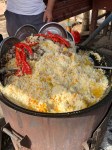
We walked through a conservative suni village where there were dozens of men congregating around cauldrons of food–one with rice, one with yak stock to mix with the rice and one with mutton stew.  I walked amongst the men shaking hands, looking into the pots and asking for photos. Shifa told me later that I totally flummoxed the men who are not use to women meddling in their affairs.  What I did not know was that there were men in the crowd who were hosting the meal and expecting the crowd to hang around for a speech about politics and religious fervor afterwards.  After about 10 minutes, Shifa indicated we should leave and so we walked away.  Another interesting encounter.

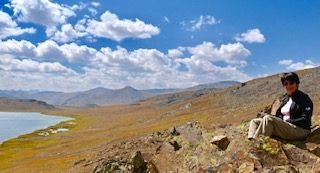
Overlooking the lake from a rocky outcrop at 13,500+ feet.

Once we had passed the last village we entered a heavily forested area at about 10,000 feet and began to see birch trees in autumn color as well as large stands of conifer trees.  This was the largest forest of timber we have seen in Pakistan, and not a stray piece of dead wood anywhere.  Every bit of scrap all the way to the top of the mountains was picked up for firewood.  The forests were pristine, unlike our old ranch. It was about 9am when we left trees behind and entered Deosai Park and paid our $10 fee.  We bumped along the road looking at brown rocky hills for over an hour and eventually reached Chikar Pass at 13,822 feet.  Right after the pass we stopped to climb a rocky promontory to view heart shaped Sheosar Lake that Shifa insisted we see from above.  I was not wearing proper shoes but managed to crawl up the hill to a very nice view spot on a rock.  Fortunately, the path down was much easier and I managed it without incident.  Mark meanwhile, wandered around like a mountain goat.  After passing the lake, there was nothing but bumpy plateau for hours.  The most exciting part about the plateau was the hundreds of fat marmots living there.  We all took many photos, but Mark got the best of our shots.
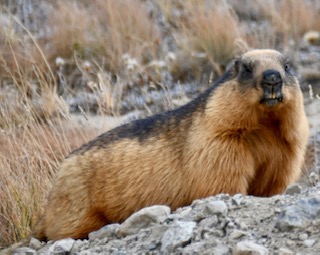
A fat marmot in the Deosai Plateau.

A fat marmot in the Deosai Plateau.

At one point we stopped at a camp providing food and tea for travelers.  Shifa and Khajullah needed a break.  We did too, but I could not face the food or the tea.  The camp looked as desolate as I felt.
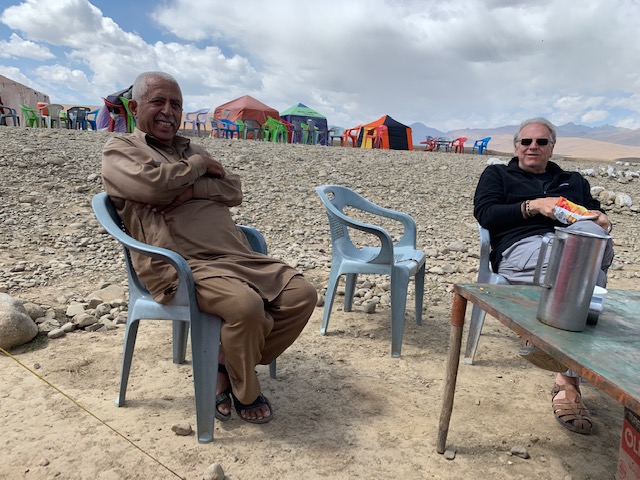
Khajullah and Mark sip on tea in the windy, desolate camp ground.

I ate a couple of crackers and drank a sip of water. Back in the car, I could think only of getting to our destination as soon as possible.  Nevertheless, once we left the plateau at 13,440 feet, and began the long, steep, narrow, hair pin turn descent to Skardu at 7,750 feet, I forgot my stomach and spent the time being afraid we would go over the edge.    Then, once in Skardu, Khajullah drove like a crazy man through city streets trying to get to our destination as fast as possible.  My insides were frozen solid.  It was not until we reached our room in the Serena at Shigar Fort at 4pm, that my body relaxed.  I had survived the day with no embarrassing moments.  I ate a toasted cheese sandwich and went to bed at 8pm.   Mark sat up enjoying our private terrace with lovely mountain views all around and listening to the sound of the river passing next to the walls of the fort.  We had been assigned the Raja and Rani’s rooms on the top floor of an ancient, meandering, irregular fourth floor walk up.

September 16, 2019

Woke up feeling almost whole.  Was ready for breakfast at a relaxed 8am with the river flowing just below the dining area. Our conversation with Shifa was very interesting about the KVO, his involvement, what it is doing and what it plans to do.

Then we wandered around the lovely gardens and had a tour of the fort.  The architecture is much like the Baltit and Altit forts only not as old.  This place was build in the 1634 by the King of Shigar and was called the Palace on the Rock as it is built into the side of a mammoth boulder.  Occupied by Rajas until the end of the 38th dynasty in 1990, it was abandoned until 1999, when rehabilitation began.  It was finished being restored in 2004 by the Aga Khan Cultural Service and turned over to Serena Hotels for operation.   The property is operated for the benefit of the Shigar community.   The hotel is in the region of Baltistan, the home of  the Balti people, and Raja was the name for king in Balti.

We walked into the local village and found a taylor and a fabric store and ordered an outfit called a Shalwar Kamiz for him.  It is supposed to be finished by 9am on the 17th.  We shall see.

Then we walked fast to get to the public girls school before they finished for lunch.   We reached the very small school of 59 students and 3 teachers and enjoyed our time with them, even though none of the students spoke English and the teachers spoke very little.  Shifa did most of the talking with everyone.  He thoroughly enjoyed himself and the students seemed to enjoy him too.  Clearly, this school was in a very poor neighborhood.

From there we walked by two old mosques.  The first one we saw, built in the 1600’s, is called  Khankah-e-mualla Mosque, and also serves as a meeting hall similar to the Ismaili meeting hall, Jamat Khane.

The second mosque was called Amburiq Mosque. It was very charming and is considered the first Islamic religious monument mosque in the Shigar Valley as it was built in the 14th century.  It too was built with stone and wood to be earthquake proof. It too was restored by the Aga Khan Cultural Service in 1998 and now has a UNESCO heritage conservation award.

Slowly we walked along the village irrigation ditch back to the hotel and spent a relaxing afternoon on our terrace.  Stayed away from the car all day.  Felt great.
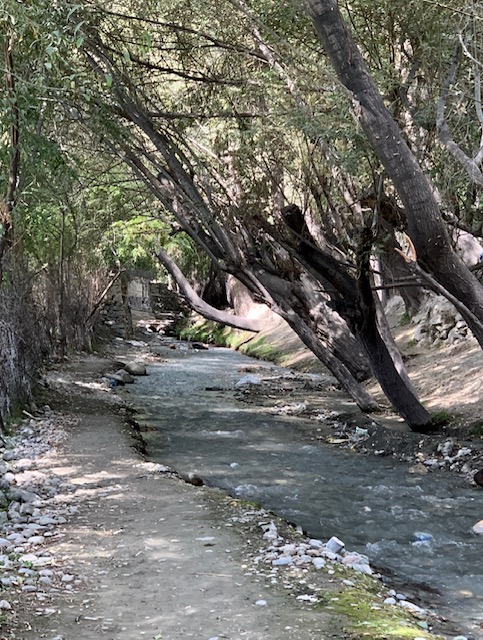
The village irrigation ditch offers a break from vehicle traffic and provides a pleasant experience.


Ashura – A Shia festival in Hunza and more mountains

September 10, 2019

Shifa had been telling us about the Maharam, a month long season of mourning, that culminates in a festival and parade that was coming.   He did not really want us to go near it as he thought there could be trouble.  There are, apparently, festivals throughout the country on the 9th and 10th of September for the purpose of mourning the death of an important Shia leader, Imam Hussin, who was brutally assassinated by a man named Yezid in 680AD in Karbala, Iraq.   He was a grandson of the prophet Muhammad.  Yazid was a Sunni and the Shia have neither forgiven or forgotten the incident.  The majority of Pakistanis are Sunni and in past years the festival has, sometime, resulted in fights and and even bloodshed.  Shifa finally agreed to pick us up at 11am and take us to a point from which we could watch at a distance.  However, when we got there, the last the marchers had just passed.  So Khajulah drove as fast as possible over the rugged and winding mountain roads to get us to a point where we could walk down a steep dirt track for about a quarter mile to reach the location where the main event was to occur on the KKH. Needless to say, the KKH was completely closed in every town for most of the day.  Also, cell phone service was shut down by the government for the day as a means of stopping social media communication and potential gang problems.

We beat the crowd and stayed on the edges of the road for quite awhile.  As marchers arrived, they stopped and sat on the ground for tea and a snack, then walked a few more steps to where hundreds of prayer rugs were laid on the ground and they could pray in comfort, although it was hot in the sun.  After half an hour of praying, lunch was passed out in plastic containers.  The men and boys sat around in groups to eat. When the containers were picked up, speakers began to make remarks to the crowd, who then sat on the prayer rugs to listen.  There was a loud angry sounding speech, a couple of songs, a long softly delivered speech and another crowd rousing speech.  We estimated the crowd to be between 800 and 1000 people.

Finally, the participants, who were mostly wearing all black clothing, began to form up into groups before the serious marching and chest beating began.  A riderless horse was brought to the front of the crowd to represent the martyred Imam Hassin.  I was impressed at how organized the event was and how the need for food and drink was handled seamlessly.  At the head of the line were ambulances, police walking around and military with guns, watching from the back of trucks.

At this point Shifa was uncomfortable with us being in the crowd so we found a perfect spot on the elevated stoop outside of a local motel. We had probably spent 15 minutes watching the proceedings when we were spotted by two plain clothed security men working for a local politician.  When they reached us they began questioning Shifa about us and our presence. After some back and forth discussion, it was decided we would move up to the second floor balcony of a street side motel and watched the proceedings from there until they passed out of sight.  By then they were beating themselves very strongly in time with drumming coming from loudspeakers traveling on trucks behind each group.  Shifa told us later that, before it was over, some people had beat themselves bloody with the chains many of them carried.  However, there were no fights and no problems.  By the time they passed by our observation point, we had had enough.

Shifa quickly grabbed a cab for Mark and me so we would not have to climb back up the hill to the car where Khajulah was waiting.  That was very thoughtful and appreciated. The cab driver spoke pretty good English and we learned that he had spent 20 years in the Pakistani Army and now operated a small guesthouse and moonlighted as a taxi driver. We also learned his younger brother was in the US Army. Last year when his brother re-enlisted and was graduating as an officer, our driver had requested a US visa so he could attend the brothers graduation.  Unfortunately, he was denied a visa. We were back at the hotel in 6-7 minutes on the now re-opened KKH behind the festival procession.

Back in our room, we agreed that we had had enough action for one day even though it was only 2:30.  It was relax time for us.


September 11, 2019

We depart the Serena after 4 lovely nights in one place.  We didn’t move very far, but we stayed busy all day until we reached the Eagle’s Nest Hotel.

First stop was the ancient petroglyphs that happen to be along side the KKH about 10 minutes north of Karimabad.  It was nice to have them so accessible.

The description informed us that these petroglyphs, called Haldeikish, mostly belong to the time when this area served as a connecting line of the Silk Road, especially under the Kushans from the 2nd century and later.  This is one of the earliest and most reliable sources for understanding the history of the region during the last millennium.  Here are a variety of images we took.

Spread over 4, large rocks, thousands of graffiti and petroglyphs, names, titles, dates,  and design in several different scripts reveal the diverse logistic and geographical origins of visitors and travelers through Hunza.   They highlight the important role the Hunza Valley played as a transition point for cultural exchange on one of the ancient Silk Route networks.  Some inscriptions from Buddhist pilgrims date from 83AD.  Another inscription mentions the greatest Gupta Emperor, Chandra Sri Vikramaditya, who reigned over most of India during the early 5th century.  I have never seen petroglyphs so informative.  Unfortunately, most of what I could recognize were hundreds of Ibex and a few men on horseback.

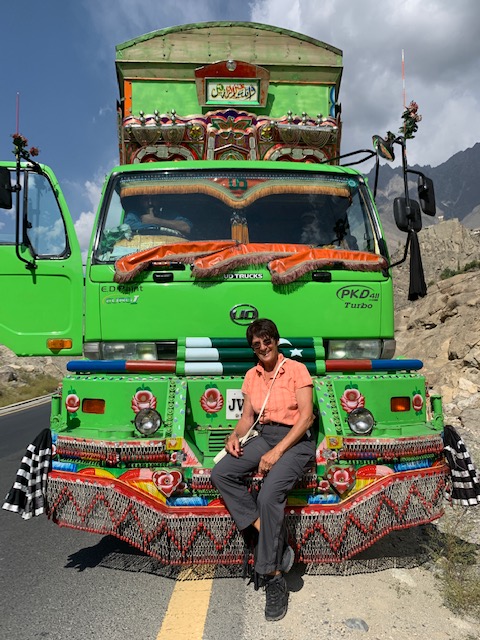
While at the petroglyphs a Pakistani truck stopped to greet us.  They let me sit on the fender.

Just down the road a few hundred yards, we stopped at a cave that Shifa explained was an abandoned ruby mine.  Apparently this area was rich in Rubys and people are still prospecting.

Standing inside an abandoned ruby mine. looking for red rocks.


Another mile or so down the road and we turned off onto the road to Nager.  Very shortly we encountered the confluence of the Hunza and the Nager Rivers, which keep the name Hunza.

The Hunza River, which we have followed and watched for many days is the only river to slice through the Karakoram Range.  It was there before the mountains and has maintained its flow through a cluster of 7,000+ meter peaks to meet the Nagar River at this point. Very nearby was a hanging bridge that Mark and Shifa crossed.  I started and quit as it was just to jiggly for me.

Up the Nagar River drainage to the village of Hoper, we encounter mountain peaks and fertile valleys.  Wheat was being threshed and apricots were drying on roof tops.  From the fertile green valley, we could make out Gold Peak looming in the distance.  Hoper village was 40 kilometers up the road and we were headed for the Hoper Hilton for lunch.  THe mountains along the way were magnificent. When we reached Hoper, we climbed up a short, but steep trail to look down on a glacial field and up at a range of mountains.

The cutest aspect about the Hoper Hilton was the name.  The place and the food was pretty awful.  However, as usual, the scenery was incredibly grand.  The elevation was 9200+ft.  We drove back down to the KKH, then across the Hunza River and back up the Karimabad hill, except we continued passed town and on and on up the hill to the Eagle’s Nest Hotel at 9250 feet.

September 12, 2019

We were here for a change of scenery and to catch the sunrise on the peaks.

Slowly, we drive down the mountain, enjoying another look at the scenery.  It has been pretty heady looking at gorgeous peaks everyday and enjoying delightfully sunny, yet pleasantly cool weather. We are now headed for Gilgit with stops along the way.  First stop is the busy, one street town of Aliabad.  We get out of the car and walk the street chatting with people we meet and checking out the various products available.

From there we drive to the tourist spot where “Rakhaposhi, at 7,788 meters is the 27th highest peak and has the highest unbroken slope on earth with its gleaming Ghulmet Glacier.” The sign by the road also read, “It is the only mountain on earth that plummets uninterrupted for almost 6,000 meters from its summit to its broad base, which measures almost 20 kilometers east to west.”  There is a rough road that climbs part way up the mountain so we decided to drive as far as possible and then walk.  We managed to get to 2366 meters and had only another 5422 meters to go when we turned around and went back down the hill to the cluster of cafes, with mouth dropping views.  Pakistani tourists were all over the place.

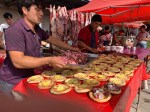
After a small snack of French fries at one of the cafe’s, we carried on down the road with one more stop to watch a baker making momos, or pasties, on the street and next door a wood turner making a small bowl.  We bought no momos, but we did buy a few spoons in apricot and willow wood.

Finally, we arrived in Gilgit and went directly to the Serena Hotel to unwind and enjoy the property, which had a large, attractive English style garden.  We watched the sunset from our green garden terrace.  A gentleman named, Saidulah Baig, joined Shifa and us for dinner in the hotel.  We had a very informative visit talking about his work educating girls in Pakistan and the Central Asia Institute (CAI). We learned that Saidullah is also Ishmaili and that he and Shifa went to school together when they were young.  What an unplanned coincidence that is.

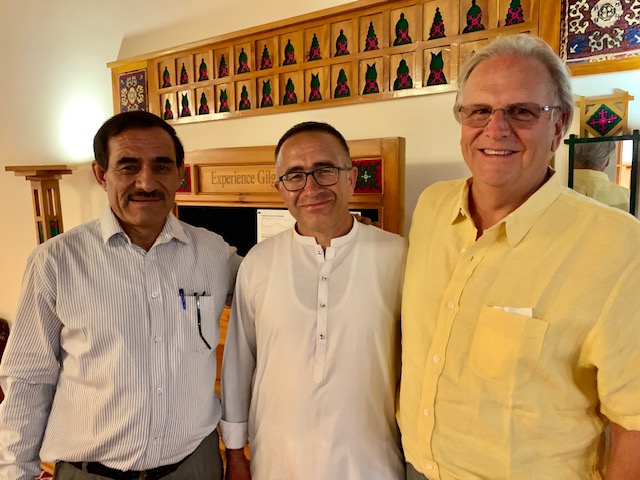
Saidullah Baig, Shifa and Mark after dinner at the Serena Hotel.

Saidullah Baig, Shifa and Mark after dinner at the Serena Hotel.

It had been an action packed couple of days and we were ready to go to bed shortly after saying good bye to Saidullah.


Karimabad, Pakistan’s popular tourist destination

September 8, 2019

With help from Mark, Shifa and the hotel IT guy, I managed to get the 9-3-19 post published around 11am.  Much frustration settles into unwilling patience before images make it into the post in places where the internet is very slow.  

It felt good to take a break.  The three of us walked up the street into the bazaar and stopped at a Coffee House.  The boys had cappuccinos and I had a chai.  The drinks were ok, if not what any of us was hoping for.  We stopped at a hat shop and Mark found his second hat of the trip.  This one was brown wool and had a detail on the rim that the Chipursan Valley hat does not have. 

After walking up and down the whole bazaar, we stopped in at the best looking carpet shop to see what was available.  We thought it would be fun to have a Pakistani rug from the Hunza Valley and we found one we both liked hanging on the wall.   It was 7.6 ft by 5.6 ft wool on cotton and very colorful.  The shopkeeper told us the pattern was one of the best Anatolian kilim designs, whatever that means, the dyes were all original, the wool was hand spun from local sheep and the price seemed reasonable.   After some fun negotiations with the shopkeeper, we settled on a price and he promised to ship it to us in early October.  Shifa vouched for him and the carpet.  We all shook hands, took a few photos and left with everyone smiling.

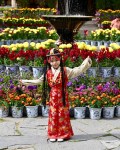
A very dressed up girl we met in the Serena Hotel lobby

Then we returned to the hotel for the rest of what was supposed to be our free day and relaxed.  So we did.

September 9, 2019

This was our day to see the 2 forts in Karimabad–Baltit and Altit.  When I asked what the names meant, I was told they meant Here and There.  They were a bit like ancient museums in fort shapes, similar to castles on hills in Europe only more rustic. We had to walk up a steep hill to get to the first fort, Baltit.  Along the way were several vendors and friendly people wanting to chat with the foreigners.  We bought 2 hats–one for me and a third one for Mark.  Finally he has one that fits his head.

At one place along the path, the owner of an ancient building is trying to make a cafe out of it and invited us in to see a 1911 photo of his ancestor, the advisor to one of the Mirs of Hunza, who used this building and the fort until 1945, when it was abandoned. 

 Finally we reach the landing in front of the fort.  Once inside, we enjoyed the architecture and room designs, which were unique and interesting. 

Before going, I thought we would be bored early, but both forts proved to be quite interesting.  Baltit was the larger of the two with 64 rooms.  The lower fort, Altit, had 22 rooms.  As there is no written history about either fort, the only way to learn their age was from carbon dating. 

The older one, Altit, dated from the 12th century and the younger one dated from the 14th century.  They were both located along the Silk Route, situated on the west side of the Hunza River and about a 10 minute drive apart.  We visited the Baltit Fort first and learned that the British invaded in 1883 and inhabited the fort until 1886 when they installed a Mir on the throne as their puppet.  From then on the Mirs had very little power.   After climbing up many steps to the entrance, we are rewarded with  clear, commanding views of Rakhaposhi Mountain (7,788 meters) and Diran Mountain (7,300 meters). Along the way we encounter smiling locals who wanted to chat.

 Between 1990 and 1996, the Baltit Fort was restored and reopened by the President in 1996 as a museum.  The Altit Fort was restored between 2000 and 2006 and was opened to the public in 2007.

The lay out and architecture are most interesting.  Most rooms have fire pits with ceilings that open to let out the smoke and provide space for people to eat and sleep while staying warm.  Other rooms are storerooms for a variety of products, hallways to get from one place to another without going outside, even dungeons for prisoners. There are large public rooms for parties and dancing as well as meetings and private rooms for the royal family.  The walls are made of stone and wood.  Our local guide told us they can resist earthquakes up to 8.2 on the Richter scale.  Detailed woodwork is hand carved and visible in many rooms.  

We finished the tour at the Altit Fort and had lunch on the terrace.  Hard to get interested in food with such  scenery.  However, we are learning to order less and be more discriminating.  I had fried chicken with vegetables.  Mark had a pitta stuffed with spicy ground chicken.  We were both content and not overstuffed.

Back at the hotel a bit after 2pm, we had the rest of the day at leisure.

Hunza Valley


September 6, 2019

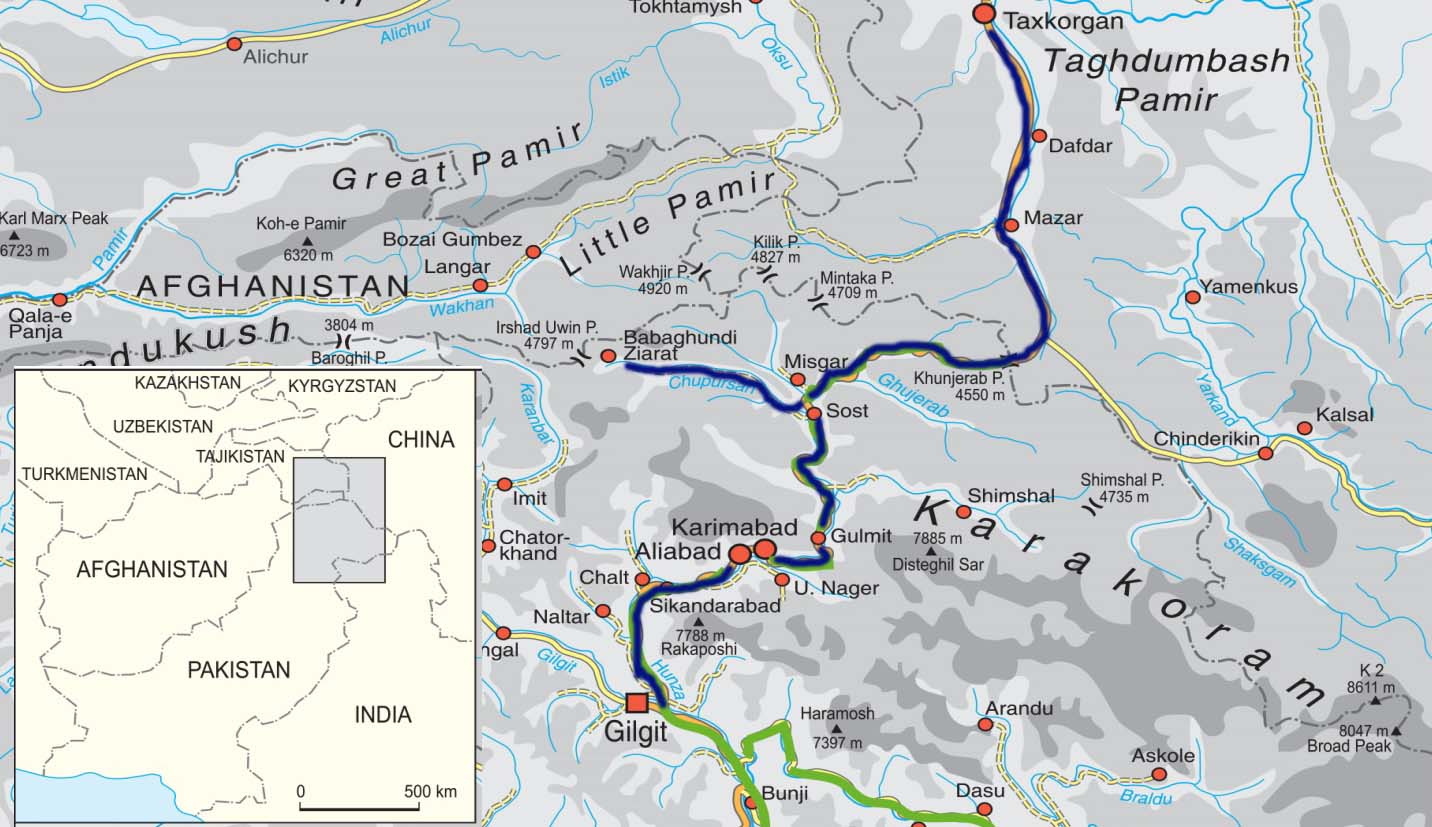
Detail map of far northern Pakistan. We have been as far as Ziarat and Gulmit so far.

Detail map of far northern Pakistan. We went as far west as Ziarat in the Chipursan Valley, which starts at Sost (follow the blue line left from Sost).  By the end of this day, the 6th, we will be at Gulmit.  Eventually we will get to Gilgit and Skardu before flying south to Islamabad.

Before leaving the Guest House, Fahim gave Mark a local, white wool hat.  It was a very thoughtful gift.  Then we said good bye to the staff and drove back through the valley.  The morning light was really nice and we took several photos of people working in their fields.  Wheat is the primary crop in northern Pakistan.

Mark in his new Chipursan Valey wool hat joins me in greeting Hikayat Shah in his fields.

We saw Hikayat Shah working in his fields as we were passing by and he ran across them to greet us. Such an infectiously nice man.  We chatted with him for several minutes and were sorry to have to say no to his offer to share tea and bid him farewell.  Shifa later told us Hikayat was the Local Support Organization Chairman (LSO), which means it is his job to keep harmony in the community.  He is certainly perfect for that position.  We decided to walk awhile to get some exercise and enjoy the day, Khajulah followed us in the car.  While walking, Shifa recognized a woman walking on the road too and they chatted as we walked together.  He told us he had arranged a scholarship for her to attend 11th and 12th grades through a hunting client.  She had completed high school, but not gone on the university because her parents wanted her to get married.  So she got married and now has 2 children, 7 and 3. Shifa believes her parents wanted to get her married so she would not be their responsibility any more.  

As we walked, we passed a prayer hall, giving Shifa another chance to talk about Ismailis.  There are 2 leaders in each local community; a first and second, who minister to their congregation in addition to managing the prayers at the daily meetings.  Their wives minister to the women in the community.  Their terms last only 3 years or possibly 6.  Then they must leave the job or transfer to another community, if one is available.

By that time we were ready to ride in the car, and sat quietly enjoying the scenery on the way back to Sost, except for one very scary spot.

  The place where the men working the day before had caused us to wait until they could clear the road, were still working in the same place.  Only now there was no shoulder on the cliff side of the road and an open ditch for a new 12 inch pipe on the other side.  We got out of the car and watched Khajullah straddle both edges of the 12 feet of open road with Shifa directing every inch of movement until the car reached solid ground again.  We all breathed a sigh of relief.  Now I know better what scary really means. 

Just as we were about to reach the paved KKH, we saw the confluence of the grey silty Chipersan and the clear Khunjerab Rivers, join to become the Hunza River.  

Confluence of the Hunza and the Khunjerab Rivers

Merging of the Chipersan and Khunjerab Rivers into the Hunza River.

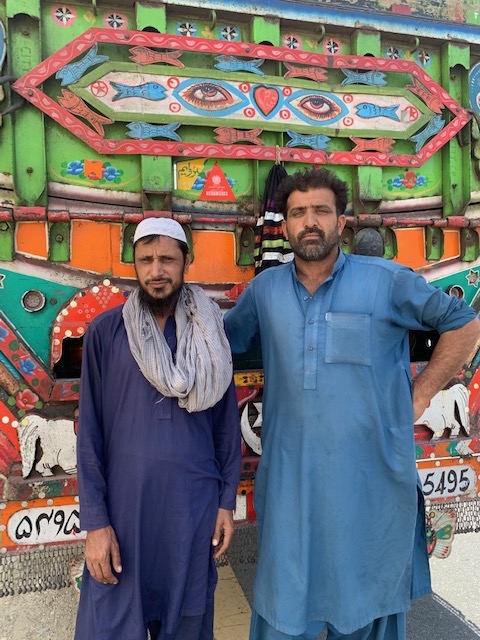
We pass through Sost stopping only to photograph the colorful Pakistani trucks lined up and waiting for their turn to get a load of goods.  Each driver decorates his own truck and takes great pride in its appearance.  Some of these I caught in motion and others were parked and waiting for a load.


Down the road we stop for lunch at a hilltop restaurant aptly named Glacier Breeze.  All of northern Pakistan is in the middle of apricot season and this place has everything on the menu made with apricots.  I had apricot soup, which was ok but not great.  Then I had chicken curry with apricots.  The best part of the meal was the apricot cake.  Not unlike pineapple upside-down cake, it was easy to see why people flocked here just for the cake.  Outside, the view is spectacular in every direction. Hard to know where to cast your eyes.  

Another 20 minutes and we reach Gulmit, our last one night stand for awhile.  This place is slightly better that the previous places as it has running water.  However, we were the only guests at the hotel and our room was a long way from the hot water tank.  It took ages to get warm water.  Neither one of us had a hot shower, but it was better than only cold.  The food was just so so, and the bed and linens were very tired, but the view from our room was grand and the hollyhocks by the front door wherever pretty.  Mom would have liked them.   Another Best Available.

September 7, 2019

The drive from Gulmit to Karimabad is only an hour, but we took a round about route to get there. 

Scene along road to Borit Lake

Scene along road to Borit Lake

Off we went on another rough and narrow gravel road to a lake called Borit.  It is an alpine lake surrounded by granite boulders eroded over millennia into many interesting shapes. 

From the lake edge we climbed up a glacial moraine to a view point overlooking the edge of  receding Bassu Glacier.  We have seem other receding glaciers in Pakistan, but none so close up.  Mostly the ice was covered with dirt and was not pretty.  Back at the lake we enjoyed tea at an Inn overlooking the lake.  In a room under the terrace, 2 young men played local songs on drums and a keyboard. It was quite pleasant music.   

From Bassu Lake we drove another 20 minutes to Attabad Lake, which was formed by a landslide on December 9, 2010.  By 2pm the next day the valley was filling behind the earth dam and a whole village was wiped out.  By July of 2011, the lake was full and a spillway had been created to keep the water from getting higher.  Several kilometers of the KKH were also underwater and through transportation impossible.  The Chinese came to the rescue and, between 2012 and 2015, they built a new road including 8 kilometers of tunnels to pass through the devastated area.  Today dead trees are still protruding above the lake in some places.  Several commercial enterprises have sprung up, so we were able to rent a short boat ride on the lake. We tested the water with our hands. At an elevation of 7,791 feet, the lake is colder than Tahoe.  

Back on the highway, we pass through the tunnels and see a bit of the landslide area between tunnels and arrive in Karimabad at 2:10pm.  The town straddles both sides of the Hunza River and is very green and lush with many planted trees and giant snow covered peaks all around.  It is a very lovely setting and no wonder so many Pakistani tourists from the flat, hot and humid, southern part of the country visit the area on holiday during the summer.  The temperature is very pleasant at 70-75 degrees with cooling breezes that moderate the heat of the direct sun, which can be intense at the 7,722 ft elevation of our hotel patio.  

We had barely arrived when Shifa talked us into an hour long walk along the sandy Karimabad city ditch. 

Kids playing in the sand along the path next to the ditch.

Kids playing in the sand along the path next to the ditch.

Very much like our irrigation ditches at home, this one followed the horseshoe shape of the town from our hotel, the Hunza Serena Inn, at one end and a road at the other end.  Houses lined the ditch on both sides with one side being up hill and the other downhill.  Every house had a lovely setting amid trees, flowers and peaks in the distance.  Mark thought there was a slight resemblance to Sausalito.  Khajulah picked us up at the far end of the horseshoe and drove us through the bazaar along the road back to the hotel.  We spotted a couple of shops we made a note to visit later.  Finally, we were in a room that allowed us to feel comfortable.  The plumbing worked correctly, the shower was enclosed, the bed was good and we had a lovely veranda with a view of the town and the peaks above.  My only difficulty was the slowness of the internet.

We had an early dinner at the hotel with Shifa.  We ordered a variety of different dishes and tasted them all.  I ate way too much and felt very stuffed.  The best dish of the evening, from my point of view, was the local version of fish and chips.  As alcohol is illegal for  Pakistani Muslims, and we do not want to offend anyone, we put our beer in a tea pot and drank it out of tea cups.  This seems to be a common solution for anyone who wants to drink alcohol in public.

I struggled with the weak WiFi connection or a couple of hours and finally gave up and went to bed.   

Sost and Chipursan Valley

September 4, 2019

Waterfall behind our hotel. It comes from the ditch created by 60 Most men

Waterfall behind our hotel. It comes from the ditch created by 60 Sost men

With a drink of good scotch that Mark purchased at the Duty Free Shop in the Customs House in Tashkorgan, we sat on the roof of the Embassy Motel in Sost looking at the mountains and sipping our drinks.  On the far side of the nearby mountain was a waterfall that came from a man made ditch and a hillside sign, “Diamond Jubilee 2018”.  Shifa told us it was in honor of the visit and 60th anniversary of His Highness, the 4th and current Aga Khan.  He is the spiritual leader of the Ismaili sect of Shia, to which Shifa and most everyone in Sost and nearby villages belong.   There are approximately 15M Ismaili throughout the world, with about 2% living in Hunza Valley.  According to Ishmaili.com the Shia Ismaili Muslims are a community of ethnically and culturally diverse peoples living in over 25 countries around the world, united in their allegiance to His Highness Prince Karim Aga Khan as the 49th hereditary Imam (spiritual leader) and direct descendant of the Prophet Muhammad.  He went on to say that Ismailies are a peaceful and happy people.  Men and women pray together and enjoy most activities together. 

Then dinner was served.  I had local farm trout and Mark had curry.  The food was good and we happily went to bed shortly after dinner.  


It turned out Shifa is from Sost and really knew his way around the area.  First he drove us up a short hill to the Dry Port where trucks coming from China transfer their goods to Pakistani trucks, which then deliver the goods all over the country.  The Chinese trucks return to China empty.  This “Port” is part of the Silk Road and owned by local people who are all members of AGM, the community trust.  The trust leases the property to NCL, the National Logistics Cell, which is a military agency.  The trust receives an annual distribution that is divided among the members.  Shifa is a member and says the business is quite lucrative.   

Having switched from the mini bus we had used from Tashkargen to Sost, our driver, Khajullah Beg,  now drove a very nice Toyota Land Cruiser.  He took us up a steep and very rutted mountainside track to overlook the river below that flowed around Sost and emerged down stream from the town.  Not a tourist site.  Shifa explained that In 1974 the Hunza Principality, which had ruled the area with an iron hand since the 10th century,  was abolished by the government and life in the valley began to improve.  The Principality, he told us, disallowed locals from leaving the valley.  There had been limited education and health facilities and no freedom.  Suddenly roads, schools, hospitals and irrigation began to be built or improved.  

Local men, including Shifa’s father, decided to dig a tunnel through the mountain we were standing on to divert water from the river to the town of Sost.  60 men hand dug a ditch 7 feet tall, 3 feet wide and 1374 feet long.  After years of planning and resistance from government officials, who thought it was a foolish idea, it took them just 2 years, with no loss of life, to complete the project in 1985, all on a volunteer basis.  Suddenly the Sost community had a permanent supply of irrigation water.  Here is a photo of Shifa in front of the opening, pointing to his father’s name on the list.  The current Aga Khan, the Duke of Edinburgh, two presidents of Pakistan, and almost all ambassadors of foreign countries came to visit the site in 1987.  Everyone was proud of the men.  So much so that each, of the 60, was granted a parcel of land in the vicinity of the new irrigation ditch.  

We walked into the tunnel a few feet and when we turned around to come out, Mark stumbled on the ditch slats and to save himself from falling onto the slats, he overextended one leg and pulled a hamstring in his right leg.  He was in some serious pain for a few days and the hematoma on his leg turned dark purple.  I had some ancient Tiger Balm I rubbed on the spot and we applied hot compresses.  The pain has lessened somewhat and he is walking ok, not great.  The hematoma will take time to resolve.  Our activities did not change.

From the ditch we headed for the Diamond Jubilee School for our first scheduled meeting with school children.  The principal, Mehr Kamil, met us at the gate and showed us into the first building, which happened to have been built by CAI, the Central Asian Institute which Greg Mortensen had founded, but was no longer maintained by them.  The school was in excellent condition with a fresh coat of paint, nice desks and colorful slogans and signs on the walls.  As we visited each classroom, we learned that there are 190 students in the school (about 2/3rds boys and 1/3rd girls), 17 teachers and 5 staff.  Students pay 2000 ($12.82) rupees per month in grades 9 and 10, 1500 ($9.62) per month in grades 6-8 and 1300 ($8.33) in grades Pre-primary – 5.  Scholarships are available for those who cannot afford the fees.  Everyone was in uniform.  The local Mullah provides uniforms for students who cannot afford them.  School is closed in the heat of summer from late June to July 20 and again for winter from December 20 to February 20.  Exams are held in September and March and combined for final results.  The National language is Urdu, so that is also the primary language in the school.  However, several classes are taught only in English—science, math, physics and English, which is the second language of Pakistan.  Other courses include biology, chemistry and Islamic studies. Most schools operate on this schedule.  At this school most kids are getting reasonable to good grades.  This year 100% of the 10th grade students graduated and were eligible to go to high school in Gilgit.  Some may need scholarships.  

The principal told us a few of the teachers quietly support some of their students.  How nice is that?  I was asked to speak to the students and while they played during recess, I thought about what to say.  I don’t remember exactly what I said, but I did tell them to study hard to be able to get ahead in the world, to be grateful for life and make each day count.  I tried to inspire them to value their eduction and continue, if at all possible, through University.  I sure hope some of them took my message to heart.  The principal and a few teachers seemed grateful for my comments.  Not every student understood me, so one of the teachers did an ad lib translation of my talk.  I left feeling full of hope for the school. 

About noon we stopped for lunch at a restaurant Shifa knew well.  Hanging on a wall was a photo of the largest recorded Ibex ever taken.  He had been the guide on the shoot and was very proud of the kill.  Then we headed for a small extension of Hunza Valley called Chepursan Valley, on a side road out of Sost.  The distance was only 45 kilometers from Sost, but the drive took 3 hours on a grueling one lane, bumpy road with terrifying cliff edges.  I could not look down, it was so steep in many places. 

At one point the road was under construction for a pipeline and we had to wait, luckily, only half an hour.  Eventually we reached the Sky Bridge Guest House (elevation 10,677 ft), our home for 2 nights, in the village of Zoodkhun Shetmerg in the late afternoon.  It was another best available situation. 

We were the only guests and allowed to use whatever facilities we needed.  As there was no hot water and the toilets only flushed when you turned on the water at the wall, we decided to use one bathroom for the splash bath with ladles.  The owners provided us with a bucket of very hot water and we mixed it with cold and used ladles to pour it over ourselves.   We slept in another bedroom with a king bed and used its dry bathroom during the night.  We had the run of the living room, dining room and kitchen.    The guy who owned the Guest House, Fahim Baig, was very helpful, in spite of the water problems.  He and his staff cooked up really good meals for us, including breakfast.  I finally got a bowl of barley meal, which was just as good as oat meal.  Mark’s eggs were perfectly cooked to his liking.

September 5, 2019

Fahim told us there were about 6,000 people living in the valley in 11 different villages.  Shifa added that 100% of those people are Ismaili (pronounced: ish my lee).  The sect got its start with Mohammed’s cousin Ali, just like the Shia did.  There are 72 sects in Islam, of which Ismaili is one (6 Shia sects and the rest Sunni).  The current Imam is the 4th Aga Khan.  The title was conferred by the Shah of Iran in the 18th century.  The current Aga Khan divides his time between France and Portugal. 

There are significant differences between Ismailis and Shia Muslims.  To be an Ismaili one must:   1) Believe in one god, whose name is Allah.  2)  Accept Mohammed as the last prophet.  3)  Believe in Imamat: The chain in leadership from Ali, Mohammed’s cousin, to the present, which is the 49th Imam.  4)  Be charitable.  5)  Pray 3 times a day in the local Jamat Khana (prayer hall), unless unable.

The current Aga Khan is the 4th.  His grandfather, the 3rd Aga Khan, was a very rich man and increased his wealth when at his 60 anniversary, he was given his weight in diamonds and, at his 70th anniversary ,he received his weight in platinum.  With so much wealth he established a chain of schools called Diamond Jubilee Schools, of which the one we visited in Sost was one.  While in Chipursan Valley we visited another Diamond Jubilee School that was even larger than the one in Sost. 

This one was in the village of Zoodkhun Shetmerg.  The enrollment was 224 students from pre-primary through 10th grade.  I was pleased to learn that 50% of the students were girls.  In addition to visiting a few classrooms, we saw the computer lab that could accommodate 11 students at a time, and a sparsely outfitted library.  Again’, I was asked to speak to the students and gave a similar speech as at the first school.  

 CAI had constructed a building at this school also and it was in good condition like the other school buildings built by other agencies. Everyone we met spoke highly of CAI and hoped they would be working in Pakistan again soon.  In this valley alone there are 34 CAI projects, including a small museum, which we visited, a vocational facility, and a health workers program, where women learn about hygiene, cooking, health education, family planning, caring for children and more.   

We also visited an unfinished college CAI was building until the government stopped their permit and brought construction to a halt in February.  CAI is doing everything they can to get their permit back so they can continue with their projects. The supervisor of the college construction was a man named Hikayat Shah. He is also the LSO, or Local Support Organization Chairman. He met us at the entrance and showed us around the entire unfinished facility.  It was sad to see the construction at a stand still, with no idea for when, if ever, it will be finished.   

After visiting several facilities in the valley and chatting with everyone we met, we drove the final 10 kilometers ( about 1.25 hours), to the end of the road where there was an Ismaili Shrine Shifa wanted us to see.  However, about 100 yards before the Shrine, a military blockade stopped us from proceeding and told us to go back.  Shifa was upset, but we had no option but to retrace our steps. In fact, we were only 20+ kilometers from the Afghan border.  What we missed was the tomb of an Ismaili holy man in the middle of an otherwise empty building.  

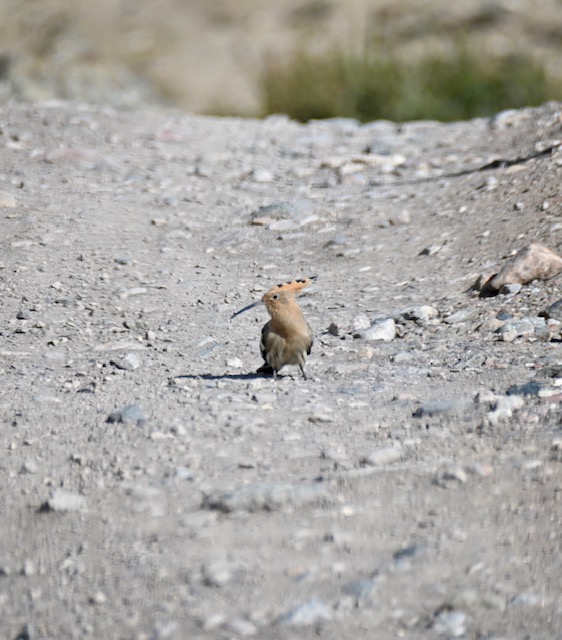
On the way back we did get to see a few Hoopoe birds and several Chucker Partridges, but got no good photos.  This image gives an idea of the bird.

A Hoopoe bird

A Hoopoe bird

 I asked Shifa how he knew so much about the Ismaili religion and how come so many people knew and greeted him, wherever we went.  So he told us he was very involved in the administration of the Ismaili community in upper Hunza Valley and had been President of the Ismaili Council for 7 years.  He is a lot more than your average guide and we are blessed to have him show and tell us about his world.   

Back at the Sky Bridge Motel, we had dinner, watched some English speaking news on TV—all unpleasant—and went to bed.

From Kashgar to Pakistan

September 2, 2019

We left Kashgar (4180 ft) and began the slow assent up the Karakoram (kara=black, koram=soot) Hwy at 9:50am.  Our guide, whose name we are withholding out of concern for him, told us today was Flag Day.  It is a ceremony that happens every Monday and attendance is required  for all minority groups and lasts 3 hours and includes Chinese songs, the national anthem and pro Chinese speeches made by preselected minority persons.  No Han Chinese are required to attend and none do.  As a result we could not buy naan as the bakery workers were at the meeting.  One more example of discrimination against minorities in China.

One good thing the Chinese did do, was build the Krakoram Hwy from Kashgar to Thakot, a town 200 miles north of Islamabad, between 1966 and 1976. 

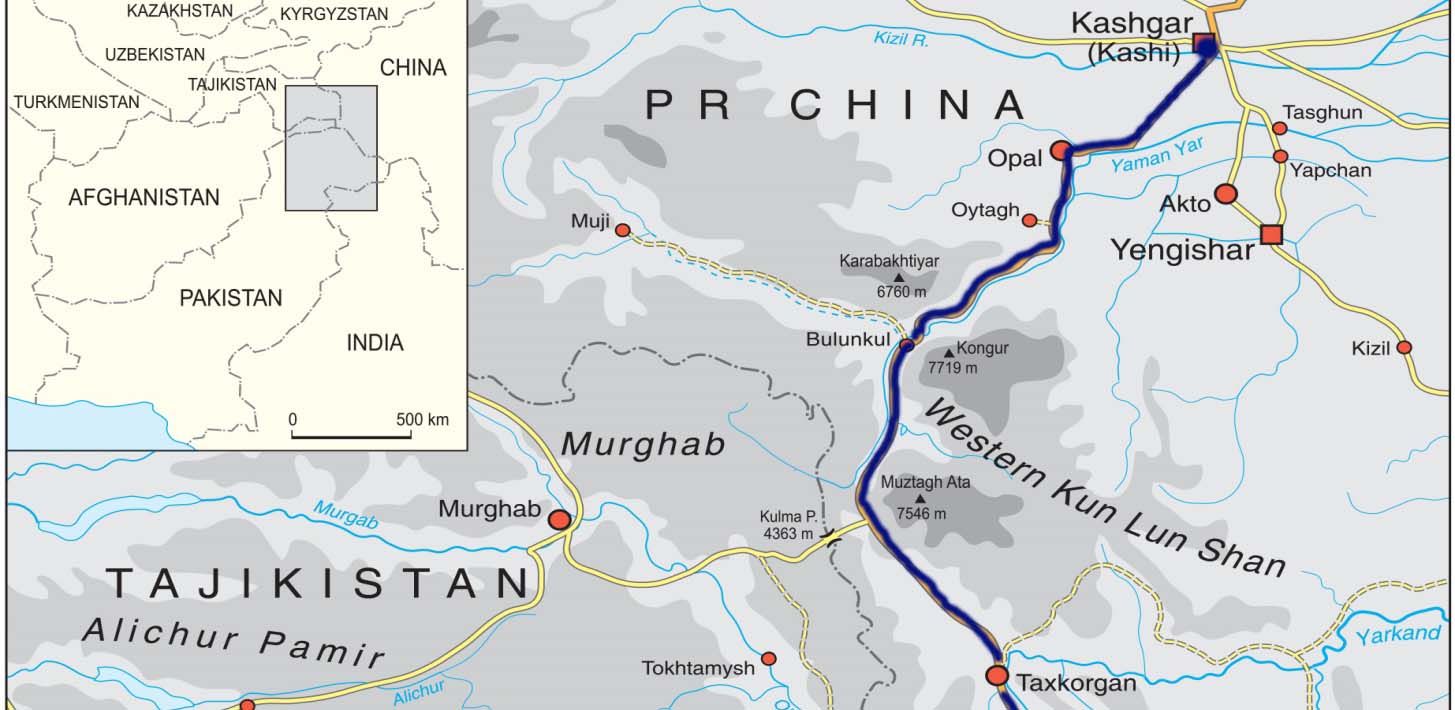
Close up map of the Karakoram Highway from Kashgar to Tashkorgan.

Close up map of the Karakoram Highway from Kashgar to Tashkorgan, the last city in China before the border with Pakistan.

On the Chinese side, the terrain is gradual, like the west side of Donner Pass in California.  At first poplar trees line both sides of the road.  We drive through Oytag Glacier Park, where the hills are of deep red rock. Bactrian camels are frequent sightings.  

Then the road enters a large glacial drainage with no trees and a gray raging river called Gas (which means salty).  Road signs are in large Chinese characters and small Uyghur ones.  We pass by the third highest mountain in China, Konggor Shan, at 25,324 ft.  The snow lever in early September is at 16,404 ft. 


I can’t remember how many times we had to show our passports, but we encountered at least 4 passport control stations and had to get out and walk from the first station to the 2nd.  Our guide said there are about 4 million government people who work in this province and they all need something to do.

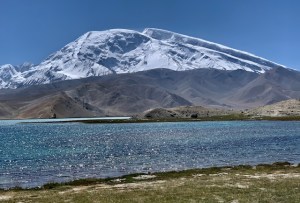
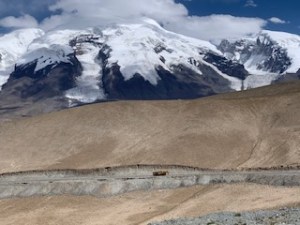
Muztag Atta, a nearly round mountain with gentle slopes.

Muztag Atta. A beautiful mountain. Great for skiing and training mountain climbing.

Along the way, we pass through a modern 2 kilometer tunnel, alongside a reservoir called Blungkol and near a very large, round, white mountain called Muztag Ata.  We also pass and open iron pit, which is not working because the price of iron is low.

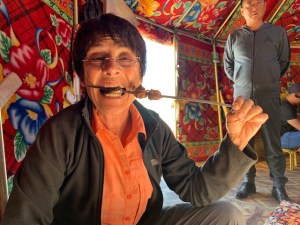
Our lunch stop is a yurt along the roadside by Lake Karakol.  Along with our guide and driver, we enjoyed hot sheep broth, mutton kabobs, rice pilaf, spicy carrot salad, a pear and a nectarine.  Very tasty and filling.  From there the landscape was wide open with high snow capped peaks in the near distance.  One more check point and we finally reached the town of Tashkorgan, where the customs office is located.  This was our last overnight stop before crossing the border.  The elevation was 10,242 ft.  Our accommodations are a place called Crown Hotel, modest but clean and acceptable.  Our guide brought us some food to eat in the room and the three of us had a very intense conversation about what has happened to him and his wife just because they are Uyghur.  I hope to find a way to share the story with you as it is important to know what is happening to minority people in China, but the time is not yet.  I can tell you that minority people are not allowed to have passports or freedom of movement, while Han Chinese are free to come and go at will.


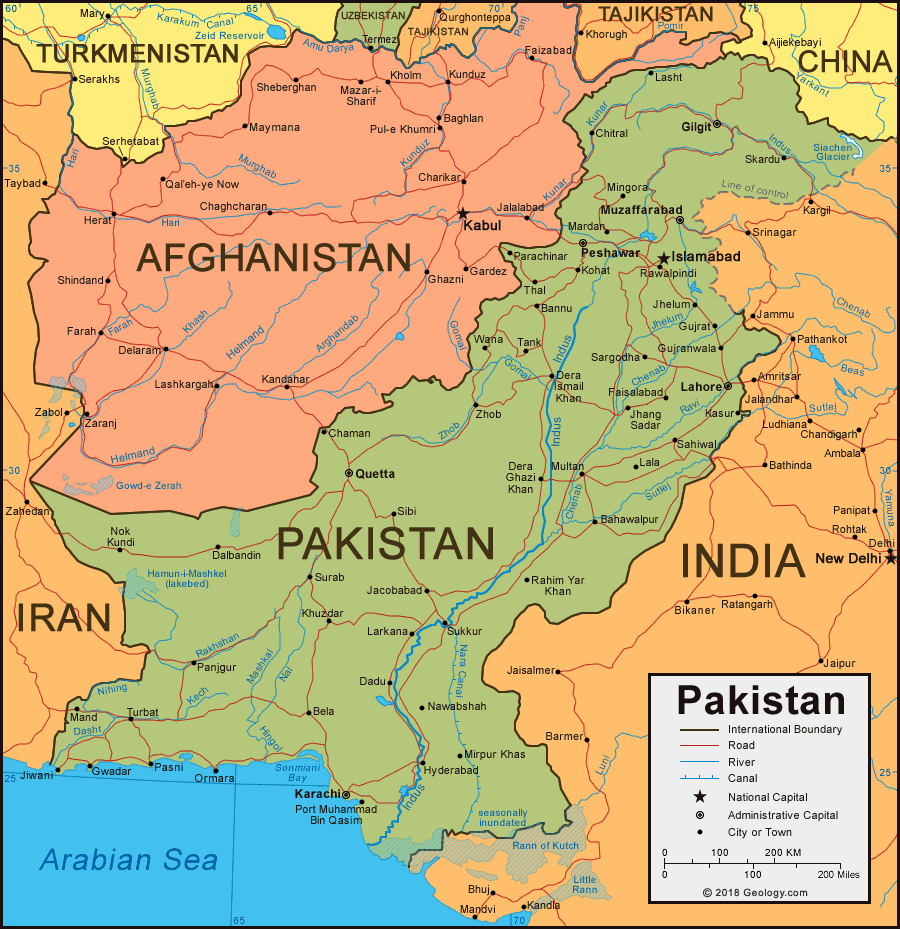
Pakistan sandwiched between Afghanistan and India

Pakistan sandwiched between Afghanistan and India.  Our entry into the country is on the pink line at the top of the map between China and Pakistan.

September 3, 2019

Our Pakistani guide, Mohammed Shifa, showed up early and for a short time we had two guides helping us negotiate the passage from China into Pakistan.  We go to the traffic office at 10:30 to buy tickets for the public bus to Sost, the nearest town in Pakistan, because we are not allowed to have a car on the Chinese side of the customs house.  We can walk but must have a bus ticket to get through.  What sort of rule is that?  Eventually, with connections, the two guides get us and our bags through customs about 1pm.  We say good bye to our Uyghur guide and head for the Pakistan border with Shifa in a small van.  

Pakistan, Shifa tells us, is a poor country, but a free one and we will like it.  The current Prime Minister is Imran Khan (63).  He has been in office a year and is well respected.  He has put corrupt officials in prison, speeded up the judicial process and streamlined the police department, increased the budget for education, provided health benefits for the poor and initiated a project to house homeless. He has also speeded up the visa process.  Pakistanis are allowed to own property.  The majority of Pakistanis are Sunni Muslims.  Life is not perfect, but most people are doing better than they were a few years ago.  The military has a powerful voice, but they are not ruling the country.  

We arrive at the Khunjerab Pass and go through the final Chinese checkpoint.  We could hardly wait to be out of China.  The van moved slowly through the gate and we were unexpectedly greeted by local Pakistani’s hanging out at the 15,510 ft sunny, but chilly Khunjerab Pass waiting to greet foreigners into their country.  They clapped and shouted “Welcome” as we entered.  Our driver stopped the van and we got out to shake hands with the smiling well wishers. We were as happy as they were to be free.  Apparently it is a popular activity to drive up to the pass to see the scenery and cool off.  Foreigners are a bonus.  Many of them spoke good English.  We even received an invitation to dinner in Lahore by two financial analysts.  After spending half an hour chatting with happy people and feeling deliciously free, we began our drive down the mountains to Sost. 


Like the east side of Donner, the view was dramatic and spectacular, but the road was much longer and steeper with 2 narrow lanes. My heart was in my throat much of the way down, but the scenery was so spectacular I could not take my eyes away.  The mountains we passed through were all part of the Karakoram Range.

At one point we stopped to look at a herd of Ibex on the opposite mountain side.  We soon learned that Shifa is also a hunting guide and takes big game hunters into the local mountains in winter to hunt Ibex, Blue and Marco Polo Sheep.  He said he spotted 18 animals including babies.  I was able to find 6 with his help.  The tan animals are mostly lost amid the rocky slopes.

Further down the mountain side we came upon a large flock of sheep being herded across a very narrow, home made bridge to get to the other side of the river.  We arrived in time to see the first animal being helped across and then the next several.  Soon, the sheep stood in line dutifully to cross the tiny bridge.  It was fun to watch.  Back on the road, we reached a Guest House and stopped for tea and cookies.  When we pulled into the hotel at Sost it was 3:40.  The time suddenly changed to 3 hours earlier, upon entering Pakistan, due to the National Beijing time throughout China.  Much more reasonable for the actual daylight.  The elevation was 9450 ft, a huge drop from the Pass.  The hotel was several levels below our preferred digs, but they were the best available.  The floor was lumpy and there was only a trickle of tepid water.  The bed was ok.

Urumqi and Kashgar

August 31, 2019 continued

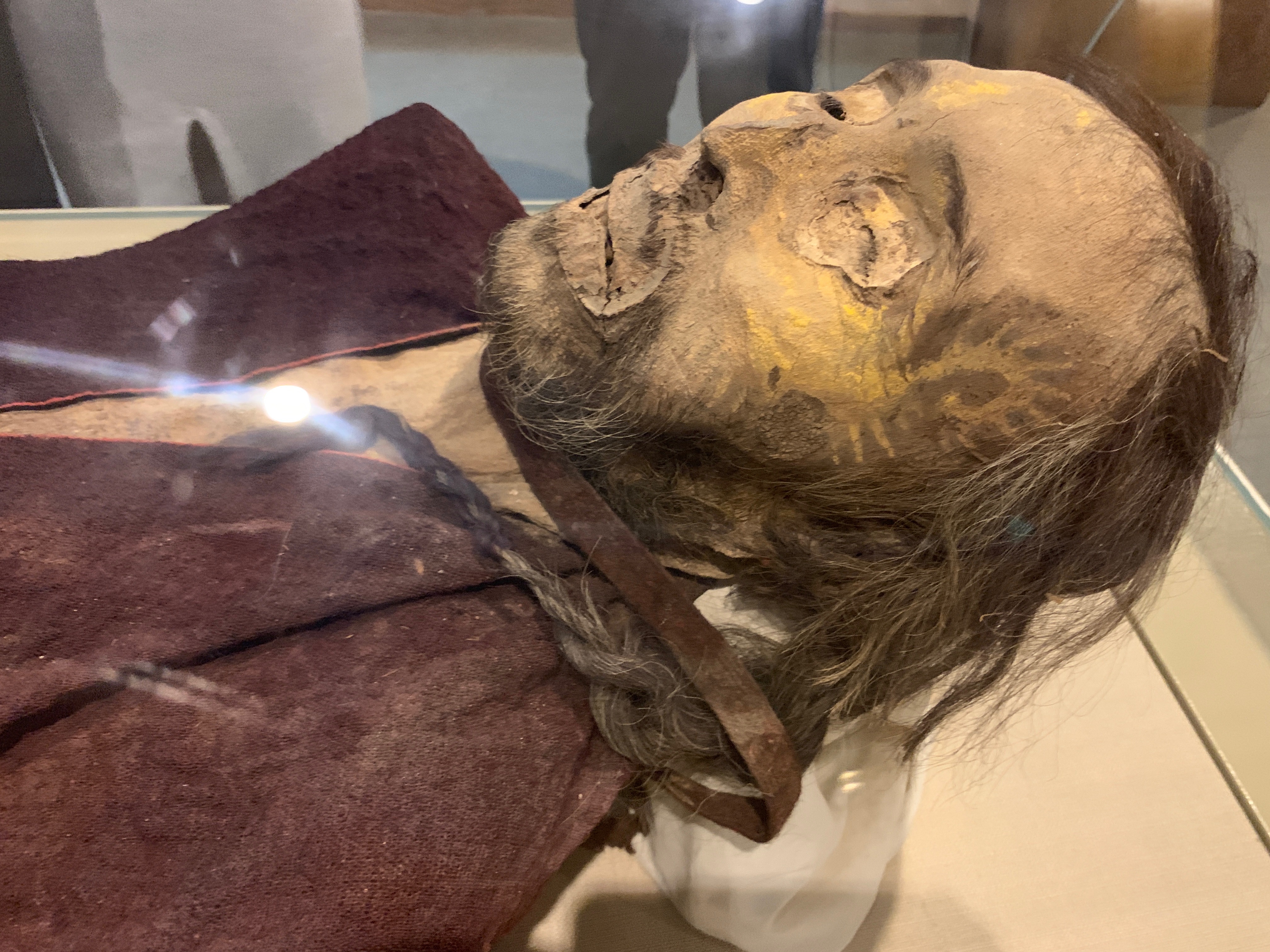
I ran out of time to tell you about the Indo-European mummies.  They were all Uyghurs buried in the cemetery with logs sticking up.  The reason they were so well preserved is that the cemetery was in the Taklamakan Desert in western China.  The bodies received no special treatment.  Just placed in a box and laid in the ground.  I think it is special to see regular people, not pharaohs, from 4,000 years ago.  It also proves that Uyghur people, who are Indo-European, were living in the area long before the Chinese give them credit. 

September 1, 2019

Tian Shan Mountains in western China

Tian Shan Mountains in western China

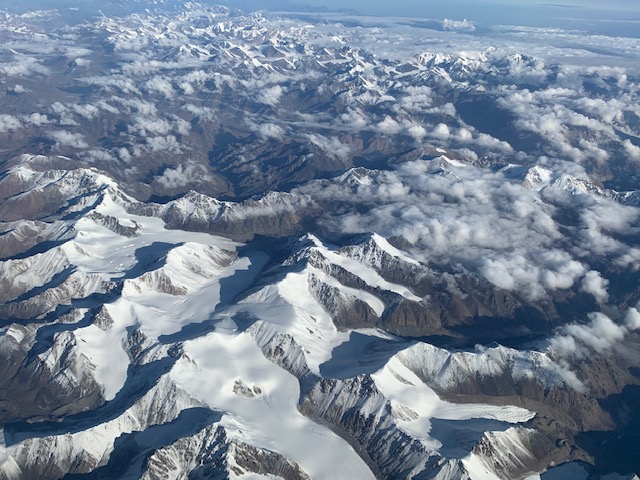
The following morning, we said good bye to Hassan at the airport and caught an early, 1.5 hour flight from Urumqi to Kashgar. It was a crystal clear day and I stared at the snow covered peaks of the Tian Shan Mountains and then the dry, hot, flat looking Taklamakan Desert below, I also read an article in a magazine that struck a cord, and thought I would share it with you, as it really speaks to our adventures on this trip as well as other past adventures.  


               “Doing something that you are not passionate about  is much harder than traveling through treacherous environments.”  Ye Ziyi, a celestial star photographer.

I hope that helps explain why we travel to the places we do.  We are indeed passionate about our adventures.

 Before arriving in western China I had done some reading about the history of the region.  Uyghurs, I learned, started building Kashgar in 200BC.  The first Kashgar king, Sultan Sutukbugra Khan, converted to Sunni Islam in 951AD.  Meanwhile, Sufiism, which also dates back to 200BC in Persia, was brought to Kashgar by King Appakhoja in 1621.  The combination of Sunni Muslims and Sufiism influenced Muslim people to be tolerant of each other, even to this day.  The current problems are about the Chinese government wanting to control the activities of the minority groups in China, of which Uyghur is the largest.  We learned a lot about the situation while we were in the Xinjiang province, but feel it is unwise to put people at risk, so we have avoided sharing information with you on the internet.  There are, in fact, eyes everywhere in China, looking and watching. 

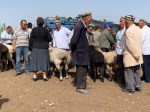
As this is Sunday, it is livestock market day.  We went directly from the airport and we wandered around the sheep, goats, cattle and yak, but no camels.  Turns out it is off season for them.  We did see a few yak, but could not get a good photo.  People watching proved more interesting, especially around the food court.

Then we went to the Appakhoja (pronounced: a pak ho ya) Mausoleum where the king is buried and the Fragrant Concubine was supposedly buried.  There was a lot of controversy about whether she actually went to Beijing to become the Emperor’s concubine or committed suicide rather than go. 

When her grave was dug up, the tomb was empty.  Her remains were found in an eastern town called Hebei.  That solved that mystery.  Next to the Mausoleum we saw the largest Uyghur cemetery in the world.

Our room was still not ready, so we went to lunch at a Uyghur restaurant called Dawayi Gheza (Da wa ye ge za). There was a female musician who made us laugh, she was so bad. “ A scalded cat” was how Mark described her.  Abdulla said she sounded like a lost calf looking for its mother.  Both comments were very descriptive.  Lunch, meanwhile, was good.  We both had  Chao Mian.  

After lunch we checked into the room, dropped our bags and headed out to see old Kashgar.  The Chinese demolished most of the old town between 2003-2011.  What is left of it has been remodeled and the home owners are required to pay the remodel costs to continue living in their own houses.  Most people lost their homes and are expected to move into the new, unappealing, high-rise apartments. 

We walked all around the Old Town, which is still pretty large, capturing images and finally reached Id Gkah Mosque, the oldest (1442) and largest (20,000) mosque in China.  It has been closed since 2016.  There are no more working mosques in the province and no more calls to prayer allowed.  Although I prefer not hearing the call to prayer when it is loud and early morning, I must say that it was sadly missing from the local environment.  There was plenty of sound on the craft street, where people are paid to be busy making crafts to sell to the tourists the government wants to attract. 

 It is hard to stick to history when the present demands so much attention.  I have heard that a book, “Oracle Bones” by Peter Hassler 2007 discusses Uyghur history for the last 50 years.  I encourage you to look it up to learn more about this persecuted minority in Xinjiang Province.  We plan to read it ourselves. 

By 6:30 Beijing time Mark and I were ready to call it a day.  We ate peaches Mark pealed with his new knife and ordered a couple of appetizers from room service.  Tomorrow we head for Pakistan on the Karakoram Highway. 


Urumqi, Xinjiang Province

August 31, 2019

We arrived in Urumchi after 9pm on the 30th, met our new guide, Hassan, and drove through town to the hotel, with Hassan talking all the way.  Beijing time does not really work so far west, even though it is the only official time zone allowed.  Hassan told us Urumchi locals use an hour and 45 minutes earlier to make life more comfortable.  So at 9pm, Urumchi people would use 7:45.  He also told us Urumchi is the Chinese name for the city and Urumqi is the Uyghur name.  It sounds the same to us, but is spelled differently.  There are currently about 4 million people living in the greater city, which is at the heart of Xinjiang province, the largest in China.  The province is divided into North and South by the Tianshan (Chinese) or Tang ri Tag (Uyghur) Mountains, which means Mountains of God.   There are 10.6 million Uyghurs in China with about 900k-1M in Urumqi.  We learned that Hassan is Uyghur, Sunni Muslim, married with 3 kids ages 13,10 and 5.  We decided on a sightseeing plan for the next day and said good night at the hotel.   We both enjoyed him better than PinPin and looked forward to our time together.

Hassan picked us up at 9am Beijing time and off we went to the National Peoples Park, aka the Red Hill Park in the center of the city.  The park was started in the late 1700s and boasted a Red Hill Temple in 1790 at the top of the hill. 

Although the Chinese stopped worship in the temple some years ago, there are several interesting statues, which are very different from the ones in Lhasa.  Wandering around the park, we enjoyed the colorful flowers and shade trees and, on reaching the red pagoda at the top we took a few photos.  

Then we drove to the Urumqi Grand Bazaar and mosque.  We enjoyed walking through the bazaar, eating freshly baked Naan, taking photos of statues and people, especially people. 

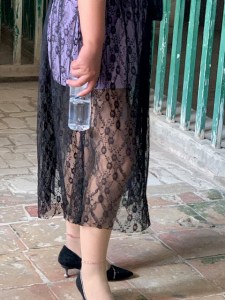
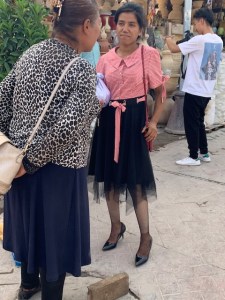
I started observing that many women were dressing in a peculiar fashion with short, tight fitting underskirts and long flowing see through overskirts, some even made of netting,  Many wore shirts that did not go with the skirts and many wore tennis shoes as well.  Weird.  So I started photographing the ones I could capture unawares.  Eventually I ran across a sophisticated group of ladies dressed in the fashion and approached them about the style.  Some of them work for a conglomerate business called “Wild Horse” and their job was to show off their clothes in the bazaar.  I chose to be enthusiastic about the style.  Their outfits ranged from $500 up.  Here are a number of shots I took over 2 days in Urumchi of these decidedly Chinese ladies.  

Mark wanted to buy a knife, so we made some effort to find one we could get through customs.  We finally found a store that sold knives, but they resisted selling to Mark.  Finally we got down to the smallest possible knife, about 2 inches long, and they let him buy it.  He only wants it to peel fruit in our room.

Finally, we were hungry and walked to a well known Uyghur restaurant called Herembag.  Mark and I ordered Polo, like the meal Rashida made for us, and Chao Mian, the dish we had watched being made with square flat noodles.  We were very happy with our selections and ate it all.  Only wish we could have had a beer with it.  While reading the menu, Hassan told us there are 32 characters in the Uyghur alphabet; 28 from Arabic and 4 from Persian.  The language got started during the 7th century and the name Uyghur mans “union” or “united”.

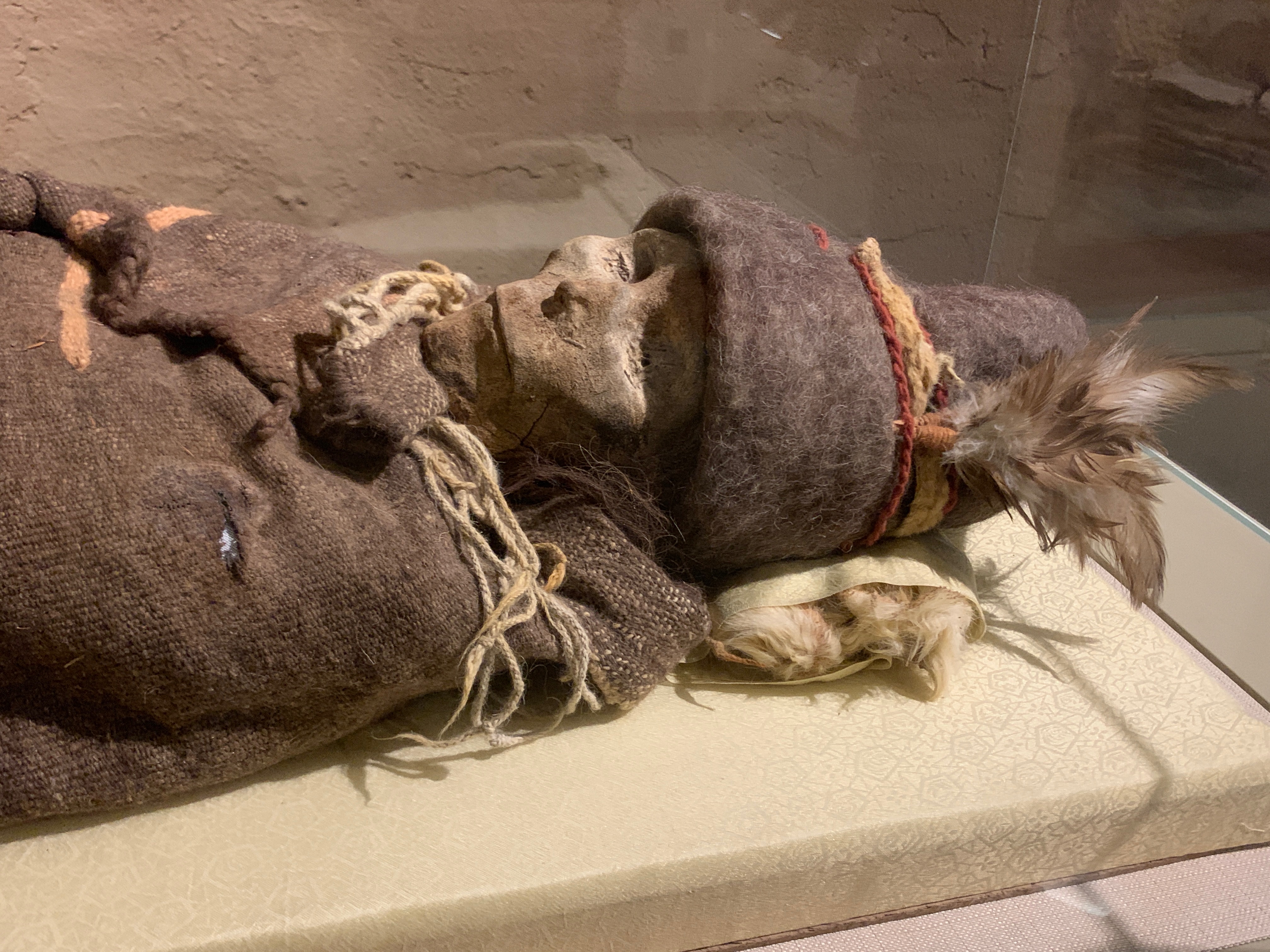
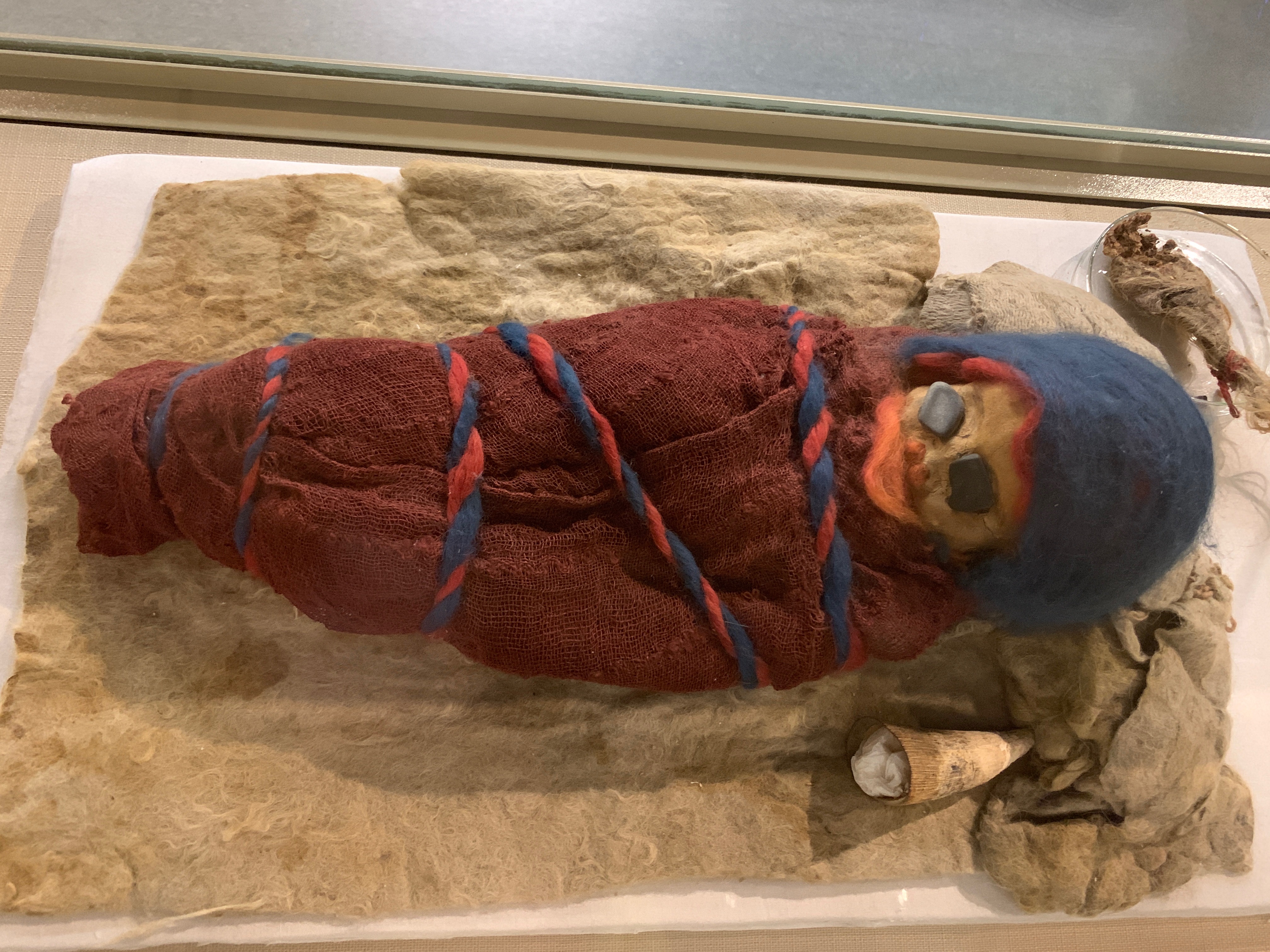
After lunch, our last stop was the xinjiang Autonomous Region Museum, which houses a special collection of mummies.  

There were just a few things that caught our eye in the Museum as well as the mummies, which were quite well preserved.

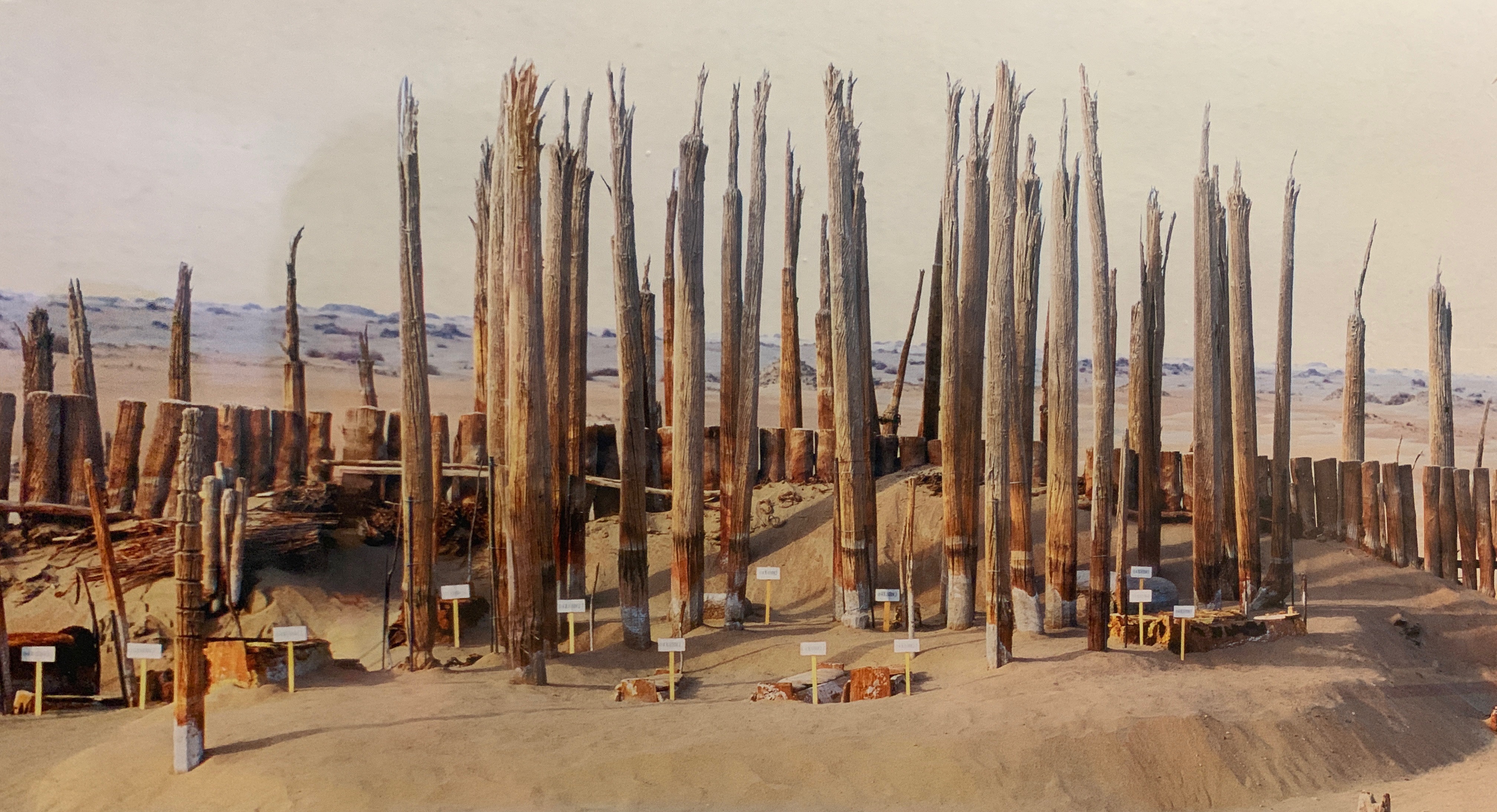
Ancient cemetery with logs on end as grave markers

Lowland Beauty (age 40-45) 3500-5000 years old. Full and head of Mummy and drawing of her face

Face of female body 3800 years old

Infant 2800 years old


Body guard with tattoo. 1100-1400 years old.

Out of time.  More later.


Valley of the Drakyerpa Meditation Caves

August 29, 2019

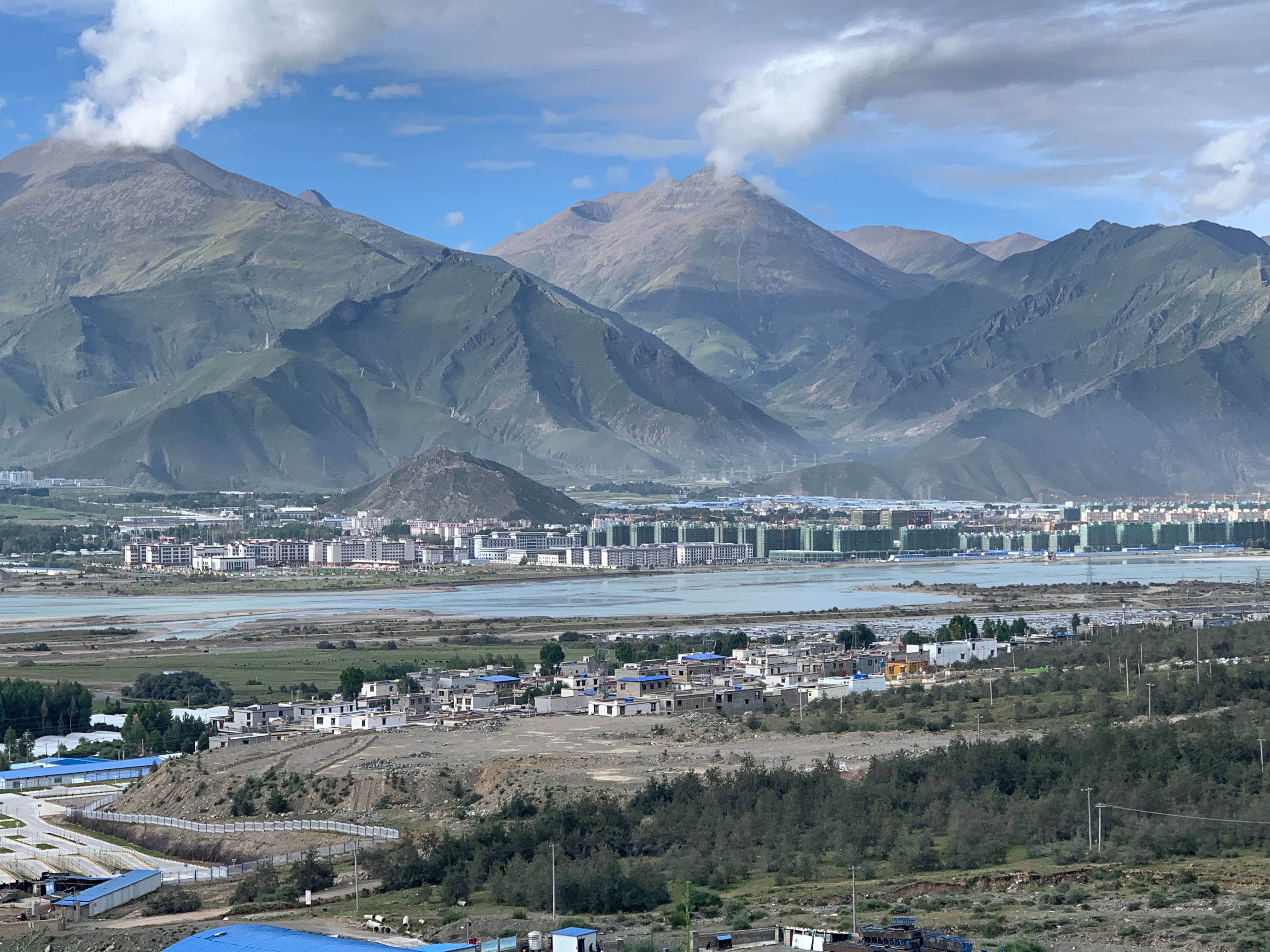
Beginning the climb out of the Lhasa Valley. Many Chinese high rises under construction, as everywhere around the city.

Beginning the climb out of the Lhasa Valley. Many Chinese high rises under construction, as everywhere around the city.

Another 9am start with PinPin, pronounced PeenPeen.  This day we are off on a 47 kilometer drive to a cave monastery up in nearby mountains called Drakyerpa Meditation Caves.  The scenery is lovely once we get away from the city.  We pass fields of wheat, corn and barley and gradually begin to climb into terraced hills. 


Soon we reach Big Nose Pass, where there are thousands of Prayer Flags fluttering in the breeze.  We stop to photograph the scene, and remembered other hillsides with many prayer flags—especially the hills of Bhutan.  However, nothing so intense as this.  

Shortly, we can see our destination in the distance and I am wondering how I will manage the climb.  Even at city level the elevation is 11,992 ft.  By the time we arrive at the car park the elevation is still 11,992.  How curious is that?

It is a little after 10am when we begin the climb.  PinPin takes my hand and helps steady me as we go up the irregular and often steep steps.  After a short time we loose the tile steps and are going up partially carved dirt.  Not east for sure.  Thank goodness the path is not wet.  Every few steps I must stop to catch my breath.  Why am I doing this, I think to myself.  After a hundred feet or so, we pick up the tile again and I am relieved.  The view down the Valley of Drakyerpa is lovely and the monastery buildings and caves above are inviting.  Up we go.  Finally, we reach the first buildings, inside which are several caves.  Each cave is a blackened rock enclosure with a nitch for meditating, one or more buddhas and candles.  Some are a squeeze to enter, others are comfortable sized rooms.   Women, some even with small children, have already come, deposited yak butter in the candles and moved on.  We continue up to the next building and repeat the process.  Currently, only 22 monks live in the whole monastery.   We must have visited more than a dozen caves, all inside charming house facades.  This place too was destroyed during the cultural revolution.  There is still much more to be rebuilt and crews are working away at making it happen.  The highest elevation we attained was 14,315 feet.  

We came down a different path on descent, but still encountered a ragged dirt path without steps.  While in that area we encountered several women carrying large, heavy stones up a wooden ladder.  It was hard to watch, but Pin Pin insisted they were young and willing to work for the money,  He said their husbands were probably home tending their children.  They are not forced to do this work.  Hmmm!

The sweet light of candles.

The sweet light of candles.

It was a relief to reach the parking lot and a restaurant…even if I wasn’t carrying stones.  We each had noodle soup.  I had mine with vegetables, Mark had his with yak meat.  It tasted great.  Never mind the dirty table.   By the time we got back to the hotel, it was 2pm and we had only 3 hours to relax before our next appointment.  I wrote and Mark read and napped.  At 5pm we met PinPin again for a momo, or pot sticker, making class.  Rather than noodle making, which we both already knew, we opted for pot stickers.  The Chinese word for it is momo. 

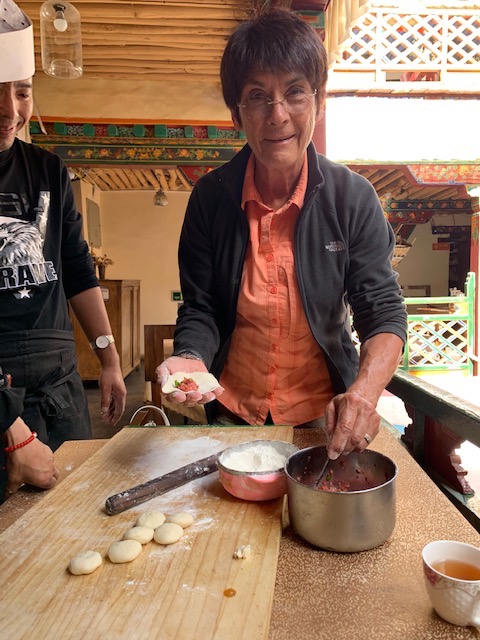
Learning to make momo, or pot stickers

Learning to make momo, or pot stickers

I tried very hard and almost got the hang of folding it.  Mark gave up early.  It did not take long, however, before my tired body wanted to stop.  So we sat down and waited for the momo to be steamed and served.  The dough was a little too thick, but the filling had good flavor, which, of course, had nothing to do with us.  We ate a bunch of them and called it dinner.  All we really wanted to do was crash.  I was in bed with oxygen at 8:15 and asleep soon after.  Woke up at 6:15 the next day.  

August 30, 2019

Up early and feeling more rested, if not completely caught up.  This was a travel day and I hoped to get a post off before we left the hotel at noon.  I had the text ready and most of the photos imbedded, but computer glitches slowed me down and I did not get finished.  Sure hope I have WiFi in Urumqi.  During our 2 flights I have continued to write and organize images, but am dead in the water without connectivity.

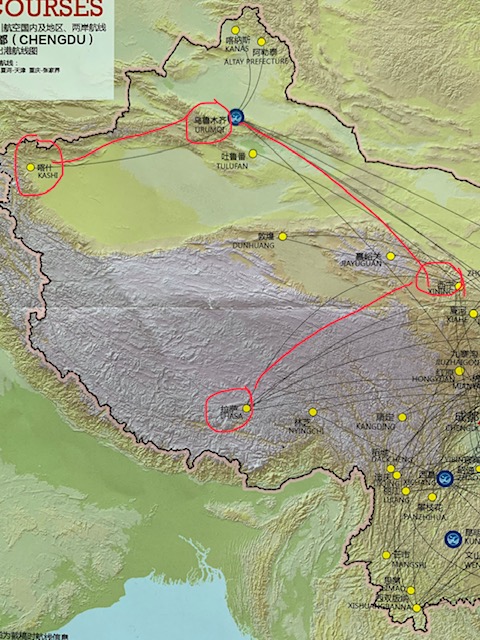
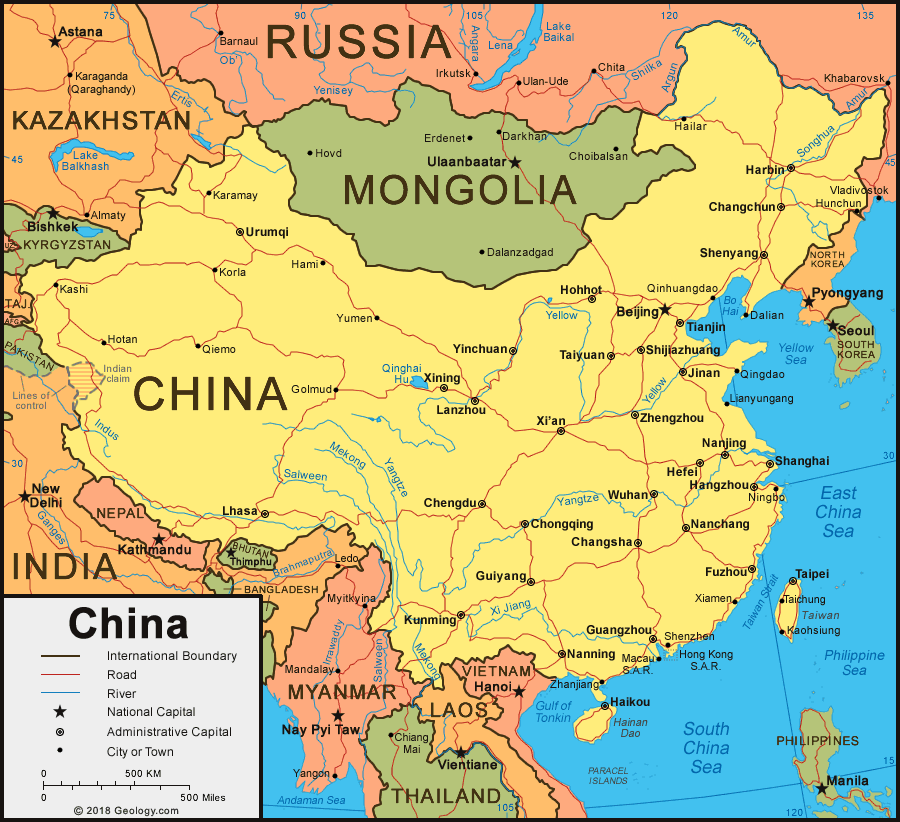
Strange flight plan we have had to endure.  We had a short 1.5 hour flight from Lhasa to Xining in the north east, which was the wrong direction for us.  Then a half hour layover in Xining before boarding another flight to Urumqi, this time the flight is going in the right direction, northwest. If you are following on a map, it will take 2.5 hours.  It will be dark when we arrive.  We will have only tomorrow to see Urumqi as we will fly off early the next morning.  

Riding on Chinese aircraft is a lesson in Chinese rules.  The English speeches are canned and very officious.  You are told that the speaker is the head Chinese Security officer and that you are to do what the hostesses say or you will be incarcerated for refusing to obey.  Even the usual speech about seat belts, exits, slides, etc. is presented very officiously.  I was using my computer as a typewriter during the flight and was told, more than 30 minutes out, to put it away as it was not allowed.  I told her it could have no affect on the flight crew, but she insisted I put it away anyway.  Once the cabin crew were seated, I started working again.  The young lady in the aisle seat called the hostess forward and I got another lecture—in Chinese. So I put it away, but was really incensed by the woman reporting me. How very Chinese.   I thought about it and, when we were on the ground I tapped her shoulder and said “Thank You,” with a big smile, “for teaching me about Chinese people.”  I think she understood, but I will never know for sure.  

I’m sure it was against the rules to tear a page out of a Chinese magazine, but I took the page that will help me give you our direction of flight, the places we are visiting and the idea of distances we are covering.  It was 1.5 hours from Lhasa to Xining, 2.5 hours from Xining to Urumqi and about an hour and 45 minutes from Urumqi to Kashgar.

A map of Xinjiang Province in far eastern China. THe Counter clockwise direction indicates our route of flight.

A map of Xinjiang Province in far eastern China. We flew from Lhasa in the south to Xining in the north east, then to Urumqi or Urumchi in the northwest.  Next we will fly from Urumqi to Kashgar or Kashe.  From there we drive west to Tashkorgan and into Pakistan.

Potala Palace, Jokhang Temple, Summer Palace

August 28, 2019

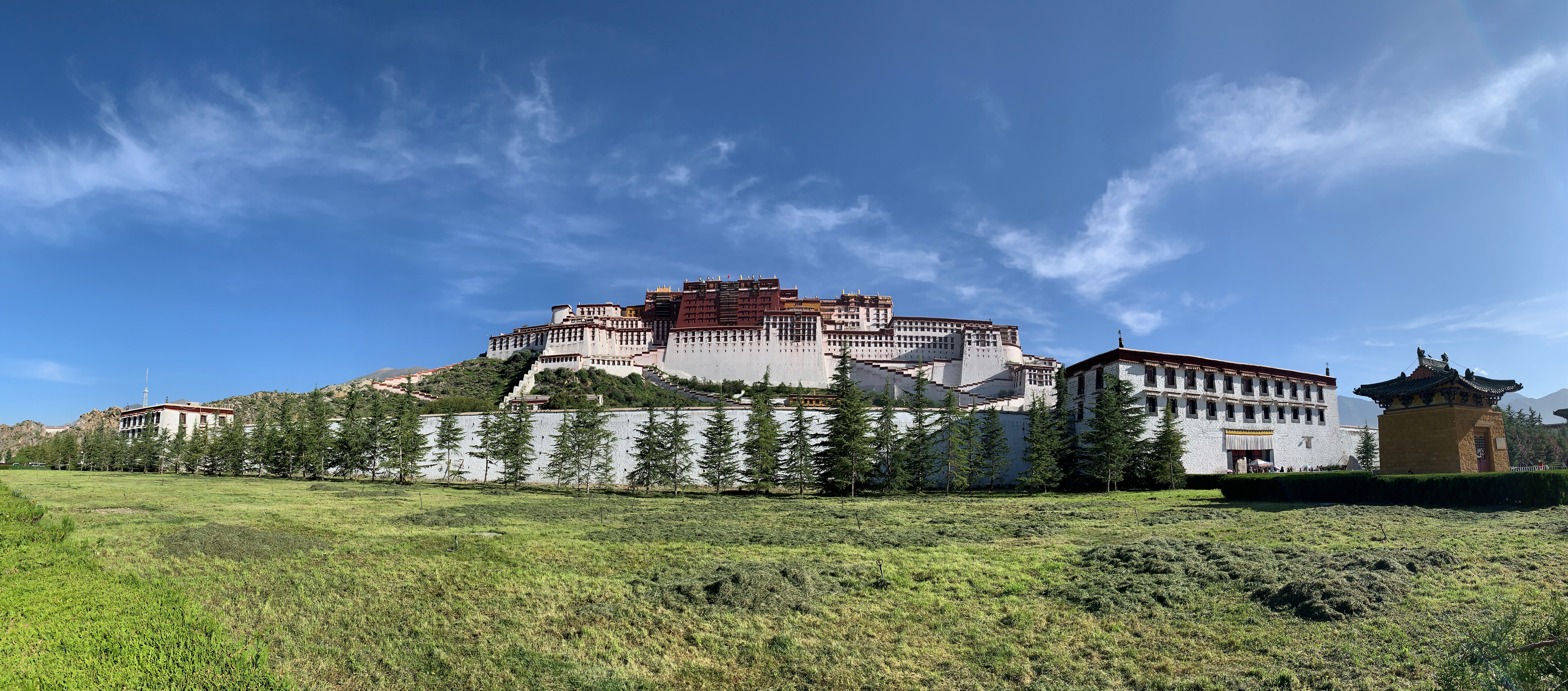
A panorama of Potala Palace

A panorama of the Potala Palace

Buddhas are the name of the game for another day.  We start with the Potola Palace, which was the spiritual and governmental heart of Tibet until 1959 when the Chinese government sent in troops to capture the Dalai Lama, forcing him to escape in disguise at night.  The troops proceeded to kill many people in the process.  Today it is a living museum for the faithful and a treasure trove for historians and tourists.  When we first arrived there were hundreds of people walking clockwise around the facility saying mantras, using prayer beads and spinning wheels.  They all seemed very devout.  We walked with them for awhile and then went back to to the ticket booth to pay and begin the walk up into the Palace.

We started at 11,992 feet, the same as our room as it happens.  As we walked, we learned the Palace was founded in the 7th century by Songtsen Gampo with 2 chapels and slowly enlarged over time.  In the 17th century the Fifth Dalai Lama made extensive modifications and moved his residence and administration into the Palace.  Since then each Dalai Lama has made extensions and modifications.  The white part of the Palace buildings are for administration and politics the red part is for religious purposes.  It is clearly more administrative and political than it is spiritual or religious.

Without a guide, I would still be lost in the labyrinth of the 999 rooms.  After walking up long steep ramps in the sun, we arrived at the bottom of the 13 floor complex and began to see inside a room here and there until we reached the top, where the huge Assembly Hall is located.   I checked the altimeter again and it read 12,467 ft.  I was amazed so many people made the climb without assistance.  Just at the beginning, as a ploy to get us in the door earlier than our scheduled entry time ,our guide told the Chinese medical team that I might have difficulty walking and they all but carried me up to a shady place where they stuck a spray oxygen bottle in my face and wanted to check me out.  I insisted that I was fit enough to make the walk and eventually started walking up the steps on my own.  They stayed behind.  I was a bit embarrassed but in the door 20 minutes early.

Again I was not supposed to take any photographs so I do not have many unfortunately.  The attendants were vigilant.  Some of the incredible artifacts we saw included huge, jeweled burial tombs of the 5th through 13th Dalai Lamas (Dalai Lamas are always mummified), except the 6th.  Interesting story there.  He liked beer and ladies and was not a good example of a traditional Dalai Lama, so he was ostracized at his death and buried somewhere else.  However, he proved to be a very good writer and published books of poetry that, our guide said, could still be purchased today.   He is remembered more than some other Dalai Lama’s.  We also saw many chambers of statues of Buddhas and lamas, frescos and murals.  One special statue was of a Buddha that was over 2000 years old and had survived the cultural revolution.  One mural on a huge wall depicted the history of Buddhism.

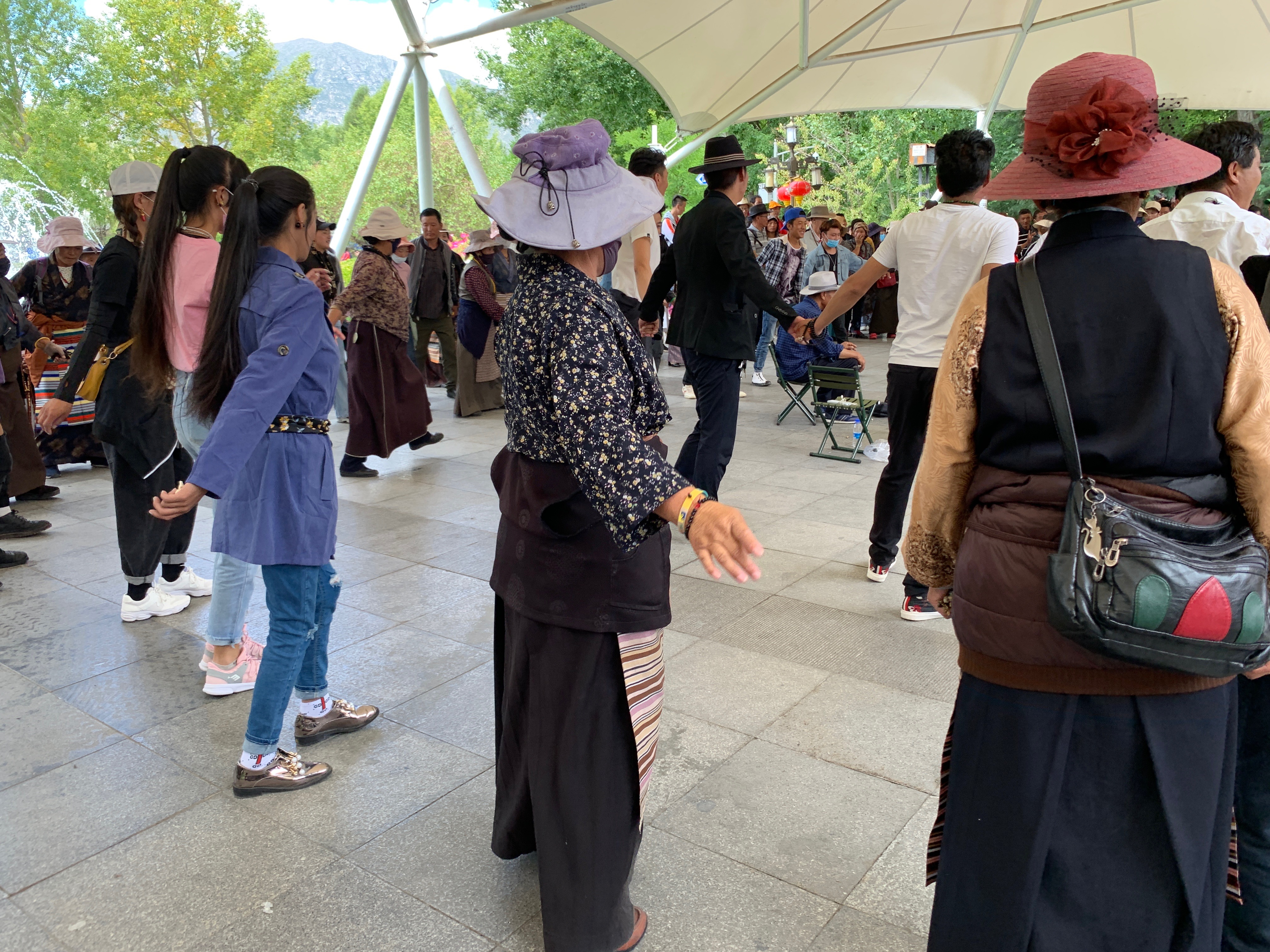
Line dancing in the park behind Potala Palace

Line dancing in the park behind Potala Palace.  The guy in white shirt is sporting big hair.

Back at the bottom of the Palace complex, we found ourselves in a park with a crowd of locals line dancing.  It was fun to watch as all ages and styles of dress were happily dancing away.  Several young men sported large pompadours and a few looked absolutely gay.

Our driver picked us up and off we went to a Tibetan restaurant for lunch.  We are both noticing how filthy restaurants, restrooms and public places are, not to mention the monasteries and the Palace.  Cleanliness is clearly not a priority.  The streets, meanwhile, are being swept clean all day long by people in orange uniforms.  We’ve also noticed that people are pushy, especially when lined up for something.  And while we are complaining, Mark added that men and women spit a lot without apology .

Although we were sitting at a dirty, but pleasantly located roof top table, our lunch was just ok.  Mark ordered a stir fried yak and vegetable dish.  I ordered fried eggplant to go with it and a dish of pot stickers.  The whole thing was pretty greasy. Time to get beyond yak, I think.

PinPin met us and off we walked through the Barkhor, Lhasa’s medieval Bazaar, to the nearby Jokhang Temple.

The temple was built in 647AD by King Songtsen Gampo, who also founded the Potala Palace, and is the holiest temple in Tibet.  It too was enlarged by the 5th Dalai Lama in the 17th century.  The story is that the King had 3 wives–a Tibetan, a Nepalese and a Chinese.  The Chinese bride brought a very old and important Buddha from China as her dowery.  When she arrived and found no place to install it, she threw her ring.  It landed in a small lake, so she had the temple built on the site of the lake to house the buddha.  The charming story is told on a mural inside the temple.  The king had only one son, who was from the Tibetan wife.   He died at age of 32 and the Chinese sent an army to take back the statue of Shakyamuni, the 2,500 year old, original, Present Buddha, which had been made in India in the 8th century BC.  The Tibetans hid the statue in a vault behind other statues in the temple and the Chinese did not find it.  It is in the temple today.

The Nepalese bride also brought a buddha for her dowery, but it was destroyed during the cultural revolution.

When we arrived at the front of the temple, we passed people praying in several ways including prostrating themselves or building mandalas.  The temple was, happily for me, on one level and there were not many rooms or statues.  Again, I snuck a few photos in spite of the rules.  There was a roof top level I did not climb.  Mark said the roof top was gold colored and probably was the real thing.  From the ground it certainly looked like a fancy gold roof.

We engaged with a few people in front of the temple and enjoyed the afternoon light.  But there was no time to linger as we had one more stop—the Summer Palace.

About 3 miles away, the Summer Palace was built in what gradually became an 89 acre horticultural park in 1755 by the 7th Dalai Lama, Kalsung Ghatso.  All the Dalai Lamas have used the Palace from then on including the current Dalai Lama.   We saw groups of people picnicking on the grass here and there under lovely shade trees.  Flowers were everywhere.  There are several palace complexes.  We entered the Truzing Palace of the 8th Dalai Lama and got to see an excellent Buddha of Compassion with 11 heads, 1000 arms and 1022 eyes.  Also there, was a statue of a buddha we had not yet seen, the Medicine Buddha from the 11th century.

Finally we entered the 14th Dalai Lama’s Palace. It was built in the mid 50’s and he occupied it for about 6 months before escaping to India to avoid the Chinese government.   Unlike any other, it had twin staircases with modern handmade carpets and a clock that is stopped at 9pm, the time the Dalai Lama left for the last time.  There was a wall with a huge mural depicting he at the age of about 27 surrounded by family, teachers, mentors, dignitaries and many others.  Each face was very identifiable.  We saw his throne and living spaces including his study room, sleeping room, meeting rooms, bathroom and living room.  It was a very personal tour.

What I learned from PinPin about succession is:  in the normal course of time, the two next highest people under the Dalai Lama, the Pachenlama and the Karmapa, choose the future Dalai Lama under a very strict set of procedures.  In the current situation there are two Pachenlama.  The real Tibetan one, the 12th Pachenlama, is in prison, and the second one, who has been appointed by the Chinese, but is not recognized by Tibetans.  So the Dalai Lama and the Karmapa, who himself escaped to India in the early 2000’s, have been conferring on how best to decide on the next Dalai Lama.  It seems like the Karmapa will have to do it alone following a set of procedures he and the Dalai Lama have laid out.  The current Dalai Lama is 86 years old.  I wish him a very long life and fear for Tibet once he has passed.

Dinner for the third night we again ate fruit in our room.  We have lovely peaches, apples and bananas and lunches in restaurants have been less than satisfying.  Oxygen again to sleep.


Lhasa’s Monasteries and Palaces

August 27, 2019

Last evening, we went for a walk around the area. It was still very light out 7:30, but the sidewalks are mostly torn up for sewer or other repairs, so walking wasn’t very pleasant.  We did stop at a muslim shop with a handful of people making pasta squares for a popular muslim dish.  Most of the shops had Chinese flags flying, but not all.  Back in our room, we went to bed.  Mark dropped off quickly, but I was having trouble breathing while laying down.  Fortunately the room has a large oxygen generator and cannulas to go with it, so I hooked myself up to it and was finally able to fall asleep.

This morning we were waiting for our guide at 9am.  Mark corrected what I thought was his name.  It is not PingPing, but PinPin.  Off we went to the Drepung Monastery.

While on the way, PinPin told us the Tibetan language is based on Sanskrit, a fact Tibetan kids will not learn.  Today they are not taught about their history or culture, only the Chinese version of Tibetan history.  PinPin’s wife, a grammar school teacher,  is not allowed to teach the truth in her classroom.  No wonder Tibetans are distressed.  Changing the subject, he told us Lhasa has a population of 500 thousand and it has been the capital of Tibet since the 700’s.  The current local population of monks is about 10,000 with 400+ at Drapung Monastery, which is one of the”great three” of central Tibet and was founded in 1416.  It was home to 10,000 monks before 1959, when the Dalai Lama escaped to India with his life.  It was also the seat of central government until the Fifth Dalai Lama expanded the Portala Palace and moved his residence there.  Today there are about 400 monks living at Drapung.

These first images are of the outside as we ascended up and into the buildings.


Once inside any room in any building, we encountered the smell of incense, wax, butter, dust and grime as well as people and buddhas.  Everywhere, people were carrying small bank notes, hot wax and yak butter in thermoses.  In front of each buddha, they would put a note worth 20 to 80 cents into a collection box and pour wax and or butter into candle holders intended to keep the candles burning.  Monks would collect the money periodically and pour out the wax before it overflowed the vessels.  We were not allowed to take photos, but I managed a few anyway.  Sorry I could not get more.  There were some spectacular objects and statues and tombs.  Here is what I captured.

There were the major Buddhas of Past Life, Present Life and Future Life repeated in every hall and space plus images of the different Lamas up through the 13th Dalai Lama.  Images of the current Dalai Lama were conspicuously missing.  In addition to the prayer halls, there were meeting rooms for the monks and at the top of the complex was the main Assembly Hall, which could hold many more monks than there are currently in residence.  I logged the elevation at the parking lot at 12,439 feet and again at the Assembly Hall at 12,629 feet–our record so far on this trip.

As we started down the steep, irregular steps, we heard musical sounds and followed our ears to an outdoor garden where a handful of monks were making music on oboe-like instruments.  They stopped when we arrived, so we had to coax them into playing more, which they graciously did.  Then we saw two very long, maybe 10 feet, horns on a tall rack and asked if they would play them.  Two other monks got up and played an entire tune in perfect unison.  I captured some of it on video.  We had a pleasant conversation with them through PinPin.  A large festival is coming up in a few days and they were practicing for it.  Finally, we left them and continued down the steps.

PinPin took us to a tourist  restaurant, not our choice, but we ordered yak curry. The curry was greasy, the meat fatty and the spices dull.  However, we did not get sick, so it counts as a success.  After lunch we walked to Sera Monastery, founded in 1419 and another one of the”great three”, it also houses about 400 monks currently and  5,500  prior to 1959.  Fortunately, this Monastery is not as high and has fewer rooms.  The special Buddha here was the Horse Buddha.  There was a huge line of people waiting to get a blessing from the buddha.  Again I was not supposed to take photos.

Horse Head Buddha, a favorite in the Sera Monastery

Horse Head Buddha, a favorite in the Sera Monastery.  The horse is at the top and small.

We happily walked on by and snuck in at the back entrance to see the buddha without getting a blessing.  The other interesting aspect of this monastery is that it sports 4 colleges with the topics: meditation, enlightenment, mantra & tantric, and debate.  At 3pm the debate school stages a performance for the public, so we went to the large courtyard where it is held and watched the process.  One monk is seated and answers the questions.  The other monk stands and puts the questions to the seated monk.  There is much slapping of hands and posturing and trying to make the seated monk “lose”.  It was a bit too staged for my taste, but it was mildly entertaining.  We watched for an hour and leaded down the hill.

When we reached the level path, we met up with a couple of elderly ladies dressed beautifully in traditional Tibetan clothing, so I stopped and gestured that I would like a photo of them.  They surprised me by saying yes, so I took several photos and was about to depart, when two ladies in modern dress  approached.  They were obviously related so I showed them the images.  PinPin got into the conversation and we learned that the two ladies in traditional dress were sisters-in-law and one of the western dressed ladies was a daughter and the other was her daughter.  A few steps further along, we met up with the husband of the modern mother and her new baby. The whole family are members of the Chema group of Tibetans,  who live in the Marking area in eastern Tibet.  It was quite a family scene and we could have chatted for a long time if we could have understood each other.  Anyway, we all laughed and smiled and said good-bye.  I really love this kind of encounter, like with the musical monks earlier, and hope they happen more often.

That ended our first day of monasteries.  It was good to get back to our room, have a piece of fruit and relax.

From Beijing to Lhasa


August 26, 2019

We are now in the air between Beijing and Lhasa, a 4 hour flight.  It seems a server in the Air China airport lounge was able to get me back up with Word Press so I am a happy camper.

 It turns out the distance between Beijing in the east and Kashgar in far western China is 2,716 miles.  I was surprised to learn that the distance between NYC and SFO is 2,902 miles, almost 200 miles farther.    

Except for not being able to access WordPress, we had a very nice time.  The weather was very warm, but not too humid.  Almost comfortable.  Our guide while there was a fellow named Wei, who spoke English with a thick accent.  I had a hard time understanding much of what he said and had to ask repeatedly until I understood.  Not fun for either of us.  But I learned a number of facts to share with you.   

The population of China is now 1.3 billion.  The city of Beijing was designed for 4 million people, but is struggling with 33 million now.  The infrastructure is totally inadequate, especially the roads and the water system, which is running low and no longer potable.   I can’t even imagine what the sewer system is like, although the streets were clean.  Just to buy a ticket to ride the subway takes 40 minutes and to get to work can take 3 hours if you live on the outskirts.  Imagine 6 hours of commute each day plus 8 hours working.  Most people, said Wei, especially the younger generation who have no means to live closer to town, barely have time to eat and sleep when they are home.  The more affluent people are, the closer to the city they live.  The average person in Beijing lives in a 30 square meter space (323 square feet).

Money and competition are the driving forces, plus the desire to live like Americans, in spite of the Communist rhetoric.  We saw signs of America everywhere—fast food places like KFC, Starbucks, McDonald’s (there are 120 of them in Beijing alone), Wumart (a copy of Walmart); cars like Buick;  western style clothing like the Gap.  

The one child per family law that went into effect in 1980 has had unexpected affects.  Most people wanted a son, so many girls were aborted until the couple had a boy.  Today there are not enough girls to go around.  Girls, meanwhile, are now better educated, have well paying jobs and many do not want children or even marriage.  Many men are remaining single.  Wei said he did not know anything about gays—obviously a taboo subject.  The government reversed itself in 2017 and now wants more children.  However, the population is declining anyway.  The largest population is in the 60-67 age group.  Retirement is allowed at 60 for men and 55 for women.  The government is thinking about raising the retirement age.


Wei was very helpful in getting us to visit Zuby’s parents, which we did yesterday.  We drove about an hour from the center of the city to the outskirts, where Zuby’s parents lived and worked in a pleasant, quiet, artist colony.   Rashida Eli, Zuby’s Mother, was waiting for us on her balcony and welcomed us with a big smile and open arms.  You would not have known we were meeting for the first time.  Her husband, Najmidin Azezi, was only slightly less outgoing.  They whisked us into their 2 story studio/apartment and we were instantly surrounded with floor to ceiling works of art, mostly oil paintings and charcoal drawings.  In spite of the art work everywhere, the place was very clean and tidy with a kitchen and dining area down stairs and 2 sleeping areas upstairs.  We found their work to be mostly somber and dark in spite of their happy, warm and upbeat countenances.  Gradually we began to understand that their work reflects  their experience and inner feelings about the hateful treatment of Uyghur people in general and their family in particular.  Her sister and a brother were captured and held for some time.  Finally, her sister returned, very changed.  Her brother is still missing.  She does not know why they were taken.  Sad story.  For once, I did not press to learn more.  

No wonder they do not go back to Urumchi.  The two of them are ok as they immigrated to Canada when Zuby was a small child and are now Canadian citizens. As foreigners, they reside in China with renewable visas. 

While there, Rashjida surprised us with a hot Uyghur meal called Polo.  It consists of rice mixed with chopped stewed beef, lamb, bell peppers, roasted garlic and spices.  It was very tasty.  She also served us a green salad and honeydew mellon, and a fruit tart for desert.  We ate it all, including the salad.  They were very generous and served our guide and driver as well.  

After 4 hours of visiting, it was time to go.  We left with warm feelings all around.  

Back in the city center, we stopped at our hotel, grabbed the computer and walked to the Apple store.  It made our Roseville Apple store look small.  It consisted of 3 stories and every floor was crammed with people.   We made an appointment with the Genius Bar, and were surprised to get called in less than 10 minutes.  I sure appreciated the fast service.  However, after conferring with each other, the 2 geniuses that served us, said the government had disallowed the use of our servers, Safari and Chrome.  So no Word Press either.  Bummer.  

Back at the hotel we cleaned up and went with Wei and our driver to a simple dim sum restaurant to enjoy steamed dumplings.  The dumplings were great.


Afterward they drove us to the National Center for the Performing Arts to attend a Woodwind and brass concert being conducted by a young American named Michael Kevin Holzman from Ohio.  They performed the Candid Overture 7th Symphony.  The concert was interesting and entertaining.  There were 45 musicians and the sound was quite engulfing with 9 clarinets, 5 horns, 3 trombones, 3 flutes, 2 bass fiddles, 2 oboes, 2 tubas, 3 French horns, a bunch of percussionists and more.  

Best of all was the Center itself.  The facility was spectacular.  From the outside it looks like half a very large glass egg floating on a lake.  It changes colors in the evening and is very appealing.  Inside, we walked underground and passed through a 30 feet high passageway with a glass ceiling that granted visibility of the large, shallow lake above.  Quite unusual.  Once through the passage, we climbed up again inside the “egg” where that ceiling was made of vaulted pieces of beautiful wood.  The effect was extraordinary.  Mark and I had seen the center from the outside during a previous visit to Beijing and we knew we wanted to experience the center from the inside.  Our effort was well rewarded.  

Today, As we approached Lhasa, the view outside the window was awesome–Snow covered peaks in all directions.  The Gongkar Airport is quite a large facility serving the capital of Tibet and the surrounding area.  Somehow I thought the place would be small and religious or spiritual, but it is overrun by Chinese, who seem to be hell bent on doing away with all things Tibetan.  Our guide, PingPing, told us on introducing himself that he is a “full Buddhist Tibetan”.  As soon as we were in the car, he admitted how upset he is with the Chinese ruining Tibet.  If the Chinese have their way, there will be no more Tibet.

There is a tremendous amount of construction happening with many Chinese moving in permanently.  The population, according to PingPing, is currently 6 million Tibetans and an additional 3 million Chinese.  The drive to Lhasa from the Gongkar Airport was 45 kilometers on a new raised highway that went over the Brhamaputra River and through 3 large, modern tunnels.  The area is quite wealthy due to large mining operations in gold, iron, tungsten and silver.  Twenty % of the money raised in mining stays in Tibet to develop the area.  The rest goes to the Chinese government.  Schools are free for both Tibetans and Chinese, but they are largely segregated.  HIs wife is a first grade school teacher in a Tibetan only school.  Along the way we saw fields of barley, wheat, corn and mustard.  Ping said they also raise potatoes, carrots, peach trees and flowers.

Finally we arrived at the St Regis Hotel through a maze of bumper to bumper shops and restaurants, high rises and construction zones.  We could see the Portala Palace as advertised, but barely, due to the building congestion.  The weather is sunny and warm.  I did not need a sweater as I thought I might.

As we checked in and I realized that I was feeling light headed and slow, so I looked at the altimeter on my phone.  We are at 11,754 feet.  The hotel staff provided hot tea, which tasted super.  Once in our room, I was happy to find that we have WiFi and Word Press.  We went to lunch, which took way too long time just to get soup and a small sandwich.  Back in our room I can sit by the window and see the Palace about a mile away.  We are content to enjoy our room and our view at an elevation of 11,993 feet.


Getting ready for Beijing

August 26, 2019

Things are very weird here in Beijing.  I had no access to Word Press while at the Peninsula Hotel or at the Apple store.  Now, at the airport, I have access through a Chinese server called BAI.  Hopefully it will hold.  But now I have no more time and must run to the gate.  Here is what I completed before we left home.   More as soon as possible.  Do not hold yours breath.

August 23, 2019

We are over Russian territory at 37,000 feet on our way to Beijing.  Our 7-week adventure to unvisited places in Asia has begun.  For the first time, I am feeling somewhat undone by the amount of time we have agreed to spend traveling.  Is my age the issue or have the stresses of work at home gotten the better of me.  I’d like to believe the latter.  For sure I am exhausted by all the stress.  In addition to difficulties finding a tenant for our Dickinson, Texas property and dealing with unfinished landscape issues at a property in Grass Valley, we recently entered into a purchase agreement for a house at Lake Tahoe. It is expected to close on October 22, but at the moment our financing is unsettled because the required appraisals have not been completed.  When we left SFO today, none of the issues have been resolved or even concluded.   Although we did make some progress with the landscaping repair problem at the last minute.  

Now that we are in the air, I am telling myself to relax, let go and lose myself in our coming adventures.  The stresses at home will naturally re-assert themselves the we return.  Maybe I should be grateful for seven full weeks in a different world where all I have to do is keep a low profile and stay away from trouble.  

We cover China from east to west, mostly by air

We cover China from east to west, mostly by air

I have brought a lot of material to read about the places we will visit and hope I manage to get to the reading……soon.  To start, I downloaded a few maps, as many of you express appreciation for having them to study.  The first map is of China and shows all the places we will visit in that country.  We start on the east coast in Beijing and gradually work our way west across the entire country, albeit mostly by air.  After a day in Beijing, we fly to Lhasa in south central China and spend several days in Tibet.  From there we fly northwesterly across the country to a city called Urumqi, pronounced Urumchi.  It is the heartland of the muslim people known as Uighur.  There are about 12 million of them and they are in the news lately for being persecuted by the Han Chinese.  We will have a couple of days there and then fly further west and south to Kashi, aka Kashgar, where we will pick up a car, driver and guide and proceed by road into Pakistan.  The distance across China is much further than across the US.    

Back to our arrival in Beijing.  At the Peninsula Hotel we will rest and try to adjust to the 9 hour time difference.  The next day we plan a special meeting with the artist parents of a young woman we have gotten to know during the Classical Tahoe summer season in Incline Village on Tahoe’s north shore.  Her name is Zubaida Azezi, aka Zuby.  She is a violinist in the orchestra.  Her fiancé is Tim Dilenschneider and he is one of orchestra’s three bass players. During the regular season, they play in the Houston Symphony Orchestra. 

Zuby and Kim with us at Gar Woods.

Zuby and Kim with us at Gar Woods.

We took them out to dinner one evening after we had learned that Zuby is Uyghur and from the city of Urumchi.  We were surprised.  She was shocked that we had even heard of her city, let alone planned to visit it.    She identifies as Uighur and told us about the difficulties happening in her homeland, the Xinjiang Uyghur Autonomous Region in northwestern China, where the largest muslim minority resides.  She has not been there or seen her relatives since she was a young girl.  It is too dangerous for her to go back, but she is confident we will have no problem as tourists.  I asked if we could look up some of her relatives and give them her regards and a photo or two.  She declined, saying even that was too dangerous for her people.  Of the 12 million Uyghur population, 2 million are incarcerated in “re-education camps” similar to what Kim Jung Un is doing with his people in North Korea.  Very sad situation.  Last October the BBC released details of an investigation into China’s “hidden camps”.  Perhaps you can find more news about it.  

 However, she said she would love to have us visit her parents, who are English speaking artists living safely in Beijing and ask if they would mind meeting with us and showing us their art and the art community in which they live.  That sounded really good to us, so she called them, made the contact and the next thing you know we cancelled our other activities in Beijing and agreed to meet her parents.  So that will be most of our day.  The drive to her parents home is about an hour from our hotel.  In the evening we have dinner reservations and tickets to the Wind Orchestra Show at the National Center for Performing Arts. We have seen the building from the outside and it is quite a lovely space.  I am looking forward to seeing the interior, which was not open when we were last in Beijing.

Back to Casablanca and home


June 17, 2019

Yesterday morning, June 16, we found the garden tidied up and ready for breakfast.  It was a lovely day.  People straggled in looking as tired as I felt.

View of our room from breakfast. Another beautiful day.

View of our room from breakfast. Another beautiful day.


I was very late in deciding to take photos of each person so I could remember them,  as several had already left, but I did manage a few.

Here is a lovely image of Gaby and Nezha beside the pool in their home, Janen Mayshad.

Gaby and Nazha relaxing by the pool.

Gaby and Nazha relaxing by the pool.

Finally, we bid the remaining staff and Gaby and Nezha good bye at 11:30.  Their driver took us back to the Four Seasons in Casablanca, where we spent the rest of the day reading and blogging while enjoying the ocean view.  On the way out of Mayshad, I stopped the car to get a photo of how the walled estate looks from the outside and another of the land next to the estate house where Nezha plans to install a farm with many fruit trees.

About half way, we stopped at a very modern and spotless gas station and convenience store.

Once back at the Four Season, Mark spent the afternoon reading while I worked on the blog.  We had a slightly different view that our first room, but the ocean still sounded as good.

At 7pm we cleaned up and walked a mile to our reserved dinner at the Cagestan Restaurant.

The Restaurant Cabestan, where we had our last dinner in Morocco had a very special bathroom. Several people told us we must visit the facilities, so we did. This image says it all. The timing was perfect. Dinner was, well ..... less exciting.

The Restaurant Cabestan, where we had our last dinner in Morocco had a very special bathroom. Several people told us we must visit the facilities, so we did. This image says it all. The timing was perfect. Dinner was, well ….. less exciting.

View from our second room at the Four Seasons.

View of our last morning in Morocco from our second room at the Four Seasons.

June 19, 2019

We are home and already back at work on our various projects.  For me the big push is to get the garden in order for the MIM Friend’s Party on the 28th. No time to recover from jet lag.  What jet lag?

My favorite experience was the current exhibit in the African Contemporary Art Museum.  I was very impressed by the quality of the work and the thoughtful comments presented by the artists about their work.  Then I was also taken by the Yves Saint Laurent Museum and the nearby gardens.  The clothing was interesting, but the presentation was most unusual and stimulating.  The walls behind the manequines were solid black with models moving around in many of the outfits on display.  Spoken words by Laurent and others were also projected on the wall.   Unfortunately we were not allowed to take photos and there were guards everywhere.

Otherwise I thoroughly enjoyed spending time at Nazha’s home and estate.  As tourists, we have always seen the outside of walled compounds, but rarely the inside and always in a hurry.  I was delighted to be able to relax and enjoy the inside of this compound as I pleased.

Now we are home for most of the summer.  We leave in late August for our long adventure of the year to China, Pakistan and India.

Happy Summer and Safe Travels,

Julia and Mark


Marrakech, Museum of African Contemporary Art and More

June 16, 2019

Mark listens to the docents introduce us to the museum

Mark listens to the docents introduce us to the museum

After the late night party, we were all slow getting going in the morning.  It was 10:30 before we were in the van and headed to  the Museum of African Contemporary Art.  It was no ordinary museum.  It was not large, but it was spectacular in its content and purpose.  Even Mark hung around to learn the meaning of each piece.  Here is a sampling of the art we experienced.

Acrylic on canvas," Eyram, Yellow is the Color of Water", Jeremiah Quarshie (Ghana)2015.About women's need for water and the difficulty of carrying it. The only painted image.

Acrylic on canvas,” Eyram, Yellow is the Color of Water”, Jeremiah Quarshie (Ghana)2015.About women’s need for water and the difficulties of carrying it. This is the only painted image in the exhibition.


First of all, there was only one piece that was painted, a western mode of art not culturally African.  The rest of the collection was made up of artifacts found in the local culture and turned into eclectic, meaningful and artful works that required thought to understand the intent.  I am including several pieces so you can get a sense of the place for yourself.  Nezha had arranged for us to have the museum to ourselves.  The two head docents shared their knowledge and insights with us at each piece.  That alone made the tour a special experience.

A concrete and steel sculpture that reads, in Arabic, "Liberty." However, the word is in concrete nailed to the wall with a steel plate over the middle of it. The message is that Liberty has not become free. I found this piece very visceral.

A concrete and steel sculpture that reads, in Arabic, “Liberty.” However, the word is in concrete nailed to the wall with a steel plate over the middle of it. The message is that Liberty has not become free. I found this piece very visceral.

Large-scale sculpture of fake acrylic nails by Frances Goodman. Subtle subversion of stereotypes that continue to surround women and their interest in the surface presentation of self. THe image I both appealing and intense.

Large-scale sculpture of fake acrylic nails by Frances Goodman. Subtle subversion of stereotypes that continue to surround women and their interest in the surface presentation of self. I found the image both appealing and intense.

Found objects like used toothbrushes and discarded soap dispenser caps make this an interesting commentary on how people use and waste things.

Found objects like used toothbrushes and discarded soap dispenser caps make this an interesting commentary on how people use and discard things.

For me, the artists presented, collectively, a feeling of HOPE.  They are not looking to the past, but working to effect change, positive change now, for the future.  I think everyone in our group came away feeling moved.

Around the corner from the museum is a golf course where we have lunch. Quite a first rate environment.

Around the corner from the museum is the golf course, where  lunch was waiting.

Then we were off to lunch at the nearby golf course.  It was a pretty setting and a super salad came without us having to order.  It was perfect for everyone at our table and we thought we were done, when a beef and chicken tagine arrived.  Suddenly, it was way too much food, even if it was tasty.  I stopped.

We all agreed to a short visit to the medina to spend some money.  Mark and I wandered around reminiscing about our last visit here 25+ years ago.  Nothing seemed to have changed.  Crowded and noisy. Shopkeepers all peddling the same goods, sellers dogging us while lowering their price as we kept walking, irascible snake charmers and sluggish snakes.  We found a pleasant shopkeeper and settled in to buy some scarves.  We had a nice visit and learned he had been in that spot for 34 years and business was always just OK.  Now there are more people, but more vendors too.

Feeling hot for the first time on this trip, we walked back to where we were to meet the van and were happy to sit down in the air conditioned vehicle.  Nearly everyone had made a purchase and we had a show and tell on the way back to Janen Mayshad.

We had a couple of hours to clean up and rest before the 8pm concert.  Other guests had been invited too, so by 7:30 the garden was filling with folks all dressed up.  At 8pm, Joel Revzen and Susan Graham made their appearance and we all took seats in the living room in front of the borrowed Steinway.

Susan Graham sings for the delighted audience.

Susan Graham sings for the delighted audience.

While Joel played, Susan sang selections from Summer Nights by Hector Berlioz and Women’s Life and Love by Robert Schumann.

The music and singing were delightful and received a standing ovation.  By 9:30 everyone was in the garden drinking wine and eating small dishes of food delivered one course at a time.    Mark and I said good night about 11:30, but the party carried on until 4am for some folks.  Fortunately for us, the revelers relocated to the pool area and all was quiet outside our window.

Marrakech, Mohammed V Training Center and more


June 14, 2019

Dinner indoors at Mayshad. Too cold to eat outside.

Dinner indoors at Mayshad. Too cold to eat outside.

We are having a delightful time getting to know the people in the group, which I count at 18.  Every meal is much later than we eat at home, but we are adapting.  Fortunately, we are not being overfed.  Got to bed about midnight and up at 8.  How civilized is that?

Today we were to depart for the days adventures at 9:30.  We managed to get away by 10:30.  Our first and most important stop of the day was at the Mohammed V Training Center where we got to learn some of what Nezha Alaoui, founder of the Mayshad Foundation, is trying to accomplish through the Foundation.


The training facility is funded by the king, Mohammed VI, and is making progress in training people in various crafts and skills, which we had the chance to observe.  Nezha wants to send 800 women her team has already identified, through the training, which lasts a year per course.  It will be more efficient than starting her own school and the government is willing to allow her to send 2-300 women through the program at a time.  In addition to the 800 she has already identified, there are many more co-operative groups on the waiting list.  Many women want to become more skilled and financially independent.  It will cost about $200 per woman for a year of training, to develop each person into a micro entrepreneur capable of successfully marketing the product she already makes and managing the financial aspects of her business.  The idea is to help hard working women develop the skills to take their business to the next level.  “Helping women help themselves” said Nazha.

There was much more to learn, but it was time to move on.  Out on the street, we walked to the restaurant enjoying our encounters with the local folk and interacting with a few.

Mark encountered a “you make, I bake” bakery and watched it happening.

Meanwhile, a few ladies joined up for a photo.  Soon we were at our lunch place called Snack Anosfa.  The food was much more and better than the name implied.

After a delicious lunch, we headed into the Jewish quarter to visit the nearby synagogue, called Slat El-Azama.

.From there Mark and I headed back to the main square where we met a spice vendor, purchased a bit of an herb-like leaf sweetener called Stevia, which contained, he told us, no sugar.  We shared a cup of tea with him. Another nice encounter.

By mid-afternoon everyone was hot and tired and ready to relax in the comfort of our home at Janen Mayshad.


The lovely grounds. Our room is upstairs on the left.

The lovely grounds. Our room is upstairs on the left.


At last, we spend the remainder of the afternoon at the pool. The day is not quite hot enough to make me want to dive in.

At last, we spend the remainder of the afternoon at the pool. The day was not warm enough to make me want to dive in, as the water was almost as cold as Lake Tahoe.

As the sun was setting, we all left the pool area and headed for the roof to watch the sun set and the nearly fool moon rise.  I bent over backward to get a pano image of toe event.  It is all there if you look closely.

We all went up on the roof to watch the sunset and the mnearly full moon rise. I managed a pan of the event.

My pano of the sun and moon.

Dinner was back in the dining room and then we gathered quietly to surprise Anthony and Jan, who is VP of Business development in the US for the Mayshad Foundation, for a celebration of their unheralded wedding 5 days earlier.  It was time to party……and this group really knew how.  A 6 piece raucus band waited in the wings until we yelled “surprise” and then the noise was deafening.  I did not need my hearing aids.


Here is a short video to get you into the mood.  Fortunately, the band quit after an hour.  The party went on without them, a bit more quietly.  Mark and I departed for bed.

Please click on the arrow to play the video.  Click on the circle with an arrow at the bottom left corner to replay the video.


Marrakech and Yves Saint Laurent

June 13, 2019

Departed Casablanca at 10am yesterday and drove leisurely through flat desert and scrub followed by sandy rolling hills and back to flat land when entering Marrakech.  We thought the weather would get warmer as we drove inland into the desert, but the air remained comfortable.

Our driver had no idea where to take us and finally he connected by phone with another driver who led us to Jenan Mayshad.  Thank goodness, or we would never have arrived.  The place is 20 minutes out of the city at a narrow, unsigned, dirt turnoff, followed by a gravel road along broken fencing and unkept desert landscape.

Entrance to Jenan Mayshad

Entrance to Jenan Mayshad

After a few hundred feet we came to a stop at an unimposing entrance gate.  I was feeling uncertain, but when we got out of the car and were greeted by our hostess, Nezha Alaoui, and a few staff people, we knew we were at the correct place.  Nezha ushered us into the grounds of what I will call a country estate.

Inside the walls, the grounds were green and lush.  the buildings around us were two story and made of stone, terra cotta and wood finishings.  We turned out to be the first guests to arrive.  After enjoying a tasty lemony drink, Nezha toured us around the whole facility and showed us each of the 17 suites in the complex.  Each one was different.  She had suggested we take the first room she showed us, so we did.  Then she told us it is the room her father used when he owned the property and is, perhaps, the most interesting and spacious suite of all.  She explained that the name of the property stands for Jenan, which means garden and Mayshad, which is a combination of her daughters names, Maysoon and Shaeen.

Shortly after settling into the room, other guests arrived.  We met everyone and gathered around a lovely table set outdoors under a lush green arbor for lunch, which started at 3 and finished at 5pm.  It was a delightful experience and reminded me of a similar lunch in a vineyard in Tuscany in 2000.

Lunch at Janen Mayshad with interesting new contacts.

We relaxed in our room and down by the pool with other guests until nearly dark.  We learned that Nazha acquired the country estate, 12 hectares worth, from her father a few years ago, as an early endowment.  She has three brothers and, if she waited until her father died, the three sons would get everything and she would get nothing,  This way her father insured she would receive something.  Both she and he are happy about the arrangement.  She is in the process of remodeling the property into what she hopes will soon become an eco-lodge.  From the looks of the place, she is very close to completing her dream.  We are the first group of guests.  It is not what I imagined it might be, but it is still a very nice experience with very interesting fellow guests

June 13, 2019

We did not get to bed until nearly midnight.  Slept in until 8.   Due to all the conversations happening around the breakfast table, we did not leave for our adventure of the day until 11am.  No one seemed to mind.

A van took 11 of us to the center of the city where we had tickets to see the Yves Saint Laurent Museum.  It was extremely well done and I had a hard time leaving.  There were 50 different outfits on display from 1962-2002, plus audio visual scenes moving on the black walls above and behind the displayed gowns and dresses.  It was awesome to be enveloped in the setting of Laurent’s work. I was very sorry I was not allowed to take photos inside, so I only have photos of lesser images.

Yves Saint Laurent was born in 1936 and died in 2008 at the age of 72.  He discovered Marrakech in 1966, bought a home in the city and returned often.  He and his partner, Pierre Berge are interred together in the adjacent gardens called Jardin Majorelle.  The gardens had been built and maintained by Majorelle, a French orientalist painter, between 1923 and his death in 1962.  The fell into disrepair until Yves Saint Laurent and his partner Pierre Berge acquired the property, restored and embellished it. It is quite lovely now, especially with the rich blue the French painter added to the walls and other elements in the garden.

THe Jardin Majorelle is a study in blue – rich blue – and it I full of gigantic bamboo and cactus and water features.  Paths meander everywhere.  It is a lovely space, if a bit too crowded.  When Laurent died, Pierre had a memorial to him built in the garden and donated the Jardin Majorelle to a foundation to preserve it.

The Laurent - Berge memorial in Jardin Majorelle.

The Laurent – Berge memorial in Jardin Majorelle.

Remember to double click on any image or text you want to see enlarged.

It took a long time for our group to finish with the museum.  No time had been set and it was after 2pm before we were sitting down to lunch in a nearby cafe. The street was lined with small boutiques and I purchased a top in the rich blue of the Jardin.  It was close to 4pm before we got back to Mayshad.  Fortunately the days are very long and the weather is perfect.

When we arrived, we could hear Joel practicing on the Steinway that had been delivered earlier in the day.

Joel rehearsing for his performance on Saturday evening. His wife Cindy is turning the pages for him.

Joel rehearsing for his performance on Saturday evening. His wife Cindy is turning the pages for him.


Casa Blanca

June 12, 2019

View from Four Seasons Hotel room

View from Four Seasons Hotel room

We arrived in Casablanca to perfect weather.  70 degrees and a light breeze. We were looking forward to settling into the hotel and relaxing.  But, It took what seemed like forever to get through immigration – more than an hour in a 15 row switchback line.  Then our driver did not show up.  After another half hour wait, we grabbed a cab for the 15 kilometer, 40 minute ride to the hotel in dense traffic.   It was mid afternoon when we finally arrived at the Four Seasons.  Walking into our room was a heavenly experience after being on the road for 24 hours.  I forgot all about the hassle getting there.  Our room fronted directly on the Atlantic Ocean with full accompaniment of the crashing surf.  I loved it.

After a couple of hours we walked along the beach to a pizza and pasta eatery.  Had our fill of comfort food and were in bed by 8pm.

We spent a good bit of the next day in the room relaxing, listening to the serf and reading.  Mid morning, we did take a taxi to the Hassan II Mosque to see it again.  Mark remembered that it was brand new when we first saw it, so it had to have been in 1994 or 1995, as the place was finished in 1993.  I remembered it being huge and huge it still is.  It is the third  largest mosque in the world behind Mecca and Medina in Saudi Arabia, which we have not seen. It does possess the world’s tallest minaret – 60 stories.

We took the tour of the facility and learned the open square will hold 80,000 people.   Inside the mosque there is room for 20,000 men on the main floor and 5,000 women in the balcony.  It has a large retractable roof on the main level to allow air circulation during large gatherings.  The room for ablutions takes up the entire floor underneath the mosque.  The facility cost about 600 million Euro and took 7 years to build, with 12 million people donating.   It was built on the ocean at the order Hassan II because, he said:  “I wish Casablanca to be endowed with a large, fine building of which it can be proud until the end of time… I want to build this mosque on the water because God’s throne is on the water.  Therefore, the faithful who go there to pray, to praise the creator on firm soil, can contemplate God’s sky and ocean.”    It is quite a spectacular place.

Turns out Casablanca at 9,000,000 people is quite a large low-rise city requiring more taxis to get around, so we took another taxi to the new Medina in the down town.

It is much more open and clean than the old Medina we remembered, but the goods being sold are still cheap and unappealing.  After walking a few streets and taking some images, we stopped at an outdoor cafe to get drinks and a bite.  They only had cheese panini, so we each ordered one and choked it down.  The drinks were better.  I had an orange-apple drink that was quite tasty.  We people watched awhile then took another cab to the heart of the city to see old French style buildings and shops.  We must have missed something, because the area was not appealing as far as we could see.  One last cab took us back to the hotel.  It was still mid afternoon so we went for a long walk on the beach and then settled in for a nap before going to dinner at a place on the beach called Le Pilotis.  We thoroughly enjoyed the oysters, octopus and Sea Bass we shared.  And we each had an adult beverage.  The hotel does not serve alcohol because it is near a mosque and not allowed.  Oh well, we liked the hotel so much, we would stay there anyway.