A week in Morocco

June 8, 2019

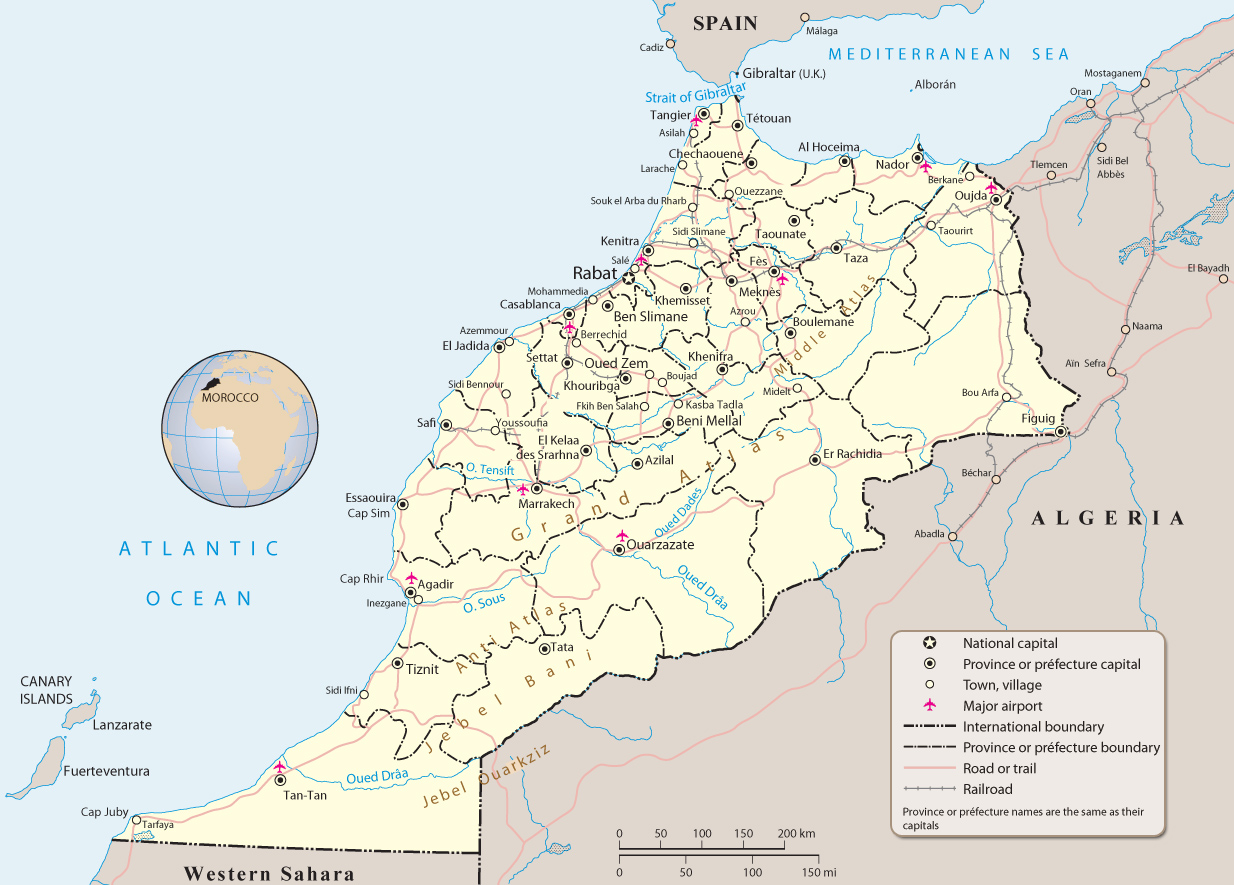
Map of Morocco

Map of Morocco. (Double click to enlarge this or any image)

We are off to Morocco on Sunday morning, June 9, 2019 for a week.  Very short adventure for us, but we are happy to have a special invitation from the Mayshad Foundation to spend several days in Marrakech at their annual festival.  So we will leave a bit early, stay 2 days in Casa Blanca and then drive to Marrakech.  Be back home on the evening of June 17.

Sometime in the mid-late 90’s we visited Morocco for a couple of weeks and drove all over the country with a very nice guide, whose name we do not remember.  He even took us to his home in Tangiers to meet his whole family and share a meal.  Here are some snaps I copied from the album.

We found the photo album, along with photos of our guide’s family, but there was not a single description or date anywhere, so, unfortunately, we are not sure when we were there.  On later trips I started adding descriptions and dates.  We do remember spending a night in a bedouin tent in the desert, complete with camel transportation, Moroccan entertainment, lamplight dinner and breakfast.

A strong wind came up during the night and we woke up covered in sand.  While I slept through most of it, Mark remembers a miserable night.  In the morning a bedouin wrapped my head for our camel ride, which was followed by breakfast in a less windswept tent.

Now we are going back, but this should be a more comfortable adventure.  We learned about the Mayshad Foundation from Joel Revzen, the Classical Tahoe Conductor we met a few years ago during performances in Incline.  He has conducted programs in Morocco for the Mayshad Foundation’s guests and invited us to join him this year for a similar program.

The following is a description about the Foundation taken from their printed material.  I include it because our entire experience will be colored by the Foundation and its founder, Nezha Alaoui.  We will learn more as we go and fill you in.

Founded in 2014 and chaired by Nezha Alaoui, The Mayshad Foundation is an American-based NGO with offices in Morocco and New York.

The Foundation has structured innovative social projects in rural areas of Africa to benefit marginalized communities with focused efforts on women and youth. These projects aim to improve the living conditions of these communities through the launch of income-generating activities.

The field projects established by the Foundation are the result of consultations with local communities, the expertise of their team and the solutions that emerge from meetings and conferences organized on topics such as education, entrepreneurship and mobilization of women and youth and their roles in civil society.

The Mayshad Foundation creates thoughtful and innovative solutions to local issues. Through various programs, it aligns itself with the Sustainable Development Goals of the UN 2030 Agenda.

The Foundation gathers experts, world leaders, and community members to discuss a variety of topics and themes with a goal of providing innovative and pragmatic solutions in order to achieve defined Sustainable Development Goals.

It then launches tailored sustainable actions as a result of the solutions determined by those leaders and community members.

The Mayshad team’s experience combined with successful outcomes of the conferences allow them to maximize value and strengthen the impact of their actions in the field.

To visit their website go to: https://www.mayshadfoundation.org

Now you know as much as I do.  I will send posts as I have photos and experiences to share.

Love and Hugs to you all,

Julia and Mark

Antarctica!


December 22, 2018

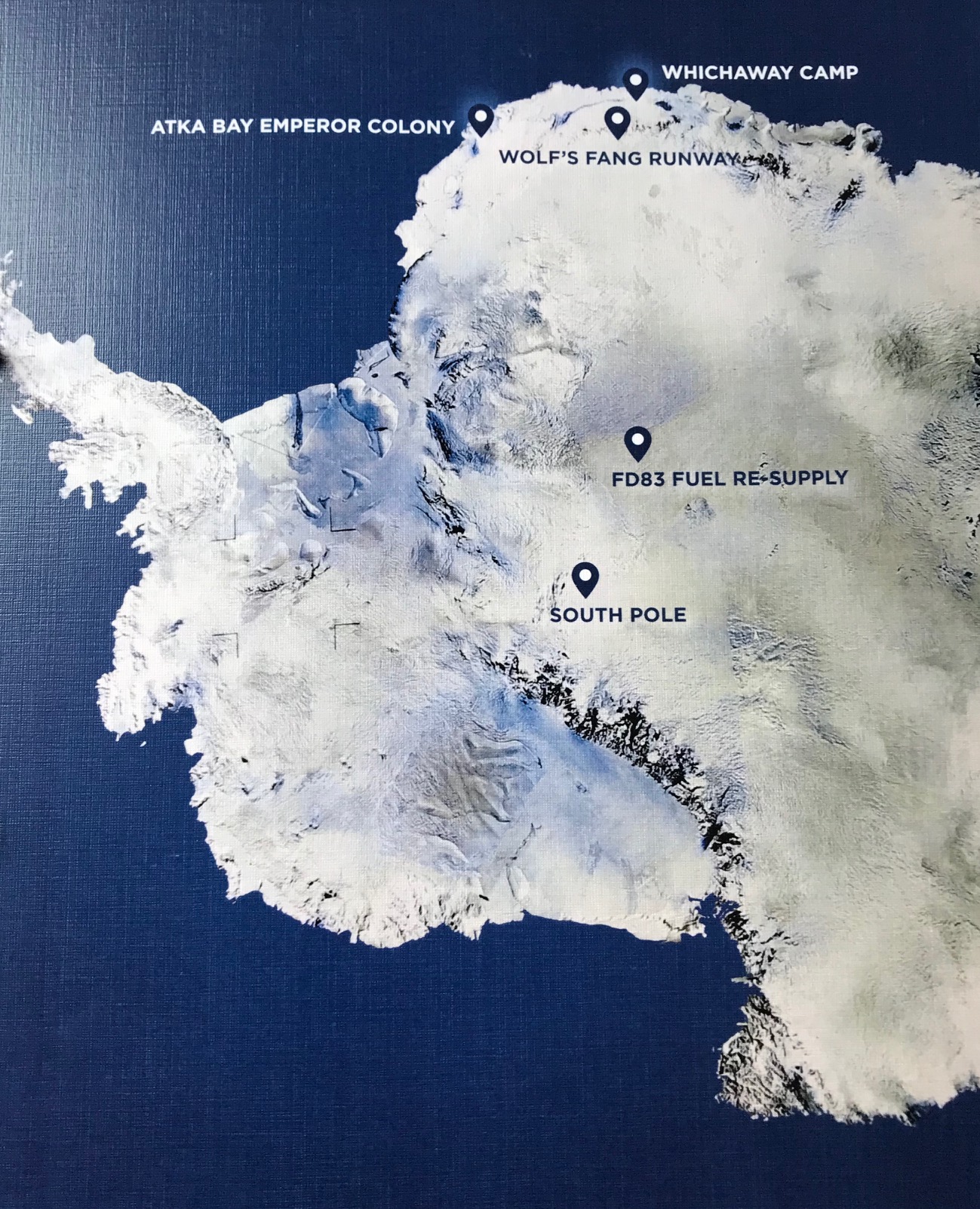
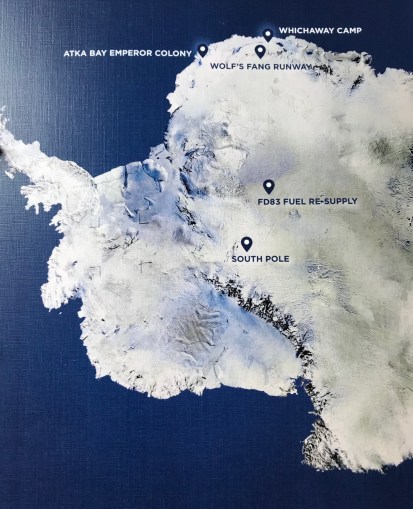
Map of Antarctica

Map of Antarctica with White Desert facilities marked.

Mark and I were picked up at Ellerman House at 4:15am on the 22nd and driven to a building on the General Aviation side of the Cape Town International Airport, where we met the other members of our group and had a cup of coffee.  Once everyone had arrived, we were then driven together to the international terminal, where we went through immigration to exit South Africa and a security check, both processes of which were expedited.  Another short bus ride brought us to the Gulfstream 550 and everyone piled on.  I was assigned seat 9, facing aft and Mark was assigned seat 13, facing sideways on a sofa.  Lift off was at 6:15am.
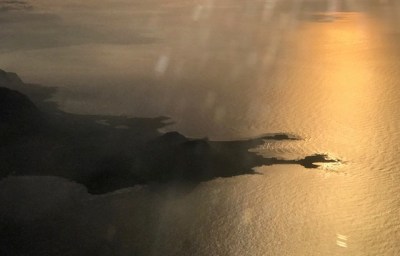
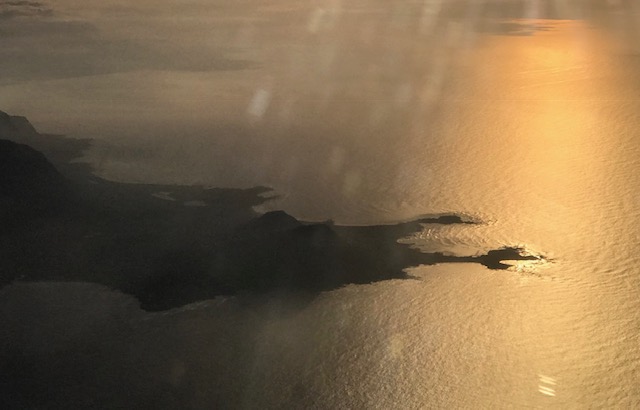
The Cape of Good Hope as we leave Africa.

The Cape of Good Hope as we leave Africa.

I managed to get a sunlit photo of The Cape of Good Hope as we passed by it heading south.  Once the plane leveled off, people moved around to chat and get acquainted. Besides us, two of them had been to North Korea and one had been to the North Pole.  Where is there to go when you have been nearly everywhere?  Everyone speaks English, but not everyone lives in the US.  One woman is Ugandan and lives in Kampala, but does not yet know of The Kellerman Foundation.  Another is German and lives in Dubai.  A father and son live in Boston.  Three people live in San Francisco, one lives in New York, three live in Tokyo.  And us.  Thirteen in total.
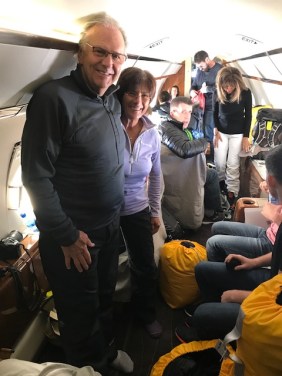
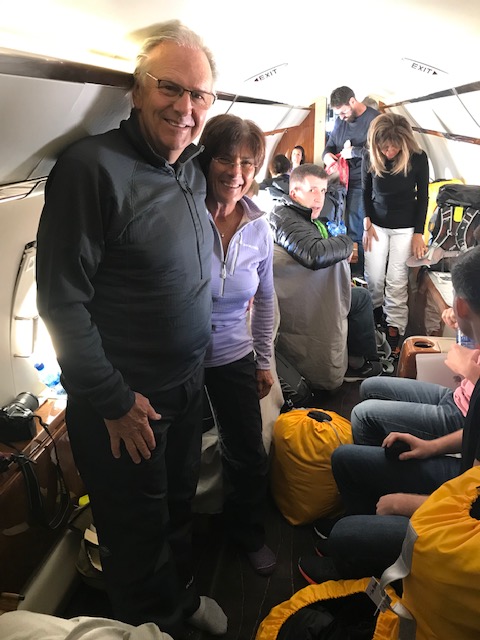
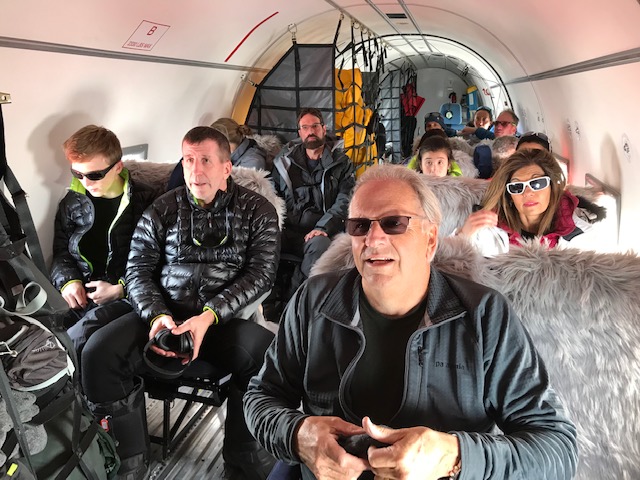
The cluttered cabin in the Gulfstream.

The cluttered cabin in the Gulfstream.

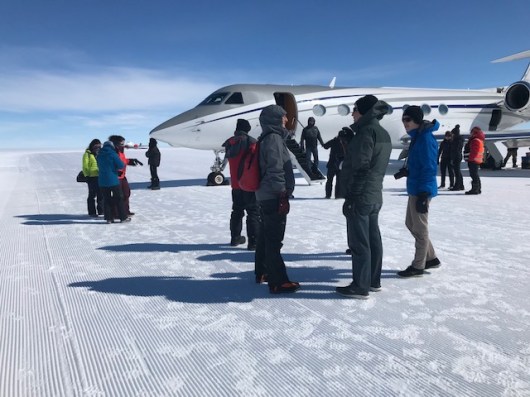
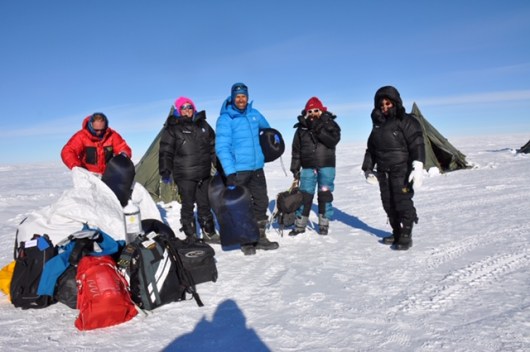
A cabin attendant served us box lunches and drinks.  The flight lasted just over 5 hours with everyone chatting to get acquainted.  Thirty minutes out, everyone was scurrying around putting on warm clothing and South Pole gear provided by the tour operator, White Desert—Baffin Boots and a super padded down jacket.  The inside of the cabin looked like Christmas right after 13 kids had opened all their presents.  The cabin attendant was having a fit.  We managed to get organized just before landing at Wolf Fang airstrip in the far north of Antarctica.

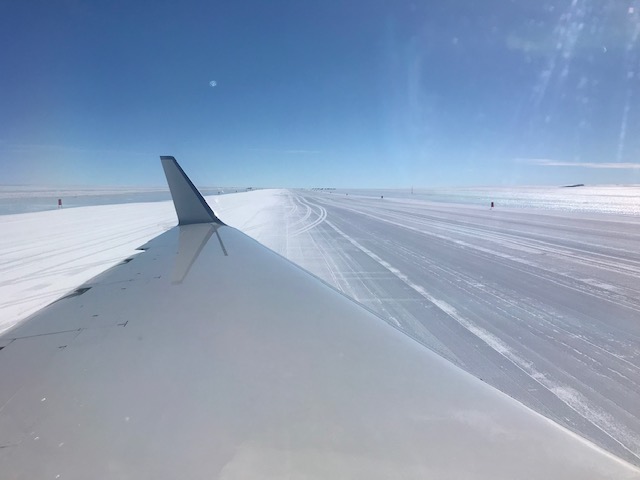
The corduroy runway as we begin to taxi back after landing.

The corduroyed Wolf Fang runway as we begin to taxi back after landing.

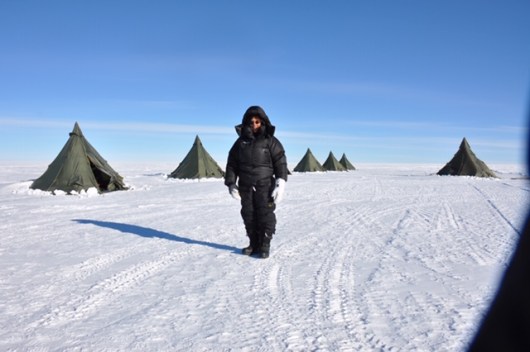
Once outside the plane, we were glad to be wearing all the gear, but were soon surprised that the day was bright, sunny, wind free and almost warm.

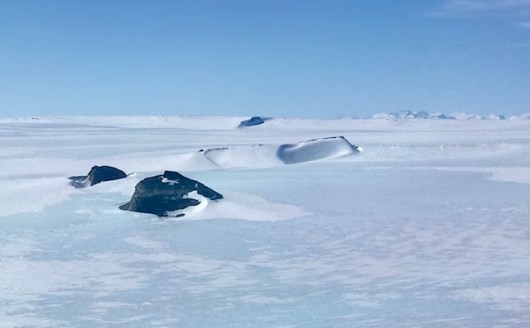
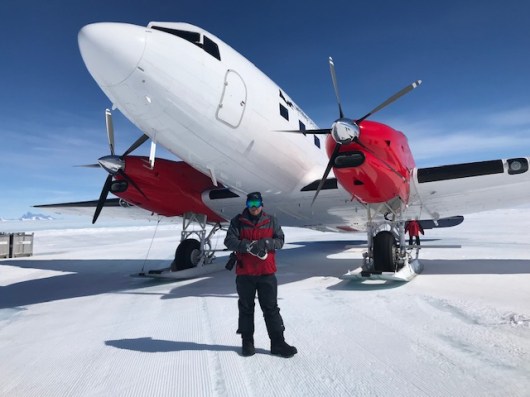
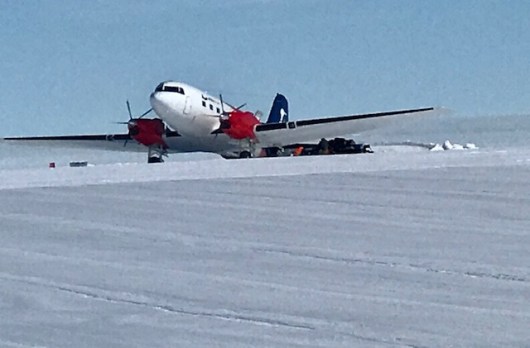
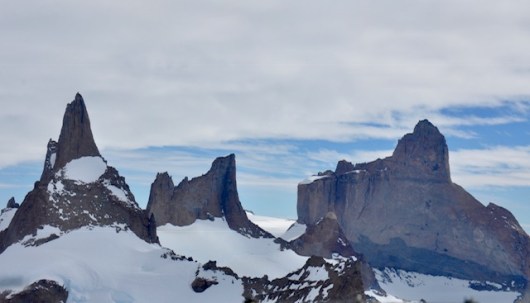
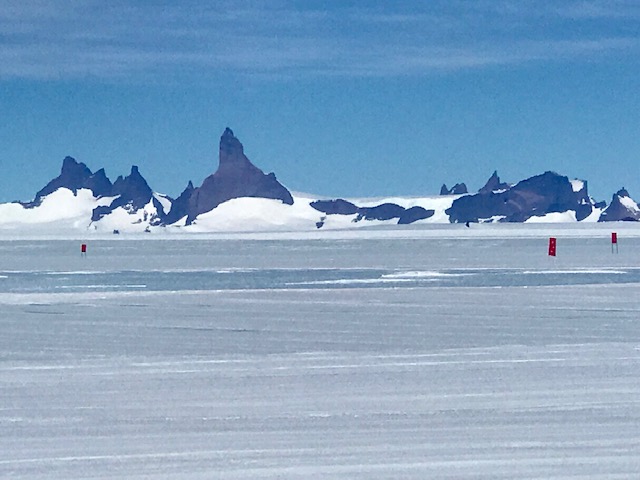
It was a balmy 30 degrees Fahrenheit.   Feeling completely comfortable, my anxiety evaporated as we looked around at the all-white scenery with a few snow free, rocky peaks in the distance, including Wolf Fang.  We walked down the recently corduroyed runway, similar to what is done on icy ski slopes, to the only other plane on the field, a Basler BT-67 fitted with skis for our next leg of the journey.  It is a retrofitted DC-3, originally built in 1946, and Basler is the company that provided the modernization.
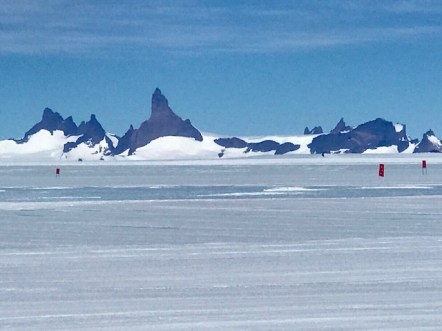
Wolf Fang Mountain from the runway.

Wolf Fang Mountain from the runway.

One enters at the back and walks uphill to the seats.  The plane has been retrofitted with new, turbo prop engines, but is not pressurized.  it is mostly heated, depending where one sits.  The warmest seats are nearest the cockpit.  Luggage is stored on one side of the cabin.

It is a tight fit with poor window visibility.  Mark and I ended up in the last seats on the first flight  and could see almost nothing.  The plane is noisy, slow, cold and not very comfortable.  One benefit.  We were the first ones out when the plane landed, after 25 minutes, at an airstrip very near Camp Whichaway.  We piled into two big trucks with huge tires, a 4×4 and a 4×6.  I needed a ladder to get into either one. The drive to camp was slow going over bumpy ice and snow.  We hit solid rock just as we entered camp.

Once at the Camp, we were welcomed into the living room, served champagne, given a short briefing and told to change our clocks to Greenwich Mean Time for the duration of our stay in Antarctica.  Then we were served tomato soup for lunch and assisted to our rooms.

A sign near the entrance told us we were at White Desert’s Whichaway Camp at 70*45’49”S by 11*36’59”E, well within the arctic circle, which starts at 66.5 degrees south of the equator and circumscribes the southern frigid zone.  The elevation at camp is 480 feet above sea level.

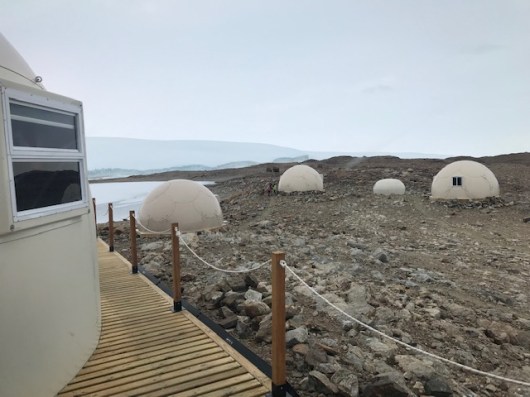
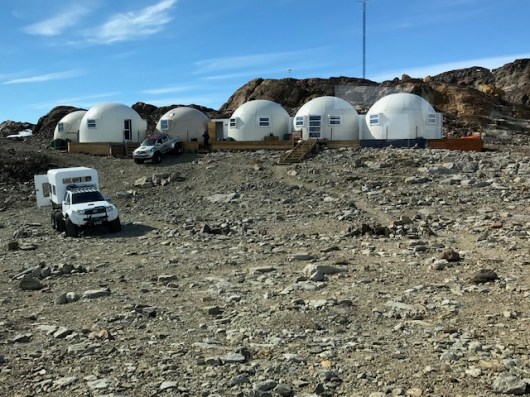
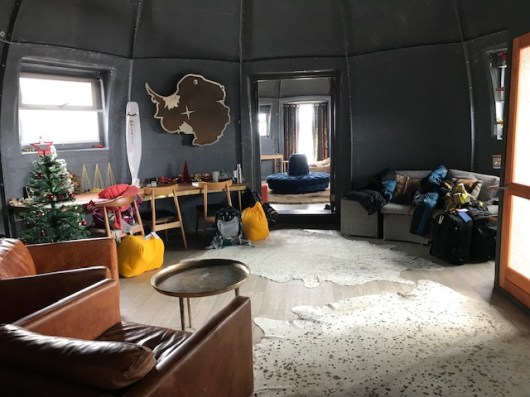
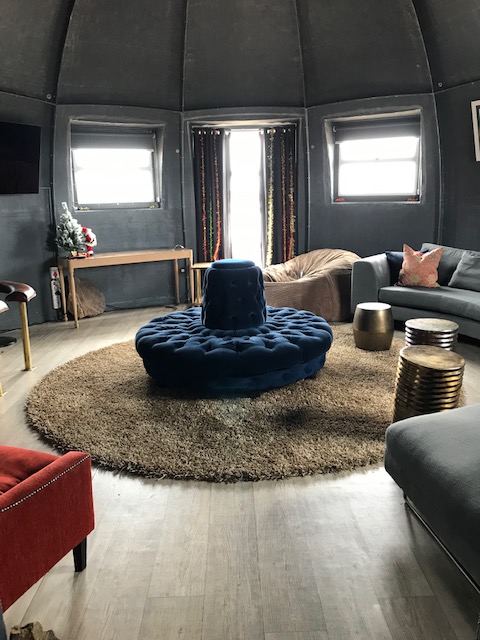
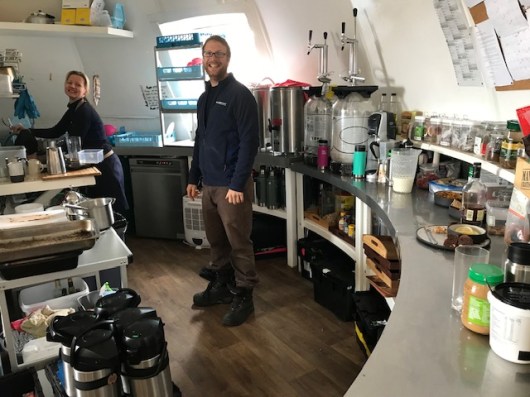
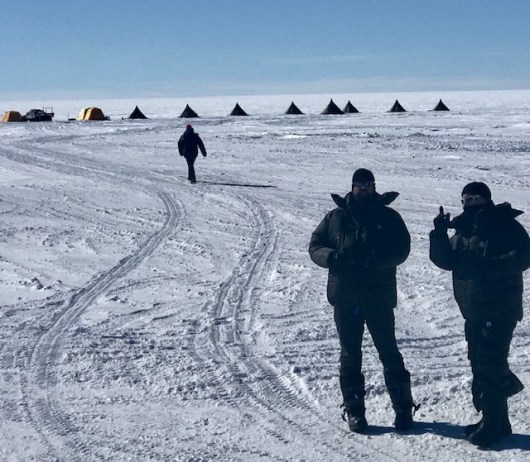
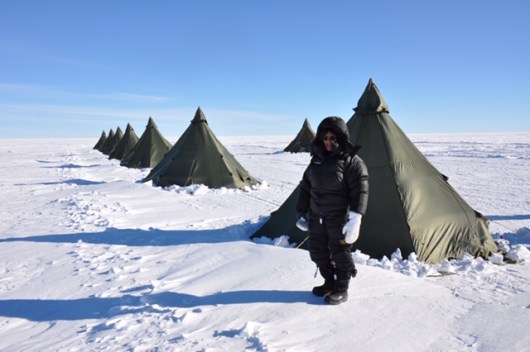
There are 7 pods scattered about the camp as well as a connected set of 4 pods for living, library, dining and kitchen.  A separate pod next to the kitchen was nicely heated and contained three private shower rooms and additional bathrooms.  Mark and I were assigned to the Cook pod, named after Captain Frederick Cook, an early arctic explorer.  The slightly elevated pod is 20 feet in diameter with a dome that curves gently from waist height to 20 feet.  Inside is a king size bed with down comforters, a desk and chair, a dresser, shelves and rack for clothes.
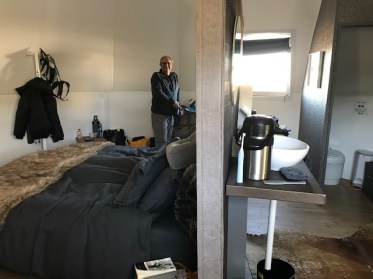
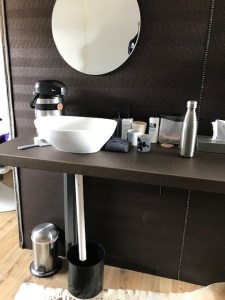
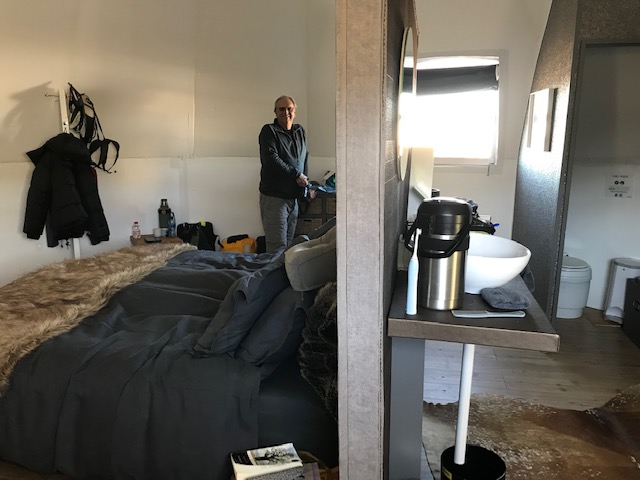
Inside our pod, divided by a partition into bed and bath.

Inside our pod, divided by a partition into bed and bath.

Behind the bed is a table with a sink and room for toiletries and a bathroom.  Water for the sink is provided by a large hand pump thermos with warm water.  The sink drains through a pipe into a bucket on the floor.  There are 2 toilets, one for pee and one for poo, and a closed bin for used toilet paper. Do not confuse what goes where. And for goodness sake, do not pee in the poo toilet.  It took a couple of uses to get coordinated with the operation.
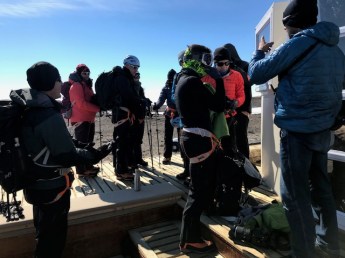
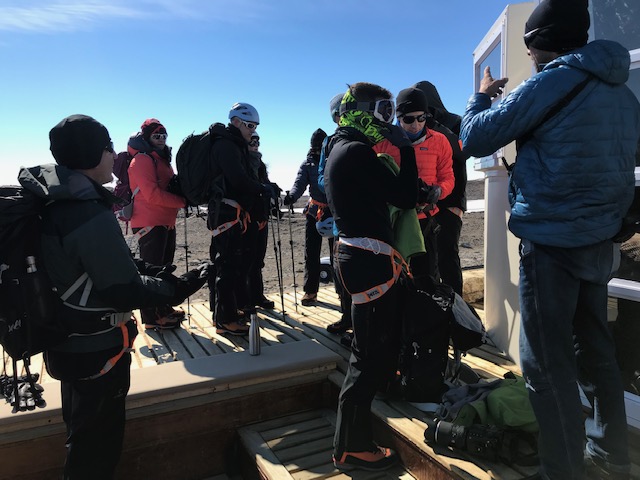
Getting outfitted for all our activities

Getting outfitted for all our activities

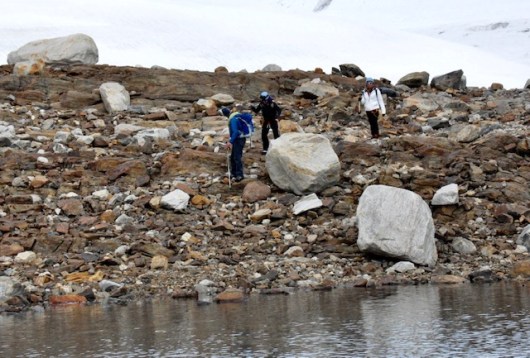
After unpacking, we met in the living room pod at 4:30 GMT.  With constant daylight, it is weird to adapt to such long days.  The plan was to go for a “short” hike.  First, we were each outfitted with crampons, harnesses, walking sticks and helmets.  As the day was sunny with almost no wind, we did not need heavy clothing.  Then we started walking right from camp over a rock and boulder field.

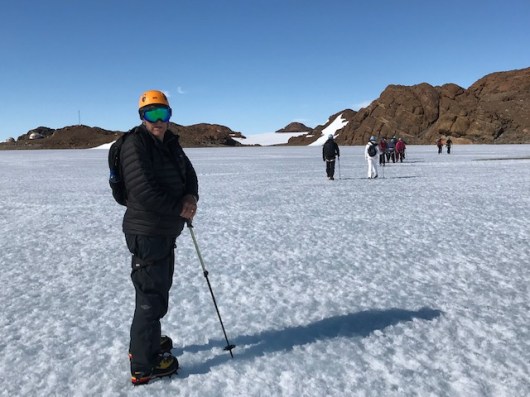
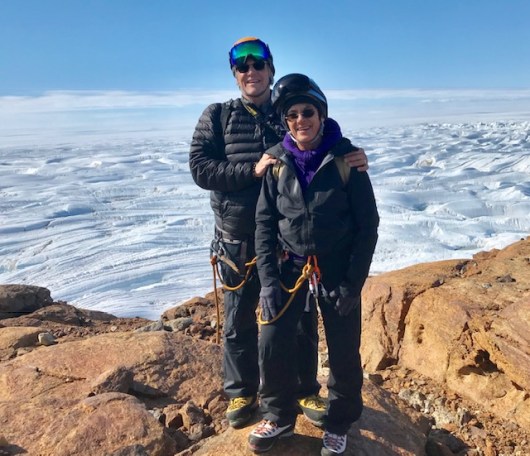
I had a hard time between my bad knee and poor balance, but I was determined to go.  I soon fell behind.  One of the guides noticed and gave me his walking stick so I had two.  That helped.  Still, I was slow.  Finally, after half a mile of rock, we reached the snow and ice pack and put on the crampons. I was thrilled to walk comfortably on the ice and snow.
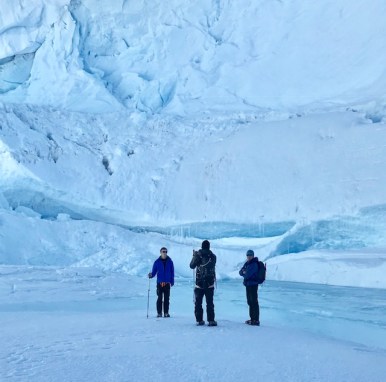
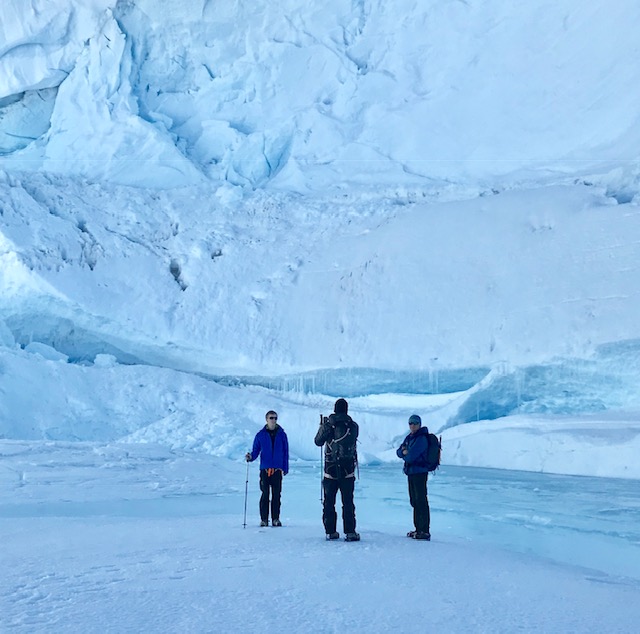
Some perspective on the glacier scene

Some perspective on the glacier scene

These were serious crampons.  We walked up hill and downhill taking in the view and gradually made our way back to camp. It felt great to be outdoors and get some exercise.  Dinner was ready when we returned.  Slowly we are getting to know each other and remember names.  It is a strange mix of folk, and there was little conversation the first few meals.
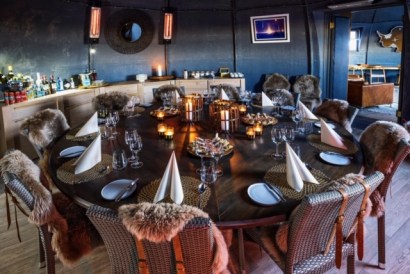
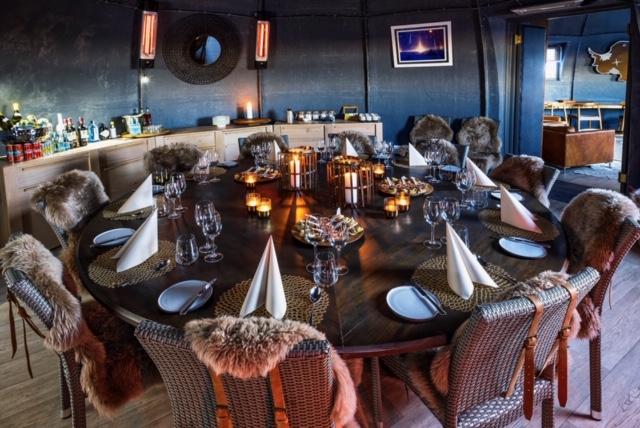
The dining room table set for dinner.

The dining room table set for dinner.

Error
This video doesn’t exist

After dinner, John, the camp manager, informed us that the weather was perfect for us to fly to the South Pole the next morning and to be ready for breakfast at 9:30am.  Although we were only beginning to adjust to being at the camp and we were all tired, there was sudden rejuvenation. We went to our pods to prepare for the overnight journey to the pole and then dove under the comforters on the very comfortable bed.

December 23, 2018

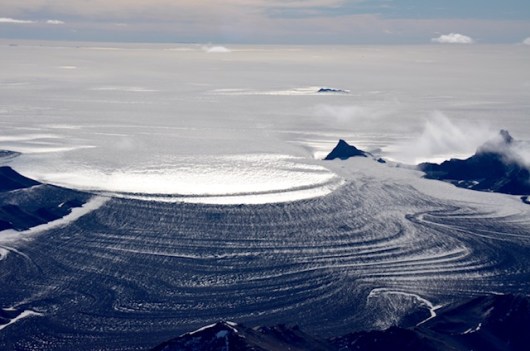
We were all ready to go, when John told us there was a delay and to relax until further notice.  So, at 11:30am, he gave us a slide presentation about White Desert. First there was a super map showing where everything we wanted to know about was located. (See the map at the beginning of this post). Antarctica is twice as large as Australia.  It covers 8.9% of the earth’s surface.  The highest peak is Mt Vinson at 16,066 feet high and the lowest point is in the Bentley Subglacial trench at 8,383 feet below sea level.  The visible mountains are located generally on the edges of the continent with 95% being covered by the polar plateau, averaging 5,249 feet, almost a mile, thick.

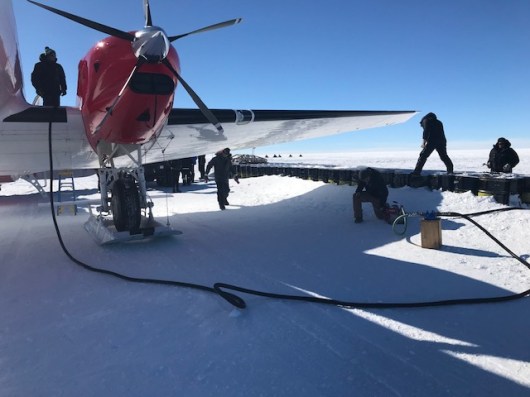
Then, he told us how things work in the Antarctic and why the cost is so high.  Most importantly is the fuel.  There has to be enough of it and it has to be where it is needed.  There is a ship depot that brings fuel to the edge of the ice on the north coast.  White Desert, as well as other users such as scientific stations pick up fuel at this depot and transfer it to where it is needed.  For example. the Basler, using skis, takes on fuel and flies it to the Whichaway skiway for use at camp.  For every gallon of fuel delivered for use, two gallons are used getting it there.  Fuel is also transferred by sled from the ship depot to Wolf Fang Airport, one of only 6 capable of handling large aircraft with tires in all of Antarctica, as well as to Depot 83, where the Basler stops to refuel to complete the trip to the pole.  The 2018 ground transfer to Depot 83, 1,740 miles from the coast where the fuel was offloaded from a ship, took 28 days.  White Desert has no access to fuel at the pole, so the Basler must carry enough to go and return from Depot 83 (at the 83rd parallel).

Then there is maintenence of the aircraft, vehicles and camp facilities, collection and purification of water, delivery of food, management of waste and more.  No wonder the trip was so expensive.

Shortly after 1pm, we drove to Whichaway skyway and flew to Wolf Fang to top off the Basler.  Then we head for Depot 83, where we will refuel again.
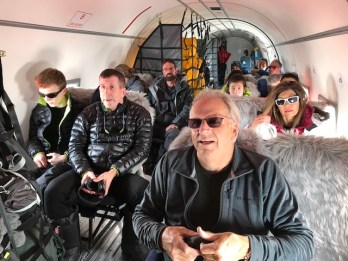
Inside the Basler. A tight fit.

Inside the Basler. A tight fit.

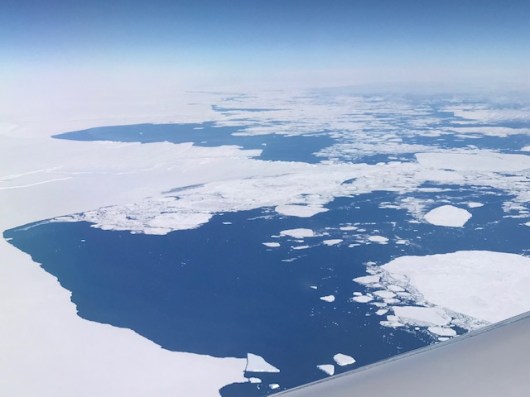
Mark and I get the two seats in the front of the plane and have a good view out the window and toasty warm heat.  Shortly after takeoff we saw a large mountain range poking through the ice cap.   Then there was nothing but the polar plateau the rest of the way to Depot 83 and the South Pole.

At Depot 83 we land at 5:50pm.  The plane was fueled, the pilot received his legal 9 hours of rest and we spent the time keeping warm, eating freeze dried food with boiling water added to make it palatable.  Then trying to sleep in private tents.  The sleeping bags provided were very warm and with our blowup pillows, Mark and I managed some sleep.  Unlike some of the group’s experience, our 6” high cots did not collapse.  Several people said they did not sleep at all.

Two difficulties were the altitude, 8,200 feet at the depot, and the very bright daylight. It was certainly the most difficult time of the trip.  I wasn’t even sure if it was day or night.  At 2 in the morning, Mark jerks me awake and says its time.  I felt like I had just fallen to sleep.  Up and out it was.  We took off from the depot at 3:15am.  It seemed like it should be night instead of day.  Never mind.  We are on our last leg to the South Pole.

Christmas Eve at the South Pole, 2018

We arrived at the pole at 5:45am.  The temperature was  minus 20 F.   it was a bright, sunny day with a 20-knot wind. The elevation is 9,301 and we were given 2.5 hours to walk around and take in everything we could.

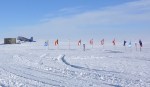
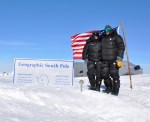
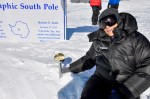
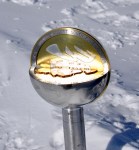
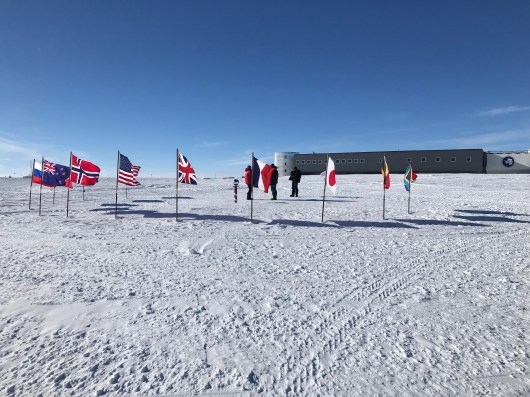
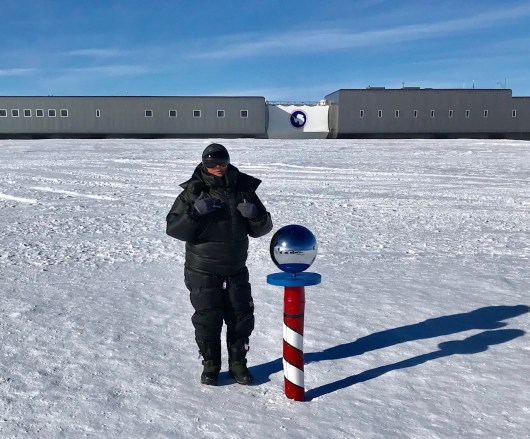
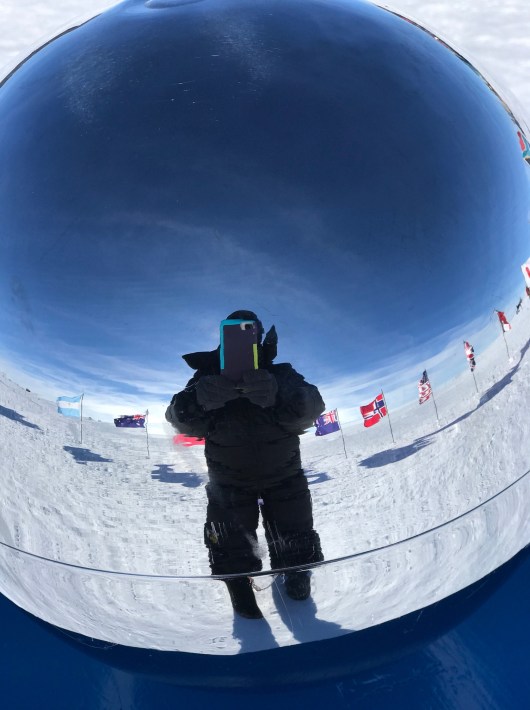
First stop was the ceremonial South Pole with flags from the original 12 countries that first signed the Antarctic Treaty, IAATO, in 1961, reserving the continent for science only.  It is colorful and appealing, but not the real thing.  We all took many photos anyway.  Second stop was the Geographic South Pole, which location is changing slightly every day. A lovely marker indicates the spot as of January 1, 2018.  In just a few days, a new marker will be planted in the correct, readjusted Magnetic location for January 1, 2019.  This Magnetic Pole is the location that Amundsen reached on 12/14,1911 and Scott reached on 1/17/1912.

The place gave me pause to reflect on the polar explorers and what it took for them to succeed in reaching the bottom of the earth.  Even arriving by air as we did, was not a snap.

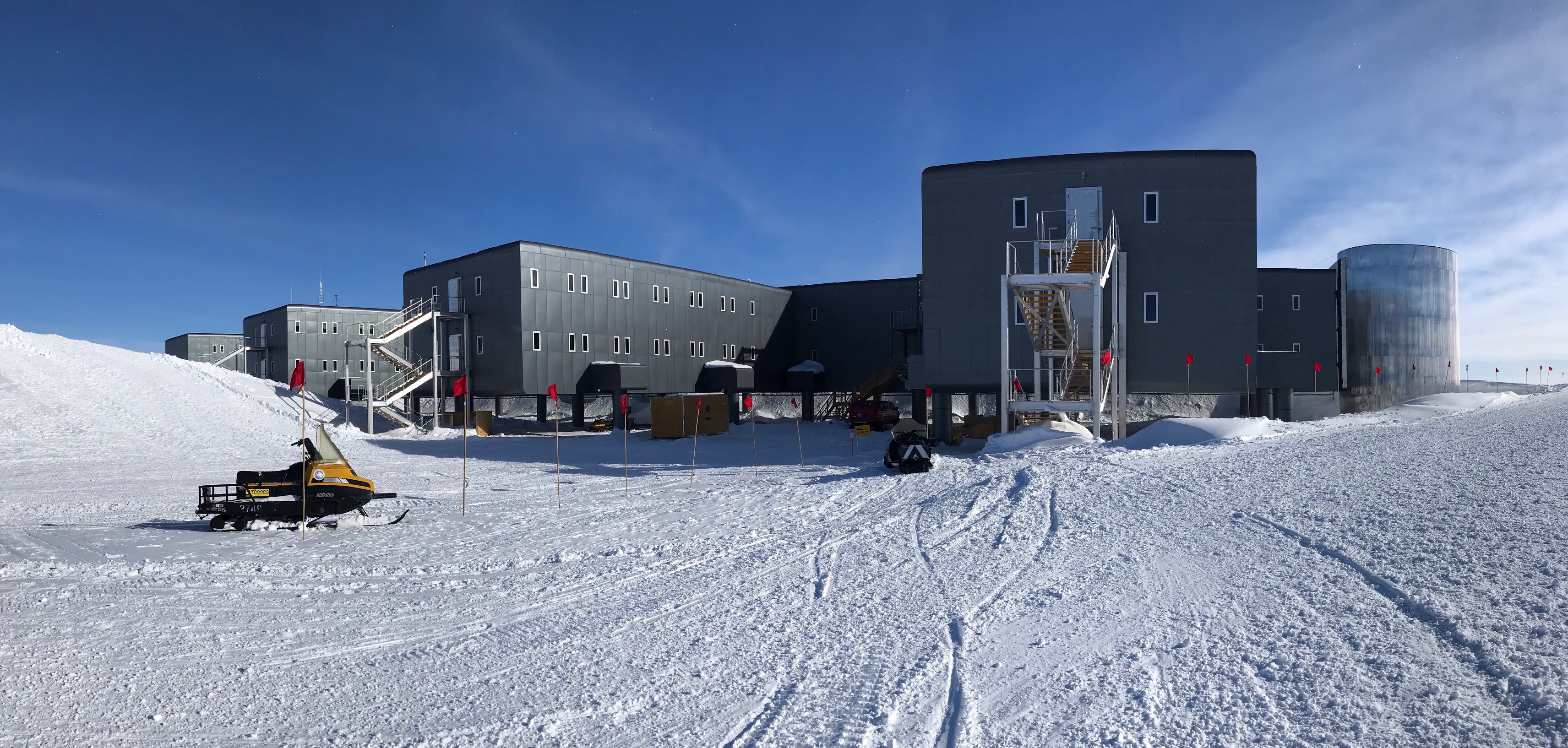
We walked around the huge housing facility that accommodates 150 scientists plus staff, kitchens, dining rooms, living rooms, sports facilities, a movie theater, even a full basketball court. As it was Christmas Eve, no one was outdoors or working and we were not allowed into the residential facility.   Although disappointed, I could not begrudge them wanting their time off.  Apparently, the science projects are all outdoors.  Although we could see several piles of equipment and machines, we had no idea how or why any of it was used.  I wanted to stay longer and linger with my thoughts. Unfortunately, our time was up and we had to return to the plane.

We departed the Pole at 7:30am and landed back at Depot 83 at 10:10am. Several of us were feeling reflective about what we had seen and felt.  There was a lot to absorb is such a short time.
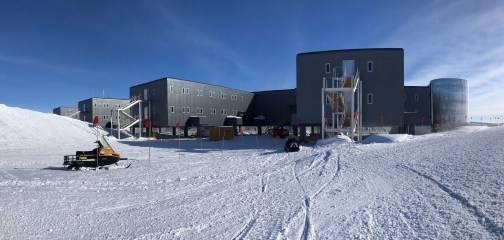
 

Side view of the residential building.

Side view of the residential building.  There is room for 150 scientists at any one time.

Refueled and departed FD 83 at 11:30am and arrived back at camp at 4:10pm.  It had been a whirlwind 1.5 days with virtually no sleep.

Everyone lined up for showers, had a very nice Christmas Eve Dinner of ham and a variety of fixings and went directly to bed.
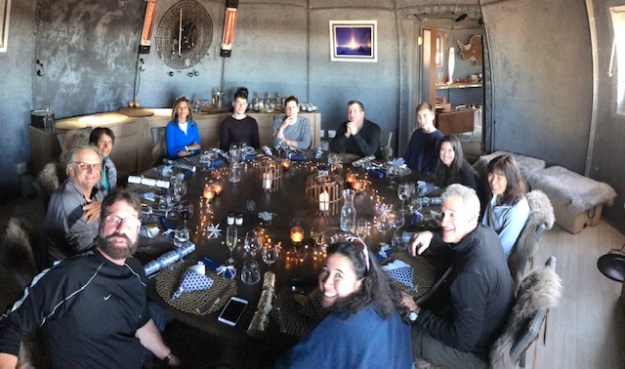
 

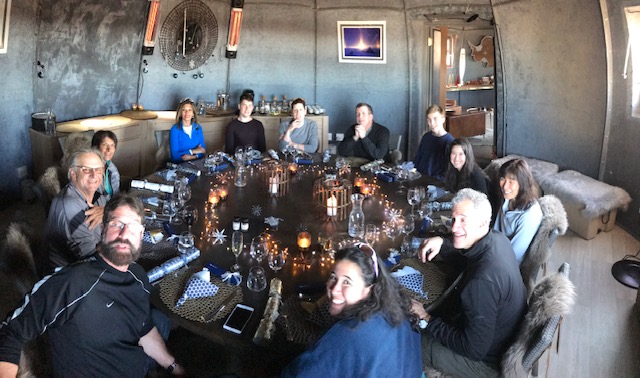
The dining room table will seat 13

The dining room table will seat 13.


Christmas Day with Emperor Penguins, 2018
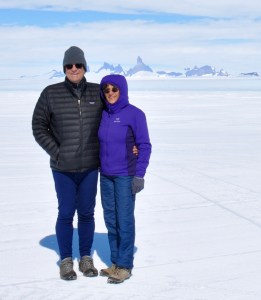
 

Waiting to board the Basler to see penguins.

Waiting to board the Basler to see penguins. Wolf’s Fang is behind us.

The weather is still holding up—warm and sunny with little wind.  We celebrated Christmas with the Emperor Penguins.  Breakfast at 7:30. Depart for airstrip at 8:30. Lift off at 9:15am.

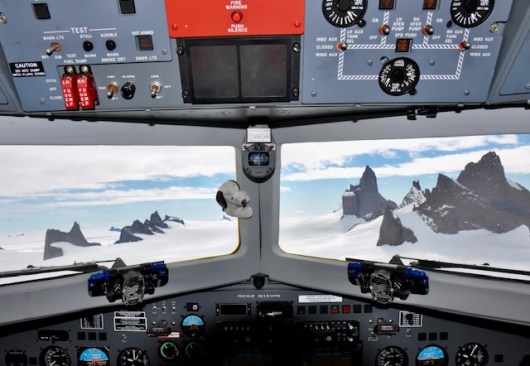
We flew to Wolf Fang—the airstrip there is 9,600 feet long–for fuel, then climbed to 8,200 feet for a mountain tour before heading for the flightless birds.  We flew around Wolf Fang Peak and several others with  Norwegian names.  I was in the cockpit for most of the flight and enjoyed the views and the conversation with the crew.  Gradually they descended to 4,000 feet before landing at a ski strip near the rookery.

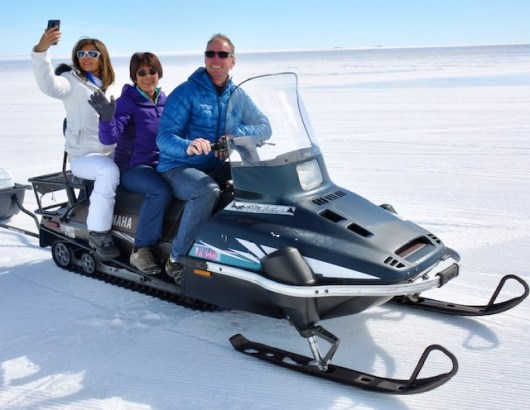
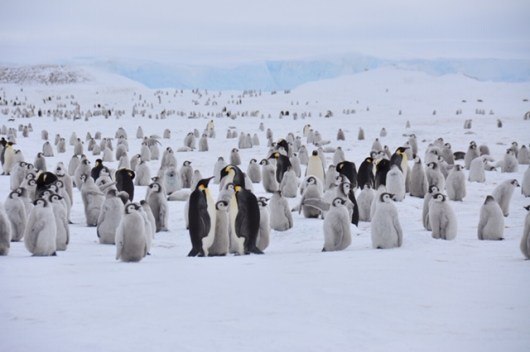
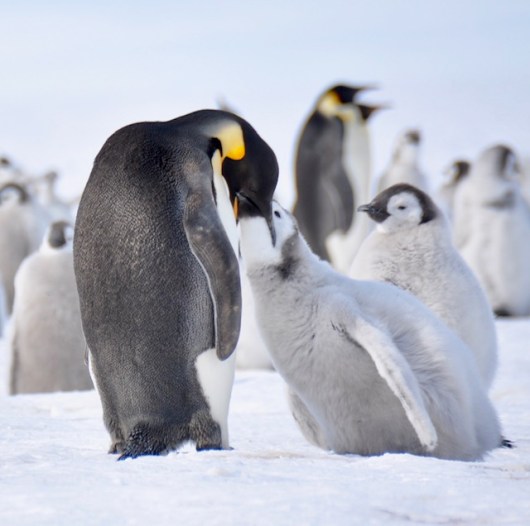
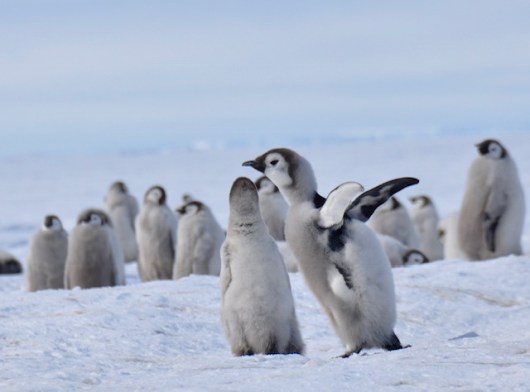
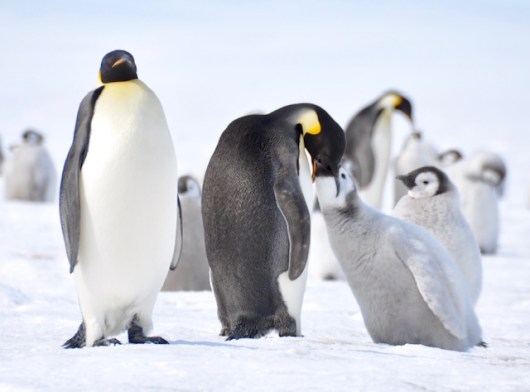
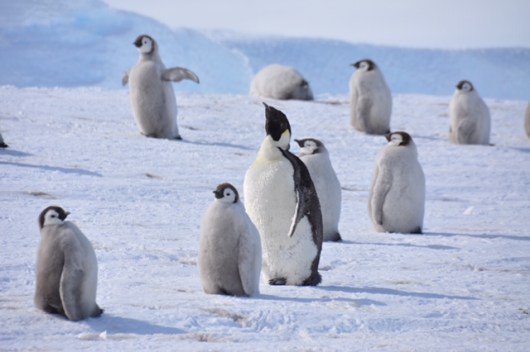
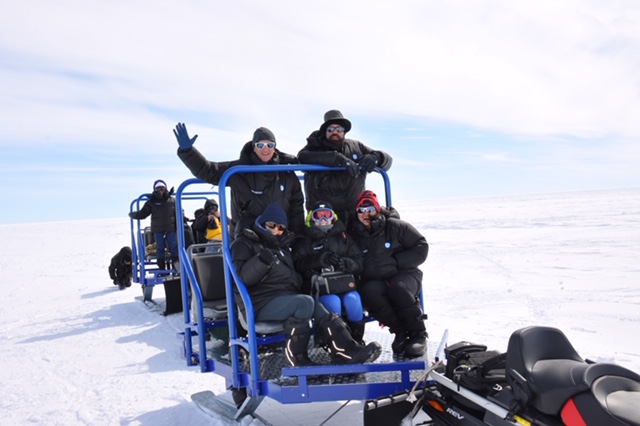
Upon landing everyone climbed onto 2 6-passenger sleds and were pulled to the penguins by snowmobiles.  There were at least 2-3 thousand animals in 2 different
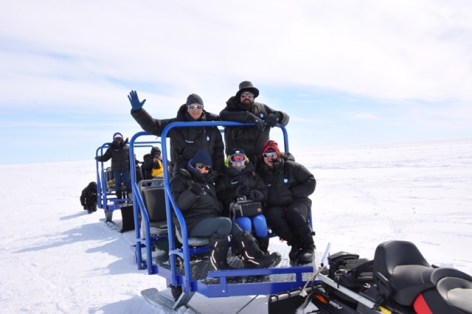
Sledding from the Basler to the Emperor Penguins

Sledding from the Basler to the Emperor Penguins

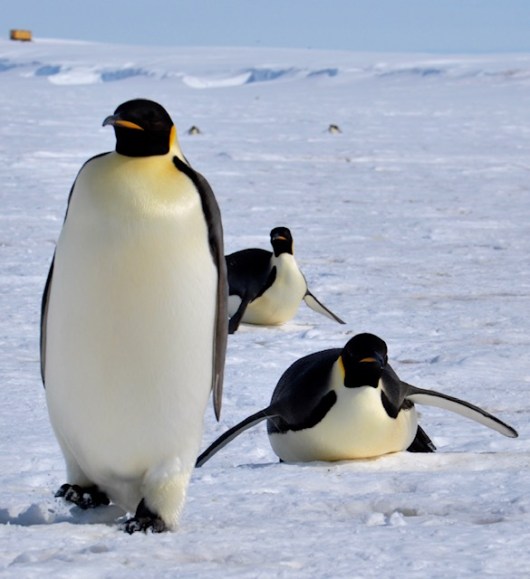
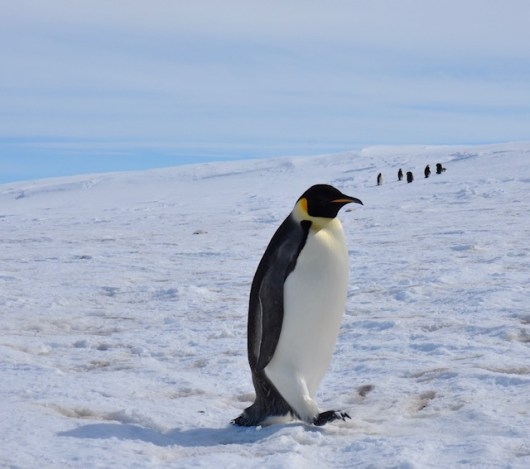
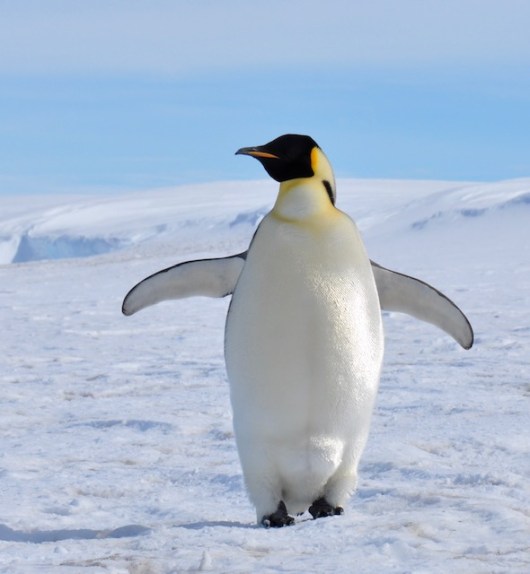
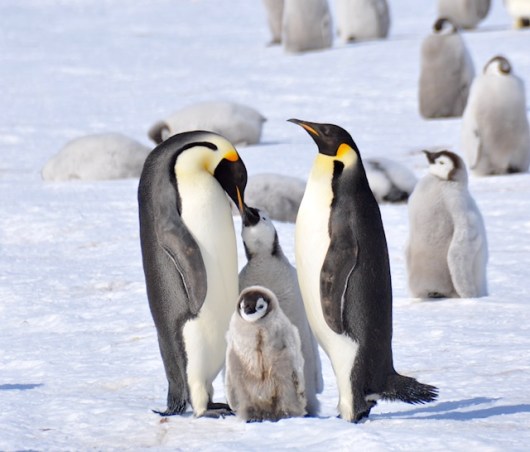
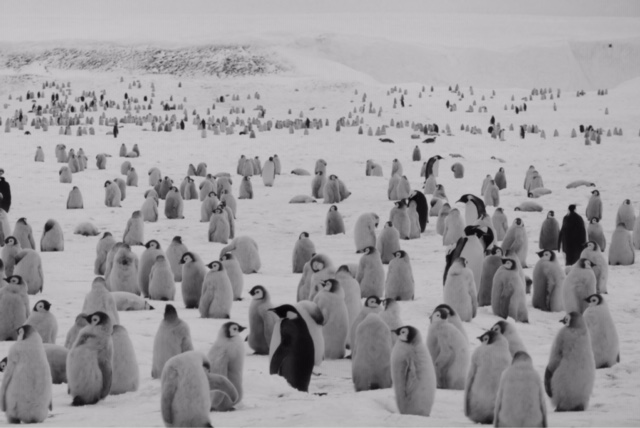
rookeries socializing with each other, feeding babies, wandering around on their bellies or by foot. We walked around and approached the penguins to about 50 feet.  Then we sat down on blankets and watched the action.  Several animals walked very near us.  We were with the birds for about an hour and a half and took photos like crazy.

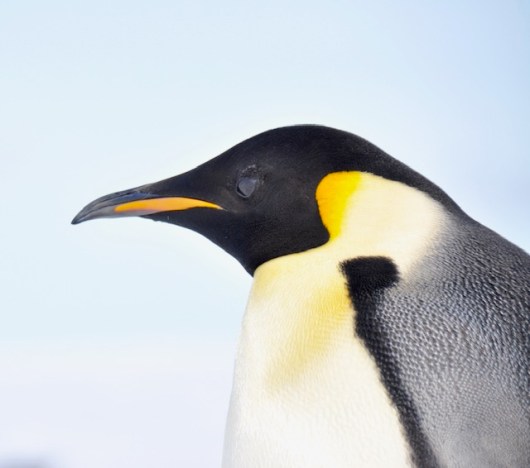
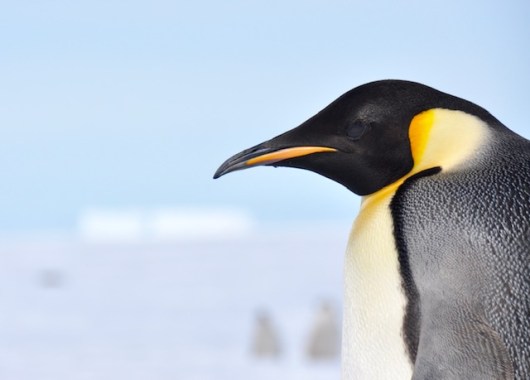
A bit about Emperor Penguins:

They live in the high Antarctic only.  There are about 40,000 breeding pairs.

 Are deep divers going mostly to 165 feet, but able to dive to 800 feet.  Longest recorded dive is 18 minutes. 

Their diet is 95% fish, 3% squid and 2% crustaceans.

They breed on the sea ice in the coldest conditions and can be independent of land.

They have no territory except the ice around wherever they are standing.

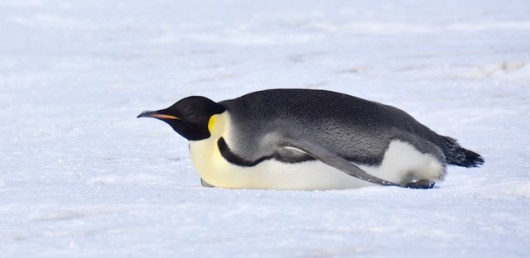
On land, they travel much faster on their bellies.

One egg per couple is laid in May/June, at the coldest time of the year and are incubated by the father until the eggs hatch at between 62 and 66 days.  The father feeds the chick its first meal of fat and protein.  By this time the father has lost 45% of his weight and leaves for the sea as soon as the mother arrives and takes over feeding.  When the dad gets back the parents share the feeding. The chick fledges in spring at 5 months. In good weather the chicks are carried out to sea by the collapsing sea ice.

Chicks stay in the ocean until sexual maturity at 4 years and then generally head for their natal colony. 

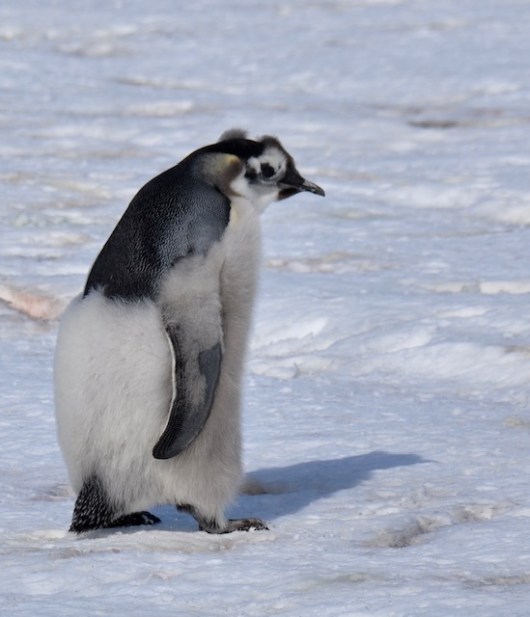
There were many dead babies laying around and several that looked near death that were apparently abandoned.  Many chicks were alone waiting for parents to return
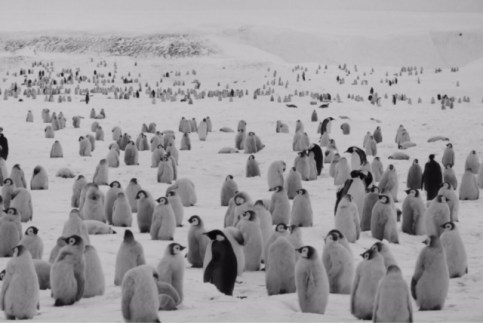
A huge colony of Emperor Penguins as far as the eye can see.

A huge colony of Emperor Penguins as far as the eye can see.

with food.  Some parents were there feeding chicks.  One bird was apparently trying to sleep.  I would have loved to be there longer to take in more of the experience.  There are no captions as the images speak for themselves.

Soon we were off in the sleds to find Wedell seals. It was a long bumpy ride over the ice shelf before we found any.  I was trying to imagine what such a ride might be like if I was trying to get to the pole over these conditions.  No fun.  Eventually we found 10 seals laying about napping.

They did not budge even when we got close.  Another fast ride back to another rookery for 15 minutes, then off to the plane for the return flight.  This time we flew to the ship depot for fuel and have now seen all of White Desert’s fueling stations. We left there at 6:45pm, flew to the camp strip, returned to camp and had a very uneventful Christmas Dinner.  I had wanted to offer a prayer, but was told not to as it would make some people uncomfortable. I finally gave up the notion and proposed a toast in thanksgiving for the penguins.  I may be the only one who cared about Christmas.  The staff had put a party favor at each place, decorated a small tree and put a few decorations around.  Nothing religious.  I had a copy of the Reflections of Father Bill with me and read his Christmas homilies to myself.

December 26, 2018

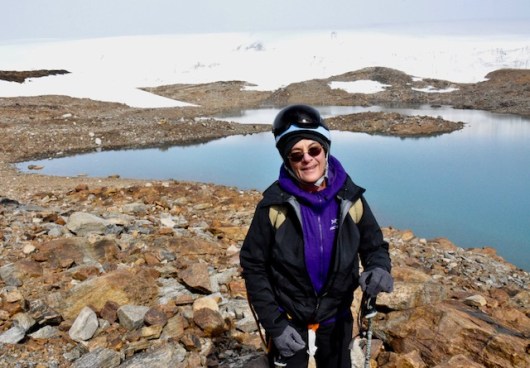
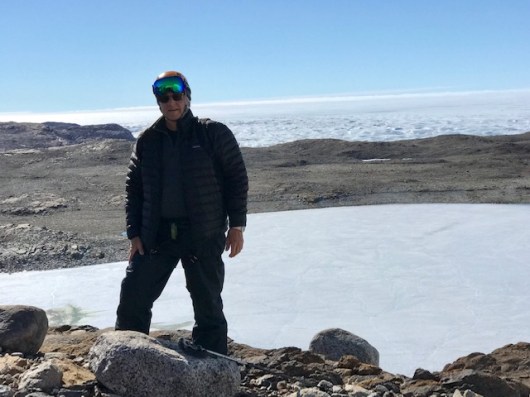
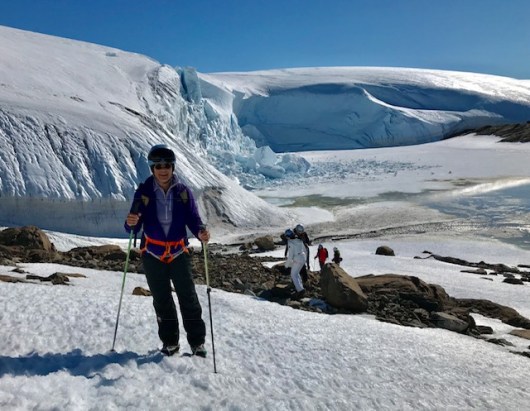
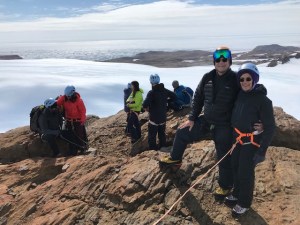
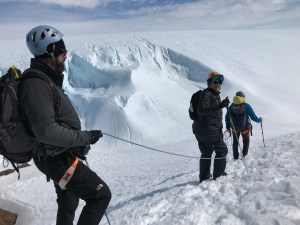
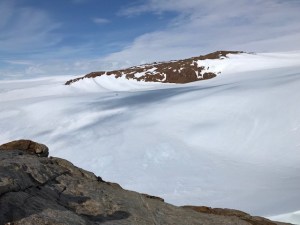
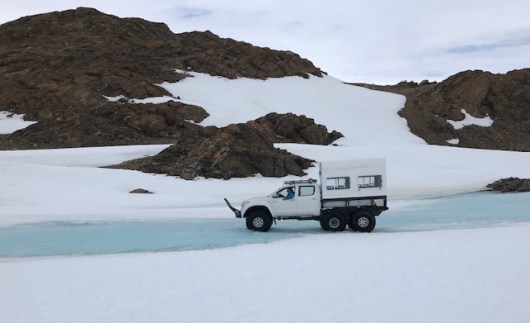
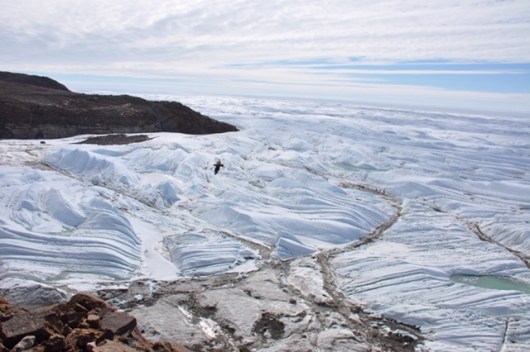
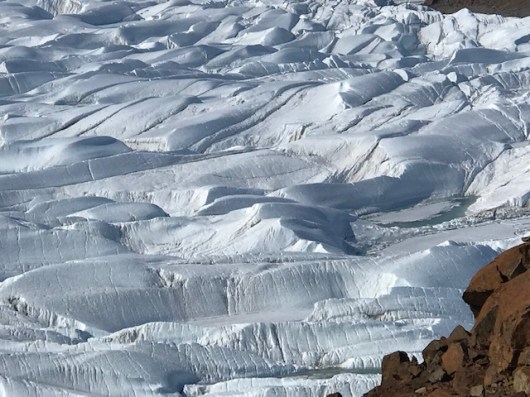
With the big events behind us, we could focus on activities around camp.  On the 26tha group of us went on a hike to the nearby nunatak, an exposed hill with no snow on it.  First they were to hike over rock, so I bailed on that part.  Driver Matt, took Francois and me by truck to an area where I could climb the snow covered hill with crampons.  We had a very nice hike and got to the nunatak at the same time as the others. Then we all hiked the short distance to the top of the hill.  Very nice views.  On the way back Francois and I took a different route and ended up hiking through thin ice with flowing water underneath.  We walked very fast in the wet parts and did not get much water in our boots.  The air is so warm that the snow is turning into rivers of melt water.  Did not feel like the Antarctic to me.

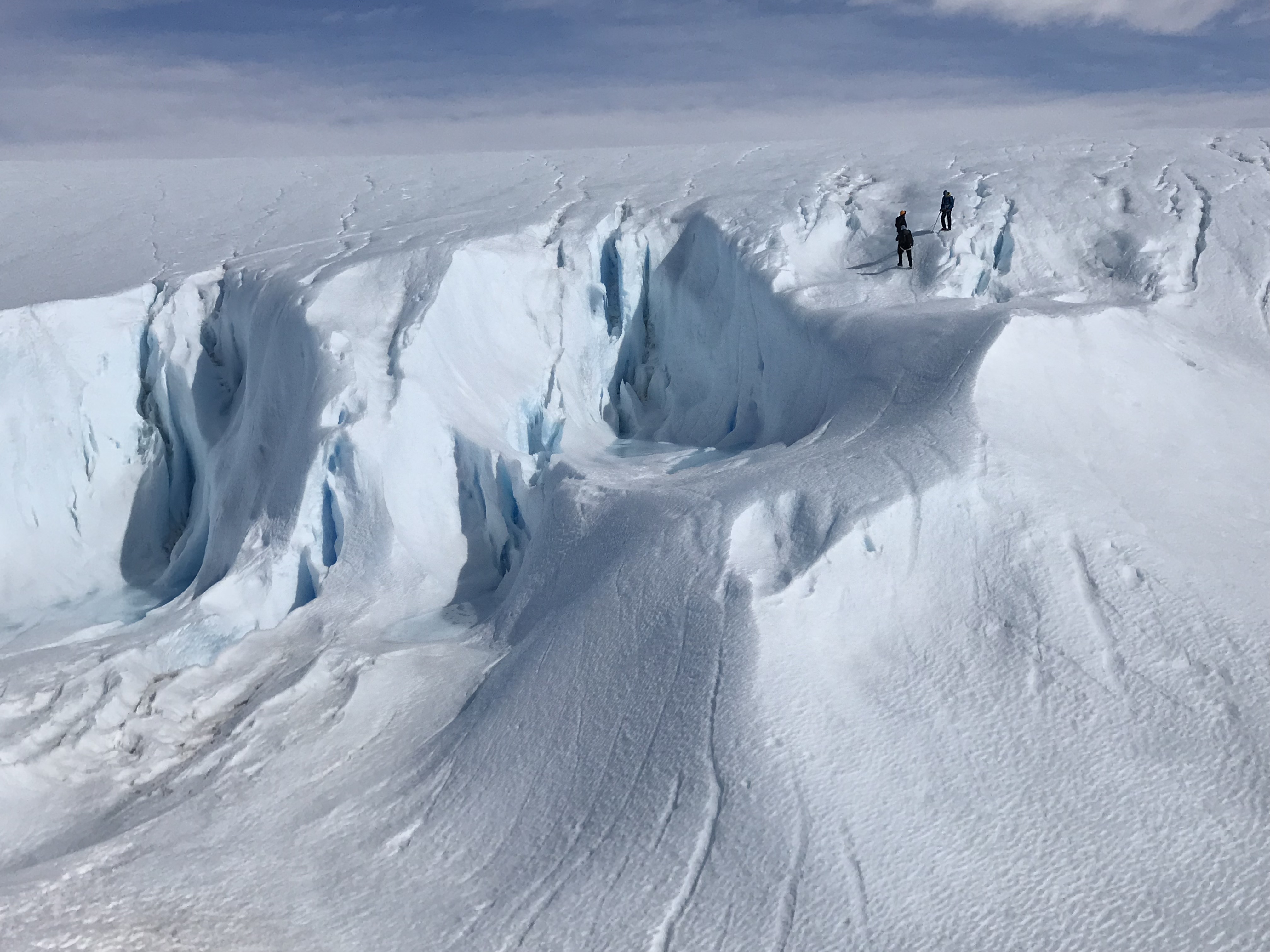
Climbing the glacier while avoiding crevasses. They are not far away, but distances are very deceiving.

Climbing the glacier while avoiding crevasses. They are not far away, but distances are very deceiving.  They are the black spots in the top center right.

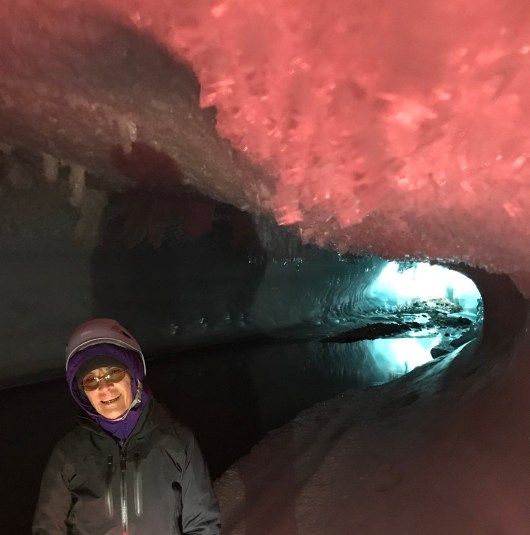
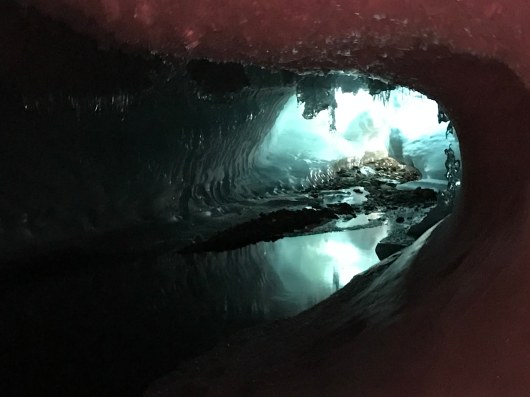
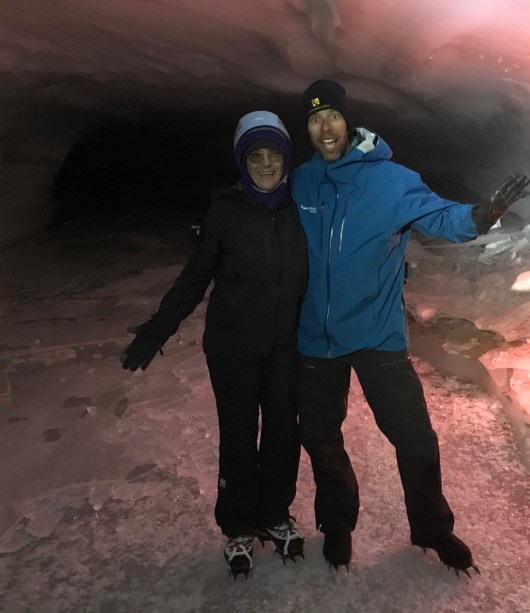
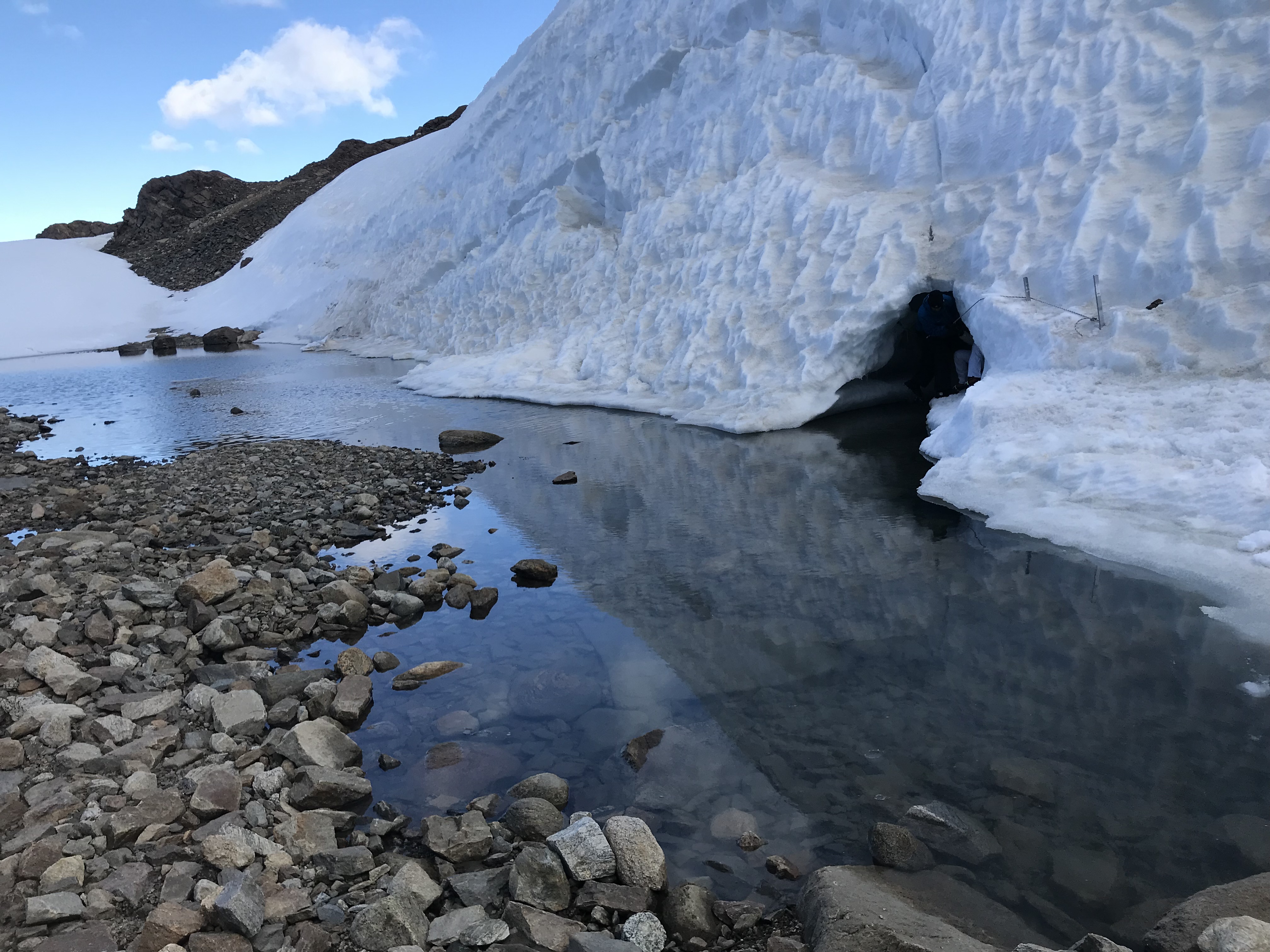
After lunch and a rest, another group of us went to see a nearby ice cave.  The entrance was partially blocked by running water, so the guides rigged rope so we could straddle the 10 feet over water into the dry part of the cave.
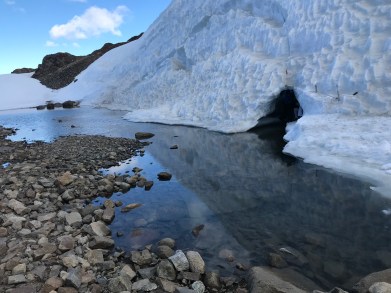
Entrance to ice cave. Not easy to straddle the opening and stay dry.

Entrance to ice cave. Not easy to straddle the opening and stay dry, but we all managed.

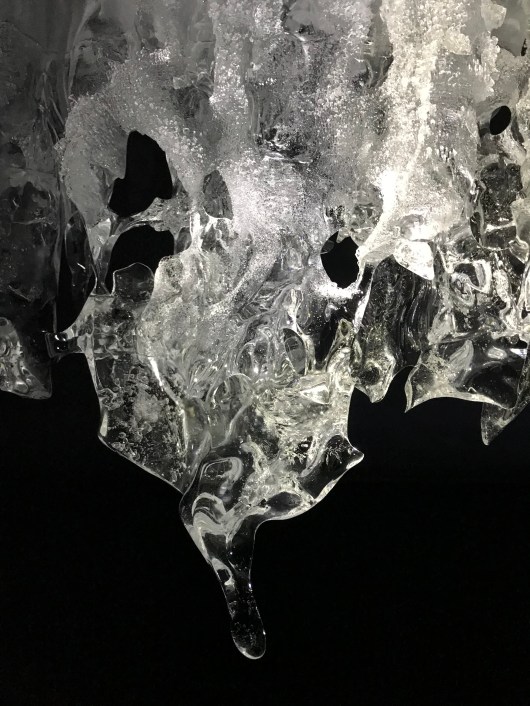
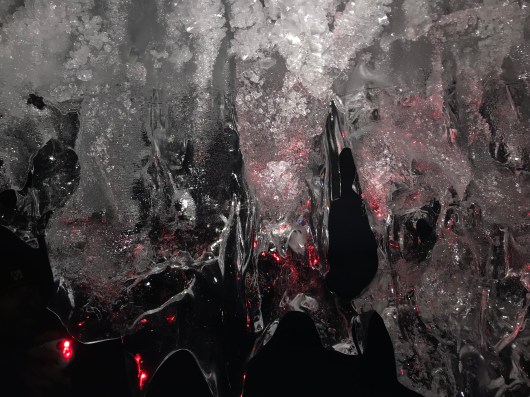
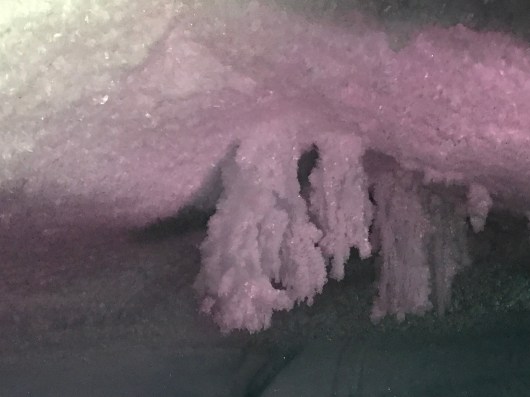
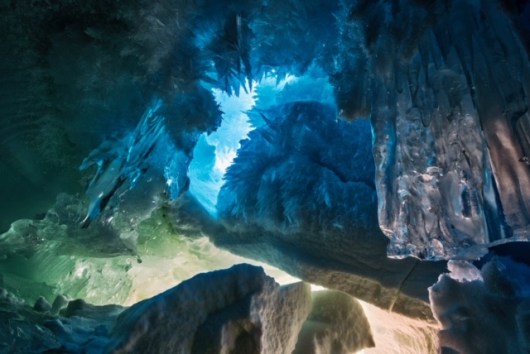
It took a lot of sliding on my butt and pushing against the rigged ropes with my feet to move along.  Taller people had no problem.  Once inside, the ice was a bluish grey color with ice crystals of every shape and size hanging from the ceiling just above our heads.   I felt like I was in a wonderland.

Everyone was a bit giddy and delighted with the experience. No one wanted to leave.  The guides played “The Sound of Silence” and did a mini light show with a multicolored wand. For a moment the group was speechless. Then everyone went crazy trying to get good photos, including me.  I was sorry Mark had opted out of this activity.   Getting out of the 80’-long cave was easier as I understood what needed to happen and my eyes had adjusted to the dark interior light.  The water running passed the cave entrance was at least 2 feet deep and running fast.  Would not have wanted to fall into it.  By the next day the cave was totally filled with water.  It had been a lucky adventure.

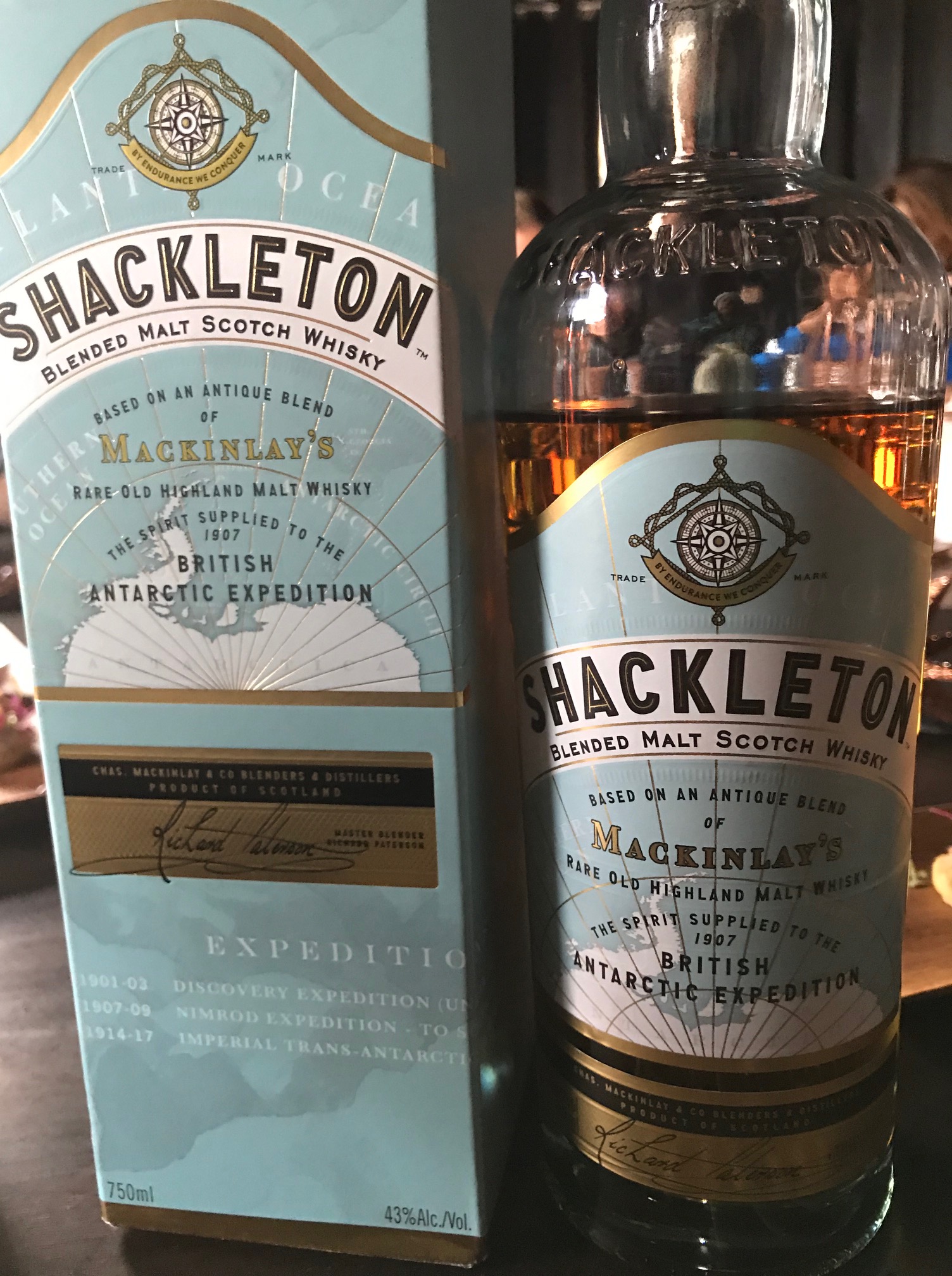
In all, it was a very fun day with much exercise, fun activities, no airplanes and good weather.  The group was lively during dinner.  Several of us got into a bottle of Shackleton scotch.  It was so good we eventually went through 5 whole bottles of the blend and wanted more.  The story on the label was that 11 intact bottles were found in Shackleton’s cabin 100 year’s after his death. Originally ordered by Shackleton, the spirit had been provided to the 1907 British Antarctic Expedition led by the great explorer.
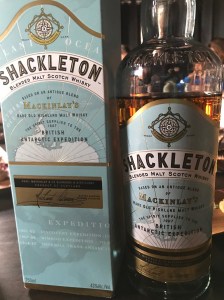
One of the 5 bottles of Shackleton our group consumed.

One of the 5 bottles of Shackleton our group consumed.

The Master blender of Mackinlay’s, the original creator, spent years reproducing “an enigmatic blended malt” that matched the spirit in the remaining bottles “with real warmth and depth at its heart, like Shackleton himself.”  Really good scotch.  We hope to be able to order it when we get home.


December 27, 2018


Another sunny, warm, nearly windless day.  It is very spoiling and special to have so many good days in the Antarctic.  The staff keeps telling us how lucky we are to have such good weather.

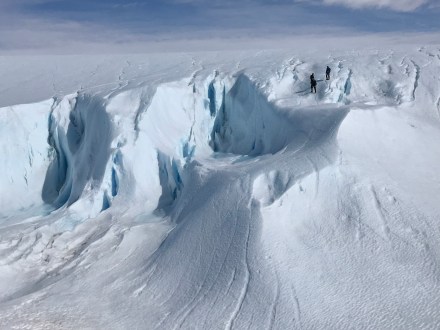
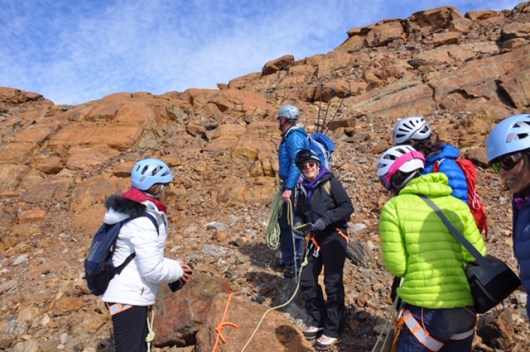
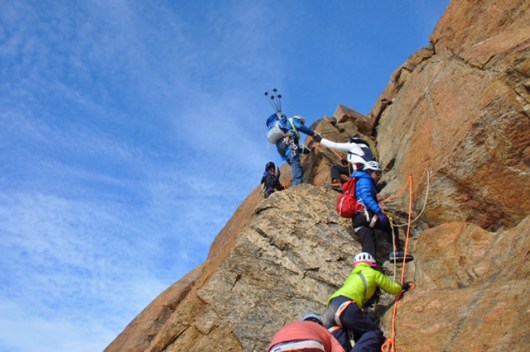
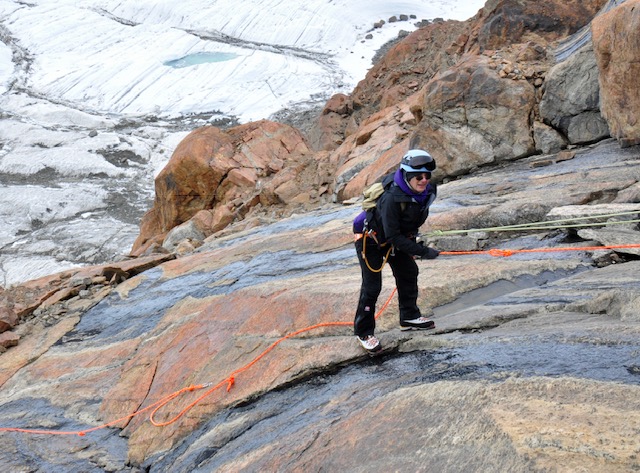
Six of us went on a hike to see ice waves, sea ice that has been compressed against the shore and is now frozen into the shape of waves.  We drove about 25 minutes to the beginning of the hike.  We needed our helmets, hiking boots, liner gloves, harness and light jacket.  No crampons, poles or other gear.  We did have to hike up and over a rocky hill to get to the start of the main reason for the hike.  Our guide, Manu, let me use my poles for walking through the rocks.  Then he took them away from me and put them in his pack. From then on, I could not have them as they would be in the way.  As he attached harness gear to each of us and a long rope connecting us to each other, he did not tell any of us what was coming, except that it was a cliff edge we would be walking on to overlook the waves.

Very shortly, the cliff edge was anything but flat or even slightly wide.  I was clinging to the rock wall for dear life.  With each step, I became more frightened as I began to see ahead that there was no cliff edge at all.  Where were we going and why is this happening to me?  Manu had put me immediately behind him and the rest were right behind me. I could not go back.  He began to tell me where to place each hand and foot. Terrified, I did what I was told. We came to a rock wall we had to get down.  A red rope with a knot in it every 3 feet hung from the top of the wall.


The first steep pitch I had to negotiate backwards. I just kept watching Manu talk me down.

The first steep pitch I had to negotiate backwards. I just kept watching Manu talk me down.  I was afraid until I realized that it was not so difficult, I just had to focus and trust–and not look back.

Manu instructed me to grasp the rope and walk myself down the wall.  I faced the wall and looked into his eyes as I did what he said.  It got a little easier as I descended and before long Farida was coming down the wall above me.  There was a small ledge at the bottom where I waited for everyone to descend. We all turned around to look at the waves and take a few photos.  After all, wasn’t that the point of this expedition?

I asked if the worst was over and Manu just smiled.  Oh dear. What’s next.  I was told to hold onto a notch in the rock wall next to my head and feel for the out of sight foothold below the rock.  I found one foothold and placed the left foot on it.  Now move the right foot next to it and find the next foothold to the left and so on for 4 or 5 steps.  Then he took my hand and guided me to the next rock hold so he could help everyone else.  When I looked down there was nothing but air for about 100 feet.  I vowed not to look down again.  Once everyone was around that spot, we continued with passages nearly as difficult for a time, taking photos of each other and the waves as we could. We next had to pass through a crack in the rock wall.  That was an easy one for me, but Mark had a hard time getting through.  Then we began to climb up the walls of rock.  My knee was not happy about the steep pitches.

Suddenly I saw another red rope and that got my attention.  Now what? Manu tells me I have to pull myself up the rock wall.  I can’t even begin to get a grip on the wall.  Finally, Manu gets behind and pushes me up to get me going.  I get only so far and have to wait for Farida, who is tied behind me, to catch up.  She cannot pull herself up either and gets a hoist from Manu.  Everyone else is stronger, not to mention younger, and more able.  Once up that wall, the worst was over.  We still had to climb the rest of the way up the rock hill, down the other side and over another hill to get back to the vehicle.  The walk had taken 3 hours (from 11am to 2pm) and we were all exhausted and exhilarated. I would not ever choose to do that hike or anything like it, if given the choice.  But having done it, I was pleased to have completed it, even with a ton of help from Manu.  The waves were only a small aspect of the entire experience.  It felt like a thrilling accomplishment, even if unexpected.

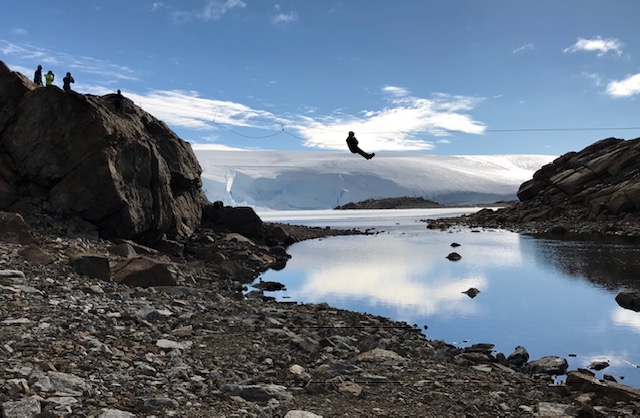
Back at the camp, my whole body ached.  I collapsed into my seat for lunch.  While having lunch, Manu and Francois suggested we go zip lining.  They have rigged a line near the camp and it would be a breeze.  By 4:30 I was feeling better and joined the same group.  This was fun and laughs.  Nothing scary, thankfully.
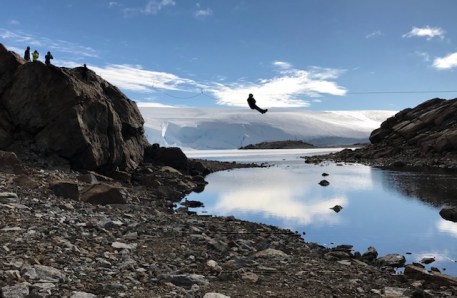
Mark zip lining across the river. Nice and benign. I did it too.

Mark zip lining across the river. Nice and benign. I did it too.  The melting glacier is in the background and camp is just to the right of the image.

After dinner and more Shackleton, John, the camp manager, came into the dining room to tell us we would not be flying home the next day as the weather was not good at the Whichaway skiway, nor at Wolf Fang Airstrip, where we would pick up the jet to fly us back to Cape Town.  The decision was final.  The powers that be would try again for the next day.  Although we were all ready to leave, we knew this weather delay was a possibility and had planned an extra day in Cape Town as insurance.

December 29, 2018

Although the guides had more activities planned and some of the group participated, Mark and I had had enough.  The weather changed to overcast, windy and cold.  I was happy to write and he was happy to read.  Our last day in the Antarctic was a quiet one.  We appreciated seeing a change in conditions as we were beginning to think summer in the Antarctic was a balmy affair.  Until this day, we did not need to wear the heavy parkas or mittens we had been loaned, or extra layers of clothing.

Dinner was a celebratory affair.  The chef, Antony, had prepared good meals all week long and this last evening was no exception—tomato and red pepper soup, rack of lamb with squash risotto and perfect lava cake for dessert.

This time John said the weather was good enough and our departure was immanent.  We were ready.

December 29, 2019

Up at 5am. Breakfast at 6.  In the trucks at 7.  In the Bassler and away from Whichaway at 7:30. Land at Wolf Fang at 8am. Weather was really cold, windy and overcast.  First time we have had such weather since we arrived.  We wait in the warming shack until the jet arrives and unloads the next group of guests.  For us it was up and away from Antarctica at 10:10am.

Azura to Cape Town


December 18, 2018

After our delicious sashimi lunch, we spent the afternoon reading, relaxing and swimming in our pool and in the slightly cooler ocean.  Mark continued his effort to get great bird photos.  He is making good progress, I think.

Mark suggested we hire the local dhow for a sunset cruise so at 5:45 we headed for the boat and sailed away with the cocktail of the day, a margarita, in hand.  It was a pleasant one-hour ride, but the sunset was a bust. Meanwhile, the staff had set up a Gin Bar on the beach. Even though I don’t usually drink gin, I could not resist the trying a couple of the many choices of drinks offered after we climbed out of the dhow and bellied up to the beach bar.   There were at least 12 different kinds of gin and a couple of recipes for each one.   We finally connected with some other guests and chatted until it was time for dinner.

Robson planned for us to have a special location for our meal and had the table set in what he called the “secret garden”.  It wasn’t much of a garden, but it was somewhat secluded, behind the gin bar.  We lingered over a mixed grille of shrimp, chicken and lobster and a very tasty berry sorbet to finish.  Back in our villa, we cleaned the sand off our feet and went to bed.  It is so nice to have the doors and windows wide open with the AC on too.  We can hear the night birds and the ocean gently lapping on the shore.   As with everywhere we have been on this trip, there are no bothersome bugs forcing us to sleep under a bed net.

December 19th, our next travel day, we have a 2pm departure from Azura.  So, we got up early and kayaked around the island before the day heated up.  It took us only 45 minutes to paddle around the small island.  The water was calm.  The tide was out and we had to go out farther from the shore than usual.

Had smoothies for breakfast then hung out around our pool, repacked and read.  It feels like the hottest day yet.  Just want to stay in the water.  Seems to me that things are getting a bit monotonous for this story–swim-read-write-swim-eat-photograph birds- read-swim-eat.  Hope you don’t mind the slowdown.  It is time to move on.

Robson served us one more tasty lunch on the breezy side of the island.  That felt good. We said good bye to him and the co-managers of the resort, paid our bill and walked to the helipad, where the pilot was waiting.  We flew back to Pemba, caught the next flight to Jo’burg and then a flight to Cape Town.  Only about an hour between legs.  Glad not to have long layovers.   Arrived after dark and got to the Ellerman House where we are staying at 10:30pm.

Ellerman House, Cape Town

Ellerman House, Cape Town

It is more like an elegant home than a hotel.  The halls are lined with art and sculpture.  There is a living room full of paintings and a Christmas tree. Indoor dining rooms as well as terraces for outdoor dining.  Hallways that end at doors to suites as well as ones that turn a corner and lead to the kitchen, the reception or the pantry or the Spa.   The grounds are meticulously manicured with flowers, water fountains, lawns and pools.

Wine Gallery with Corkscrew wine rack

Wine Gallery with Corkscrew wine rack

One pathway leads to a huge wine room with the most unusual wine storage I have ever seen.  It is a circular device about 10 feet in diameter made of carbon fiber and shaped like a corkscrew.  It is full of wine bottles laying on their side and enclosed by glass walls all around.   The property is perched, multi-leveled, on the slopes of Bantry Bay, a residential neighborhood in Cape Town.  It faces west, overlooking the Southern Atlantic coastline.  We knew nothing about the House, except that our GeoEx agent, Starla, had booked us here.   Arriving as late as we did, there was only the night manager to show us to our room. She had arranged for sandwiches and snacks in our room, brought the extra suitcase we had sent ahead a few weeks earlier and left us.  We enjoyed the lovely view of the city from our room, at a few snacks and went to bed.

December 20, 2018

Not due at the Silo Hotel for our White Desert briefing for the South Pole until 11am, we had time to wander around the hotel and check out the place.  Awesome.

At 10:30, White Desert staff picked us up and took us to the Silo for our briefing.   I was both excited and nervous.  Did I have the right equipment?  Would it be hard to put it all together?  Soon everyone was shaking hands and saying hello.  By 11:15 13 of us were seated in the top floor room with picture window views of the city all around, and big spaces for us to put our bags.  We watch a short film about where we were going and how we would get there and some dos and don’ts while in camp.  Then the White Desert rep told us what will be happening.

The first thing we learned was that the flight will be a day late as the weather is not allowing us to fly in on the 21st.   Sadly we loose a day, while the folks there now, gain a day there.  Very early on the 22nd–4:30am–we will be picked up and taken to the airport for a 6am departure on a Gulfstream 550.  The flight will be 5.5 hours to an airstrip called Wolf Fangs Runway on Queen Maud Land.  From there we transfer to a Basler BT-67 (similar to a DC3) for a 25 minute flight to camp.  The Basler is outfitted with skis and is unpressurized. Then we are transferred by snow cats to Camp Whichaway.   That ride takes 15 minutes.  So we take off from Cape town in summer clothes and change into winter wear before landing at Wolf Fangs Runway.

Then we get into the nitty gritty.  What to pack and where to pack it.  First we pull out whatever we think we need to wear when we land at Wolf Fang.  Plus whatever we need to have with us between the briefing and departure.

Everything else needs to go into our large bags that will go in the hold of the plane.  We each had a White Desert person go through our clothes with us so we have everything we actually will need.  That was very helpful.  I felt like I was more prepared once that task was completed.

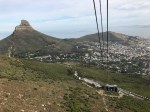
Then we were free to go.  We went on a sight seeing drive about with a guide that had been prearranged.  Tried to go to Table Mountain, but the crowds were so great that we decided to do that early the next morning.

Had lunch in a charming neighborhood spot called Kloof Street House, walked around the colorful Muslim neighborhood  of the Bo-Kaap, which dates back to the 17th century.  Each building is painted a different bright color that originally represented the kind of shop that is inside.   From there we drove around Signal Hill and took in the lovely views.  It was a perfect sunshine day and people were everywhere outdoors.

Garden path to our "Spa Room" for the last night

Garden path to our “Spa Room” for the last night

Happily, we went back to the Ellerman House, enjoyed the evening on the lawn, had a wonderful dinner there and relaxed our way into bed.

December 21, 2018

Got up in time to catch an Uber to Table Mountain at 7:45.  Not as perfect a day as the day before, but close enough.  There was virtually no line and we had a happy experience up on the mountain top.  There is a pleasant, if irregular, stone path to get around the top.  The distance is about a mile total and includes many steep overviews with a few railings (not nearly what would be there if it was in the US.), many flowering plants and signs telling you what is in the distance. We were down and back at the House by 11am.

Because we are staying an extra night, we had to be moved to another suite.  It is not the fancy place the Suite was, but it is most comfortable and next to the swimming pool and fountain.  It is also neat to the Spa, so Mark waisted no time in getting a pedicure.  We are set to relax for the rest of the day.

Since we will be unable to communicate from this evening until our planned return on the 28th, we both wish you all a Merry Christmas and a Happy New Year.  May you especially experience the birth of Christ in your heart and know the joy of His love.

God bless you all,

Julia and Mark


Azura Quilalea, Mozambique

December 15, 2018

Half way through our travels on this trip, we visit Pemba, Mozambique and an island near there called Azura Quilalea.  Pemba can be found in the upper right corner of the map of Mozambique.

Map of Southern Africa. Our destination is Pemba, Mozambique

Map of Southern Africa. Our destination is Pemba, Mozambique

December 17,2018

Am sitting on the porch of our villa at Azura on the island of Quilalea, in Northeastern Mozambique, looking at the pale blue sky above the lightly disturbed Indian Ocean, enjoying the cool morning breeze.  We arrived here two days ago to sticky hotness that did not abate until last night when we had a big rain that continued much of the night and is still spritzing off and on.

Our Azura villa with its own mini pool.

Our Azura villa with its own mini pool.

As we relax for a few days on this Robinson Crusoe-like jungle island, complete with 58 large baobab trees, we reflected on our five safari adventures of the last few weeks.   There have been so many experiences and sightings, we are struggling to remember what and where things happened.  Here is our review.

First there was the Ngorongoro Crater.  There we enjoyed a large diversity of animals, including our most unusual sighting of a serval cat, all in a bowl.  Once inside the bowl, it becomes immense.  We saw two rhino and a few elephants at a great distance.   Our home there was a formal, overstuffed bungalow in a relaxed setting, on a cliff overlooking the crater.  It was a tantalizing beginning to our adventure.

Next up was the Nimiri Plains.  There we were in the only actual tent of the trip.  The plains were full of tall lion-colored grass.  We saw many animals, but remember the cheetah and lions most.  At least 16 cheetah and 17 lions.  Our favorite sightings were of a beautiful male lion named Bob Junior and a nameless mother cheetah we spent a whole day watching and came to refer to it as “a day in the life of a cheetah”.  On our next morning drive to the airport, we spotted her and had just enough time to watch her kill a Thompson’s gazelle.

From Namiri Plains we went toMwibaLodge in the 148,000-acre private Mwiba Ranch.  There we stayed in a solid house with canvas wall coverings.  It was the most spacious and contemporary of our accommodations.  Our animal sightings included a large male leopard in a tree and a pack of 13 wild dogs lounging in a meadow.  For all that, I remember best our two cultural experiences: a Datoga clan and the Hadzada hunter-gatherers.  Brad had told us this place would provide great memories and it certainly did.  Our favorite driver/guide was here too—Godson. He was very knowledgeable, intelligent, responsive and fun to be around.

Our forth camp was the Sabora Lodge in the private 350,000-acre Grumeti Reserve.  It was a successfully developed version of Mwiba, with 10 more years of experience and many more animals.  Here in the open savannah is where we experienced the wildebeest migration in process.  In addition to the wildebeest, we saw dozens of hyena and vultures feeding on lion kills after the lions had finished.  We also saw a mostly eaten wildebeest killed by hyena on their own.  There were numerous lions, too many to count.  The wildebeest were a real draw.   A leopard lay in a bushy tree waiting for darkness and we waited with her.   She had hidden her kill in a bush the night before.  We finally saw her go into the bush and heard her munching on meat and bones. Our camp was in a wooded plain and very colonial-big game hunter in style and décor.   Our wooden, platformed tent looked out onto the plains and animals came right up to our deck when we were quiet.

That was it for Tanzania.  Brad left us. We flew to Jo’burg and on to Tswalu Game Reserve, a 258,000-acre private conservation project owned and developed by the Oppenheimer Family in the arid savannah of southern Kalahari.

Tswalu Lodge

Tswalu Lodge and pool.

The lodge itself was pleasant with a well-located dining area and swimming pool overlooking the animal watering hole. Altogether a bit tired, the facility is scheduled for a major remodel in 2019.  We remember two rhino seen deep in the brush and a pack of 20 wild dogs who hung around our camp’s water hole for two days before going off to hunt.  We followed them until they were out of sight in the darkness.  We remember a number of large antelope, not seen much in other places—roan, oryx, red hartebeest, and identified some different birds—Bokmakierie, Velvet-winged Waxbill, Eastern Yellow-billed Hornbill and Swallow-tailed Bee Eater.  Other interesting experiences included walking among a mob of habituated Meerkats and seeing a Striped Polecat on a night drive. The best part of this Reserve, however, was the landscape itself.  The scenery ran the gamut from rocky-mountains to rolling grass and brush hills, vegetated sand dunes and miles of flat lion-colored grassland.  It felt infinite in its vastness.

Reflecting on the wonder of it all, I am thrilled by God’s planned diversity and creativity.  Hopefully, with the continued help of wealthy conservationists, there will be wild places for the diverse animals to live and flourish in the future, even if access will most likely be restricted.

Thankfully, wildlife photographers preserve excellent stories of the animals and their habitats for future generations to see free of charge.

Meanwhile, back on December 15, the flight from Jo’burg to Pemba was an eye opener.  We could watch the landscape 25,000 feet below us and saw mostly empty scrub land, devoid of roads, farms and people.  Where do the 28,000,000 Mozambicans live?   36% live in a city.   We did not see farm land and roads until we were nearing Pemba.  As we flew over the city, the many small, closely packed houses had tin roofs.   It was understandable that 47% of the population lives below the poverty line.  We also learned that 45% of the same population is under the age of 16 and that 80% live by subsistence farming.  No surprise that Mozambique is one of the poorest nations in the world.   Aids has had a terrible effect on the population through excess mortality in all age groups. The current medial age is 17.2 years with a population growth rate of 2.46% and a birth rate of 38.1 births per 1,000 people.  The 11thhighest in the world.  Children average 10 years in school. There are many more facts if you are interested.   Altogether it is a sad story.

Quilalea Island is the one on the right.

Quilalea Island is the smaller one on the right. Azura lodge is on the left end.

Our helicopter arrival at Azura,

Our helicopter arrival at Azura.

From Pemba airport we flew by helicopter to Azura on the island of Quilaleain the afternoon of December 15. The day was hot and sticky.  The manager, Leon, greeted us at the helipad and led us on a gravel path through a jungle-like landscape for about a third of a mile to the camp.  After his wife, Claudia, gave us the camp briefing, we finally got to our tropical, castaway style villa, dropped our clothes and jumped into our 6×6 soaking pool.  It was warmer than we would have liked, but much better than no pool.  We stayed in it when our butler, a friendly chap named Robson, showed up with the evening “drink of the day”, tequila sunrises.

Our Azura villa with its own mini pool.

Our Azura villa with its own mini pool.

Later, over dinner, served on linen covered tables on the beach, we learned that he is from a town in central Mozambique, has a wife and 4 children and really likes having this job, even though he works 90 days on and has 30 days off to go home and visit his family.  He gets a helicopter lift to Pemba, then takes a 2-day bus ride to his home town.  His wife worked here with him until she had their fourth child a year ago.  Now she stays home.  He sees her and the family only 3 months a year.  The other children are 20, 16 and 14.  Meanwhile, the work is not physically demanding and the pay is good.  He gets no benefits from his employer, but he receives free health care at public hospitals and gets a pension, he says he can live on, when he turns 68.  I suspect jobs in tourist resorts are very desirable when you can speak English.

December 16 was an island day.  We went deep sea fishing at 6:30am for 3.5 hours and caught three fish along with several missed strikes.  I, with much help, landed a 9-kilo King Mackeral.  Mark caught a 4-kilo King Mackeral and a Giant Travally, which he had to throw back, because it is a protected specie. Our boat men spoke Portuguese, the local language in Mozambique, but virtually no English. We used sign language and got by.

On shore, we took photos of our fish and cleaned up for lunch. Then we went on a short kayak ride around part of the island.  When the wind picked up, we turned back.  Am hoping we do more kayaking before we leave.   We wanted to see the baobab trees, so we went for a walk around the island and managed to see several of them and many more of a tree called a paper bark tree with turquoise skin under the bark.  Very interesting tree.   In less than 2 hours we pretty much covered the whole island.

We spent the rest of the day in our pool, reading and taking an  ocean swim.  Mark is spending a good bit of time photographing birds.  There are many very pretty ones on this island.  We are finally having an actual vacation.  Cocktails, sunset and dinner back on the beach and then back to our room and bed.  How dull is that?

Sunset from our island get away.

Sunset from our island get away.

At 9:30 on December 17, I went for a shore scuba dive with the lodge manager, Leon, who has over 5000 dives under his belt.  I was still rusty.  Thankfully, he was very patient and helpful.  The BC was too big on me and there was too much weight.  We stayed under water only 35 minutes as the current was taking us into an area where there was nothing worth seeing and my equipment was becoming an issue.  The underwater life was a mixed bag.  The fish were small, plentiful and colorful. Several sea anemones harbored fish as did a few hard corals.

Leon and Julia head out to scuba dive from shore.

Leon and Julia head out to scuba dive from shore.

However, much of the coral was not in good shape and the visibility was about 30 feet and murky, probably from the previous night’s rain.  Leon told me this dive was free.  If I want to go again, he will charge me $30.  Sounded good to me, so I am booked for 9am on the 18th.   The day has heated up and we sit sweltering in the shade of our patio.  More pool and ocean time.

Here are a few of Mark’s bird photos.

Swallowtail Beeeater, adult and juvenile.

Swallowtail Bee-eater, adult and juvenile.

Yellow-billed Hornbill. Mark's super shot.

Yellow-billed Hornbill. Mark’s super shot.

Black-headed Weaver

Black-headed Weaver in front of its nest.

Madagascar Bee-eater

Madagascar Bee-eater in front of its nest.

Little Egret

Little Egret

Did another shore start dive at 9am.  Sure is easier on my ears to start from the shore.   Was outfitted with a smaller BC vest and a better fitting mask and only one weight.  Much more comfortable.  Even so, the weight was too much, so Leon took it out and carried it in case I needed it.  We passed through many schools of fish that barely bothered to move aside for us.  There seemed to be no fear of people.  I extended my hand onto a shrimp cleaning station and soon I had several shrimp cleaning my fingernails.  Their feet and bites tickled.

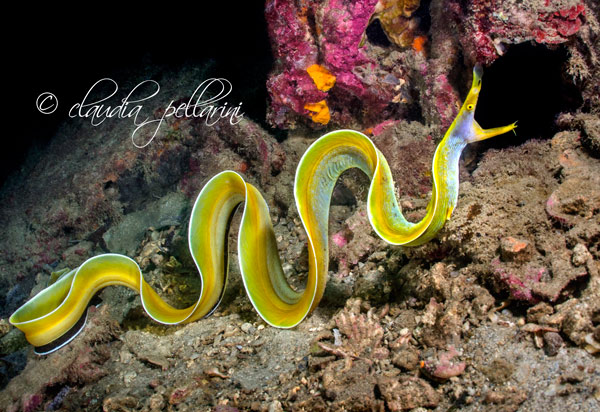
Ribbon eel. A photograph by Claudia Pelarini, the manager of our Azura Lodge.

A blue and yellow, Ribbon eel, photographed by Claudia Pellarini, the co-manager of our Azura Lodge.

One of the more interesting and colorful creatures spotted was a small, blue and yellow, ribbon eel.  When Leon poked a stick at it, it came part way out of its hole and tried to bite the stick.  The fish were many and most colorful and the corals dead or muted.  The island is in a Marine Reserve, which is why the fish are so plentiful and relaxed around us.  Hopefully, the coral will recover also.  We stayed down over 45 minutes.  I still had a lot of air, but could not complain.  The price was very minimal.

Lunch was King Mackerel sashimi from the fish we caught the day before.  It was especially tender and delicious, not to mention fresh. With it we had rocket and roasted butternut squash salad.  We are certainly eating well, considering the isolated location we have landed upon.

We still have 24 hours on the island before heading for Cape Town.   Hope to send one more post before we depart the Cape for Camp Whichaway on Antarctica.


Tswalu Game Reserve in western South Africa


December 11, 2018

Tswalu Game Reserve in South Africa.

Tswalu Game Reserve in South Africa.

Stayed in the Hotel Intercontinental in Johannesburg (Pretoria on this map) until our departure time of 11:45.  Was able to make progress on the post you just received.  We were picked up by a driver for the charter company that will fly us southwest to our next safari stop, a place called Tswalu, which means “new beginning” in the Tswana language (one of 11 languages spoken in SA).  He drove us to the general aviation side of the airport and we checked in at a private air transport firm called  Fireblade Aviation – Oppenheimer.  We were 2 of 9 passengers on the 1.5 hour KingAir flight to the Tswalu airstrip.  We sat next to a man who is in charge of marketing for Tswalu and learned a number of interesting bits of information.  It is a private game reserve, owned by the grandson of Ernst Oppenheimer, who founded the diamond company, Debeers.   Nicki, the grandson, acquired the 258,000 acre property in 1994 and continues to buy land to increase the size of the reserve.  It was declared a protected area in 2014.  No hunting is allowed and there are currently 80 species of mammals and 240 species of birds.  The Tswalu camp is composed of 9 suites and one large villa for families.  The total capacity is 28 guests and 175 staff.  Although we are here during the hot season, the best time to come to Tswalu is March through May, when there is no rain, the air is cooler and the ground is green.   As we fly over the landscape, he points out that the whole area is arid savannah and quite different from the savannah we have experienced in Tanzania.  Out the window I see low mountains, rolling hills and savannah full of rough grasses, bushes and short trees.  It is not appealing from the air.  The elevation is 4,700 feet.

Map of Tswalu Game Reserve. Near the middle of the map, a marking called Motse is where the lodge is located. THe airstrip is to the right of that. We saw the rhino in the lower right area

Map of Tswalu Game Reserve. Near the middle of the map, a marking called Motse is where the lodge is located. The airstrip is to the right of that. We saw the lions and rhinos in the lower right area.  The Oppenheimer family hopes to acquire more land from farmers in the lower mid section and in the upper left corner and increase the size of the reserve.

At the airstrip we meet our new driver and guide, Sarah.  She introduces us to our tracker, Ben.  We load up and are off at 2pm on a short afternoon game drive to the Tswalu Lodge. In the dense vegetation it is hard to get a good look at animals, but we did see a few new creatures:

Kudu males in fine form

Kudu males in fine form

Ground squirrel

A male oryx, or gemsbok

springbok, which are similar to gazelles; yellow mongoose, which are solitary and slightly larger than a dwarf mongoose;

Close up of a sable.

Close up of a sable.

white-browed sparrow weavers; red hartebeest, which are similar to the topi; southern giraffe, that look like other giraffe elsewhere; roan, another large antelope; and oryx or gemsbok.  We also saw familiar kudu and wildebeest.  Not bad for a short drive.

We were taken to our suite and were grateful to find it air conditioned, as well as spacious and very well appointed with an office area as well as a bedroom, large bathroom with indoor and outdoor showers, and outdoor living room facing the arid landscape.  We chill until the 5pm game drive.

Sociable Weaver Nest in a thorn acacia.

Social Weaver Nest in a Camel Thorn acacia.

We join Sarah and Ben and head out to find cheetah and whatever else turns up.  It is quite warm but not so bad when the land rover is moving.  As long as I can stay clear of the sun, I am ok.  We stop to study a social weaver nest in a camel thorn acacia tree.  Sarah tells us about 100 or more live in these particular nests, but they can literally cover the tree and hold over 500 birds.  The nest is so large that it regulates temperature for the birds.  Not too hot and not too cold.  Helps the birds conserve energy.  Their biggest predator is the cobra, which slithers into the nest and eats all the babies and more.  Not a very happy image.

Spring hare on our night drive.

Smith’s Red Rock Rabbit on our night drive.

About dusk Ben spotted a Smith’s Red Rock Rabbit with a reddish tail before encountering a coalition of two brother cheetah spread out on the ground near a tree.  They were just beginning to wake up as the sky was becoming too dark for photographs.

We hung with them as they stretched and then started walking in the brush and then along the perimeter of the fenced reserve.  Eventually it grew too dark to see them and we drove back to the lodge.

We joined the other guests for a BBQ dinner, watched a small entertainment by the staff children and went to bed.

December 12, 2018

Wild Dogs running down the road toward us.

Wild Dogs running down the road toward us.

Up at 4:30 and on the road by 5am. ( I was not a happy camper at that hour.) The goal was to find wild dogs.  We drove in the direction of where they had last been located and ran into them on the road running in the other direction.  We got in line behind the other vehicles following them and ended up back at the camp watering hole, where they were headed.

THe dogs play after drinking. We were late getting to the water hole.

THe dogs play after drinking. We were late getting to the water hole.

We watched along with the other guests who were just getting up and

The dogs literally climb all over each other.

The dogs literally climb all over each other.

looking at the dogs in their PJ’s.  It seems I did not have to get up so early after all.  After drinking, the dogs played and ran around the lodge area.  Eventually, it became clear they were not going hunting any time soon, so we got back in the car and drove through the fence and across a road to another part of the reserve.

A scene of the east side of the property. We preferred it.

A scene of the east side of the property. We preferred it.

Morning game drive on east side of property. Ben is tracking.

Morning game drive on east side of property. Ben is tracking.

It was much prettier than the side the lodge was on, I thought.  The lodge side is very desert-like and not very appealing.  The other side is hilly and has more tall grasses and general vegetation and is a touch greener.

It was not long before Ben spotted two white rhinos downhill in tall grasses.  Sarah drove through and over the bushes to get close, but they were very shy.  When they crashed off further into the bushes, we gave up, and crashed our way back to the road, found a spot to stop and have a coffee and tea break.  The sky was a deep blue and the air warming up, but still pleasant.   The scenery quite lovely……

Along the way we saw a Bat-Eared Fox on the move and a light tan-colored roan.  We stopped at another water hole and watched for birds.

There were many we had not seen, but we identified the Violet-eared Waxbill and the lovely Bokmakierie, a bush shrike.

Once at the lodge, we put on our suits and went to the pool.  We were free from 10:30am to 5pm.  Very nice to have a pleasant rest and a very cool pool, in which to swim.   We enjoyed a late lunch/early dinner poolside.

At 5pm we were off again.  This time to find meerkats, a member of the mongoose family.   The “mob of meerkats” we were looking for have been habituated to people and we were allowed to hang out with them and take photographs….if we could.  Here is a collection of our efforts.

After cavorting with meerkats, we drove to a high point on a slightly vegetated sand dune and had our sundowner.  We were in the western part of the property, which is full of sandy soil, some dunes and flat bunch grass and low shrubs to the  horizon.

View from a sand dune. The whole scene is within the Tswalu Game Reserve.

View from a sand dune. The whole scene is within the Tswalu Game Reserve.

The endless vistas continue.

The endless vistas continue.

The property is so vast, it is hard to get our bearings.  Sarah told us the dunes were estimated to be 30,000 years old.  At the top of the dune we had a 360 degree view of the property.  Our old ranch was tiny in comparison.  It was nearly dark when we finished our sundowner, so we finished the day with a night drive to the lodge.  All was quiet in the western front.  We managed to see a springhare and a bat-eared fox along the way in the dark.

Back at the lodge, we went directly to bed.  These 4:30am wake up calls are not my thing.   By going to sleep at 9pm, it was a bit easier to get up at 4:30.

December 13, 2018

This morning we headed back to the eastern side of the Tswalu Game Reserve looking for lion.  The pretty scenery sort of makes up for the few animals we see along the way.

Driving through the landscape.

Driving through the landscape.

This time we see a few kudu and a male ostrich.  Eventually, Ben does track down the lions using the “follow the footprints” method.  We first come upon 3 lions lying under a tree, as usual.  One is a very large 10 year old male with 2 subadults about 3 years of age.  Ben is sure there are more lions nearby so we continue looking and soon find 5 more animals–another large male, who is the brother of the other male, two females and two cubs, 6-7 months old.  This is the North Pride.  The South Pride has about the same number of animals.  They were all into sleeping and we were so done with lions that neither of us took any photos. We soon tired and drove up another sandy hill for a breakfast break.  It is very nice to be on such a huge reserve with no other vehicles or people watching anything we are watching.  The staff make sure the guests on each vehicle have their own private experience.

A southern giraffe. This one has toes that curl up from walking on sand rather than hard surfaces.

A southern giraffe. This one has toes that curl up from walking on sand rather than hard surfaces.

As we drive slowly back to the lodge, we finally see zebra for the first time on the Tswalu Game Reserve and another tower, or kaleidoscope, of giraffe.  Then, back to the lodge for the heat of the day.

How giraffes differ in patterns and colors. THe lower left is the Southern Giraffe in Tswalu. THe THe lower three on the right ate found in Tanzania.

How giraffes differ in patterns and colors. The lower left is the Southern Giraffe in Tswalu. THe THe lower three on the right ate found in Tanzania.

Spent most of the day sitting on the pool deck looking at animals at the watering hole, writing and swimming.  It was very hot and dry.  I was glad not to be out driving around.  Anyway, there was plenty to watch at the hole–roan, oryx, wildebeest, red hartebeest, and the whole dog pack.  There are 20 in the pack, 9 adults and 11 puppies of different ages.  They stayed around the previous night and this whole day.  We had decided to go to what the staff called the “dune BBQ” a couple miles away from the lodge.  So we planned to head out about 6:30.  While we waited to go, we noticed the dogs starting to get excited and move around.  Ben told us they would be going out to hunt soon, so we got in the vehicle and stationed ourselves so we could see the action.  It turned out to be much adieu about not much.  We chased the dogs about a mile.  They would stop every so often with the alpha female and other adults resting, while the pups played.  At one point the pups harassed an oryx, but that animal is too big for them. They need to find a smaller animal, like a springbok or a warthog.  The pups had fun and so did we watching.  The oryx was not pleased.  All too soon, the light was gone and we couldn’t see anything.

Because we had taken so long with the dogs, we were the last people to arrive at the BBQ.  Twenty-five other people were seated at kerosene lit tables, complete with table cloths and cloth napkins.  It was a very nice buffet spread.  We had a delicious piece of oryx meat.  I found it more tasty and tender than beef.  Sarah ate with us and we got to know a bit about her.  She is single, from Cape Town, is leaving Tswalu in a week and plans to spend the next six months in Canada, while Tswalu  Lodge is closed for a major remodel.

On our last night drive we took a longer route and had some successful sightings: a genet, several springhare, a scrubhare, a very unusual sighting of a polecat, a sand grouse, yellow mongoose, and a porcupine.  Too dark for photos.  We had hoped to find an aardvark, or a pangolin, but satisfied ourselves with the sightings Ben found with his spotlight, especially the polecat and the genet.  We arrived back at the lodge after 10:30 and went directly to bed.

December 14, 2018

I liked this try in the lodge garden, but don't know what it is. Sorry.

I liked this desert tree in the lodge garden, but don’t know what it is. If one of you does, please let me know too.

Slept in until 5:30.  Very nice.  Had a leisurely breakfast and took a few more photos. Then we were off to the airstrip.

The Tswalu airstrip waiting area hosts a huge social weaver nest in its rafters.

The Tswalu airstrip waiting area hosts a huge social weaver nest in its rafters.

A Fireblade Aviation wing mural as we lift off Tswalu.

Fireblade Aviation is known for its mural paintings.  Here is one on our wing as we lift off Tswalu.


A parting view of the Tswalu landscape

A parting view of the Tswalu landscape

Flew back to Jo’burg in a Pilatus PC 12 and arrived back at Fireblade Aviation on the far side of the International field.   Said good bye to the staff at Fireblade and were back at the Intercontinental Hotel before 11am.  we spent the day at the hotel getting caught up on packing and writing.  Mark had a massage and I had a pedicure and a massage.  Felt great.

In the dining room we saw our first Christmas tree this season.  It has not seemed like Christmas time where we have been.  Happy Christmas to you all.

Next stop is Azura Quilalea, on an island near Pembe, Mozambique.


Lines, Lions and more Lines at Grumeti Reserve


December 6, 2018

It was another beautiful day.  We leave our fine Mwiba Lodge digs and say good bye to the lodge staff at 7:30.    At the Mwiba airstrip we had a short wait for the Cessna Caravan and then said good bye to Godson, who had been a super driver/guide.

Good bye to Godson, our superb Mwiba driver/guide.

Good bye to Godson.

In only 25 minutes we arrive at Sabora Camp in the Grumeti Reserve.  This is our last camp to be with Brad and he is most excited about showing us the reserve and what it has to offer.

Our new vehicle was a land rover and our new driver/guide was a man named Kim.

Remains of a zebra, left in a tree by a leopard the night before

Remains of a zebra, left in a tree by a leopard the night before

Not even 5 minutes away from the airstrip, we encountered the remains of a young zebra up in a tree. Kim thought he had seen a leopard, but all we found were the remains.  Kim told us it had been killed the night before, probably by a leopard.  We were off to a good start.  In the same area were vervet monkeys, 2 mousebirds, a Caqui Frankolin, tawny eagles and a brown parrot in a sausage tree, our first parrot of this trip.  Several dwarf mongoose, the smallest of their kind ran in front of us on the road.  The terrain is rolling savannah, which is a combination of plains and woodlands.  So, the animal sightings are more in the open. It was easy to see the many wildebeest, buffalo, topi, eland, zebra, impala, and hyaena.

Along the road into camp we almost ran over a leopard tortoise.

Leopard tortoise

Leopard tortoise

Kim picked it up for a photo and then set it off the road.

Wildebeest on the march. One day they walked south and then it rained and they walked north. They could not seem to make up their minds

Wildebeest on the move. One day they walked south and then it rained and they walked north. They could not seem to make up their minds.

We soon realize we are seeing part of the wildebeest migration with hundreds of them walking in single file into the savannah.

The savannah with wildebeest everywhere

The savannah with wildebeest and zebra everywhere.

Many are already here and more are coming.  Quite a spectacular sight. Grumeti Reserve is about 10 years ahead of Mwiba in terms of animal conservation and development.   Grumeti Reserve consists of 350,000 acres at an average elevation of 4100 feet and is available for only 100 guests at any one time.  Game viewing is spectacular with very few vehicles competing for position.  The birds are good too.

At last we arrive at our tented camp and are assigned #8 out of 9 tents. Only half the tents are occupied. The place has a colonial, big game hunter, Ernest Hemingway feel.  The décor is overdone, but charming.

Sebora Tented Camp

Sebora Tented Camp in the Grumeti Reserve

This zebra locked eyes with me.

This zebra locked eyes with me, while I was sitting on our tent deck.  I was dazzled.

Lunch is served outdoors on the large wooden deck that extends out from the dining room, lounge and bar.  My cold soup and salad were delicious.

After lunch we planned to hang out on our tent deck, but a big wind and rain storm drove us indoors and the staff came and closed all the tent flaps. By 4:30 the storm had passed and we went out on a game drive.  All the usual animals were out and about plus a few new sightings: A large Black-chested Snake eagle; a white-headed vulture; and a pair of large, colorful Bateleleur eagles with short tails.  They soar beautifully, hardly ever flapping their wings and they mate for life.  My kind of bird.

A pair of Bateleur, who mate for life

A pair of Bateleur eagles.

Shortly we find 2 full lionesses asleep near another lion that looked very sick and injured.  Nearly 20 hyeana were hanging around.  They seemed to be waiting for the lion to die.  Also wandering around the savannah in our eyesight, were giraffe, baboons, wart hogs and several lions walking along nonchalantly.  At some point we gave up counting both hyaenas and lions.  We saw no cheetah in this reserve, but did see 3 leopard.

The wildebeest were scattered over the savannah in large numbers.  There are approximately 1.5M wildebeest that are constantly on the move from one grassy place to another.  Currently they are slowly traveling west and south into the Serengeti Plains.  Over cocktails that evening, we learned from the head of the anti-poaching program in Tanzania that the average number of animals poached each year is between 80-120,000.  Although the anti-poaching teams are slowly reducing those numbers,  they do not seriously impact the wildebeest, unless some other calamity, like a drought, happens.  The anti-poaching teams capture poachers and give them paying jobs to find and remove animal snares.  This practice has helped reduce poaching quite a bit, but not completely.

From our dinner table we could just make out 7 lions lounging on the grass about 300 feet away.  Eventually, darkness blotted them out of sight.

December 7, 2018

Two lions walking along in the early light

Two young male lions walking along in the early light

We are out at 6:20 to take advantage of the early light.  First thing we see is 2 subadult male lion walking along.  Soon they stop in a bushy area, lay down and are out of sight.

Vultures fly over the savannah to the kill

Vultures fly over the savannah looking for lunch.  Follow them and we find lion already at the feast.  This is true savannah–tall grass and random Balenite trees stretching as far as you can see.   Wildebeest add to the image.

In another area near camp, we spot two other lions feeding on a Wildebeest carcass.  Other lions have already walked away.  We watch as they tear at the meat on the rib bones.  There is plenty left, but it is hard for them to get at it.  Eventually one quits and walks away.  The other stays with it a while longer, while the vultures and hyeana slowly gather around.  Once the last lion has finally abandoned the carcass, the crowd moves in. A dozen hyaena tear into the remains and pull it all apart.  As each one gets hold of a piece, it runs off with it to eat in peace.  Several of them fight over the larger pieces, while the vultures pick up the bits that drop on the ground.  In 10 minutes there was nothing left at the sight except some blood stains.  Even the head got dragged away.  I laughed at the hyaena that ran off with the tail waving behind.

Looking for more action, we drive through huge herds of scattered wildebeest and zebra.  Brad told us that wildebeest have an 8 month gestation and time their babies for early March so they have time to grow before the migration in September-October. They have the capacity to hold off the birth for up to 29 days in case their timing is not correct.   Wildebeest numbers will generally increase by a third each spring.

A herd of zebra at Sasakwa Dam, a man made watering hole

A herd of zebra at Sasakwa Dam, a man made watering hole

In a large low shrub, we come upon a hyeana den.  There were over 20 animals hanging around the place.  We figure we have seen close to 200 hyaena on this trip so far.  Quite a record for us.

Slowly we drive up a hill for a 360 degree view of the reserve and have breakfast– fresh OJ, bacon/egg/cheese sandwiches and sweet rolls–on the front of the vehicle.  We can see the savannah filling up with wildebeest as though the migration is about to begin.

A hyaena puppy wallows in the mud

A hyaena puppy wallows in the mud

Back down the hill, we find a herd of topi, a few eland, a Black-shouldered Kite, a juvenile hawk eagle, a hyaena lolling in the mud,  a tawny eagle, a couple of leopard tortoises and one elephant.  We spent some time with the elephant and finally headed back to camp to relax.  We skipped lunch.  We are eating way too much food.

Blacked-shouldered Kite

A pretty Blacked-shouldered Kite

A tawny eagle about to lift off.

A juvenile African hawk eagle about to lift off


A nice elephant with plenty of wrinkles

A nice elephant with plenty of wrinkles

I decided not to go on the late afternoon drive.  However, within half an hour, I got a call that the boys were headed back to get me because they had seen a leopard and did not want me to miss it.  Very thoughtful of them.  I bolted for my things and the door.  Got to the carpark just as they pulled in.  Off we went.

Next morning, the leopard is back in the tree

A female leopard in a bushy tree.  Look carefully and you will see the nose, whiskers and mouth.

The female leopard on the move

Near dark, the female leopard out of the tree and headed for her kill,

The leopard was well camouflaged in a bushy tree.  With help, I could finally make it out.  The boys had poked around the nearby bushes and found the kill.  Brad was sure the leopard would come down to get the kill before dark. So we parked in a viewing spot and settled in to wait.  Literally, just as the sun had finished setting, the female leopard came out of the tree, sat in the tall grass near the tree and did not move.  It was almost totally dark when she walked into the bush where her kill was stashed.  We could no longer see anything, but we could hear her munching on the bones of the animal. We listened awhile and finally drove away.  Brad was disappointed we did not see her haul the animal up the tree.  We agreed to come back in the morning for another look.

Dinner was served under the stars.  No animals nearby.

December 8, 2018

At 6:20 we head back to see the leopard, about a mile away.  She was back in the tree.   The kill was not to be found.  Guess she ate it all or something else finished it off.

We drove further into the Savannah and realized we were in the middle of a full on migration of thousands of wildebeest heading south in long lines.  Their numbers had been building every day since before we arrived in the Grumeti Reserve and now there are so many, they are moving out toward the Serengeti.  Wow!  We had not expected to see any part of the migration on this trip.  The scene was awesome, overwhelming and humbling.  Hard to put it into words.  However, Mark was succinct: “It was a shitload of animals.”    We watched from different vantage points for a long time, then headed to camp for breakfast at 10:30.   So many things happen in such a short time.  No wonder we are exhausted by the end of each day.

Breakfast on the grass in front of camp

Breakfast on the grass in front of camp

Breakfast was served out in the savannah, under a tree near a watering hole.  Nice setting. While eating, we observed zebra, wort hog, wildebeest, a grey heron and a Lilac-breasted Roller. What more entertainment can a person want.

Grey Heron

Grey Heron

Lilac-breasted Roller on the fly.

A lovely Lilac-breasted Roller on the fly. My favorite African bird.

Back in our tent, until the afternoon game drive at 4:30pm, we wrote and read.  Another wind and rain storm came through and really cooled the air.  This one was serious and I stayed in all afternoon working.  Mark and Brad sat in the bar, drank margaritas and smoked cigars.  We were all happy.  I joined them for dinner at 7:30.

December 9, 2018

Our last day in the Grumeti Reserve was full of excitement, even more than the previous days had been.  The first thing we saw was a hyaena kill.  No lion involved.  There were at least 30 animals around, but most of them were full and sitting on the side.  There was very left left of the wildebeest when we arrived.  We soon tired of watching and looked for other sights.  More lions.

We happened upon a tower of giraffe.  They are so pretty as they amble along slowly and munch on leaves.  Then we wandered into another bunch of sleeping lions called the Butantam Pride.  There were 6 males and 2 females, all young adults.  We got some photos, but nothing memorable.  Have we seen too many?  Hmmm  Of more interest to me, was a White-headed buffalo Weaver.  We had seen several of these pretty birds, but had difficulty photographing them.  This was our best shot.  Then Mark spotted a Woodland Kingfisher.  That topped the weaver for looks.

White headed Buffalo Weaver bird

White headed Buffalo Weaver bird

Woodland Kingfisher

Woodland Kingfisher

We went to the Sasakwa Lodge on top of a hill for breakfast.  Brad had made reservations.  It is quite a fancy formal-feeling facility.  We were glad to be staying in our tent next to the animals rather than high above them.

View from Sasakwa Lodge.

View from Sasakwa Lodge.  Our camp is in the right rear.  Wildebeest fill the plains in the background.

After lunch we drove back down the hill into the Savannah and found …… more lion.  At last we saw one we wanted to photograph, a lion up in a tree.  We have seen tree climbing lions in Uganda, but this was still a surprise.  Mark said this lion made 20 sightings for this day alone.

Female lion in lounging in tree

Female lion lounging in a tree

This was our day for animals in trees.  Late in the afternoon, we found another leopard deep in a tree and impossible to photograph.

Our last dinner with Brad was indoors as it was pouring rain outside.  In the Library, where the staff seated us, was a bat flying about.  Brad grabbed three pith helmets and gallantly put them on us rather than drive the bat out.  We had one more of many good laughs.

Last dinner with Brad, in pith helmets

Last dinner with Brad, in pith helmets

The rain kept up all night. It was lovely to hear it.  I worked late and was still up when lions started calling loudly.  I could see nothing, but the sound made me feel like they were right outside the tent flap.  Feeling safe, I enjoyed the sounds.  They finally stopped and I went to bed.

December 10, 2018

There was still a light rain and fog in the morning.  We had a late breakfast at 8:30 and then drove in the open Land Cruiser in the rain to the airstrip for our scheduled flights to Seronera, Zanzibar, Dar Es Salaam and Johannesburg.  Along the roadside, we passed about 40 elephant walking and feeding.  This was the largest group of pachyderms we have seen on this whole trip, but, unfortunately, we had no time to take photos.  Too bad.

We parted ways with Brad at  the Dar Es Salaam airport.  He was an excellent guide and had become a good friend.  Once he was out of sight, we missed him immediately.

In Johannesburg, we were met by a handler who got us through customs, immigration and baggage claim in a flash.  Then he walked us to the Intercontinental Hotel, adjacent to the terminal.  We checked in, grabbed a bite for dinner and went to bed.  It was 9pm locally, but 10pm in Tanzania.

Mark has been keeping a log of creatures seen and he commented over dinner that we have seen 64 bird species and 44 mammals so far on this trip.  I wonder what we will see next, as I drift off to sleep.

Murder and Mayhem in Mwiba Game Park

December 3, 2018

Before leaving Namiri Plains, I want to give you our count.  We saw 17 lion and 14 cheetah and some of them we saw more than once.  This was a record for us and we were very thrilled to have had the experience.  Moving on…..

Namiri Airport was full of safari guests moving from one camp to another.  Our next stop was the Mwiba airstrip and Mwiba Lodge, 25 minutes away.  We flew south over the Serengeti Plains and passed over another ecotone between plains and dense woodland.  What a different world.  The elevation is 5,800 feet, 600 feet higher than Namiri, the temperature is hot and the scenery is dense, with messy woods, tall, dried and crushed grasses and many broken trees.  The word Mwiba means “thorn” in Swahili and it is quite apt.  Our new driver/guide is a friendly man named Godson.  The vehicle is newer and beefier then our last one and needs to be, given the terrain. Godson drives just about everywhere including over bushes, small trees, boulders and whatever is in his way to get us into photo range.  As we drive toward the lodge, we see only small things–a pair of dik dik, a couple of Slender Mongoose, a few birds and an impala.  An inauspicious beginning.

At the lodge, which is in the middle of a dense boulder and wooded setting,  we meet the staff and are blown away at the architecture and decoration of the facilities.  The place is a deluxe version of a tented camp on steroids, as Brad put it.  There are 10 rooms and they are each beautifully appointed.  We were assigned Room 5 and have a view overlooking a small stone gorge.  From the deck we saw an elephant and a rock hyrax.

A Rock Hyrax, cousin to the elephant

A Rock Hyrax, cousin to the elephant

Brad asked us to guess what the closest living relative is to the rock hyrax.  The rock hyrax looks like a large hamster and lives in rocky out crops. He tells us to think outrageously with our guesses, but never did we think of an elephant.  Apparently this little creature bears common traits with the elephant, such as a long gestation period of 8 months which is quite something considering a rabbit is only 6 weeks and a lion is only 3.5 months (An elephant’s gestation is 22 months, so the point is that both are long). Then, just like its distant cousin, it has modified incisors, which form tusks, internal testes, and finally 4 toes at the front and 3 at the back – interesting stuff!

Brad has been coming here for the last 8 years, when there was only a rustic tented camp.  He knows the owner, Dan Friedkin, of the lodge and private ranch, which consists of 148,000 acres, as well as the contiguous Maswa Game Reserve, which contains 692,000 acres.  The Mwiba Lodge was built 5 years ago and is the only guest facility in the entire concession.  Because the place is private, we are able to go anywhere at any time to see game or have an interesting experience.

After checking into our tent, we enjoyed a delicious lunch and then headed out to see if we could find a lion that was reputed to be in the area.

After an hour of plowing through dense forest, we encountered Kalamas, a huge lion, larger even than Bob Junior, but not nearly as handsome.  He had lost his mane somehow and was only slowly growing it back and he had been in a fight with another male and injured his right leg.  We watched him yawn several times and finally get up.  When he tried to walk, we could see the pain he was in.  In a couple of steps he laid back down and did not move.  Brad and Godson were sure he would recover, but it was sad to see him in such a bad way.

We left him in search of other animals we had not seen and soon spotted a small group of kudu, large grey antelope with approximately 5 vertical stripes down their sides.  A very attractive animal.

A kudu, large member of the antelope family

A kudu, large member of the antelope family

After trashing through a lot more bush we find a new pride of lions composed of, Nala, and her two remaining cubs, a boy and a girl; Bahati and her remaining single boy cub.  The two females, who are not related to each other have banded together to raise their remaining three cubs.  With them is an unnamed male who is leading the pride.  Godson believes this lion is the one who fought and injured Kalamas.

While watching the scene, which was difficult to photograph because of the low light and the animals being spread out, Godson offered to let us name the male lion, as the staff had not yet come up with one.  Mark suggested Julius.  Godson liked it and called him Julius from then on.

By this time it was getting late.  We stopped for a short sundowner along the roadside and watched a colorful sun, set between the trees.   Driving to camp in the dark Brad used a large spot light to illuminate the vegetation around us as we passed.  We spotted Grey-breasted Spur Fowl, Steppe Eagle, mongooses and several Bush Babies, which are the world’s smallest primates.  After a nice dinner, we went to bed and crashed.

On December 4, 2018 we had coffee and biscuits  and were in the vehicle by 7:30am.  We had several sightings including:  Defassa Water Buck, Eastern African Bush Buck, Grey Hornbill, and a herd of elephant we met on the road.
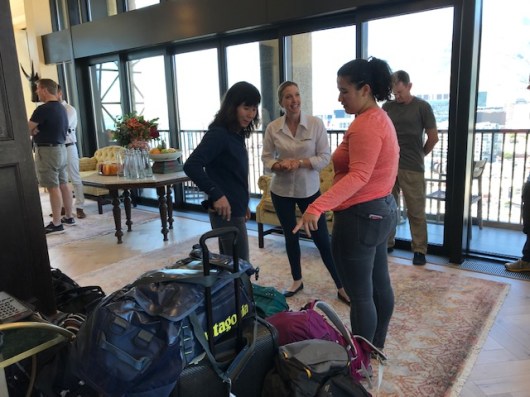
A small herd f elephant we met along the road

A small herd f elephant we met along the road

Rock overhang with graffiti

Rock overhang with Sukuma pocher graffiti

Godson stoped at an overhanging bolder to show us some, not very ancient, graffiti from 2005.  He and Brad surmised it was made by the Sukuma tribe of about 5 million people who live near Lake Victoria.  The Swahili markings appear to have been made by a hunting group who poached bush meat for commercial sale and marked the name and number of their kill on the rock wall.

That visit led Brad into a discussion of the unification of languages in Tanzania.  The first president of Tanzania, Julius Nyerere, eliminated tribalism by uniting Tanzania under one language, Swahili, in the 60’s.  This was very helpful in reducing tribalism.  Citizens now think of themselves as Tanzanians.  Unfortunately, according to conversations we had the general feel, he was a socialist and ruined the economy during his long tenure.  The current president, John Magufuli, is a capitalist and is trying to stop corruption, industrialize, support tourism and build railroads, electrical systems and harbors.  He has built a new pipeline to move oil from Uganda, through Tanzania to the harbor and is charging Uganda a very high price.

Unusual dark colored giraffe

Unusual dark colored giraffe

Brad making breakfast at the tree platform over the Sele water hole

By the end of that discourse it was about 10:30 and, we were at a watering hole overlooked by a tree blind, which was perched in a Whistling Thorn Acacia.  Mark and I sat in the blind enjoying the view and usual animals, including giraffe, while Brad, Godson and staff who had arrived with breakfast, proceeded to build a fire and cook sausage, bacon, toast and eggs for everyone.  We had coffee and fresh squeezed OJ in the blind and came down when breakfast was ready.  Very nice treat.  I love all these little surprises.

After lunch, we head for a cultural experience Brad has been looking forward to sharing with us.  He has explained that there are 125 ethnic tribes in Tanzania and that the Datoga Tribe has many clans.  We will be visiting one of these small clans called the Darorajega, that happens to live just outside the Mwiba Ranch border.

Kalamas, a very large shaggy lion showing his teeth. I think they need cleaning

Julia, Mark and Kutita, our Maasi tracker in full regalia.

We are accompanied by Kutita,  a Maasi tracker, as well as Godson, who speaks some Datoga as well as fluent Swahili, will help us communicate. He taught us two Detoga words–hello, pronounced “say you” in Detoga and thank you, which sounds like “da ba distaway” in Datoga.


It was a delightful experience and we took many photos and videos of them dancing and singing.  As soon as we arrived,  the married women, who were dressed in lovely beaded, goat skin dresses, formed a circle and sang and danced for what seemed like a long time.

Different women would take turns moving into the center of the circle and jumping a foot or so in the air without using any apparent effort.

Datoga women jumping to the music

Datoga women jumping to the beat of singing and clapping

More jumping to the rhythm.

More jumping to the rhythm.  Yes, their feet are not touching the ground.

They laughed a lot at each other with joy.  I became convinced they were mostly entertaining themselves.  Godson told us each song had a purpose, such as; improving fertility, having a baby, recovering from sickness, etc.

Godson pointed out a lady who had Datoga scarification and asked her if I could take her photo.  She admitted that the scarification was very painful, but a sigh of beauty, so she did it.

A Datoga lady with decorative scarification.

A Datoga lady with decorative scarification.

Mataja, a 31 year old Datoga woman

Mataja, a 31 year old Datoga woman

After awhile, I singled out one woman, who smiled at me and seemed willing to talk.  Godson translated.  Her name was Mataja.  She was very pretty and told me she was 31, married with 2 sons and a daughter.  Her husband works for the Mwiba Reserve and does well by their standards.  They live in a private boma near the large open compound, where we are being entertained.  I would like to have continued talking with her, but Brad wanted us to watch the men dance on the other side of the compound, so we left the women, who continued dancing, and went to watch the men, who had already begun to dance.

The men dance with the unmarried girls, who jump and sway for a very long time.

The men dance with the unmarried girls, who jump and sway for a very long time.

This dancing was quite different, with the men standing in two rows facing each other and making strange, but musical, sounds with their mouths, hands and voices.  A couple of them even played harmonicas. ( I was sorry I did not have recorders to give them).

Unmarried girls jumping to the rhythm set by the men.

Unmarried girls jumping to the rhythm set by the men.

After the men danced by themselves awhile, six young, unmarried women, began to join them in the dance.  They were dressed very differently from the married women and were covered in robes over their dresses.

The girls jump and jump

The girls jump and jump

They would shake their bodies and jump in unison to the beat of the clapping and singing without ever bending at the waist.  After a few minutes they would leave the men and step aside for awhile.  Then they would reenter the dance and shake and jump again.  Finally, they continued without stopping.  I grew tired of watching and don’t know how long they carried on.

The scene at the Datoga homestead.

The scene at the Datoga homestead.The girls jump and jump

Mataja joined us as we toured the dwellings in the compound.  One was for the men and the other two were for the first wife and the second wife.  The dwellings were  small, rectangular and made of tree limbs, mud and dung.  The roofs were made of straw, with a layer of mud on top to protect them from the intense wind that comes up nearly every day.  The ceilings are a little shorter than I am and definitely to short for the Detoga. I asked Mataja why this was.  She explained that the shorter structures were less likely to blow away.

In the middle of the open area, there were skin mats laid out with hand made jewelry on each.  Mataja told me this was the work of the ladies and they were hoping we would buy something.  Each lady had her own mat.  I did not want any of it, but what could I do?  So I bought something from several mats including hers.

While some men and maidens continued to dance we said “da ba distaway” to Mataja and the elders.

It was quite an unusual experience for us.  There were no other visitors and the performances were not the least contrived for our benefit.  I felt very privileged to have seen the people and witnessed the dancing, singing and joy.

We drove back into the Mwiba Ranch property, stopped along the way home for a sundowner and a toast to the setting sun, whilst absorbing what we had just witnessed, and continued to Mwiba Lodge for dinner and bed.

Sunset at the Datoga homestead

Sunset near the Datoga homestead

We seem to be heading for bed about 9:30 every evening.   Each day is full of so many memorable experiences we have no energy to stay up longer.

December 5, 2018

We were in for another cultural experience with a completely different tribe, who happen to live independently on the Mwiba Ranch.  They are the Hadzabe Tribe, with only 800 in the world, and 500 who practice the hunter-gatherer way of life, like the small group we will see.  Godson drives to a prescribed place where we leave the vehicle and start walking.  Nkangala, a Hadzabe Tribe member, who is an anti-poaching ranger working for Mwiba Lodge, accompanied us to be our interface with the tribe, who had been primed for our visit.  He carries  machete and walks purposefully for about 10 minutes.  Then he starts whistling and shortly three women appear.  They approach cautiously and do not talk.  They are wearing tattered Salvation Army shirts, patched wrap around skirts and beads. and, when I get closer, have a strong smell.  We keep walking and Nkangala keeps whistling.  After another few minutes we hear the return whistling, a dozen figures appear out of the woods.  There are a handful of young, strong and very healthy men and a few more women.  The men are wearing shorts and wrap around skirts and have many beads criss crossed over their chests for decoration.

We are introduced to the Hadzabe clan.

We are introduced to the Hadzabe clan.

They shake our hands without smiling or making eye contact and then begin walking through the bush.

The Hadzabe people head out on out on our walk about

The Hadzabe people head out on out on our walk about

We dutifully follow.  Very soon they stop walking and grab bunches of leaves from a particular bush, Nkangala tells us is called Cassia, and rub them all over their arms and chests.

Grabbing leaves from the Cassia bush to rub on themselves as protection from bee stings and swelling.

Grabbing leaves from the Cassia bush to rub on themselves as protection from bee stings and swelling.

Mark learns this is good to keep away bees and reduce swelling and grabs some for his arms as he has had many tsetse fly bites.  Everyone laughs and that breaks the ice.

About 30 yards later the clan spots a Commiphora tree that they see contains honey and proceed to hack into it to get to the honey.   There is a tube that the bees make that protrudes from the hive to allow bees in and out while not allowing ants to get in.  Ingenious!  We each get a small sample and find it very tasty and sweet. They thank the tree for the honey and move on.  Within another 100 yards, one of them sees a bush baby up in a tree and expertly shoots it with one arrow.

He then climbs into the tree to fetch it and finds a baby bush baby still alive.  He brings both down and ties the not yet dead adult animal to his belt.  The baby is handed to one of the women who lets it snuggle into her chest.  On closer inspection, we realize that another bush baby and a dik dik are already hanging from the belts of other tribe members.

Continuing on, they stop at a Capparis bush, that Nkangala says is  used for healing snake bites.  They dug out some roots, peel off the bark, chew the root and rub it on the wound.  They also make a drink with the juice from the root and drink that to help clear the poison from the victim’s blood.

Further into the woods, they stop again and the women start digging energetically at the roots of a shrub called Tselelaloago.  The women make a powder of the root and mix it with baboon fat.  It is believed that by rubbing this mixture on her body, a woman will attract a man.  I asked if any of these ladies had tried it and they laughed and said no.  None of them had had trouble finding a man.

At another bush, the eldest woman began to dig under a plant Nkangala said was a Ipomea tuberlosam, or “long flowering tubor”, and soon we saw her pull potato like tubers out of the soil.  She pulled out 6 or 7 and covered up the rest of the plant, so more would grow.  On the spot they peeled the tubers and ate them.  They cut pieces for us, but I declined, as so many hands had been on them.  Mark took a chance and said it had a light potato flavor.  He did not get sick.

In a small clearing was a large Commiphora tree.  One of the young men climbed the tree and declared that there was a good supply of honey in it, but the hive was made by African killer bees, as opposed to the previous hive, which was from the African stingless bee.  He came down and the men began preparations to get the honey.  First they built a fire by rubbing sticks together. Everyone gathered wood. One gathered straw for starter and soon they had a roaring fire going.  They built it in such a way that the smoke from the fire blew toward the bee hive to smoke them out.  Then one of the men cut down the tree and they all went after the honey combs.  There was not as much as was hoped, as the bees had eaten a lot keeping themselves alive.  They made short work of the honey and we did not get any this time.

Then it was time to cook the meat they had killed.  First the dik dik and 2 bush babies were skinned and thrown into the fire.  I saw the woman with the baby take it off her chest, wack it on the head and throw it in the fire, skin and all.  As the meat cooked, it would be turned over, then pulled out of the fire and the cooked part broken off and eaten.  Eventually everyone got some meat, although not a lot.  Some of the dik dik meat was stuck on a stick to cook.  When done it was handed to me and, knowing it had not been handled while cooking, I took a piece.  It was very tasty.

Last of all was a bow and arrow demonstration.  Each of the men had their own hand made bow and several arrows, used to kill different animals.  For a target Mark volunteered his ball cap.  The very second shot went directly through his visor.

After that all of us took turns trying to shoot a plastic bottle.  I got closer with each shot, but was not given any more arrows.  Mark was not successful either.  Everyone had a good laugh.  The Hadzabe people were finally comfortable with us and gave us hugs all around.  We were each given a bead necklace as a gift.

A group photo with the Hadzade people

A group photo with the Hadzade people

At each stop along the path we had taken, the Hadzabe would sing and chatter and laugh.  They seemed to be having a good time and enjoyed the bounty they had collected.  Mark measured the distance we walked with them to be 2.2 miles in 2.5 hours.  They walked with us back to our vehicle and bid us good bye. Then they all turned away and walked down the road singing and laughing.

The Hadzade people turn and walk down the road singing

The Hadzade people turn and walk down the road singing

We had just finished another thrilling cultural experience.

However, it turned out our day was just beginning.  We had heard there were Wild Dogs on the ranch and wanted to find them.  Fortunately, Brad and Godson had the co-ordinants of where they had last been seen.  It was an hour and a half away and rained hard most of the time, but we did not care.  Wild Dogs had been an unfulfilled goal for years.

A large Baobab tree. I saw just a few.

A large Baobab tree. I saw just a few.

Along the way we saw a few huge baobab trees in the dense forest.  When we reached the spot, the dogs were not there.  We drove in circles hoping to see them and were about to give up, when we ran into an anti-poaching team, who had just seen them and directed us to an open meadow.  There they were, the 13-member strong Mwiba Pack, lounging around.  We stayed with them over an hour enjoying their relaxed antics.  These animals appeared very healthy and full.

On the way back to the lodge, we identified a few more creatures, not to mention the many we have already seen: a Eurasian Roller; a small antelope, called a Grey Duiker, which is unusual because it eats birds; a few Red Billed Hornbill; a pancake tortoise, which is thinner than the leopard tortoise; and a white Headed Buffalo Weaver bird sitting on a nest.

Eurasian Roller

Eurasian Roller

Pancake tortoise

Pancake tortoise

Just a few minutes from the lodge, at about 3:15, we suddenly spot a leopard sitting in a tree next to the road.  What a sight.  He was very handsome, healthy and full.  We watched until he came down from the tree and walked into the dense bush.  Unable to find him again, we returned to the lodge.

Male leopard in tree near Mwiba Lodge

Male leopard in tree near Mwiba Lodge

A sleeping Leopard in a tree

A sleeping Leopard in a tree

The leopard changed positions and we knew it was a female.

The leopard changed positions and we knew it was a female.

Brad did not give us any time off.  At 4:30 we went for a 1.2 mile walk from the lodge to a nearby hill.  He would not tell us why, just insisted we do it.  Nkangala joined us and stopped to pick a couple of branches from different trees.  I was pooped, but went along without paying any attention to Nkangala, and barely made it to the end……until I saw padded chairs waiting for us at the top.  Suddenly I had more energy, got to the top and plopped into one of the chairs.

Sunset on top of a rock near Mwiba Lodge

Waiting for the sunset on top of a rock near Mwiba Lodge

The staff had built a fire, set up a bar, laid out snacks and pointed our chairs toward the not yet setting sun.  Nkangala proceeded to make a bow and arrow the Hadzabe way.  It took him an hour to make the perfect bow and arrow.  We put Mark’s hat out again and he shot the arrow right through it.  Mark now has a hat with a story.  The sunset was lame, but we sat in the dark for quite a while watching a multidirectional lightening show in the distance and reminiscing about the very special day we had just experienced.

We sit looking west into the coming lightening show in the distance.

We sit looking west into the coming lightening show in the distance.

Back at the lodge, dinner went quickly, as bed beckoned.


Three days in the lives of paws and claws

December 2, 2018

We are back on the Namiri Plains in the southeast section of the Serengeti plains.  There are six sections and they are each huge.  We are just a speck in the vastness.  At this moment, we are tracking another cheetah, named Campari, and her three 6-month old cubs, 2 boys and a girl.  So, I am back at the computer while we wait and watch.

Passing through a village on way to Serronera Airport

Passing through Karatu village on way to Seranera Airport

Our story picks up on November 30.  We left the Ngorongoro Crater Lodge about 8am and drove an hour and 20 minutes to the Manyara Airport.  We stopped at the gate to the park to check out and then had to drive slowly as we passed through Karatu village, where there were many cops watching for speeders.

The flight from Manyara Airstrip to Seranera Airport in the heart of the Serengeti Plains was about 35 minutes.  Our next driver, whose name is “Good Luck”, and a Toyota Land Cruiser were waiting for us.  Off we went into the southeastern Serengeti Plains, known as Namiri Plains, looking for game while generally heading for our accommodations, the Namiri Planes Camp.  This area is known as an “ecotone”, the divide between two habitats, where woodlands meet open plains.  The elevation is approximately 5,200 feet.  The weather is cool, breezy and slightly overcast.  Perfect light for game viewing.

A singular acacia tree

A singular acacia tree in the Namiri Planes

Right away Brad is naming creatures we spot: the very distinctive, and pretty, buffalo weaver bird , which has a large white spot on each wing and an orange rump;  a klipspringer, which is a small antelope covered in thick brown fur, who lives in harsh rocky environments; a pair of light brown dik-dik, who are the smallest antelope in the Serengeti, always appear in pairs and mate for life; steenbok, another smallish antelope who also mates for life  and are a tanish brown. (sorry we missed these photo shots)

Grey-breasted Spur Fowl. Saw a lot of these skittish birds.

Grey-breasted Spur Fowl. Saw a lot of these cute, skittish birds.

As we drive through the dry, knee high grasses, we pass areas of acacia woodland and open areas with occasional granite outcrops, called “koptjies”, that are each uniquely distinctive and vital dens for breeding cats.  They are all named and used as identifying landmarks.

Steppe Eagle

A Steppe Eagle migrates to the plains from Mongolia.

The zebra alerted us to the lions they were all staring

The zebra alerted us to the cheetah they were all staring at.

We were homing in on a family of 20 elephant, when we noticed a dazzle of zebra staring intently in one direction.  We followed their gaze and our eyes came to rest on a cheetah under a tree in the shade.  She was clearly pregnant.  This was our first sighting of a cheetah on this trip, but, happily, not for long.

After a short time, we left her and drove over to the elephants and hung out with them as they munched on some green grass.

From there we drove about 20 minutes before we spotted our second cheetah of the day, a male drinking water at an small oasis in the dry arid plains.  The oasis was surrounded by multiple species, unable to take advantage of the water due to the presence of the cheetah.

Another short drive and we saw three hyaenas laying under a bush.  Soon after, we spotted a coalition of 2 cheetah brothers resting in the shade of a lone tree in the open plains.

A coalition of two cheetah brothers parked in the shade very close to the 13 lion Pride at the watering hole.

A coalition of two cheetah brothers parked in the shade carefully eyeing the 13 lions very close by at a watering hole.

While watching them, I followed their gaze and was surprised to see a large pride of lion laying in a sandy drainage with a bit of fresh water.  Walter drove us over to them and we counted 13 lion.  Good Luck said they were the Kibumbu Pride composed of 3 males, 7 females and 6 subadults.

It was not long before one of them got up to drink and soon all of them followed suit.  They appeared quite full and very relaxed.  We enjoyed the sighting.

It is amazing to see so many animals in the open, where the endless grass appears to be devoid of animal life.  We saw reedbok, another small antelope, hartebeest, large, quick running, light tanned antelope, many Helmeted Guineafowl and three, Spotted Hyaena running through the grass.  We are, sadly, unable to get good photos of everything.

A Guineafowl pecking around.

A Helmeted Guineafowl pecking around in the grass.  They rarely fly, but run very fast.

Can hardly keep it all in my mind.  Out in the open we could not help but see wart hogs running here and there, and thousands of gazelle, both Tommy’s and Grant’s, casually walking about and feeding.

Good Luck stopped by a koptjie for us to have lunch.  He spread out the food on the front of the vehicle and we all ate heartily in spite of the wind that had picked up enough to make us take shelter on the leeward side of the land cruiser.  It was 2:15 when we finished.

Slowly we headed back to camp.  The only new animal we saw was ostrich – one male and 4 female.  As we drove back, Brad told us that Serengit is the Masaai word for endless plains, from which the Serengeti derives its name. The plains are 6,564 square miles and truly do seem endless.

As we pulled into the woodland camp, the sun was just beginning to set.  I was thrilled at the site of several giraffe browsing on the nearby trees.

Finally, we are introduced to the camp staff, given the camp rules and taken to our tent, Tembo (“elephant” in Swalhili).  Having accumulated a ton of dust in our open, three-tiered vehicle, we were most ready to have showers and relax.  Am very thankful that we have not been hot while in Namiri Planes.  Each tent has a 100 liter hot water supply, created by a dedicated solar panel, a flush toilet and a sink with cold water.  The tent is very spacious and comfortable.  We are happy campers.

Our tent, Tembo (Swahili for elephant), in Namiri Camp.

Our tent, Tembo (Swahili for elephant), in Namiri Camp.

Dinner was served family style at 7:30, preceded by a cocktail party around a large camp fire.  We enjoyed the ambiance and comradery of the other 13 guests and were most happy to fall into bed after dinner.

December 1, 2018

According to Mark and Brad, hyaena were whooping near camp during the night.  I slept through it blissfully.  When animals are not sounding, the place is exceedingly quiet.

Coffee and 2 biscuits and we are in the vehicle and on our way at 6:15am. We have a new driver, Walter, who is very accommodating and friendly.
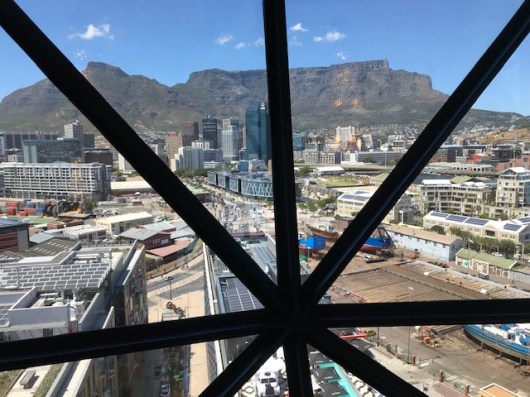
Outside camp we immediately saw one of my favorite large antelope, the topi. It is two toned in colors of milk and dark chocolate.  According to Mark the colors are more like capuccino and Espresso, with the espresso on the shoulders and rump and the cappuccino everywhere else.  The long tail is dark brown to black with a tassel at the end.  We see several during our time in the Serengeti, but not in large numbers.

We follow a fellow camp guest, the professional photographer, Mark Mol, to the site he is watching and discover the most handsome male lion I have ever seen sitting on a rock koptjie looking away west with the wind at his back.  Beautiful.

Bob Jr is a magnificent 7 year old in his prime.

Bob Jr is a magnificent 7 year old in his prime.

Soon he stands, stretches, walks off the rock and heads into the grassy plains.  We learn his name is Bob Junior.  He is 7 years old and the son of a lion that was even more grand according to Walter.  His father’s name was Bob Marley, for the dread locks that formed in his mane, and he lived to be 16, a very unusual age for a male lion.   We follow for a long time, until it becomes clear he was not interested in hunting, only relaxing.  He is the head of the Semetu Pride, which currently consists of himself, 2 female and 4 subadults.

Seemingly in the middle of nowhere, the boys in our vehicle spot 2 lion laying in lion-colored grass.   We drive up to them for a close look.  They are two lionesses, one of which is collared.  We hung around a few minutes and drove off for more interesting opportunities.

A pair of lions we came across in the grass.

A pair of lions we came across in the grass.

I spot something in the grass next to the vehicle and think it looks like a bird with an egg.  The boys laugh long and hard.   On closer inspection is turns out to be a Scrub Hare with a white bunny tail.  Its only camouflage is its coloration.  It perfectly matched the color of the grass around it.  It was a good sighting….. I thought.

A Scrub Hare. Brad renamed it the head wing bird and does not stop teasing me about it. It is rather funny.

A Scrub Hare. Brad renamed it the” head wing bird” and does not stop teasing me about it. It is rather funny.

It is clear that I cannot see anything in the distance without help.  Fortunately, I am with three eagle eyed men who don’t miss a lick.

We come upon another coalition of 2 cheetah brothers and follow them as they hunt slowly after a herd of gazelle.  Very patiently we watch and wait a good distance away so as not to interfere with their hunt.  Fortunately for me, Brad loans me his computer and I take the opportunity to write for about an hour and a half. At some point, a hyaena ambles by and the cheetah give up.  They do not want to catch an animal, only to have it stolen by the hyaena.   It has been another cool, windy, dusty day……nicely productive for me.

The cheetah mom watching out for her family

The cheetah mom, Sezia, watching out for her family

On our way back to camp, already late for lunch, we decide to have a look in the woodlands and come upon Sezia, a mother cheetah with her three male cubs. There had been a forth cub, a female, but she had been killed by a hyaena.  We enjoyed watching them play and eventually peeled off and went to camp for a very late lunch—3:10pm.  Being very dusty again, we quit for the day, cleaned up and relaxed.
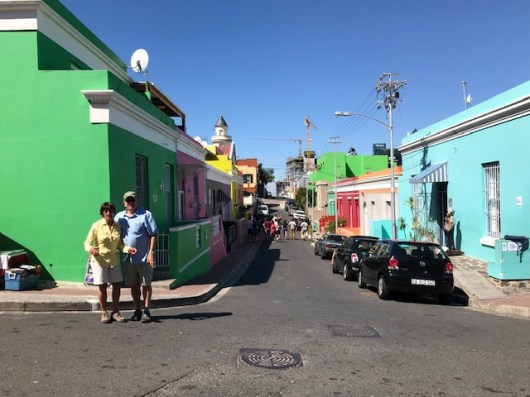
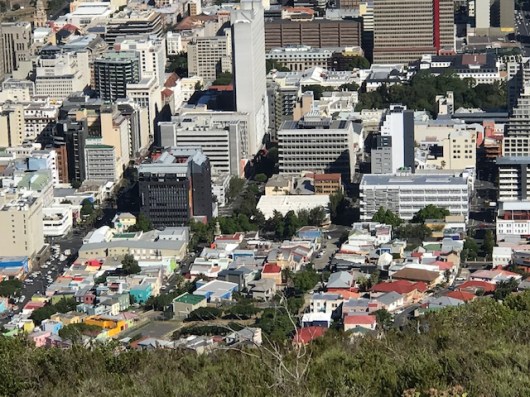
Am very frustrated with problems getting photos into the blog.  Brad and Mark tried helping me with the patience they had developed watching the cheetah hunt.   I went to bed with the problems unsolved.  Uge.

When I woke up this morning, December 2, 2018, and checked the computer, the photo problems seemed to resolve themselves.  Brad and Mark both reminded me it was a weak internet issue no one could solve until the signal improved.  It is actually amazing we have internet at all in the middle of these endless, unpeopled planes.

Out again at 6:15am, we were soon in the woodland area and locked on with the female cheetah, Sezia, and her three cubs.  We watched them play for quite awhile.  At 5 months of age, they are very curious, playful and not very obedient.  Hard for a mother to keep her brood in check when she needs them to be quiet while she hunts.  Brad told us to notice the back of their ears, which are black and quite visible.  The cubs can follow their mom easily and she can spot them as well.  Nice feature.


We left those 4 cheetah and shortly came upon another 4, a female named Campari, her two male cubs and one female.  Compari has much darker coloration than Sezia and is quite pretty.  Her cubs are a month older than Sezia’s brood and slightly more attentive and watchful.  They are starting to participate in the hunting process.  We watch them until we get a call from the professional photographer’s car, that he has seen a lion kill a wort hog.  He was too late to get a good photo of the kill, but waited for us to show up so we could find the sight.

A lion takes shelter under a tree and chows down on a wart hog.

A lion takes shelter under a tree and chows down on a wart hog.

We arrived to a very placid scene with a lioness relaxing under a shade tree with a dead wart hog next to her.  She was still panting from exertion.  After about 20 minutes she began to open the hog to get to the protein rich vital organs. Once she had consumed them, she began the slower process of chewing the bones and the meat.  Another 20 minutes and we left her to enjoy her meal without an audience.

Back we drove to where we last saw Compari.  The boys found her quickly and we settled down to wait for her to make a move.  I pulled out my computer and did some writing.  We spent over 4 hours watching her attempt to hunt.  Twice we actually saw her give chase, to no avail.

Compari slinks through the grass in the direction of her cubs.

Compari slinks through the grass in the direction of her cubs.

One time she was stalking a mother gazelle and her fawn.  We saw the gazelle actually nursing her fawn, but Compari did not see the baby.  The gazelle lured Compari away and when Compari gave chase, there was enough distance between them that Compari could not catch her.  Meanwhile, the fawn stayed hidden in the grass.  2 points for the gazelle and 0 for the cheetah.  We were so intent on staying with Compari that we ordered lunch to be brought to us, having consumed our box breakfasts hours before.

Walter, Mark and me in our Namiri Planes vehicle

Walter, Brad and me in our Namiri Planes vehicle watching Compari hunt.

As we sit there in the late afternoon, I put the computer down and enjoyed the warm breeze, the clear, clean sky, the mountains 40-50 miles in the distance, the scattered cumulous clouds all around, the vast grasslands bending with the breeze, the woodlands intruding into the horizon.  It is a wonderland too big to hold.  I asked for comments from the boys and heard the following:

Mark: The greatest vastness you can imagine, does not nearly encompass reality.

Brad: “Africa in its rawest form, as we witness the struggle for life”.

Walter Bachubila:   If you go east, or go west, the Serengeti is the best.

Walter’s story: He was born in northwest Tanzania near the Ugandan border.  Is married with a 4 year old boy and a 1 year old girl and has been a driver/guide for several years.

We watched Compari recover from failed attempts and finally, in the setting sun, she turned back toward the spot she had left her cubs.  We followed and heard her make chirping calls for them.  Eventually they called in return and she found them.  We were surprised that there was no welcome greeting.  She walked right passed them and they fell in line behind.  Eventually she climbed onto a termite mound and collapsed.  They stayed close, but did not play.  We wondered if they were all distressed that there was no dinner.

We turned for camp in the darkening twilight and got back just passed 7pm.  We had been out for 13 hours, mostly watching cats.  Having spent the whole day sitting, we were not exactly tired, but were happy to get out of the vehicle, clean up and have a scotch.  We all felt privileged to have spent a day in the life of a cheetah family in the Namiri Plains.

December 3, 2018

We say good bye to the Namiri Camp staff

We say good bye to the Namiri Camp staff

It is the end of our stay at Namiri Camp.  We wave good bye to the staff and pull away at 7:15am  intending to do a casual game drive on the way to the airport.  About 10 minutes out of camp we see Campari trotting up a grass slope in the direction of a herd of gazelle.  She leaves her cubs behind and proceed alone.  We are hooked and follow her up the hill as a distance.  We are all excited as this time there is a lot of tall grass for her to remain under cover.  One gazelle remained at attention for quite awhile but eventually relaxed.  The herd appeared totally at ease. Campari inched along in the deep grass. Finally committed, she charged.  We held our breath as she homed in on one gazelle, tripped it and latched onto its throat.  Soon it was lifeless.

Compari finally gets a gazelle after 4 days of not eating

Compari finally gets a gazelle after 4 days of failed attempts.

The whole event took about a minute.  I watched the scene with my binoculars and let out a big yelp when I could see that she had succeeded.  What an exciting experience after having spent a whole fruitless day with her.  We drove up close to have a good look, then, feeling completely satisfied, we drove on to the airport.  Brad was concerned that the vultures and hyaenas would get to the scene before her cubs had time to get there and eat, but for the moment, Compari could feed herself.  We leave her in peace.


Ngorongoro Crater-Day 2

December 1, 2018 Serengeti Plains

It is early afternoon and I am sitting in our vehicle on the plains waiting for a coalition of male cheetah doing what appears to be nothing.  They walk a few steps and look around.  It is a waiting game.   They are on the hunt for gazelle, but have not made a move. It is requiring much patience for us as well as the cheetah, and I now have a new appreciation for professional photographers.  Fortunately for me, Brad brought his computer, so I am happily able to write.


November 28, 2018 was our second day in Ngorongoro Crater.  Brad planned it this way so we would have more time in the crater than the usual tourists, who usually have one long day. On the 27th, we had 3.5 hours in the afternoon.  On this day we had over 4 hours viewing in the morning and lunch.  We reached the crater floor just before 8am and were soon spotting some of the many animal species in the park –numerous hyeana, wildebeest, cape buffalo, gazelle, ostrich, baboon and zebra.

Clouds build in the distance as decent into the crater

Clouds build in the distance as we descend into the crater

Animals on the move in the early morning

Animals on the move in the early morning

We came upon a pond with a few hippos laying on the bank sunning and sleeping.   Had rarely seen them so “exposed” and so close to us.    While there a large male lion walked by.  There was another vehicle near us and the lion marked the back of it.  Fun to watch.

This was the first day we had experienced other vehicles and found ourselves watching to see where they were clustered.  Even though we did not like having them around, we took advantage of the opportunity to see more animal action.

A lion marks new territory

A lion marks new territory

Sure enough, the biggest event of the day was at the site of a cluster of 7 other vehicles.  We arrived just in time to get a good parking spot and experience a very unusual sight.

In a narrow water drainage were the remains of a dead Cape Buffalo. It had been killed the night before by lions, who had had their fill and left.  When we arrived there were at least 200 vultures and one hyeana fighting noisily over the carcass.   Although they fought like crazy with each other, they seemed to all get something to eat. Once they had their fill of food or fighting, they moved off and others took their place.   While we watched, three Black-Backed Jackel arrived on the scene and moved into the fray.  They were more vicious than the hyeana and wasted no time getting into the middle of the carcass along with a few vultures.  It was quite a scene.   We watched for 30 minutes before leaving to explore the area further.  It wasn’t long before we spotted a lone female lion walking along.  We followed her and soon realized it was headed directly toward the vulture scene. So we drove fast back to the scene to get a good parking spot.  The scene had not changed.  We were in place only a few minutes before the lion came around the corner of a rock outcrop.

As soon as the crowd at the kill saw the lion, the scene immediately evaporated, the noise stopped and all that could be seen was the lion standing over her kill. It was amazing to see the effect of her presence.  She hung around a few minutes, gave the vultures a glaring look as they backed even further away, looked around one more time and walked away.   We waited to see what would happen.  First back on the carcass were the three jackel.  Ten minutes passed, but the vultures continued to hang back, while the jackel feasted.   We grew tired of waiting and headed off.

Our driver, Ukadi, said he had a lunch site in mind so off we went.  We drove quite a while and finally passed through a wooded area with a river course through it.   We saw several vehicles stopped and having lunch and I thought we would stop there too. Instead we continued across the creek, around another wooded area and into a clearing.  When Ukadi stopped, we could see several of our lodge staff waving to us and singing.  What a surprise.

Our picnic complete with champagne and roses

Our picnic complete with champagne and roses


Apparently, Starla Estrada, our GeoEx travel agent in San Francisco, had arranged for this affair and what a happy affair it was.   Our first sight was a large champagne bucket filled with champagne and roses.   About 6 staff greeted us with smiles, towels, champagne and mango juice, a better Mimosa than usual.  When we had time to look around, we saw a lean to with a table set for four, a large buffet table filled with food, a BBQ cooking skewers of chicken and pork, a dessert table piled high with roses and sweets, an out house at a distance and a dressing table with more roses and a water basin for cleaning hands.

Brad enjoyed watching us be delighted.   The meal was super and everyone had a good time, including the staff. There was way too much food, but Brad assured us it would not go to waste.

Feeling full and content, we climbed back into the vehicle and headed up and out of the crater, back to our lodge.   We arrived about 2:30 with a free afternoon ahead.   When we walked into our cottage, we found the floor covered with rose petals in the shape of three hearts leading us to the bathtub full of hot bubbly water.   Although I had planned to spend the afternoon writing, I could not resist having a bubble bath with Mark.    What a fun and delicious conclusion to a perfect day.

The rose petal hearts leading to our hot bubble bath

Rose petal hearts lead to our hot bubble bath.

When we went to dinner, we realized the lodge was full of guests, as they were all in the living room having drinks and visiting.  The ambiance, complete with a crackling fire, was very pleasing.   Dinner was a pleasant and uneventful affair.  We depart for the Manyara airport first thing in the morning, so now to bed.


Tanzania has much to experience

November 29, 2018

Mark in front of our tent at the Polo Club

Mark in front of our tent at the Polo Club


Our second day at the Polo Club, November 27, was another action packed day.  While at Breakfast, Brad Hansen, the guide that we met on our Chad trip in March and hired to be our guide on this trip, arrived–only a day late.  After teasing him a lot we made plans for the day, while watching a couple polo players practice with their horses.

Polo practice

Polo practice

Since we had learned about the Chrysanthemum operation from Bas, we decided to visit the factory and green houses where the chrysanthemums are cut just when they bud, then packaged and readied for air shipment to Holland.  There they will be planted in a grow medium where they finally get to bloom and be shipped on to wholesalers/retailers.   The plant manager, Nelson, toured us through the whole place and explained everything.  There are several buildings where the plants are grown from seedlings.  A row, or bed, contains 3,600 plants of one variety.  There are several varieties and many beds.  Each bed is picked every three days.   A team of 15-18 female workers and a supervisor are expected to  pick 1,100 shoots per hour each.  Beds are planted at different times, depending on the orders that come from Holland, and turned over every three months.  Overhead sprayers water and fertilize twice a week.  Lights are turned on from 9pm until 4am for maximum growth.  Pesticides are sprayed twice a week in the evening.  By morning, the effects of the pesticide spray have worn off and do not harm the pickers.  Women are used because they pick faster and are able to work the long hours.  We also visited the waiting, packing and shipping departments.  The growing rooms were quite warm and humid, while the packaging room was cold and the waiting to be shipped room was freezing.

After the tour, Nicole took us back to the Polo Club for lunch and a rest.  It was nice to stop.  The weather has been very pleasant since we arrived in Tanzania.  Warm with a slightly cooling freeze, fresh clean air.  Our tent is perfect–quiet, cool and comfortable.

At 4pm we reassembled for a drive to Nicole’s project as she calls it.  She and her Spanish fiancé, Javier, are rebuilding a house she bought unfinished from an uncle and converting it into a 10 room B&B near the Dolly Country Club that is part of the property developed by her father and uncle. The rooms are built around a courtyard with a swimming pool in the middle.  She has named it the Golf Safari House and hopes to have it finished by Christmas time.  It is quite contemporary and modern.   She is hoping it will produce a steady income stream for herself and Javier.  The property backs up to the golf course and will have access to it when finished.

Then we drove into the golf course, called KiliGolf, checked out the club house and headed over to the 16th tee, which is at the highest point of the course and has a commanding view of Mt Kilimanjaro….on a clear day, which this was not…and a lovely view of the course.  The course is very long and difficult, very green and lush and will be hosting the Tanzanian Golf Championship Tournament for the third year in a row in 2019. Great setting for a cocktail party.  Nicole had arranged for staff to set up a full bar, chairs and a table with appetizers.  Attendees included Nicole and Javier, Brad, Jo, a friend of Nicole’s who operates a horse safari business, and Mark and me.   We all had a lot of fun and laughs until dark.

16th Hole at KiliGolf Course

16th Hole at KiliGolf Course


Partying on the 16th Tee

Partying on the 16th Tee.  Brad, Javier, Mark, Nicole and Jo.

Back at the Polo Club, dinner as waiting.  We ate and headed for bed

The party continues over dinner at the Polo Club

The party continues over dinner at the Polo Club16th Hole at KiliGolf

Yesterday, November 28, we were up and out early as we had an 8am commercial departure from the Dolly airstrip, adjacent to the KiliGolf.   There were 2 other passengers already on the plane for the 45 minute flight to Lake Manyara in a Cessna Caravan.   Our driver, Ukadi, and a Toyota Land Cruiser were waiting for the three of us and soon we were headed for the Ngorongoro Crater Lodge at the top of the crater.  We arrived late morning and checked out our room.  What an outlandish space it was. It was a separate structure composed of 2 rooms with dark hardwood floors, overstuffed chairs and tables around a fireplace, massive draperies that lay over a foot onto the floor, pitched banana leaf ceilings with crystal chandeliers, a clawfoot bathtub in the middle of the dressing room, and numerous objects that looked like getting to the toilet in the dark  could be a dangerous proposition.  In addition to all that, it had nice wooden deck and a fabulous view of the crater.   It certainly made us smile.

The dining room is equally overstuffed and formal, but we managed a light lunch and took off to see the crater.  It took about half an hour to get to the crater floor.  The elevation at the Lodge is 7,500 feet and the crater floor is 5,000 feet.  Not only is there a change in elevation, but a change in temperature too.  The crater is 10 miles wide and 12 miles long.  It is one of only 7 fully formed caldera’s in the world and the only one that is not flooded.  From our room it looked like there were no animals.  As we descended the one-way road we began to see animals: both far, due to the vastness of the mostly flat and treeless floor and near, due to the adaptation of the animals to vehicles.

Some of the things we saw included: flowering candelabra trees, sunbirds, Auger Buzzards, both common ones that are black and white and rare ones that are all black (technically known as melanistic, the opposite of albinism), suburb starlings, Grey Crowned Cranes and Secretary Birds making a nest in a tree.  Zebra’s, wildebeest, buffalo, Impala’s, Grant’s  and Thompson’s Gazelles were numerous, well destributed and willing to let us get close.  We also saw several lions in small groups, dozens of hyenas running everywhere, several golden and black backed jackal, a few ostriches, numerous weaver species, shrike species, bustard species and many more birds, including lesser and greater flamingoes.  Mark spotted a serval cat and we all thanked him for finding such an unusual and elusive creature.  We hung out with it for a long time, but it did not cooperate to give us a good view.  Later on we saw 2 rhinoceroses, 1 elephant and several hippos.

Required to be out of the Park by 6pm, we drove up the one way road out.  Our lodge was right at the top so we were back before dark.  Even though we had been in the ark only 3.5 hours we had seen a huge number of animals and birds and were happy with the whole experience.

Dinner was good, but too much food for me.  I am feeling as overstuffed as our accommodations.  Just as we were finishing, 8 staff members came out of the kitchen singing and playing homemade instruments, including a marimba and a 2 string bango-like instrument.  They were clearly having fun and sounded very good.  They played 3 songs and marched out singing. It was the perfect amount of entertainment.  Back in our room, I was too tired to write.  I am having too much fun and drinking too much scotch.  Ohhh, eeeeee.


Revisiting Tanzania

November 25, 2018  Istanbul

We are finally away.  Attended a lovely memorial service for our friend Rich Toothman and left immediately from there for SFO.  Was a busy Saturday with roads full, I suspect,  of discount shoppers scurrying about.  Took us 3.5 hours to get to the airport.  Good thing we did not linger at the memorial, though I wanted to stay longer.

We have now traveled with Turkish Airlines several times and are very pleased with the configuration of our seats and space as well as the food served.  Our flight here was 12 hours and 12 minutes.  We both arrived rested after a leisurely 4 course dinner, a sound sleep of 7 hours for me and 5 for Mark.  Then we had a fruit and yogurt breakfast before landing.  Now we sit in the Turkish Airways lounge waiting for our 7 hour leg to Zanzibar, followed by another short leg to Kilimanjaro.  By then we will be waisted.

Meanwhile, this airport is a huge place full of people from everywhere.  Must be one of, if not the, busiest airport we have ever been through.  Can hardly walk along the wide corridors without being jostled.  We passed through one area where everyone was sitting in groups on the floor.  They looked to be Muslims from their attire.  And they all seemed happy to be on the floor.  It looked like the absence of seating was intentional.   We walked a good mile before arriving at the lounge near our next gate.  It is also very crowded, but we were able to find seats in a dark, quiet corner.

Below is a map of Southern Africa, which happens to also include part of Tanzania, as well as Mozambique and South Africa.

Map of Southern Africa

Map of Southern Africa                                                                                                                          Next is a map of the National Parks in Tanzania.  We will be focusing in on parks in the northern part of the country.  Mark just shared some facts he learned with me.  Tanzania is twice the size of California; Mt Kilimanjaro, at 19,340 feet tall, is the highest mountain in Africa; the median elevation of the country is 3,340 feet and we will be about 300 miles south of the equator.  

Map of Tanzania showing the national parks

Map of Tanzania showing the national parks

November 26, 2018

We are now in a tent in the Polo camp at the Nduruma Polo & Country Club nestled in natural bush country and within eye shot of Mt. Kilimanjaro and near the town of Arusha.  We arrived here after 25 hours of flying from SFO to Istanbul, then Zanzibar and, at last to Kilimanjaro, where a delightful young lady, Nicole, picked us up at 4:45 am and took us on a 40 minute ride in the dark to the Polo Club.  We arrived just in time to see the sky getting light.  The cloud cover kept the air cool, but also obscured our view of the mountain.  Rather than go directly to the tent, Nicole suggested we have breakfast on the patio of the club, so we did.  She joined us and we began to learn the history of the club and all about her family ties to it.  Turns out her father bought the land and converted the sisal farm into a Polo Club with 10 acre parcels around the polo fields, which are now all sold, and a golf course that is surrounded by smaller parcels that are just starting to sell.  Quite a property.

We are here because our guide, Brad Hansen, chose this place so we could see what it might be like if we decided to have a part time place in Tanzania and spend more time in Africa.   He was our guide when we were in Chad several months ago.  We liked him so much we asked him to be our private guide on this trip.   We have had a good laugh about him, as he forgot our trip dates and did not arrive when we did.  Now he is on the way and will arrive tomorrow.   Lucky for us, Nicole is here to step in for him.

About 8am, we got to our tent and relaxed.  But not for long.  At 10am we met Nicole at the stables and went for a horse back ride in the wooded part of the grounds, which include 5,000 fenced acres that contain many African animals that her family has rescued, in addition to the polo fields and the country club.  We got up close to a few zebra, Thompson’s gazelles and wildebeest.   We also spotted a rare animal we have never seen before, called a Gerenuk. It is a long necked gazelle.   It was hard to get the horse to stand still while I tried to get photos.  (Click on any image to make it larger.)

In the afternoon we rested for a couple of hours then joined Nicole and her fiancé for a visit to the golf course and a walk about a few of the holes.  It is a lovely, long and difficult, course.  Afterward, we had a short drink on the club house veranda, then drove over to Nicole’s parents home for cocktails and appetizers.  What a surprise that was.  Their home is spectacular with  teak wood and glass everywhere.  The construction was the best I have seen anywhere in Africa.  Her parents, Bas and Anna are in their mid 50’s and full of energy, numerous activities and laughter.  We had quite a visit.  He made his money in the rose and chrysanthemum businesses and now concentrates on his passions–conservancy, polo and old 4×4 land rovers.

Anna gave me a tour of their spectacular 2-story home.  There is so much floor to ceiling glass that I walked into a glass wall without realizing it was not open.  The best part of their house is the setting.  From every window you look into woods filled with wild animals.  From the veranda where we had drinks, we were sitting 50 feet from a herd of zebra with 2 babies, several gazelles and a wildebeest relaxing on the ground.  I was so entranced with the whole scene that I forgot to take photos.  Shame on me.

Back at the Polo Club house, Nicole and her fiancé joined us for dinner.  The interesting conversation continued with us learning more about Nicole’s family.  They were all born in Tanzania and speak fluent Swahili.  Even so, she has a Dutch passport and does not intend to ever become a Tanzanian citizen, which would require her to give up her Dutch citizenship.     Her grandfather moved to Tanzania to get into the rose farming business.  He did reasonably well, but could not compete with the Kenyan rose farmers, so he and his son, Nicole’s father, switched to chrysanthemums.  They now have 30% of the world market.  No wonder they are able to indulge their passions.

At 9pm, Mark and I finally went to bed after having been up over 48 hours.

Eastern Lebanon

October 15, 2018

map-of-lebanon-2016.jpg

On this map you can pick out Beirut, the cedars and monasteries in the north,  the Jeita Grotto, Byblos and Our lady of Lebanon (the yellow circle with a +),   On our last day we drove over the mountains to Baqaa Valley to visit Baalbeck.  As you can see, Syria is very close.

We completely changed plans for our last day in Lebanon.  We were supposed to stay in the mountain area near our hotel and keep things easy and safe.  However, Dave thought we should not miss Baalbeck and we agreed.  Why was it not on our itinerary anyway?  Dave said it was because the area around Baalbeck is where the Hezbillah forces are located and our agent in the states, Martina, had thought it prudent to stay away.

We agreed with Dave and off we went for the 2.5 hour drive  east, over the mountains to the fertile Bekaa Valley where Baalbeck was built on the highest part of the valley. The road was narrow, windy and exhilarating to say the least.   I closed my eyes a couple of times.   We ascended to 6000 feet before cresting the mountains and dropping steeply down to the fertile and green valley floor.  Once in the valley, we could see the rich, deep red soil in unplanted fields.  We passed several vineyards, orchards of apples and olives, and fields of tomatoes, potatoes and much more.  We also passed several refugee camps and a couple of down and out looking towns that Dave said the refugees had taken over.

IMG_9694.jpg

A Syrian refugee camp right on the roadside, shortly after we reached the Baqaa Valley floor.

IMG_9575.jpg

A rough looking town in the Baqaa Valley.  Dave told us a lot of refugees have moved out of the camps and into town.  Was not an inviting place.

IMG_9594.jpg

A gold-leafed mosque built by Iran.  This part of Lebanon was occupied by Syria from 1976 to 2005.  The whole eastern side of Lebanon is bordered by Syria.

IMG_9589.jpg

This megalith, the largest cut stone in the world,  seems ready to be transported to the temple site.  It gave us tourists a taste of the mammoth undertaking involved in building Baalbeck, a 5 km distance from this quarry..

Finally, we reached Baalbeck, visited a quarry for the stones used in construction of the temples, and recognized the immensity of the temple complex even before entering it.  Dave gave us an orientation and sent us into Baalbeck on our own.

IMG_9597.jpg

Outside the Temple complex is the Temple of Venus (3rd c. AD).  It was a round building set on a horseshoe shaped podium.  It was used as a church from the Middle Ages until modern times and was thus better preserved than the Temple of the Muses, just to the right of it, where there are only a few columns remaining..

IMG_9747.jpg

A drawing of the temple complex.  The Jupiter Temple dominates, with Bacchus at the left.  The Venus Temple is in the lower left.

IMG_9741 3.JPG

A borrowed photo of how the site would look today if the 6 major Jupiter columns were not covered in scaffolding.  They are immense.  The huge south wall of the Temple of Bacchus has only a few columns.  The other sides are more dramatic, but they are not even close to the size if the Jupiter columns..

IMG_9609.jpg

Part of the Hexagonal Courtyard looking toward the entrance.

IMG_9622.jpg

A panorama of the Great Courtyard with the Altar still in the middle.  The open “trench”  to the left of the Altar is where artifacts from 4000 BC were found.  Note the size of the person next to the trench.

We were awestruck by the immense size of the complex and took many photos of the main temples—Jupiter and Bacchus—as well as other details.  History of the site goes back to the discovery of flint shards in 4000 BC.  By 300 BC a sanctuary had been built to the god Baal and was called Baalbeck, or Lord of the Bekaa in Semitic.  For a thousand years the place was called Heliopolis when Baal became identified with Zeus.  Alexander the Great conquered the site and held it until his death.

agy0n.jpeg

Site plan of Jupiter and Bacchus temples.

In 64 BC, Pompey occupied Phoenicia and a long period of Roman rule began.  By the time of Emperor Hadrian, who visited Baalbeck in 130 AD, the Roman Empire had become well consolidated and entered into a long period of peace and wealth.  Baalbeck received the benefits of the time and became the largest temple complex outside Rome itself.  Building the monuments was the preoccupation of all the emperors until 312 AD, when Constantine the Great recognized Christianity as the religion of the empire and temple construction abruptly came to an end.

IMG_9615.jpg

The northwest corner of the Great Courtyard.  Mark sits on what was a pool for ablutions.

IMG_9611.jpg

A detail, at ground level, of the incredible stonework.

IMG_9634.jpg

A lion gargoyle that was part of the drainage system.  It was part of the lentil covering the roof.

IMG_9627.jpg

The six remaining columns of the Jupiter Temple were, sadly for us, surrounded by scaffolding.   We actually saw people working near the top.

IMG_9644.jpg

The well preserved Bacchus Temple.

IMG_9647.jpg

Climbing the steps to the Bacchus Temple  The Romans built the steps in odd numbers so when a person started with their right foot they would reach the top with their left foot and step into the temple with their right foot.

IMG_1648.jpg

The Monumental gate of the Temple of Bacchus

IMG_9636.jpg

The north wall of the Bacchus Temple.  Note the proportion of the person in the doorway to the columns.

IMG_9653.jpg

Mark in the covered corridor on columns on the north side of the temple.

IMG_1651.jpg

A section of the covered ceiling still in place.  The detail is marvelous.

IMG_1650.jpg

A ceiling frieze that collapsed.  Depicted is Cleopatra being bit by a snake.

IMG_9659.jpg

This image really gets at the feeling of being small in relation to the temples.  When completed, the temple was completely surrounded by these huge columns.

Mark and I spent an hour and a half slowly wandering through the complex and taking it in.  Dave said he was getting worried about us.  I could have stayed much longer.

IMG_9673.jpg

Grand entrance to the inner chamber of Bacchus Temple

IMG_9672.jpg

Inside the inner chamber of Bacchus Temple.  Awesome indeed.

IMG_9668.jpg

Cornice details on the corinthian columns in the central room of Bacchus Temple.

IMG_9682.jpg

In a tunnel under Baalbeck was a museum,  It contained the remains of a buried woman that had not been robbed by grade diggers.  On the head of the skeleton were 53 gold oak-shaped leaves.  There were also 8 round plaques decorated with female figures and a lead ring coated with gold.

On the way back down the valley, we stopped for a beef and lamb wrap, called a Shawarma.  It was so good I could have had a second one.  The beef and lamb are piled onto a large skewer, cooked standing up rotisserie style and then shaved into sandwich portions.

IMG_9730.jpg

A server in a cheese shop makes a crepe with soft cheese and honey.

After that, Dave stopped at a cheese shop where he bought us each a crepe wrap filled with a cottage-like cheese and honey.  A few bites of it were enough for me, but, not to offend Dave, I managed to eat it all. Fortunately, it was not overly sweet.  We stopped at a pumpkin vendor to get a look, then made our last stop in the valley at a winery.  Mark sampled several varieties.  He was not impressed.  However, Dave had said it was his favorite wine, so we purchased a bottle for him.

IMG_9735.jpg

A roadside vendor selling pumpkins in Baqaa Valley, Lebanon.

Finally, we headed back up the mountain to our hotel.  It had been a 2.5 hour drive each way.  In addition to visiting Baalbeck, the scenery itself made the trip well worth the effort…..mostly Dave’s effort, as we just sat back and enjoyed the ride.

Back at the palace, we cleaned up and took a taxi to a nearby restaurant called Maestro.  It specialized in sushi and pasta.  Go figure.  Worked for us.  I had sushi and Mark had pasta.

October 16, 2018

Dave picked us up at 11:30 for our 2-hour drive to the airport.  We had one last chance to ask him questions.  I asked him about the status of women in Lebanese society.  According to him, women have equal rights with men regarding jobs and income.  They can make and sign contracts, buy and sell property and act independently of men.  There is no requirement to wear scarves or other coverup.   I was glad to hear that.     Both Mark and I think Dave was one of, if not the, best guides we have ever had.  Nothing like having the owner of the agency provide personal service.

As for my thoughts about this whole adventure, it was actually three separate trips in one.  The Group adventure in Uganda and Rwanda was a very special experience for me.  I have not created and executed a trip for others before and was very pleased at how well it was appreciated and enjoyed by everyone.  My great pleasure was watching all of them having good experiences.  No one complained about the difficult hike they had to endure to get to Clouds or about anything else.  If there were problems, they were solved without my knowing of them.    I learned more about being vulnerable and listening and that was good for me.

The Seychelles were…..well….heavenly.  Even though we were there 5 days and nights, our time there was too short.   I wish it was not so very far away from home.  We began a discussion about having more fun trips rather than heavy duty adventures.  We shall see.

The last portion was back to more adventure travel.  Our time in Jordan and Lebanon was very interesting and educational.  We were perfectly safe everywhere we went and saw and experienced many activities.  There was more of interest and variety to do in Jordan and I recommend visiting that country to anyone.   The main sight to see in Lebanon, in my opinion,  is Baalbeck and, after seeing our photos and reading our story, you might be able to save yourself that trip.  The problem I had with both countries was the frequent change in altitude.   Up to a mountain top and down to -1450 feet at the Dead Sea, then back up again, several times in both countries.  I developed a sinus and ear infection that is slowly going away now that I am home.

I hope you have enjoyed these adventures with us.   In 5 weeks we will go back to Africa again.  This time to Tanzania, Mozambique and Cape Town in South Africa.  Then we will have a once in a life time experience flying to Antartica for a week of summer in sub-freezing weather, visiting Emperor Penguins, the South Pole and whatever else might happen along the way.  I don’t know if we will have wifi on Antartica, but do come along with us for whatever communication we do have.

My parting comments are summed up in this thought provoking poem I saw in one of the tunnels at Baalbeck.

IMG_9688.jpg


North of Beirut

IMG_9337

Climbing into the mountains north of Beirut

IMG_9340.jpg

Lots of villages along the way, even as we climb up to tree line.

IMG_9343.jpg

A cliffside monastery we spotted over the side of the road.

October 13, 2018

By 9am, we started our drive up into the mountains north of Beirut, to visit the Cedars of Lebanon.  I had heard so much about them from my parents, who visited Lebanon in the late 60’s, that I wanted to see them for myself.  As we drove along the coast, Dave told us Lebanon has 225 km of shoreline on the Mediterranean and that the highest point in the country is in northern Mt Lebanon at 3086 m.  The mountains receive ample snow to keep several ski resorts busy during the winter.

Along the way, Dave talked more about the political history of the country.  Mark and I were eager to learn what happened from the perspective of an educated Lebanese.  Israel invaded Lebanon in 1982 to push out the Palestinian refugees who had relocated there.  They were supporting the Lebanese Christians who wanted to move the Palestinians far from Lebanon and the Israeli border.  The Palestinians, not being allowed to have part of Israel, wanted to take over Lebanon with the help of the Arab world and make it their home.  If that is the case, it is no wonder that the Lebanese Christians wanted to oust the Palestinians from Lebanon.  Meanwhile, the PLO was a major player in support of the Palestinians. The story becomes more complicated with the introduction of each new element.

Hezbollah, both a political and a militant Shi’ite Muslim group was founded in 1982 to defend the occupied territory in the south, following Israel’s invasion of Lebanon in the First Lebanon War.  Israel’s success in expelling militant Palestinian groups from southern Lebanon allowed Hezbollah to gain a stronger foothold in Lebanese politics. Trained by Iranian forces, the group became highly organized both politically and militarily.  Once Israel withdrew from Lebanon in 2000, Hezbollah assumed greater power in the south.  The group initially stated that its primary goal was to liberate Lebanese soil and, as long as it did that, it had the support of the majority of Lebanese people.  When it continued, with encouragement from Iran, to fight for Palestinians, the total defeat of Israel and to assist Assad in Syria, it lost the support of about half the population of Lebanon, including Dave.

IMG_9350.jpg

A portrait of Khahil Gibran, who died at 48, by a friend of his.

Enough about politics.  We were high on a narrow mountain road headed for the home and gallery of Khalil Gibran (1883-1931).  It took me awhile to remember that I had heard of Gibran many years ago as the author of the book “The Prophet”.   It is a famous book, although I cannot remember what was in it.  His home contained a great deal of his paintings as well as his tomb.  I found the cave-like, converted monastery rather strange.  As Mark said, it was “rambling and piecemeal”.   Neither of us was drawn to any of his art, although he did have a good command of the human anatomy.  Dave’s comment was that it was “very pale”.  It sure was.  And eerie as well.  We did not stay long, but his Epitaph is memorable:

IMG_9348.jpg

IMG_9357.jpg

Looking at a ski station above tree line.  The young trees are cedars that have been planted.  The larger ones are about 30 years old.

At 6,490 feet above sea level, we finally reached the cedar trees, most of which have been planted during the last 30-40 years.  They need to be carefully watered, fertilized and cared for during the first 10 years after being planted.  After that they will survive and grow on their own as long as they are planted between 1000 and 2000 meters in elevation, receive ample water, sun, snow and humidity during the year.  With good weather conditions, they will grow 7 centimeters per year.

IMG_9363.jpg

Tourist shops next to the Cedar Forest.  A large, well shaped cedar over shadows the vendor kiosks.

There is a small grove of old growth trees that have survived thousands of years of deforestation by everyone starting with Egyptian Pharaohs in 2500 BC. We stopped at the tourist area beside the forest and took a walk through it on a well-marked trail.  The sky was delightfully blue, clear, cool and fresh and the huge old trees were very photogenic.  We lingered a good while taking them in and thinking about other old forests we have seen like the redwoods in Marin’s Muir Woods and the Bristle Cone Pines in the White Mountains.  In one of the shops we bought a sandwich to share, while we chatted with the shopkeeper.

IMG_9370.jpg

On the path through the cedars, we see trees that have not yet bent over to form a flat top.  In this photo are samples of both young and mature trees.

IMG_9366.jpg

My favorite tree in the grove–large and multi trunked.

IMG_9381.jpg

This forest is not as dramatic as our west coast Sequoia forests such as Muir Woods, but it was still good to see it.

From this lofty elevation we winded our way down a very steep narrow road to the Kadisha Valley where monks came to live after 636 AD to escape persecution from the Arab conquests.  We saw several old hermitages, some of which are still in use.

IMG_9394.jpg

Driving along the steep, narrow and scary road.  At least it was paved.

IMG_9403.jpg

Dave and Mark contemplate this hermitage chapel in a cave.

IMG_9395.jpg

Monastery of St Anthony of Kozhia

We visited the Monastery of St Anthony of Kozhia where we saw the first Arab printing press, dated from 1610.  It printed in Arabic as well as Syrac. Syrac is a derivative of Aramaic, the language Jesus spoke, if I understand it correctly.  The last vestiges of the Aramit people, who were among the first tribes to believe in Jesus, were ousted from Iraq in 2011. They moved to Scandinavian countries according to Dave.

Along the road we saw a man selling ripe persimmons and I bought a couple. The man did not want to take my dollar bill because it was too much to pay for the fruit I was buying, but Dave insisted he take it and help someone else less fortunate.  He said he would.


IMG_9425.jpg

A farmer peddling his persimmons. Called “Cacky” in Lebanese.

Back at the hotel at the end of the day, Mark and I cleaned up and walked to a nearby restaurant called Al Sultan Brahim for its fresh fish.  Dave had told us to get baby barracuda and red mullet. The head waiter suggested we also get octopus and squid for appetizers.  We got it all and enjoyed every bite.  I selected 3 small barracuda and Mark chose 6 red mullet.  My favorite dish was the squid.  It was gently sauted in a buttery wine sauce and was perfectly hot and tender. After dinner we wandered through a pedestrian area and enjoyed watching the young people.

October 14, 2018

IMG_9435.jpg

The morning of October 14, we drove 19 miles North again to experience the Jeita Grotto, which consists of two separate galleries.  First, we took a cable car uphill a couple hundred feet to the entrance of the upper grotto.  There, our cameras were taken, and we began a long walk through the grotto. The several rooms were all large and one was huge in vertical height and breadth.  Stalactites and Stalagmites were everywhere and well lit.  There were forms of curtains, columns, draperies, mushrooms and other imaginable shapes.  We saw one of the world’s largest stalactites, 8.2 meters long.  The whole grotto was impressive.  If only I could have used my camera.

After exiting the upper grotto, we walked down a road to the lower grotto, where we got into an electrically powered boat for a 400m. floating tour. Although nice, it was anticlimactic compared with the upper grotto.  Soon we were back in the SUV and on our way to Byblos.

IMG_9483.jpg

The port at Byblos was once a major player in the Mediterranean.

IMG_9479.jpg

A couple of the many stores in Bybs

Byblos is a Greek word meaning “book”.  The town, slightly north of Beirut, became a commercial hub in 1200 BC and is a rich archeological site as well as a major tourist town on the Mediterranean.  It is full of old souks, bars and restaurants. During the middle ages it was a Crusader fortress and has long been a fisherman’s port.

IMG_9445.jpg

Lebanese is not a language. It is a dialect.  These signs are readable to someone who speaks Lebanese.  Dave read them to us and they made sense…..at the time.

IMG_9442.jpg

The Phoenician alphabet of 22 characters and eventually evolved into the Greek, Latin and Arabic languages.

The Phoenician alphabet was exported from here in 800 BC.  I do not know who or how it was created.  It was composed of 22 characters that evolved into the Greek language and later into Latin and Arabic.  As we wandered around the town, we encountered several bridal parties all having their photos taken near the St John Markus Church.

IMG_9506.jpg

A bride prepping for her photo shoot.

IMG_9451.jpg

The 4th generation owner in his fossil shop, started in 1954 by his ancestor, Mikhael  Abi Saad.

Stepping into a fossil shop, we encountered the owner and learned about the discovery of fossils in the area.   According to his story, there were torrential rains 100M years ago that caused an increase in plankton, which captured the oxygen, released toxins and asphyxiated all living organisms.  The dead fish accumulated on the sea bed.  When the Lebanese mountains rose up 40M years ago following the displacement of tectonic plates, fossils became exposed around Byblos.  Today, more than 800 species of fish, crustacean, plants and turtles can be found in the nearby hills.   He had some very interesting fossils including an octopus and sting rays.

At an outdoor bar, we had a long discussion with the bar owner about scotches, while I drank a beer.  Mark tasted a few scotches.  It was a most pleasant couple of hours.

IMG_9527.jpg

The bar man who specialized is scotches

After leaving Byblos, Dave took us to see Harissa, a large statue of Our lady of Lebanon, which stands 550 m. above sea level.  To get there we rode a cable car up the mountainside to the base of the statue. The statue is made of bronze and painted white.

IMG_9530.jpg

The cable car ride to the top of the local hill

IMG_9542.jpg

Byblos on the Mediterranean as seen from the cable car.

Unfortunately, she was undergoing some work and was encased in scaffolding.  In the Koran, Mary is considered the mother of the prophet Issa, another name for Jesus. In Lebanon, Muslims and Christians celebrate all holiday for both religions.

IMG_9551.jpg

Our Lady of Lebanon being repainted.


Very close to the statue was St Paul’s Greek Melkite Catholic Church.  It was a pretty church that was also where Dave celebrated his wedding.  He is happily married and has two daughters, both of whom received full ride scholarships to universities in the US.  They both live and work in the US and probably will stay there.  Dave hopes to visit them someday.

IMG_9556.jpg

St Paul’s Greek Melkite Catholic Church just a couple blocks away from Our Lady of Lebanon.

That ended the touring part of the day.  We headed south and east into the hills to get to our country hotel for the next 2 nights.  It was a restored palace called Mir Amin Palace.  The place was a bit on the tired side and not what we had gotten used to on this trip.  Nevertheless, we slept well and spent little time in the hotel.  We had dinner and breakfast the next morning on the hotel terrace.  The air was a bit crisp at 2000 feet elevation, but quite acceptable.  The staff spoke very little English and we had a hard time ordering.  Regardless of what we asked for we received the Lebanese version of breakfast—cheese, olives, tomatoes, cucumbers, parsley, yogurt with olive oil, hot beans, coffee, orange juice and toast.  Oh well.  We made do.

IMG_9738.jpg

Mir Amin Palace Terrace

IMG_9737.jpg

A typical Lebanese breakfast.


Lebanon, Beirut

October 12, 2018

IMG_9234.jpg

We landed in Beirut on October 12, 2018 for our first visit to Lebanon.   After immigration, baggage claim and customs, we were met by our Lebanese driver/guide, Dave.   We were immediately pleased by his excellent English skills.  He was friendly and conversational without talking too much or asking too many questions.  We liked him right away.  We later learned that he owns the tour company and wanted to guide us himself.  His Mitsubishi SUV was large and comfortable and soon we were off.  He took us directly to our hotel in downtown Beirut, Le Gray, but the room was not ready, and the sky was threatening to rain, so we went directly to the National Museum of Beirut, where Dave pointed out the important items.

IMG_9278.jpg

National Museum of Beirut, Main Floor

IMG_9280.jpg

Marble sarcophagus.  Priam kneels before Achilleus begging him for the body of his son Hector, who is attached to a chariot.  Tyre,  2nd c. AD.

IMG_9288.jpg

Ivory statue of Papposilenos, master of the god, Bacchus, Roman Period.

IMG_1575.jpg

A broken container with the remains of a small child.  Did not get the date


IMG_9255.jpg

Each sarcophagus portrays with realism the particular facial features of a woman or a man.

IMG_9268.jpg

Vase representing a woman’s head with an elaborate hairstyle (64 BC-395 AD).  I really liked this sculpture created by a potter named Loukios.

IMG_9273.jpg

The birth of Alexander, Baalbeck 4th c. AD

We also watched a documentary that showed the destruction of the museum during the civil wars between 1975-90 as well as flooding and humidity from exposure to the elements.  Also how concrete tombs had been built around some of the larger pieces by museum staff to safeguard them. We were saddened by how many items were either destroyed or stolen.  Although the building has been restored as well as some of the artifacts, the place feels as if something was missing.   Here are some of the items we were able to appreciate.

IMG_9296.jpg

New buildings in downtown Beirut.

IMG_9317.jpg

An all new part of the city including outdoor cafe’s.

After visiting the museum, Dave took us on a walking tour of the down town.  We learned that Beirut was originally a Hellenistic city with the Romans making major developments, the remains of which we could see in areas that have been exposed during the recent reconstruction. If ruins are discovered during the construction of a new building, they must be preserved. They were followed by the Byzantines, who Christianized the area until an earthquake and tsunami struck in 551 AD.

IMG_9290.jpg

A damaged building left as a reminder of the wars.

Severly damaged, the city fell into decline until the Arabs conquered the city with little resistance in 635.  In 1110, the crusaders arrived and held the city until the Ottomans arrived.  Fast forward.  At the end of WWI, France acquired a mandate over the northern portion of what had been the Ottoman Empire.  In 1920, the French demarcated the region of Lebanon.  In 1921 the country received its first mandated president. The good things that happened under French rule included free education, healthcare, social security and free universities.  With independence, declared in 1943, came religious freedom, a balance of religious communities and a modern democracy.  The constitution requires the president to be a Maronite Catholic, the prime minister to be a Muslim Sunni and the speaker of parliament to be a Muslim Shia.  At the time the population was approximately 50/50 Muslim/Christians.  Today the law is the same, but the population has shifted to more like 54/40 Muslim/Christian, with 5.6% Druze, a different sect.

IMG_9324.jpg

The floor of a Roman Bath discovered when the city was being rebuilt.  It was left exposed.   

Dave talked a good deal about the civil wars from 1975 to 1990, which resulted in approximately 120,000 fatalities and years of social and political instability.  Although the city was largely destroyed, it has been and continues to be rebuilt and looks thoroughly modern, we did see a few buildings that have been left intentionally un-repaired, lest people should forget.  Anyone under 28 was not even born during the destruction.  The current population of the country is 5 million with 2 million living in Beirut.  There are 15 million Lebanese living abroad, mostly in Brazil, the US and Canada.  In addition, there are 1.5 million refugees from Syria and another half a million from Palestinian.  Syrian refugees receive $67/mo/child and more if they do not “need” to work.  If the refugee takes a job, it means a Lebanese has to give one up.  If they go back to Syria, the refugee will get much less, even if they work.  There is not much incentive to leave Lebanon. This is funded through the U.N.

As we walked, we saw a monument erected in 1943 to martyrs of the Ottoman period.  In the first Arab-Israeli War of 1948, 25,000 Palestinian refugees had arrived in Lebanon with the support of the Arab world. The conflict between the Arabs and Israel continued and during another Arab-Israeli war, 250,000 more refugees arrived in Lebanon.

Militant groups began to develop.  Yasser Arafat, Chairman of the PLO (Palestinian Liberation Organization) from 1969 to 2004 and a founding member of the Fatah political party during that same time, figured significantly in the civil wars.

During the 1975-90 wars, the monument we were standing in front of during this discussion, received a number of bullet holes that are still visible.  We learned that Syria occupied the north and eastern part of Lebanon from 1977-2005 and that Israel occupied the south from 1982-2000.  Even during reconstruction, the country was not at peace.  It was not until March 14, 2005 after all the occupiers had withdrawn, that complete freedom was declared.

IMG_9300.jpg

Enter a caption

On one side of Monument Square is the new Mohammad Al Amin Mosque.  Next door is St George’s Maronite Cathedral. We visited both buildings.  Nearby was the government parliament palace.  Dave was enthusiastic about how comfortable Christians and Muslims are with each other and were before the civil wars.

IMG_9312.jpg

Had to wear this cloak to go into the mosque.  However, women are welcome in all Lebanese mosques.

The city was vibrant and very busy with shops, arcades and malls everywhere, which the Lebanese call “souks”.   We did see many policemen as well as military soldiers walking and driving around. No one seemed to be bothered by them. Dave, for one, was glad they were there as they keep the city and the country safe.

IMG_9322.jpg

Saint George’s Orthodox Maronite Cathedral.  We saw several like it in Central Europe.

Then we drove along the seafront where we saw the American University, the yacht club, many apartments and hotels.  We stopped in front of Pigeon Rocks for a photo.  It was nearly impossible to visualize the city in ruins as it must have been in 1990 when the country was in chaos with no government or administration.  Many countries have donated and loaned Lebanon billions of dollars to assist in the recovery.  In addition, taxes, which had never been assessed, were instituted in 1992 and have also contributed to the rebuilding of the country.

IMG_9328.jpg

The busy seafront in Beirut

By the time Dave took us back to the hotel, it was getting dark and we had not yet seen our room.  Le Gray is a new boutique hotel in the heart of the city.  It is visually very appealing inside with a circular atrium that starts wide with decreasing circles as floors ascend, until the 6thfloor where there is a restaurant, a bar, a cigar lounge and a rooftop bar.  All the spaces, including hallways, are large and our room was no exception.  There were works of art on many walls.  We happily ate in the hotel and went to bed.

IMG_9327.jpg

Pigeon Rocks at sunset as seen from the seafront walk.


Jerash and Amman

October 11, 2018

Mohannad picked us up at 9am and we drove north to Amman.  We passed through the all white city in an hour and continued driving north to the town of Jerash, a provincial town that flourished during the Roman Empire. For centuries it was hidden under the sand and has come to light again during the last 70 years of excavation and restoration.   It is considered to be one of the best-preserved Roman towns in the world, which is why Mohannad brought us to the ruins.   A local guide, Dougan, walked us through the town.  It was quite impressive in size.

IMG_9146.jpg

Hadrian’s Gate (130 AD)

Even before we passed through any of the gates, we could see standing Corinthian columns all over the site, providing the name “city of a thousand columns.”  There were three standing large gates.  One at each end and a third one build by Hadrian in 130 AD, just outside the town walls.

IMG_9135.jpg

The Oval Plaza where large gatherings were held in Roman times.

The most interesting features to me were three colonnaded streets, the Oval Plaza near the entrance and the two theaters.  The Oval Plaza, with Greek and Roman features, was built between the 1st century BC and the 1st century AD.  It reminded me of the plaza in front of St Peter’s Basilica in Rome. It must have been a grand place and could have held thousands of people.

The main colonnaded street even had sidewalks.

The main colonnaded street even had sidewalks.

IMG_9070.jpg

The intersection of Crdo Maximuson the left and a side street.  There were four towers, one of which is delineated in the center of the image and another, which is in shadow on the left.  marked the intersection during Roman times.

The streets still had all the original stones, complete with ruts from chariot wheels, as well as many tall columns along both sides of each street.  The main North-South street, called Cardo Maximus, was lined with stone shops on both sides.  Included here is the intersection of the Cardo Maximus with a side street.

IMG_9107.jpg

The north theater originally for CIty Council meetings and later enlarged as the city grew in size and power.

There was a theatre at each end of the town.  One was built for city council meetings and later enlarged with an upper level for performances.   The other was much larger and could hold several thousand.

IMG_9131.jpg

The south Theater

Also notable was a temple to the Greek goddess, Artemis that was started in 135 AD but never finished.  Only 12 columns out of a planned 32 were erected.  Over the centuries it was put to several uses including a fort by crusaders in the 12th century.

IMG_9113.jpg

The unfinished Temple of Artemis (ca 135 AD)

IMG_9120.jpg

THe Church of St Theodore (494-496)

The Church of St Theodore (494-496 AD) was a three-aisled basilica constructed with many stone blocks taken from earlier Roman structures.  It was destroyed by an earthquake in 749 AD.

IMG_9141.jpg

All the structures were made of local limestone with a few columns made of granite.  Although the day was warm, it was not unbearable and now and then a cooling breeze kissed us.  I had fun with this pano shot of a cluster of columns above the Oval Plaza.

We stopped at the Jerash gift shop and saw instruments for sale that were like the one Mark tried to play in the desert.  It is called a Rababa and is a traditional Bedouin violin.  The single string is made of horse hair and the covering is made of sheep leather.

On the way back to Amman, we asked some questions of Mohannad.  Why are all the buildings white?  Because, he said, since 1975, there is a law that they must be white.  It is cooler in the summer and warmer in the winter.   Anyway, the King likes it that way.

Why is the call to prayer so much softer and quieter than in other Islamic countries?  One person with a good voice has been selected to sing the call every day from a central mosque in Amman.  His voice is broadcast simultaneously to every mosque in the country, so there are not a number of different calls overlapping.  Also, because there are many Christians in Jordan, the call is kept short and soft.  It is the most pleasant call to prayer we have heard anywhere.

Why is the country so easy going? The kingdom is neutral in a sea of discord and has a peace treaty with Israel.  The current king, Abdula II, is half British, pro-western, and follows his father’s popular policies closely.  There is free education and healthcare for everyone.  There is freedom of religion and no restrictions on women.  The population is mostly progressive Sunni and have a live and let live attitude.  Everyone we met was friendly and relaxed with us.

Back in the city, we stopped at the Citadel.  It was rather unimpressive compared to Jenash, but did offer a good views of the city.   The fortifications included an Entrance Hall which was interesting.

IMG_9148.jpg

A view of the white city where all buildings are required to be white since 1976.

IMG_9152.jpg

View looking South.  Includes a large Roman theater at the edge of the Citadel.

IMG_9175.jpg

The Entrance Hall at the Citadel in Amman (ca 730 AD)

IMG_9193.jpg

Inside the Entrance Hall.

IMG_9186.jpg

Mark at the Citadel with the huge Jordanian Flag above a government building.

Back at the hotel, we changed and walked to the pedestrian street called The Boulevard.  We had quite a time finding the street, as our directions were sketchy.  We ended up following our intuition and asking several people directions.

IMG_9224.jpg

We finally find The Boulevard and look along the whole street for the Jubran Restaurant.

When we got to it, there was no mistake.  It was a pretty street with fountains, flowers and sails decorating the walkway.


The atmosphere was festive and fun.  Determined to have a Jordanian meal, we finally found the Jubran Restaurant on the 7thfloor of a glass high rise in the middle of the district.  Our meal was reasonably good, but not great.  The best part was the hot puffy bread.

IMG_9230.jpg

People began to arrive as we were ready to leave.  It is clearly a night time crowd that is too late for us.

When we finished dinner and emerged back on the Boulevard the crowd had quadrupled in size.  We hung out for a few minutes, then headed to our hotel.  I did not want to walk so we took a taxi and got fleeced.  We did not check to make sure the meter was on and he demanded $15 for a ride that should have cost no more than $5.  Shame on us for not paying attention.

October 12, 2018

Mohannad picked us up at 6:30am for our flight to Beirut.  On the way to the airport, he stopped at a falafel shop and bought a box of freshly made, very hot falafels as well as two falafel sandwiches, all for us.  It was very nice of him and so we dutifully ate the sandwiches even though it was too early for our stomachs.  I must admit that, in spite of the early hour, they were the best falafels I have ever eaten.   Fresh, hot, and tasty.   Mohannad bid us good bye at the airport where we met the agent who walked us through the departure process.  Soon we were on Middle East Airlines headed for Beirut, Lebanon.

The Dead Sea to Amman

October 11, 2018

Mark and I are in Amman now and will head to Beirut in the morning.  Meanwhile, I will update our adventures since departing Petra.

Nabataean coin with image of the wife as well as the king

Nabataean coin with image of the wife as well as the king

First, I want to mention that I read about the women during the Nabataean era and learned that they were way ahead of even modern cultures today.  Women were the equal of men and had an important role in politics and society.  According to Nabataean law a woman’s inheritance was equal to a man’s.  She could own property, run her own business, sign contracts, buy and sell property, even own the family cemetery.  The names as well as the images of both the king and queen appear on coins.   Just thought my lady friends would like to know.   Onward.

Map of Jordan

Map of Jordan with Wadi Rum in the south, Petra a bit north of Wadi Rum, The Dead Sea just above Petra and Amman in the north.  Mt Nebo and Madaba are near each other and just south of Amman.

October 9, 2018    Our 25thwedding anniversary.

From Petra, it took only 1.5 hours to get to the southern end of the Dead Sea.  Along the way we identified oak trees, a huge potash plant and the stone figure thought to represent Lot’s wife in the Sodom and Gomorrah story.

The southern edge of the Dead Sea.

The southern edge of the Dead Sea.

The Sea is 45 km long, 25 km wide and 300 meters deep.  It is shrinking at such a great rate that we noticed a drop in just the 2 days we were there.  The surface of the Sea is -425 meters or 1,394 feet below sea level.  I had a bad sore throat and could really feel the pressure in my ears.  Mark noticed nothing.

The staff of Moses with a serpent wrapped around it.

The stylized cross and staff of Moses with a serpent wrapped around it at the top of Mt Nebo.  .

At the northern end of the Sea, our driver, Mohannad, took us up to Mount Nebo, located on one of the western ridges of the ancient Plains of Moab (about 1,500 feet above sea level and quite a change for my ears).  This is where Moses is believed to have seen “the Promised Land”, as mentioned in the Old Testament, and died near there.  A stylized cross with a serpent wrapped around it marked the spot.  From there we looked in the direction of the Holy Land and could just barely make out the Dead Sea to the south, Bethlehem, Jerusalem, Jerrico and the Jordan River Valley through the haze.

Since the 4thcentury a church in Moses honor has been on the site.

Following a few ancient churches and a basilica, there is now a contemporary church on the site.   A service was in progress while we were there.   Inside, on the walls and floor, are mosaics restored and preserved from the different eras.   They were very finely crafted, well preserved and lovely to see.

At the entrance to the site, was a monolithic sculpture of Moses that incorporated the books and stories of the Old Testament.  It had been personally dedicated by Pope JPII in 2000.   If you ever get there, spend some time with this sculpture.

I

n the nearby town of Madaba we visited the Madaba Institute for Mosaic Art and Restoration.  After receiving an explanation about how the mosaics are made and how the Queen mother is helping the Institute by providing a 5-year program for artisans to learn to make, repair and restore mosaics, as well as paying the postage for shipping finished works to buyers, I became interested in buying a piece.  Before long I had ordered a round mosaic to be made and  even selected the artist to do it.  I should receive it in a couple of months.   Am not exactly sure what I will do with it, but something will occur to me.

The largest and oldest mosaic map. In Greek Orthodox Church of St George in Madaba, Jordan

The largest and oldest mosaic map. In Greek Orthodox Church of St George in Madaba, Jordan.  This is a copy.


A section of the world's largest mosaic map

A section of the actual mosaic of the world’s largest mosaic map


After leaving the Institute, we stopped at the nearby Greek Orthodox Church of St George to see a very colorful mosaic map of Jerusalem, Bethlehem, the Dead Sea, Jordan River, Jericho and other sites in the Holy Land.  It is reputed to be the largest mosaic map in existence.  Unfortunately, it is no longer complete and is very difficult to photograph in one piece.

We left Madaba and headed down the mountain to our hotel on the Dead Sea.  We were more than ready for a break from driving and sightseeing.   I checked the elevation once we were in our room and noted we were approximately 1,250 feet below sea level.   The elevation at the surface of the Sea is about -1,394 feet.  We wasted no time putting on our suits and heading for the Sea.  It was a very warm day and we wanted to get wet and see how well we floated.   It was really fun and weird.  We stepped into the warm water and when it was a couple of feet deep we got down and immediately began to float.

Relaxing in the Dead Sea

Relaxing in the Dead Sea

As we went out farther, we had to bounce to touch bottom.  Finally, it was deep enough that we could not touch bottom even though we were in a standing position.  The best and most relaxing position was on our backs.  I rolled onto my stomach once and could barely keep my face out of the water as my legs would not stay down.   I got a drop of the heavily mineralized water in my eye.  That smarted, but a dozen blinks and my eye was fine.  After half an hour in the sea, we were ready to find a cool, fresh water pool, of which the resort had several.

By evening we had cleaned up, enjoyed a drink on our patio and headed for a poolside Italian dinner to celebrate our anniversary.  Sadly, I felt miserable and was unable to enjoy the dinner.  I had been getting worse as the day progressed and was in no mood to celebrate.  I felt badly for Mark and hoped we could celebrate the next day.  Mark gave me some meds and I was in bed by 8:30pm.

October 10, 2018

Don't we look like statues?

Don’t we look like statues?

My throat was so sore I could barely swallow in the morning, but I made it to breakfast and ate some soft foods. As we had the day “at rest”, I did just that.  By late morning, I felt good enough to take another swim in the Sea and we wanted to try the mud pack.  Being in the hot, humid air probably was not good for my skin, but it sure helped my throat.  It was fun to play in the mud and goop each other up with it.   After about 15 minutes, it began to itch and we just wanted to get the mud off.   It was time to go into the Sea and let the mud float off.  We both admitted that our skin felt really smooth and silky after rubbing the mud off in the Sea.   Another 20 minutes of floating and bobbing and we were again ready for the cool, fresh water pool even if we could not float in it.   We spent the afternoon in and out of different resort pools.  By the end of the day my throat did not hurt as much and I was ready to celebrate our anniversary for real.   We enjoyed the 4-course lobster dinner Mark had planned for the night before.  It was delicious.

Next up, Jordan

October 10, 2018

We arrived in Jordan late afternoon, October 6, after flying from Mahe to Dubai and then on to Amman.  Had a few anxious moments when Mark’s bag did not show up on the carousel.  Turns out customs had taken his bag and were waiting for him to report it missing.  They had him open it for their inspection.  A pair of binoculars was the offending culprit and soon we were free to go with all bags accounted for.  Our driver, Mohannad, and guide, Sabatini, were waiting for us and we immediately began our four hour  drive south to Wadi Rum.

Sabatini started talking right away about camels.  He quizzed us to see how much we knew, very little for sure, and taught us a few things.  They have a 25 year life span, can go 7 days without water and 14 days without food.  They weigh 500 to 1,000 kg and can carry an amount equal to their weight.  They have a 12 month gestation and the baby weighs between 50 and 70 kg at birth.  They cannot have twins.  When I asked why he was asking us so much about camels, he said it was because we were booked to ride camels early the next morning.  So we corrected him.  We have ridden enough camels and do not intend to ride any more.  Suddenly, there was no more camel talk and we learned we could sleep an extra hour in the morning.

Sabatini told us that the population of Jordan is 10 million and that there are 4 million in the capital city of Amman.  There are currently 1.3 million Syrian refugees residing near the Syrian border.  Many of them work in Jordan.  There were also 300 thousand Iragi refugees, who have mostly been assimilated or returned to Iraq.  There are also 800 thousand Egyptian laborers in Jordan.  They are all hard working people.  Other stats he rattled off include:  7% of the population is Christian and the rest are Muslim; only 5% are active Bedouin.  Most Bedouin have been assimilated; the country has 26 miles of shoreline on the Red Sea, at the Gulf of Aquba.  The annual growth rate is 4.5% and 42% of the population is under the age of 15.  There are 4,000 primary and secondary schools and 50 universities.    Jordan’s largest income producers are phosphorous, potash and tourism.

About half way to Wadi Rum, we stopped at a large tourist place selling what I call “useless dustables”.  There was a huge amount of Christian objects from rosaries to rugs with pictures of the last supper; jewelry, pottery, brass trinkets, soaps and much more.  When Mark asked why there was so much stuff for Christians and very little for Muslims, the salesman said 95% of tourists who come through the store are Christians.  Only a few Muslims come through.  While there, Sabatini suggest we eat something.  We settled on cheese sandwiches.  I was not too sure about eating raw food in Jordan at the moment and decline the cucumbers and tomatoes.

We arrived at Wadi Rum, a national reserve, about 8:30pm.  It was dark and we could see very little of the desert camp, Sun City Camp, where we were to stay, as there were only a few dim lights along the uneven boardwalk laid on the sand, that lead to the back of the camp and our martian dome.  Sabatini helped us onto the dome platform, about 4 feet above the sand, and into the rigid structure.  It was very basic, but it had a good bed, a full bathroom and best of all, AC.  The desert was quite warm, even at night.


charcoal baked bedouin brea

charcoal baked bedouin bread


Hand mixing bread with milk and yogurt

Hand mixing bread with milk and yogurt

THe finished mash with oil in the middle

The finished mash with oil in the middle, called Tharid.

We thought we were in for the night until Sabatini told us to grab a flash light and come with him.  Back down the boardwalk, we got into a funky pick up truck and headed, off track, deeper into the dark desert to do some star gazing.  Eventually, we saw a camp fire and stopped near it.  Several young men were seated around the fire chatting, while a round of bread baked in the ash and coals.  Sabatini told us these were bedouin boys and they were making a traditional dish called Tharid.  While the bread cooked, we walked away from the fire to look up at the night sky.  After the bread was picked out of the coals and pronounced done, one boy dusted it off with his dirty hands and gave us a piece from the middle of the loaf.  We enjoyed the hot bread with no bad effects.  Then he tore the rest of the bread into tiny pieces in a large pot, poured milk and yogurt over the bread, and mixed it into a mash with his hands.  Most unsavory.  Finally, he poured the mash onto a large platter, smoothed it out, made a hole in the middle and poured oil in the hole.  Voila!  The group of them dived into the mess with gusto, scooping it up with their own dirty hands.   After a few polite comments, we withdrew and went back to our dome, the night sky not all that interesting.

Next morning, we opened the dome door to find ourselves surrounded by martian domes, sandstone hills and desert.  The camel ride we skipped, passed by us.  After a breakfast in a large dome, we were off on a 3 hour ride through the desert on the back of a pick up truck.

We made several stops to: climb a sand dune, visit two natural stone bridges, see ancient petroglyphs and share tea with a Bedouin and his son.  The Bedouin played his homemade instrument for us.  It looked a bit like a one string violin.  Mark gave it a try and found it interesting.

Back at camp, we had lunch and moved to our air conditioned touring vehicle, which Mohannad had already packed, and were off to Petra.  Only 1.5 hours north, we reached Little Petra by mid afternoon.

A house in Little Petra

Inside the Caravansary at Little Petra

Apparently, it had been a caravansary for camel trains passing through Petra along trading routes.   The traders would stable their hundreds of animals at the caravansary and go into Petra to shop, trade and visit religious sites.  There were no accommodations in Petra, especially not for camels.  There were the facades of a few well carved buildings inside the large open area, accessed through a narrow sandstone passageway.

From there we drove on to the Movenpeck Hotel across the street from the entrance to Petra and relaxed for the evening.  Sabatini left us and we acquired a new guide, Issam for our walk through Petra.

October 8, 2018  Petra

Map of Petra

Map of Petra

We met Issam at 7:30 and began our long, hot walk through Petra in the heart of the Shara Mountains.  As we very slowly walked through the Siq, the 1.2 km sandstone gorge that gently slopes down toward the ancient city of Petra until it opens on to the famous Treasury, Issam told us the history of the place and the people who founded Petra and lived there from 700 BC until 109 AD, the Nabataeans.

On either side of the passage were niches where statues of gods were placed.  However, our attention was drawn by the channels we could see on both walls of the Siq.

A water channel along the Siq

A water channel along the Siq


A sample of the ceramic tiles in the water system

A sample of the ceramic tiles in the water system

Water channels ran along each side and held clay pipes that carried fresh water to the city from springs, and cisterns and reservoirs that collected rainwater.  To prevent leakage, the Nabataeans developed a waterproof cement to line the walls of the cisterns and reservoirs.  They were master hydraulic engineers and developed a sophisticated water supply system that allowed them to flourish in the middle of the desert regardless of the season.  Terraced gardens were cultivated inside the city for beauty and erosion control.  Livestock and irrigated crops received ample water and hillsides were protected from erosion.

Petra was the perfect location to take advantage of flourishing trade  during the last centuries BC and early AD.  The main trade routes were the Frankincense Route from the south and the Spice Route from the east.  Both routes passed through Nabataean territory and converged in Petra before moving west to Egypt, northwest to Europe or north through the Levant.  To pass through Nabataean territory was expensive as they extracted a tax on each camel passing through.  The only reason it made sense was that the trade in spices was lucrative for the traders. In Petra, the goods could be traded, repackaged and redistributed.  The Nabataeans, masterful merchants, grew rich on both trade and taxes.

Samples of Myrrh and Frankincense

Samples of Myrrh and Frankincense

The key to all this wealth and power that culminated in Petra, was the rise in demand for incense.  The Nabataeans were nomadic traders long before they came to Petra.  They roamed the deserts of Arabia transferring items from one place to another to earn their living.  With the rise of the Egyptian, Greek, and Roman empires, demand for incense proliferated.  It was used for burials, embalming and burning at temples, sacrifices and rituals by all three civilizations.  Much of the incense–that is frankincense and Myrrh–came from Arabia, what is now Oman and Yemen.  Originally Nabataeans were the middlemen in the transport of incense, but by 100 BC, they became the primary transporters of south Arabian incense. Incense was valued as much as gold.  It makes total sense to me that the wise men were probably traders carrying incense for trade, would have had it in their caravan and could have given a bit of it to Mary and Joseph as an aid to keep evil away.  But I side track.

The first mention of the Nabataeans was in the 7th century BC when they were listed as enemies of the King of Assyria.  The next reference is of a military campaign by one of Alexander the Great’s general’s trying, in the 3rd century BC, to conquer an area controlled by the Nabataeans.  The campaign failed.  The reference suggested that the Nabataeans had already established themselves in the region.  It is believed that they may have begun to settle in Petra as far back as the 6th century BC.  Petra peaked between 100 BC and 100 AD as a modern, cosmopolitan and organized trade center.  In 106 AD, the last Nabataean king died and the kingdom was absorbed by the Roman Empire.  The city remained an important trade caravan stop for another two centuries.  The Romans built a theater, a colonaded road, a Roman Soldier Tomb and other structures.  Even the Treasury has Corinthian columns.  In 324 AD, Petra became part of the Byzantine Empire.  Some of the population converted to Christianity and Petra became the seat of a bishop.  Many important structures were converted to churches and at least one Byzantine church was built from the ground up.

In 363 AD a major earthquake struck and many free-standing structures crumbled.  Worst of all, the water system was damaged.  Despite these setbacks, the Byzantines remained in the city into the 6th century when another earthquake brought more devastation.  After that, the city’s population declined.

In addition to the history, Issam told us Petra is a Greek word which means “rock”.  , Siq means “huge crack” and the word Nabata means “to get water out of the ground”.  Frankincense and myrrh were mixed together to create an incense that people believed would keep evil away.

For many centuries, Petra was lost to the world.  The first westerner to re-discover the site was a Swiss explorer named Johan Burckhardt, who heard about it on his travels and finally found it in 1812.  His sketches drew the attention of others.  And here we are.

Finally, after the slow walk through the Siq, we turned a corner and got our first glimpse of The Treasury.  It is just as grand as the photos you may have seen depict.  What is different and much greater, is the size of the city complex that surround the facade and the number of other structures (over 850 tombs alone) still standing and available to be explored.  It is not all visible from the area in front of the Treasury, but there is enough to know you are only at the beginning.  The Treasury, carved out of a single block of stone, is 39.5 meters high, 29 meters wide, and was carved from the top down.  Although a Bedouin legend has it that a pharaoh hid gold in the urn at the top, many people shot holes in the urn to no avail.   Archeologists believe it is the mausoleum of King Aretas IV (9 BC – 40 AD).  The facade is decorated with funerary designs and symbols related to death and the afterlife.  The corinthian style columns are examples of Hellenistic influence along with a frieze of winged griffins.  In the center is the goddess Isis.

We wondered around the area awhile and took several photos.  As the morning wore on, the crowds increased.  It was obvious that many people see the Treasury and leave.  We, however, were ready to move on and see more of Petra.

The Theatre built into the rock wall

The Theatre built into the rock wall

Continuing our down hill walk to the city center, we stopped at the Roman Theatre, which seated 6,000 spectators and is the only theatre in the world that is carved  into the rock.

Continue reading

Fregate Island, Seychelles

Here are a couple of photos I just received from Scott and could not resist sending. Hope you enjoy them.

Julia dragging Jean away from the elephantJulia dragging Jean away from the elephant

Julia dragging Jean away from the elephant

The lovely chameleons crawling around Julia. The dark one is on my wrist.

The lovely chameleons crawling around Julia. The dark one is on her wrist.


October 6, 2018

Mark and I left the Seychelles October 6thin the early morning, after a glorious 5 days and nights on Fregate Island.  I can’t fully express how relaxing and luxurious and wonderful the tiny island was for our wellbeing.

Fregate Island

Fregate Island


On October 1, we flew into Mahe, the main and largest Seychelles island, on Ethiopian Airlines, and were immediately taken to the helipad for a 15-minute helicopter ride to Fregate Island, one of hundreds of Seychelles islands, only a few of which are inhabited.  On the way we learned that the total population of the Seychelles is 94,000, 70,000 of whom reside on Mahe.  The capital city is called Victoria and the islands, now an independent and democratic country, were last colonized by the UK.  English is the main language and driving is done on the left.  As the country is so small and lies 750 miles east of Nairobi in the Indian Ocean, it is very safe.  Life is low key and quiet.  Perfect for our visit.

Wayne waves to us at the heliport

Wayne waves to us at the heliport


On landing we were greeted by the resort manager, Wayne, who told us a bit about the island and what to expect.  He also introduced us to our PA or Personal Assistant, Sumith, who is from Sri Lanka and will be attending our every need.  Wow!  Am not sure if we will be able to adjust to such service.  His first task was to take us in our personal electric golf cart to Villa 8 for our stay.

Along the way we could not miss the Aldabra giant tortoises everywhere.  We learned there are 5,000 on Fregate and they have the right of way at all times.  There are 11 miles of concrete road on the island, more like wide sidewalks, traveled only by electric carts. There are 16 villas that can accommodate about 40 people at a time.  The villas are nearly identical, except a few have 2 bedrooms for families. Total staff on the island is about 150 people.  There are no people on the island that are not connected with the resort, which is owned by a German, who takes great pride in sustainable management of everything on the island.

Villa 8 exceeded our expectations.  We climbed several irregular rock steps to reach the wooden door to our private garden, then descend several more steps to the villa entrance.  The scene alone was dramatic as we could see the ocean directly through the front door and the entry room.  To the left of the entry room was a large living room and to the right was an equally large bedroom.  It was like a large one-bedroom apartment with glass windows and doors everywhere.  It even had an outdoor shower.

Much of the time we stayed in our villa, reading, blogging, swimming in our own pool and going to our private beach just below the villa.

The water was a beautiful color and the perfect temperature.  Mark went body surfing a few times.  I went once and crashed upside down so many times, I gave up.  It took a couple of showers to get all the sand out of my hair, ears, etc.  We ate breakfast in the public dining room every morning except the last one when Mark proposed we have it in the tree house.  Sumith obliged.  Why not. It was fun to be high in a banyan tree with the birds.  We happily skipped lunch every day and snacked on fruit and nuts, which were always present in our living room.

View of Villa 8's beach from our pool

View of Villa 8’s beach from our poolFregate Island

During our first full day, we hired a boat to go off shore and I went scuba diving with the dive master.  Mark was not interested.   First, we motored around Little Fregate Island and noticed that the huge rocks on the island looked a bit like Stonehenge.


Little Fregate Island

Little Fregate Island


While there, we saw several dolphin and one large sea turtle.  The wind and waves were too rough to dive there so we went to the leeward side of Fregate, near our villa where the water was calmer.  It has been 9 years since I last went diving and I knew I was rusty.  Fortunately, the dive master was very helpful and made sure I had a fun and safe experience. We stayed underwater 55 minutes and went to 20 meters.

I saw two sharks, one of which was a sleeping nurse shark, three octopuses, three Spanish dancers (nudibranchs), one of which danced for us, several eels, sting rays, a lion fish, a box fish and many other fish.  I was saddened to see so much dead corral, but also noticed that it was recovering well in some places.  Later I learned that the tsunami that occurred during the early 2000’s was the source of the die off.

Walking in the forest on Fregate Island

Walking in the forest on Fregate Island

One day Wayne invited us on a forest walk and told us about the history of the island.  In 1502 Vasco de Gama explored the islands.  No one lived here at the time.  He did not stay.  In 1742 the Frenchman, Lazare Picault, discovered Mahe Island.  By 1768 the French and slavers settled in the Seychelles.  One story tells of a pirate named Le Buse, who captured a ship bearing gold religious objects, including a large solid gold cross, and buried the stash somewhere on Fregate Island.  Many people have since dug many holes to no avail.  A few small gold items have turned up over the years.  Then in 1794, the British fought the French and took the islands.  They manage the Seychelles, Reunion and Mauritius from Mauritius.  In 1903, the islands become a separate British colony.  They gained independence in 1976.  Since then there have been a succession of different leaders.  The current leader, Denny Farue, took over in 2016. He was given succession by the previous elected official.  Under his leadership there is free health care and free education in primary and secondary schools.   So much for my knowledge of Seychelles history.

Wayne also told us about the giant tortoises and how they have been brought back from major depletion.   He thinks that, with the current rate of births, there will be 20,000 tortoises in less than 10 years.  Only a few years ago there were just a few hundred.  Giant tortoises can live well over 100 years.  Wayne gets them to move by rubbing part of their shell, rather like ticketing them.  The current owner has worked diligently to have rats, domestic animals, bamboo and other invasive species eradicated and is reintroducing depleted native species such as the Seychelles Magpie Robin, the Fairy Tern andother birds.

We walked across the island, going through the forest to a beach on the far side.

Walking in the forest on Fregate Island

Walking in the forest on Fregate Island

Wayne, Mark, Me and Sumith at the far beach

Wayne, Mark, Me and Sumith at the far beach

The windward beach.

The windward beach.


Almost every bird on the island has one or more tags on its legs.  Other things Wayne pointed out included:  termite nests attached to trees,  an old cemetery dating from the 1800’s, a rare palm called the Coco de Mer–only six exist and three of them are on Fregate, and the very common banyan trees that grow everywhere from the top down.

Under a large banyan tree

Under a large banyan tree

Coco de Mer Palm

The rare Coco de Mer Palm

Cemetery from the 1800's

Cemetery from the 1800’s

Termite nest attached to a tree

Termite nest attached to a tree


Another day we visited the island’s hydroponic garden and walked around with the head gardener, Simon, who explained how the system works.  Getting the correct amount of water and nutrients to each plant is key.  He has worked in the garden for most of the last 20 years and has free reign to do what he wants.   No wonder the food was so good.  We were eating fresh garden vegetables and fruits grown on the island every day.  We walked through the garden with Simon sampling some new varieties for us like Water Spinach, Chinese Broccoli and fresh tropical fruits.

We told Sumith our anniversary was coming soon, so he organized an anniversary dinner for us in the resort library.  It was very thoughtful of him and we enjoyed to meal.

The cake was very pretty and tasty too.   One morning we had breakfast in a treetop.  It was delightful being in the trees with the birds.

The treehouse in a banyan tree

The treehouse in a banyan tree

For dinner on our last night, Sumith planned a lovely Indian meal on the beach.  It was a fitting end to our stay on Fregate Island.  We thought five nights would be long enough.  Faced with imminent departure, we wanted to stay much longer.

The beach in front of the resort lobby

The beach in front of the resort lobby when a storm was threatening

Macquereau Beach

Macquereau Beach, where we changed the sign to “In use” and went au nautural.  Nice.

Victorin Beach aka the "Conde Nast" beach

Victorin Beach aka the “Conde Nast” beach.

Mark entering the water at Victorin Beach. Note the texture of the sand

Mark entering the water at Victorin Beach.  The sand is exceeding fine.


A few times we ventured away from our own digs to check out other beaches.  Here are a few of our images including the beach reputed to have the finest sand and the prettiest setting. It also appeared in the pages of Conde Nast as one of the world’s best beaches.  It was exquisite.  Mark went swimming, but declared the undercurrent too strong for me so I did not go in.  We stayed to watch the sunset on our last night on the island.


Our pilot did a fly by of Villa 8 as we flew away.

Our pilot did a fly by of Villa 8 as we flew away.